
Tonkoli Forest Reserve: Difference between revisions
No edit summary |
No edit summary |
||
| Line 72: | Line 72: | ||
|[[#R01828|Brncic et al. 2010]] | |[[#R01828|Brncic et al. 2010]] | ||
| | | | ||
|SLE0002, SLE0003 | |SLE0002, SLE0003<div class="mw-collapsible mw-collapsed" data-expandtext="+13 more" data-collapsetext="less">SLE0004, SLE0014, SLE0015, SLE0017, SLE0018, SLE0021, SLE0024, SLE0025, SLE0026, SLE0029, SLE0032, SLE0036, SLE0037</div> | ||
|} | |} | ||
Revision as of 15:13, 14 October 2026
West Africa > Sierra Leone > Tonkoli Forest Reserve
Français | Português | Español | Bahasa Indonesia | Melayu
Summary
- Western chimpanzees (Pan troglodytes verus) are present in Tonkoli Forest Reserve.
- The population size is unknown.
- The chimpanzee population trend is decreasing.
- The site has a total size of 71 km².
- Key threats to chimpanzees are logging, hunting and loss of habitat due to agricultural expansion.
- Conservation activities are not reported.
Site characteristics
The site was established as a forest reserve in 1926 (WDPA).
Table 1. Basic site information for Tonkoli Forest Reserve
| Species | Pan troglodytes verus |
| Area | 71 km² |
| Coordinates | Lat: 8.885335 , Lon: -11.493043 |
| Type of site | Protected area (Forest Reserve) |
| Habitat types | Subtropical/tropical moist lowland forest |
| Type of governance |
Types of sites Governance types Habitat types
Ape status
During a national survey in 2009, interviews were conducted in 24 communities in and around the Tonkoli Reserve; 8 reported the presence of chimpanzees, and 16 communities reported having no chimpanzees in the vicinity (Brncic et al. 2010). Several people reported that chimpanzees were present around their community before the war. Based on interviews, they may still be present in the southeastern part of the reserve (Brncic et al. 2010).
Table 2. Ape population estimates reported for Tonkoli Forest Reserve
| Species | Year | Occurrence | Encounter or vistation rate (nests/km; ind/day) | Density estimate [ind./ km²] (95% CI) | Abundance estimate (95% CI) | Survey area | Sampling method | Analytical framework | Source | Comments | A.P.E.S. database ID |
|---|---|---|---|---|---|---|---|---|---|---|---|
| Pan troglodytes verus | 2009 | Present | Tonkoli Forest Reserve | Interviews | Brncic et al. 2010 | SLE0002, SLE0003 SLE0004, SLE0014, SLE0015, SLE0017, SLE0018, SLE0021, SLE0024, SLE0025, SLE0026, SLE0029, SLE0032, SLE0036, SLE0037
|
Sampling methods Analytical frameworks
Threats
The main threats to chimpanzees in the site, as reported by local communities during a 2009 interview survey, include hunting, farming, logging, and civil war (1991-20020). Many people reported that chimpanzees were present before the war, but not seen now for some time. The site was used extensively by rebels during the war. Much of the forest has been damaged or lost as a consequence; chimpanzees have been largely hunted or driven out from the area. In addition, much of the forest has been cleared for agriculture (Brncic et al. 2010).
Table 3. Threats to apes reported for Tonkoli Forest Reserve
| Category | Specific threats | Threat level | Description | Year of threat |
|---|---|---|---|---|
| 2 Agriculture & aquaculture | 2.1 Annual & perennial non-timber crops | High (more than 70% of population affected) | A large portion of the forest appears to have been cleared for crops such as rice and pepper (Brncic et al. 2010). | Ongoing (2010) |
| 5 Biological resource use | 5.1 Hunting & collecting terrestrial animals | High (more than 70% of population affected) | Hunting was reported as a main threat during a 2010 interview survey in the area (Brncic et al. 2010). | Ongoing (2010) |
| 5 Biological resource use | 5.3 Logging & wood harvesting | High (more than 70% of population affected) | Logging and subsequent agricultural activities have severely degraded the forest. A logging company appears to have a concession inside the reserve (Brncic et al. 2010). | Ongoing (2010) |
| 6 Human intrusions & disturbance | 6.2 War, civil unrest & military exercises | High (more than 70% of population affected) | The decline in chimpanzee population was noticeable to local communities as a result of war and increased severity of related threats, such as hunting and logging (Brncic et al. 2010). | 1991-2002 |
Conservation activities
Table 4. Conservation activities reported for Tonkoli Forest Reserve
| Category | Specific activity | Description | Implementing organization(s) | Year of activity |
|---|---|---|---|---|
| 5 Protection & restoration | 5.2 Legally protect ape habitat | The site is a forest reserve. | 1926-Ongoing (2026) |
Challenges
Table 5. Challenges reported for Tonkoli Forest Reserve
| Challenges | Specific challenges | Source | Year(s) |
|---|---|---|---|
| Not reported |
Enablers
Table 6. Enablers reported for Tonkoli Forest Reserve
| Enablers | Specific enablers | Source | Year(s) |
|---|---|---|---|
| 1 Site management | |||
| 2 Resources and capacity | |||
| 3 Engaged community | |||
| 4 Institutional support | |||
| 5 Ecological context | |||
| 6 Safety and stability |
Research activities
Documented behaviours
Table 7. Behaviours documented for Tonkoli Forest Reserve
| Category | Behavior | Observation type | Prevalence | Observation dates | Source | Habituation | Species | Comment |
|---|---|---|---|---|---|---|---|---|
| Not reported |
Exposure to climate change impacts
As part of a study on the exposure of African great ape sites to climate change impacts, Kiribou et al. (2024) extracted climate data and data on projected extreme climate impact events for the site. Climatological characteristics were derived from observation-based climate data provided by the Inter-Sectoral Impact Model Intercomparison Project (ISIMIP, www.isimip.org). Parameters were calculated as the average across each 30-year period. For 1981-2010, the EWEMBI dataset from ISIMIP2a was used. For the two future periods (2021-2050 and 2071-2099) ISIMIP2b climate data based on four CMIP5 global climate models were used. For future projections, two Representative Concentration Pathways (RCP) were used. RCP 2.6 is a scenario with strong mitigation measures in which global temperatures would likely rise below 2C. RCP 6.0 is a scenario with medium emissions in which global temperatures would likely rise up to 3C by 2100. For the number of days with heavy precipitation events, the 98th percentile of all precipitation days (>1mm/d) was calculated for the 1979-2013 reference period as a threshold for a heavy precipitation event. Then, for each year, the number of days above that threshold was derived. The figures on temperature and precipitation anomaly show the deviation from the mean temperature and mean precipitation for the 1979-2013 reference period.
The estimated exposure to future extreme climate impact events (crop failure, drought, river flood, wildfire, tropical cyclone, and heatwave) is based on a published dataset by Lange et al. 2020 derived from ISIMIP2b data. The same global climate models and RCPs as described above were used. Within each 30-year period, the number of years with an extreme event and the average proportion of the site affected were calculated (Kiribou et al. 2024).
Table 8. Estimated past and projected climatological characteristics in Tonkoli Forest Reserve
| Value | 1981-2010 | 2021-2050, RCP 2.6 | 2021-2050, RCP 6.0 | 2071-2099, RCP 2.6 | 2071-2099, RCP 6.0 |
|---|---|---|---|---|---|
| Mean temperature [C] | 25.6 | 26.8 | 26.6 | 26.8 | 28 |
| Annual precipitation [mm] | 2263 | 2210 | 2281 | 2278 | 2344 |
| Max no. consecutive dry days (per year) | 34.3 | 37.6 | 38.5 | 41.3 | 42.5 |
| No. days with heavy precipitation (per year) | 5.6 | 5.9 | 5.9 | 6.2 | 7.4 |
Table 9. Projected exposure of apes to extreme climate impact events in Tonkoli Forest Reserve
| Type | No. of years with event (2021-2050, RCP 2.6) | % of site exposed (2021-2050, RCP 2.6) | No. of years with event (2021-2050, RCP 6.0) | % of site exposed (2021-2050, RCP 6.0) | No. of years with event (2070-2099, RCP 2.6) | % of site exposed (2070-2099, RCP 2.6) | No. of years with event (2070-2099, RCP 6.0) | % of site exposed (2070-2099, RCP 6.0) |
|---|---|---|---|---|---|---|---|---|
| Crop failure | 5 | 0.15 | 3.5 | 0.15 | 4.5 | 0.15 | 8.5 | 0.35 |
| Drought | 0 | 0 | 0 | 0 | 0 | 0 | 0 | 0 |
| Heatwave | 8.5 | 100 | 7.5 | 100 | 9.5 | 100 | 8 | 100 |
| River flood | 0 | 0 | 0.5 | 1.07 | 0.5 | 2.08 | 2 | 2.6 |
| Tropical cyclone | 0 | 0 | 0 | 0 | 0.5 | 2.46 | 0 | 0 |
| Wildfire | 30 | 0.55 | 30 | 0.55 | 29 | 0.57 | 29 | 0.57 |
-
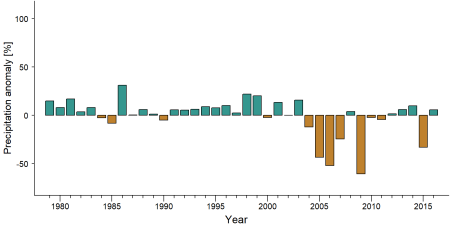
Precipitation anomaly in Tonkoli Forest Reserve -
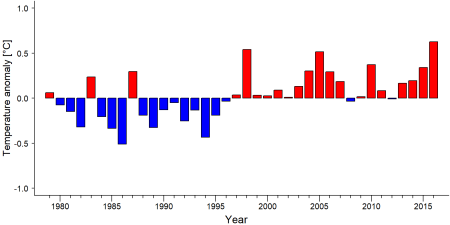
Temperature anomaly in Tonkoli Forest Reserve


External links
References
Brncic, T.M., Amarasekaran,B. & McKenna,A. 2010. Final Report of the Sierra Leone National Chimpanzee Census Project. Tacugama Chimpanzee Sanctuary, Freetown, Sierra Leone. link
Kiribou, R., Tehoda, P., Chukwu, O., Bempah, G., Kühl, H. S., Ferreira, J., …, & Heinicke, S. (2024). Exposure of African ape sites to climate change impacts. PLOS Climate, 3(2), e0000345. doi:10.1371/journal.pclm.0000345
Page created by: APES Atlas Team Date: 2023-11-16