
Virunga National Park: Difference between revisions
No edit summary |
No edit summary |
||
| Line 525: | Line 525: | ||
|No. days with heavy precipitation (per year) | |No. days with heavy precipitation (per year) | ||
|6.7 | |6.7 | ||
|8. | |8.7 | ||
|10. | |10.2 | ||
|9.1 | |9.1 | ||
|12.1 | |12.1 | ||
| Line 568: | Line 568: | ||
|0 | |0 | ||
|0.5 | |0.5 | ||
|16. | |16.67 | ||
|0.5 | |0.5 | ||
|16. | |16.67 | ||
|1 | |1 | ||
|33.33 | |33.33 | ||
| Line 576: | Line 576: | ||
|River flood | |River flood | ||
|3.75 | |3.75 | ||
|2. | |2.2 | ||
|5.5 | |5.5 | ||
|4.57 | |4.57 | ||
| Line 602: | Line 602: | ||
|0.88 | |0.88 | ||
|29 | |29 | ||
|0. | |0.56 | ||
|} | |} | ||
Revision as of 04:10, 31 October 2025
Central Africa > Democratic Republic of the Congo > Virunga National Park
Français | Português | Español | Bahasa Indonesia | Melayu
Summary
- Eastern chimpanzees (Pan troglodytes schweinfurthii), Grauer's gorillas (Gorilla beringei graueri) and mountain gorillas (Gorilla beringei beringei) are present in Virunga National Park.
- It has been estimated that 6 eastern lowland gorillas and over 350 mountain gorillas occur in the site; the chimpanzee population is unknown.
- The mountain gorilla population trend is increasing; the eastern lowland gorilla population is decreasing; the chimpanzee population trend is unknown.
- The site has a total size of 7,900 km².
- Key threats to great apes are poaching, encroachment, logging and fuelwood collection, and insecurity issues further complicating conservation efforts.
- Conservation activities have focused on anti-poaching patrols, providing employment opportunities to local communities, tourism, education, and supply of hydroelectric power to the local population.
- The national park is the most biologically diverse and the first to be established in the African continent.
-
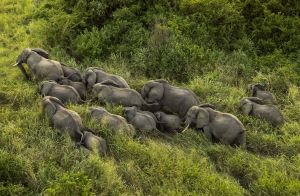
© Virunga National Park -
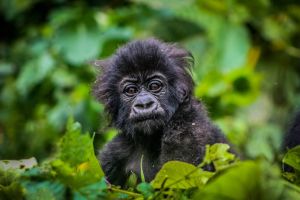
© Virunga National Park -
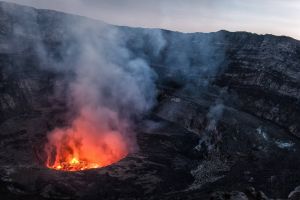
Mount Nyiragongo © Virunga National Park


Site characteristics
Virunga National Park is located in eastern Democratic Republic of Congo and comprises the most biologically diverse protected area on the continent (Virunga National Park n.d.). The national park was first established in 1925 as Albert National Park. In 1960, following the country's independence from Belgium, it was renamed Virunga National Park. In 1979 the site was designated as a UNESCO World Heritage Site (UNESCO 2021).The park is unique with its active chain of volcanoes and rich diversity of habitats. Its range contains an amalgamation of steppes, savannas and plains, marshlands, low altitude and afro-montane forest belts to unique afro-alpine vegetation and permanent glaciers and snow on Monts Rwenzori whose peaks reach in 5,000 m height (UNESCO). The park is home to 218 mammal species, 706 bird species, 109 reptile species and 78 amphibian species (Virunga National Park n.d.). It also serves as refuge to 22 primate species, including mountain gorillas (Gorilla beringei beringei), the eastern lowland or Grauer's gorilla (Gorilla beringei graueri) and the eastern chimpanzee (Pan troglodytes schweinfurthii). A third of the world's mountain gorilla population is found in the park. The density of biomass of wildlife is one of the highest on the earth Planet (27.6 ton/sq.km). Among the wide diversity of ungulates found at the site, certain rare species are found, such as the okapi (Okapi johnstoni), endemic to the Democratic Republic of the Congo, and the red forest duiker (Cephalophus rubidus), endemic to Monts Rwenzori (Virunga National Park n.d.). The site is a Key Biodiversity Area owing to its global importance to the planet’s overall health and wealth in biodiversity (Key Biodiversity Areas Partnership 2020).
Table 1. Basic site information for Virunga National Park
| Species | Gorilla beringei beringei |
| Area | 7,900 km² |
| Coordinates | Lat: -0.250721 , Lon: 29.391204 |
| Type of site | Protected area (National Park) |
| Habitat types | Subtropical/tropical moist lowland forest, Subtropical/tropical moist montane forest, Savanna, Wetlands (lakes, rivers, streams, bogs, marshes) |
| Type of governance | Shared governance |
Types of sites Governance types Habitat types

Ape status
The last mountain gorilla census in DRC, Rwanda and Uganda in the Virunga massif was in 2016. The results showed a total of 266 gorillas found on the Congo side. From then until December 2021, the number of gorillas has increased to over 350 individuals (Shengeri, A.R., pers. comm. 2021). The chimpanzee population in the park is unknown. Eastern lowland, or Grauer’s gorillas, are extremely rare in the park; only six individuals are being monitored (Shengeri, A.R., pers. comm. 2021).
Table 2. Ape population estimates reported for Virunga National Park
| Species | Year | Occurrence | Encounter or vistation rate (nests/km; ind/day) | Density estimate [ind./ km²] (95% CI) | Abundance estimate (95% CI) | Survey area | Sampling method | Analytical framework | Source | Comments | A.P.E.S. database ID |
|---|---|---|---|---|---|---|---|---|---|---|---|
| Gorilla beringei beringei | 2016 | 266 | Virunga National Park | Genetic (dung/hair) | Shengeri, A.R., pers. comm. 2021 | ||||||
| Gorilla beringei beringei | 2021 | 350 | Virunga National Park | Genetic (dung/hair) | Shengeri, A.R., pers. comm. 2021 | ||||||
| Gorilla beringei beringei | 2024 | 350 | Virunga National Park | Full count | Count method | Virunga National Park 2024 | Abundance estimate accounting for 249 habituated individuals. | ||||
| Gorilla beringei graueri | 2025 | 11 | Virunga National Park | Full count | Count method | Parker, L. pers. comm. 2025 | |||||
| Pan troglodytes schweinfurthii | 2025 | 150-200 | Virunga National Park | Opportunistic observation | Count method | Parker, L. pers. comm. 2025 | Estimate based on direct observation, approx. 150-200 for the site. |
Sampling methods Analytical frameworks
Threats
Ongoing security issues continue to present challenges for the management of the park, although the number of militia operating in the area has declined over the past few years (UNESCO 2021). Issues of encroachment and deforestation for charcoal production continue to have a severe impact on the integrity of the park; as of 2021, approximately 18.5% of the site is affected by encroachment (UNESCO 2021).
The eruption of Mount Nyiragongo in May 2021 has further complicated the situation and compounded the COVID-19 crisis. Around 234,000 were displaced from the surrounding area, and houses, schools, and health centers were destroyed (UNICEF).
Table 3. Threats to apes reported for Virunga National Park
| Category | Specific threats | Threat level | Description | Year of threat |
|---|---|---|---|---|
| 10 Geological events | 10.1 Volcanoes | Medium (30-70% of population affected) | The Nyiragongo and Nyamuragira volcanoes are active volcanoes in the park. Chimpanzees residing on the slopes of Nyamuragira were threatened by the eruptions of January 2010. In addition to the impacts of mortality and further habitat loss, the eruptions reduce the chimpanzees’ ability to survive in a region where human development around the volcanoes prevents migration to other areas (Maldonado et al. 2012). | 2010-Ongoing (2025) |
| 1 Residential & commercial development | 1.1 Residential areas | High (more than 70% of population affected) | New villages built in the park: Kasindi/Lubiriha and Kilorirwe (Shengeri, A.R., pers. comm. 2021). Fisherman villages around Lake Edward have also increased and occupy many hectares of the park (Shengeri, A.R., pers. comm. 2021). The threat has been steadily increasing since the 1980s, but there was a steep increase post 1994 (Parker, L. pers. comm. 2025). | 1994-Ongoing (2025) |
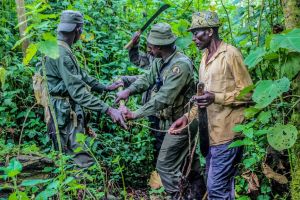
| 5 Biological resource use | 5.1 Hunting & collecting terrestrial animals | High (more than 70% of population affected) | Poaching by armed groups (UNESCO 2021). Many poachers are arrested by rangers during patrols in the park. Most of them are sent to the court and are jailed. In addition, many traps and illegal hunting camps are destroyed by rangers during patrols (Shengeri, A.R., pers. comm. 2021, Parker, L. pers. comm. 2025). | 2021-Ongoing (2025) |
| 5 Biological resource use | 5.1.4 Capture for the live animal trade | Medium (30-70% of population affected) | Illegal pet trade of chimpanzees. It is estimated that the illegal pet trade risk for eastern gorillas in the park is low given the extreme and daily monitoring to which these populations benefit. The population of chimpanzees in Tongo are vulnerable to the pet trade as they are situated in a volatile environment of armed conflict (armed groups are known to conduct illegal wildlife trafficking) and substantial land invasion for agricultural purposes. Chimpanzee populations in the Semliki Valley are largely unmonitored as this area is isolated and susceptible to armed conflict, leaving them vulnerable to poaching and illegal pet trade (Parker, L. pers. comm. 2025). | Ongoing (2025) |
| 5 Biological resource use | 5.1.5 Persecution/human wildlife conflict | Medium (30-70% of population affected) | Human wildlife conflict (HWC) is a growing threat for the park’s population of mountain gorillas as the electric fencing has been destroyed during the current conflict. Mountain gorillas are increasingly going into farmers’ fields for crop raiding. HWC for the park’s small population of eastern lowland gorillas is (for the moment) non-existent as these gorillas rarely range at the periphery of park borders and are not likely to encounter humans (other than park staff). There is a dedicated monitoring team who closely monitors their movements on a daily basis. HWC in regards to chimpanzees is still relatively high given their geographical location in volatile and agriculturally exploited areas, particularly in the area of Tongo. Cases of chimpanzee attacks (sometimes fatal) on humans are not uncommon in this area (Parker, L. pers. comm. 2025). | Ongoing (2025) |
| 5 Biological resource use | 5.3 Logging & wood harvesting | High (more than 70% of population affected) | Deforestation for charcoal production has led to widespread depletion of forests in the lowlands (UNESCO World Heritage Centre 2025). | 2021-Ongoing (2025) |
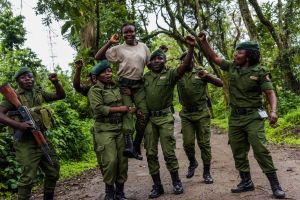
| 6 Human intrusions & disturbance | 6.2 War, civil unrest & military exercises | High (more than 70% of population affected) | Civil unrest stemming from two civil wars and the illegal extraction of natural resources in the park, from which armed groups (e.g., ADF/NALU, FDLR, Mai Mai) continue to make revenue. Over 200 park rangers have been killed in the line of duty (Virunga National Park). Influx of 1 million refugees occupying adjacent parts of the Park (UNESCO World Heritage Centre 2025). Insecurity has been a factor since the mid-1990s, beginning with the First Congo War and continuing almost without interruption since then (Parker, L. pers. comm. 2025). | 1995-Ongoing (2025) |
| 2 Agriculture & aquaculture | 2.1.1 Shifting agriculture | High (more than 70% of population affected) | Land conversion for agriculture (slash-and-burn agriculture). Encroachment started decades ago in the 1960s and 70s in some areas but it really accelerated after 1994 when large numbers of people were displaced into the region after the genocide in Rwanda (Parker, L. pers. comm. 2025). | 1994-Ongoing (2025) |
| 2 Agriculture & aquaculture | 2.3 Livestock farming & ranching | High (more than 70% of population affected) | Livestock farming / grazing of domesticated animals (UNESCO 2021). Ongoing in 2025 (Parker, L. pers. comm. 2025). | 2021-Ongoing (2025) |
| 3 Energy production & mining | 3.1 Oil & gas drilling | Low (up to 30% of population affected) | Concerns over potential oil exploitation and exploration (UNESCO 2021). The issue first appeared around 2010–2011 when exploration concessions overlapping the park were granted (Parker, L. pers. comm. 2025). | 2010-Ongoing (2025) |
| 4 Transportation & service corridors | 4.1 Roads & railroads | Present (unknown severity) | Different roads across the park are present in Virunga National park, e.g., between Mutwanga- Beni-Karuruma-Kambo-Ishasha-Nyakakoma-Rutshuru-Kanyabayonga (Shengeri, A.R., pers. comm. 2021). UNESCO, reports Road and military infrastructure within the site (UNESCO World Heritage Center 2025). | 2021-Ongoing (2025) |
| 8 Invasive & other problematic species, genes & diseases | 8.4 Pathogens | Low (up to 30% of population affected) | Risk of acquiring human pathogens, particularly respiratory diseases. Respiratory illness is the second most common cause of morbidity and mortality in habituated mountain gorillas, with outbreaks that occur annually and often cause group-wide morbidity (Gilardi et al. 2021). Risks to gorillas and other wildlife were already being noted in the 1980s, around the time of the first habituation efforts, but they’ve become much more prominent since the 2000s with growing human activity and tourism. Respiratory disease has always been a concern, especially as it relates to tourism. Serious disease outbreaks like Ebola, Marburg, Mpox also seem to be increasing over recent years (Parker, L. pers. comm. 2025). | 2000-Ongoing (2025) |
| 8 Invasive & other problematic species, genes & diseases | 8.1 Invasive non-native/alien species | Low (up to 30% of population affected) | For all three great ape taxa in the site the threat of invasive plants is relatively low. The forests of Tshiaberimu and Mikeno (home to eastern gorillas) are largely intact and although there is some evidence of invasive species in these areas, the risk remains low for the moment. Likewise for chimpanzee populations in large forested areas. Chimpanzees located in the Ishasha Valley are situated in a gallery forest which is mostly protected from the savanna invasive species, however, there is still a risk these species will eventually encroach the gallery forest (Parker, L. pers. comm. 2025). | Ongoing (2025) |
| 9 Pollution | 9.4 Garbage & solid waste | Low (up to 30% of population affected) | Trash observed near fishing villages around Lake Edward. In addition, poachers sometimes mix poison with water (Shengeri, A.R., pers. comm. 2021). Ongoing in 2025 (Parker, L. pers. comm. 2025). | 2021-Ongoing (2025) |
-
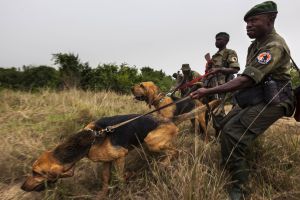
© Virunga National Park -
© Virunga National Park -
© Virunga National Park


Conservation activities
In 2011, the Congolese National Parks Authority, (Institut Congolais pour la Conservation de la Nature, ICCN), and the Virunga Foundation (then known as the Africa Conservation Foundation), entered into a partnership to manage the national park. The Virunga Alliance was then created with the support from the EU. The Virunga Alliance is a development program that aims to end illegal and destructive resource extraction in the region by addressing the direct causes of poverty and conflict. The program was established to create more than 100,000 jobs to draw people out of armed militia groups and into work that fosters peacebuilding. The program is focused on tourism, sustainable energy, and agriculture (Virunga Alliance). The park is part of the Greater Virunga Landscape (GVL), a transboundary collaboration between DRC, Rwanda, and Uganda to conserve the landscape.
Four sites have been chosen for monitoring and for tourism: the Mikeno sector, with 226 habituated mountain gorillas; Tshabirimu, with 6 eastern lowland gorillas; Tongo, with 28 chimpanzees, where habituation started in 1991; and Rumangabo, the headquarters of the park, where 18 chimpanzees have been habituated since 2015 and tourists can observe while visiting the station (Shengeri, A.R., pers. comm. 2021).
Four main conservation pillars were established in 2010 with the Virunga Foundation in cooperation with the DRC government to protect the Virunga National Park:
1.Conservation: fight against poachers and destruction of the ecosystem of the park. The protection of highly important ecological corridors connecting different sectors of the park through regular ranger patrols is one of the main activities.
2.Tourism: development of tourism infrastructures.
3. Protection of Lake Edward against poachers and eviction of all squatters who take young fish.
4. Hydroelectric power plant construction around Virunga National Park which allows the local communities to develop their economy.
Table 4. Conservation activities reported for Virunga National Park
| Category | Specific activity | Description | Implementing organization(s) | Year of activity |
|---|---|---|---|---|
| 5 Protection & restoration | 5.2 Legally protect ape habitat | The site is designated as a national park. | 1925-Ongoing (2025) | |
| 6 Species management | 6.9 Rehabilitate injured/orphaned apes | The Senkwekwe Center opened in 2010 in the park's headquarters to take care of orphaned gorillas (Virunga National Park) and stopped operations in 2022 (Parker, L. pers. comm. 2025). | 2010-Ongoing (2022) | |
| 2 Counter-wildlife crime | 2.3 Conduct regular anti-poaching patrols | The park has nearly 700 rangers who patrol the park ([ https://virunga.org/alliance/virunga-rangers/ Virunga National Park n.d.]). Aerial patrols are also conducted. In addition, patrols regulate fishing activities in Lake Edward and evict squatters (Shengeri, A.R., pers. comm. 2021). Anti‑poaching, anti‑charcoal and security patrols by ICCN/Virunga Foundation aim to deter illegal activities and protect habituated gorilla groups (UNESCO World Heritage Center 2025). Patrols have been conducted since the park's establishment (Parker, L. pers. comm. 2025). | 1925-Ongoing (2025) | |
| 2 Counter-wildlife crime | 2.6 Regularly de-activate/remove ground snares | Snare removals (Gorilla Doctors 2025; Shengeri, A.R., pers. comm. 2021). | Gorilla Doctors, ICCN | 2021-Ongoing (2025) |
| 3 Species health | 3.1 Wear face-masks to avoid transmission of viral and bacterial diseases to primates | Tourists and staff wear surgical masks in the presence of the gorillas (Virunga National Park). | 2021-Ongoing (2025) | |
| 3 Species health | 3.2 Keep safety distance to habituated apes | Shengeri, A.R., pers. comm. 2021, Parker, L. pers. comm. 2025 | 2021-Ongoing (2025) | |
| 2 Counter-wildlife crime | 2.1 Implement road blocks to inspect cars for illegal ape bushmeat | Shengeri, A.R., pers. comm. 2021, Parker, L. pers. comm. 2025 | 2021-Ongoing (2025) | |
| 3 Species health | 3.3 Limit time that researchers/tourists are allowed to spend with habituated apes | Shengeri, A.R., pers. comm. 2021, Parker, L. pers. comm. 2025 | 2021-Ongoing (2025) | |
| 4 Education & awareness | 4.1 Educate local communities about apes and sustainable use | Education programme teaching local communities the importance of the park (COCO) (Shengeri, A.R., pers. comm. 2021, Parker, L. pers. comm. 2025). | 2021-Ongoing (2025) | |
| 4 Education & awareness | 4.2 Involve local community in ape research and conservation management | Virunga Foundation recruits members of the local community (HUGO), who receive a stipend for patrolling and gathering data (Shengeri, A.R., pers. comm. 2021, Parker, L. pers. comm. 2025). | 2021-Ongoing (2025) | |
| 5 Protection & restoration | 5.7 Build fences to keep humans out | Construction of fences. Building fences to reduce the movement of animals from the park and stop human encroachment and poachers (Shengeri, A.R., pers. comm. 2021, Parker, L. pers. comm. 2025). | 2021-Ongoing (2025) | |
| 5 Protection & restoration | 5.6 Habitat restoration | Restoration in central sector due to invasive plants (Parker, L. pers. comm. 2025). | 2022-Ongoing (2025) | |
| 6 Species management | 6.1 Habituate primates to human presence to reduce stress from tourists/researchers | Treks led by Virunga rangers and local pisteurs, who monitor ten habituated gorilla groups every day (Virunga National Park). | Ongoing (2021) | |
| 7 Economic & other incentives | 7.1 Provide monetary benefits to local communities for sustainably managing their forest and its wildlife (e.g., REDD, alternative income, employment) | Create employees for local communities; supply the local communities with credits to help them improve their businesses; support farmers; provide employment to local youth and to widows of rangers (Shengeri, A.R., pers. comm. 2021, Parker, L. pers. comm. 2025). | 2021-Ongoing (2025) | |
| 7 Economic & other incentives | 7.2 Provide non-monetary benefits to local communities for sustainably managing their forest and its wildlife (e.g., better education, infrastructure development) | Hydroelectric power is supplied from 4 stations around the park (Shengeri, A.R., pers. comm. 2021, Parker, L. pers. comm. 2025). | 2021-Ongoing (2025) | |
| 8 Permanent presence | 8.2 Run tourist projects and ensure permanent human presence at site | Due to ongoing security concerns, the park has faced several temporary closures since 2018, but between 2014 and 2016, substantial revenue came from tourism (Parker, L. pers. comm. 2025). | 2014-2018 | |
| 3 Species health | 3.10 Treat sick/injured apes | Targeted treatments reduce mortality from injuries and respiratory disease in habituated groups (Gorilla Doctors 2025). | Gorilla Doctors, ICCN | 2007-Ongoing (2025) |
| 3 Species health | 3.11 Implement continuous health monitoring/permanent vet on site | Routine health monitoring (Gorilla Doctors 2025). | Gorilla Doctors, ICCN | 2007-Ongoing (2025) |

Challenges
The main challenges to ape conservation at the park include lack of security due to different rebel groups in the region. In 1986 when Uganda rebels ADF/NALU crossed into DRC and remained in the park around the Rwenzori massif (North sector), where many chimpanzees were present. In 1994 millions of refugees and defeated militaries crossed the border and settled around the Mikeno Sector, home to mountain gorillas. Since then, rebels continue to kill animals, rangers, cut trees for commercial charcoal, kidnap local people, and are involved in other criminal activities (Shengeri, A.R., pers. comm. 2021).
Table 5. Challenges reported for Virunga National Park
| Challenges | Specific challenges | Source | Year(s) |
|---|---|---|---|
| 6 Safety and stability | 6.3 Civil unrest/war | Shengeri, A.R., pers. comm. 2021, Parker, L. pers. comm. 2025 | 2021- Ongoing (2025) |
| 5 Ecological context | 5.1 Ecological constraints (e.g., susceptibility to climate change, difficult terrain) | UNESCO World Heritage Center 2025 | Ongoing (2025) |
| 2 Resources and capacity | 2.3 General lack of funding | Parker, L. pers. comm. 2025 | Ongoing (2025) |
Enablers
Table 6. Enablers reported for Virunga National Park
| Enablers | Specific enablers | Source | Year(s) |
|---|---|---|---|
| 1 Site management | 1.1 Effective leadership | Parker, L. pers. comm. 2025 | Ongoing (2025) |
| 1 Site management | 1.2 Effective coordination | Parker, L. pers. comm. 2025 | Ongoing (2025) |
| 1 Site management | 1.3 Adaptive management practices | Parker, L. pers. comm. 2025 | Ongoing (2025) |
| 2 Resources and capacity | |||
| 3 Engaged community | |||
| 4 Institutional support | 4.3 Strong transboundary cooperation | GVTC Regional coordination across DRC–Rwanda–Uganda | 2007-Ongoing (2025) |
| 5 Ecological context | |||
| 6 Safety and stability |
Research activities
In 1990, the habituation of gorillas and chimpanzees was established in Virunga National Park.
Documented behaviours
Table 7. Behaviours documented for Virunga National Park
| Category | Behavior | Observation type | Prevalence | Observation dates | Source | Habituation | Species | Comment |
|---|---|---|---|---|---|---|---|---|
| Not reported |
Exposure to climate change impacts
As part of a study on the exposure of African great ape sites to climate change impacts, Kiribou et al. subm. extracted climate data and data on projected extreme climate impact events for the site. Climatological characteristics were derived from observation-based climate data provided by the Inter-Sectoral Impact Model Intercomparison Project (ISIMIP, www.isimip.org). Parameters were calculated as the average across each 30-year period. For 1981-2010, the EWEMBI dataset from ISIMIP2a was used. For the two future periods (2021-2050 and 2071-2099) ISIMIP2b climate data based on four CMIP5 global climate models were used. For future projections, two Representative Concentration Pathways (RCP) were used. RCP 2.6 is a scenario with strong mitigation measures in which global temperatures would likely rise below 2C. RCP 6.0 is a scenario with medium emissions in which global temperatures would likely rise up to 3C by 2100. For the number of days with heavy precipitation events, the 98th percentile of all precipitation days (>1mm/d) was calculated for the 1979-2013 reference period as a threshold for a heavy precipitation event. Then, for each year, the number of days above that threshold was derived. The figures on temperature and precipitation anomaly show the deviation from the mean temperature and mean precipitation for the 1979-2013 reference period.
The estimated exposure to future extreme climate impact events (crop failure, drought, river flood, wildfire, tropical cyclone, and heatwave) is based on a published dataset by Lange et al. 2020 derived from ISIMIP2b data. The same global climate models and RCPs as described above were used. Within each 30-year period, the number of years with an extreme event and the average proportion of the site affected were calculated (see Kiribou et al. subm. for details).
Table 8. Estimated past and projected climatological characteristics in Virunga National Park
| Value | 1981-2010 | 2021-2050, RCP 2.6 | 2021-2050, RCP 6.0 | 2071-2099, RCP 2.6 | 2071-2099, RCP 6.0 |
|---|---|---|---|---|---|
| Mean temperature [C] | 20.6 | 21.7 | 21.5 | 21.9 | 23 |
| Annual precipitation [mm] | 1401 | 1396 | 1514 | 1374 | 1536 |
| Max no. consecutive dry days (per year) | 17.2 | 22.6 | 23.8 | 24.3 | 20.6 |
| No. days with heavy precipitation (per year) | 6.7 | 8.7 | 10.2 | 9.1 | 12.1 |
Table 9. Projected exposure of apes to extreme climate impact events in Virunga National Park
| Type | No. of years with event (2021-2050, RCP 2.6) | % of site exposed (2021-2050, RCP 2.6) | No. of years with event (2021-2050, RCP 6.0) | % of site exposed (2021-2050, RCP 6.0) | No. of years with event (2070-2099, RCP 2.6) | % of site exposed (2070-2099, RCP 2.6) | No. of years with event (2070-2099, RCP 6.0) | % of site exposed (2070-2099, RCP 6.0) |
|---|---|---|---|---|---|---|---|---|
| Crop failure | 7.5 | 0.71 | 4 | 0.48 | 8.5 | 0.35 | 12.5 | 0.72 |
| Drought | 0 | 0 | 0 | 0 | 0 | 0 | 0 | 0 |
| Heatwave | 0 | 0 | 0.5 | 16.67 | 0.5 | 16.67 | 1 | 33.33 |
| River flood | 3.75 | 2.2 | 5.5 | 4.57 | 2.5 | 0.38 | 8.75 | 1.91 |
| Tropical cyclone | 0 | 0 | 0 | 0 | 0 | 0 | 0 | 0 |
| Wildfire | 30 | 0.87 | 30 | 0.85 | 29 | 0.88 | 29 | 0.56 |
External links
Virunga National Park - official website
UNESCO - Virunga National Park
The Greater Virunga Transboundary Collaboration
References
Gilardi, K., Nziza, J., Ssebide, B., Syaluha, E. K., Muvunyi, R., Aruho, R., ... & Masozera, A. B. (2021). Endangered mountain gorillas and COVID‐19: One health lesson for prevention and preparedness during a global pandemic. American Journal of Primatology, e23291.https://doi.org/10.1002/ajp.23291
Key Biodiversity Areas Partnership (2020) Key Biodiversity Areas factsheet: Virunga National Park. Extracted from the World Database of Key Biodiversity Areas. Developed by the Key Biodiversity Areas Partnership: BirdLife International, IUCN, American Bird Conservancy, Amphibian Survival Alliance, Conservation International, Critical Ecosystem Partnership Fund, Global Environment Facility, Global Wildlife Conservation, NatureServe, Rainforest Trust, Royal Society for the Protection of Birds, World Wildlife Fund and Wildlife Conservation Society. Downloaded from http://www.keybiodiversityareas.org/ on 12/12/2021.
Maldonado, O., Aveling, C., Cox, D., Nixon, S., Nishuli, R., Merlo, D., Pintea, L. & Williamson, E.A. (2012). Grauer’s Gorillas and Chimpanzees in Eastern Democratic Republic of Congo (Kahuzi-Biega, Maiko, Tayna and Itombwe Landscape): Conservation Action Plan 2012–2022. Gland, Switzerland: IUCN/SSC Primate Specialist Group, Ministry of Environment, Nature Conservation & Tourism, Institut Congolais pour la Conservation de la Nature & the Jane Goodall Institute. 66pp https://www.iucngreatapes.org/grauers-gorillas-and-chimpanzees
Virunga National Park (2025) Rapport d’évaluation du Bien-Être des Gorilles de Montagne des Virunga 2024. Unpublished report.
Page created by: Rwimo Shengeri Augustin & Natsuno Shinagawa Date: 2022-01-17
Page updated by: Laura Parker Date: 2025-10-14