
Lobéké National Park: Difference between revisions
No edit summary |
No edit summary Tag: Reverted |
||
| Line 467: | Line 467: | ||
<span id="R01076"></span>Yuh, Y. G., Dongmo, Z. N., N’Goran, P. K., Ekodeck, H., Mengamenya, A., Kuehl, H., …, & Elvis, T. (2019). Effects of Land cover change on Great Apes distribution at the Lobéké National Park and its surrounding Forest Management Units, South-East Cameroon. A 13 year time series analysis. ''Scientific Reports'', 9(1), 1-19. [https://doi.org/10.1038/s41598-018-36225-2 doi:10.1038/s41598-018-36225-2] | <span id="R01076"></span>Yuh, Y. G., Dongmo, Z. N., N’Goran, P. K., Ekodeck, H., Mengamenya, A., Kuehl, H., …, & Elvis, T. (2019). Effects of Land cover change on Great Apes distribution at the Lobéké National Park and its surrounding Forest Management Units, South-East Cameroon. A 13 year time series analysis. ''Scientific Reports'', 9(1), 1-19. [https://doi.org/10.1038/s41598-018-36225-2 doi:10.1038/s41598-018-36225-2] | ||
<span id="R02246"></span>Kiribou, R., Tehoda, P., Chukwu, O., Bempah, G., Kühl, H. S., Ferreira, J., …, & Heinicke, S. (2024). Exposure of African ape sites to climate change impacts. ''PLOS Climate'', 3(2), | <span id="R02246"></span>Kiribou, R., Tehoda, P., Chukwu, O., Bempah, G., Kühl, H. S., Ferreira, J., …, & Heinicke, S. (2024). Exposure of African ape sites to climate change impacts. ''PLOS Climate'', 3(2), 1-19. [https://doi.org/10.1371/journal.pclm.0000345 doi:10.1371/journal.pclm.0000345] | ||
Revision as of 10:34, 15 October 2026
Central Africa > Cameroon > Lobéké National Park
Français | Português | Español | Bahasa Indonesia | Melayu
Summary
- Central chimpanzees (Pan troglodytes troglodytes) & western lowland gorillas (Gorilla gorilla gorilla) are present in Lobéké National Park.
- It has been estimated that 2,658 gorillas and chimpanzees occur in the site.
- The great ape population trend is decreasing.
- The site has a total size of 2,153 km².
- The main reported threats are poaching to chimpanzees and gorillas, illegal mining, agricultural activities and human wildlife conflict.
- The primary reported conservation activities include awareness-raising and education, ecotourism support and development, employment of local individuals in conservation projects, and the implementation of patrols.
- The site forms part of the Sangha Trinational transboundary conservation landscape.

Site characteristics
Lobéké National Park is situated in the southeast corner of Cameroon. The park forms part of the Sangha Trinational (TNS) transboundary conservation landscape, which also includes Dzanga-Ndoki National Park in the Central African Republic, and Nouabalé-Ndoki National Park in the Republic of Congo (N'Goran 2017; BirdLife International 2020). With at least 305 bird species recorded, Lobéké National Park is a designated Important Bird Area (BirdLife International 2020). The saline swamps found in Lobéké attract large numbers of elephants and bongos, and the park contains a significant proportion of untouched primary forest (BirdLife International 2020). The park has one of the highest concentrations of gorillas and elephants in the continent (Sangha Tri-national Trust fund).
Table 1. Basic site information for Lobéké National Park
| Species | Pan troglodytes troglodytes, Gorilla gorilla gorilla |
| Area | 2,153 km² |
| Coordinates | Lat: 2.298493 , Lon: 15.689466 |
| Type of site | Protected area (National Park) |
| Habitat types | Subtropical/tropical moist lowland forest, Subtropical/tropical swamp forest, Wetlands (lakes, rivers, streams, bogs, marshes) |
| Type of governance | Governance by government |
Types of sites Governance types Habitat types

Ape status
Table 2. Ape population estimates reported for Lobéké National Park
| Species | Year | Occurrence | Encounter or vistation rate (nests/km; ind/day) | Density estimate [ind./ km²] (95% CI) | Abundance estimate (95% CI) | Survey area | Sampling method | Analytical framework | Source | Comments | A.P.E.S. database ID |
|---|---|---|---|---|---|---|---|---|---|---|---|
| Pan troglodytes troglodytes & Gorilla gorilla gorilla | 2015 | 2658.0 | Lobéké National Park | Line transects | N'Goran 2017 | ||||||
| Gorilla gorilla gorilla | 2014 | 1.59 | Lobéké National Park | Line transects | Distance sampling (decay time unknown) | Tsakem 2017 | Dr Tsakem's PhD thesis study | ||||
| Pan troglodytes troglodytes & Gorilla gorilla gorilla | 2009 | 2685.0 | Lobéké National Park | Unknown | N'Goran 2017 | ||||||
| Pan troglodytes troglodytes & Gorilla gorilla gorilla | 2006 | 5598.0 | Lobéké National Park | Unknown | N'Goran 2017 | ||||||
| Pan troglodytes troglodytes & Gorilla gorilla gorilla | 2002 | 6360.0 | Lobéké National Park | Unknown | N'Goran 2017 |
Sampling methods Analytical frameworks
Threats
Table 3. Threats to apes reported for Lobéké National Park
| Category | Specific threats | Threat level | Description | Year of threat |
|---|---|---|---|---|
| 1 Residential & commercial development | 1.1 Residential areas | High (more than 70% of population affected) | The presence of villages in close proximity has been reported and is contributing to the destruction of great ape habitats (Tsakem pers. comm. 2025). | 2017 |
| 2 Agriculture & aquaculture | 2.1 Annual & perennial non-timber crops | High (more than 70% of population affected) | Agricultural activities including slash-and-burn, lead to the destruction of great ape habitats (Tsakem pers. comm. 2025). | 2017 |
| 3 Energy production & mining | 3.2.3 Artisanal mining | Present (unknown severity) | The presence of illegal mining on the outskirts of Lobéké National Park has been reported, including artisanal and increasingly commercial activities that pose a threat to gorillas (Tsakem pers. comm. 2025) | 2019 |
| 5 Biological resource use | 5.1 Hunting & collecting terrestrial animals | Medium (30-70% of population affected) | Poaching reported (Tsakem pers. comm. 2025). | 2017-Ongoing (2025) |
| 5 Biological resource use | 5.1.2 Unintentional effects | Present (unknown severity) | Traps set probably intended for other animals have injured some great apes (Tsakem pers. comm. 2025) | Ongoing (2025) |
| 5 Biological resource use | 5.1.4 Capture for the live animal trade | Low (up to 30% of population affected) | The exploitation of young gorillas for international trafficking has been reported at a low incidence rate of 10%. Most individuals are intercepted and safely returned to the Mefou Sanctuary (Tsakem pers. comm. 2025). | 2017 |
| 5 Biological resource use | 5.1.5 Persecution/human wildlife conflict | Present (unknown severity) | There is a significant conflict between humans and great apes. The apes frequently raid local farms, consuming crops and causing economic losses. This behavior has left people feeling unsafe, especially as some apes have displayed signs of aggression. In response, traps set by locals have injured some apes, with a few losing limbs. Additionally, humans and apes rely on the same water and food sources, increasing the risk of disease transmission between the humans and apes (Tsakem pers. comm. 2025). | Ongoing (2025) |
| 8 Invasive & other problematic species, genes & diseases | 8.4 Pathogens | Present (unknown severity) | Potential risk of diseases transmission between humans and great apes reported (Tsakem per. comm. 2025). | Ongoing (2025) |
Conservation activities
The Sangha Tri-National Trust Fund has contributed to the implementation of several conservation activities across the TNS; the WWF has helped develop and improve management plans for the area through their Jengi programme.
Table 4. Conservation activities reported for Lobéké National Park
| Category | Specific activity | Description | Implementing organization(s) | Year of activity |
|---|---|---|---|---|
| 2 Counter-wildlife crime | 2.3 Conduct regular anti-poaching patrols | Patrols and law enforcement operations aimed at controlling illegal activities have been reported (Tsakem pers. comm. 2025). | Ongoing (2025) | |
| 4 Education & awareness | 4.1 Educate local communities about apes and sustainable use | Awareness raising and educating local people about great apes (Tsakem pers. comm. 2025). | Ongoing (2025) | |
| 4 Education & awareness | 4.2 Involve local community in ape research and conservation management | Local communities are involved in conservation programs by participating in field research and data collection, as well as taking part in surveys conducted in riverside villages (Tsakem pers. comm. 2025). | Ongoing (2025) | |
| 7 Economic & other incentives | 7.1 Provide monetary benefits to local communities for sustainably managing their forest and its wildlife (e.g., REDD, alternative income, employment) | Employment opportunities where, local people are hired to work in conservation programs (Tsakem pers. comm. 2025). | Ongoing (2025) | |
| 7 Economic & other incentives | 7.2 Provide non-monetary benefits to local communities for sustainably managing their forest and its wildlife (e.g., better education, infrastructure development) | Supporting and developing ecotourism initiatives (Tsakem pers. comm. 2025). | Ongoing (2025) |
Challenges
Table 5. Challenges reported for Lobéké National Park
| Challenges | Specific challenges | Source | Year(s) |
|---|---|---|---|
| Not reported |
Enablers
Table 6. Enablers reported for Lobéké National Park
| Enablers | Specific enablers | Source | Year(s) |
|---|---|---|---|
| 2 Resources and capacity | 2.6 External partnerships that add expertise or resources | Tsakem pers. comm. 2025 | 2025 |
| 1 Site management | |||
| 3 Engaged community | |||
| 4 Institutional support | |||
| 5 Ecological context | |||
| 6 Safety and stability |
Research activities
Several studies have been conducted at Lobéké National Park. A recent study found that changes in land cover from 2001 to 2014 influenced great ape nest distribution (Yuh et al. 2019).
Documented behaviours
Table 7. Behaviours documented for Lobéké National Park
| Category | Behavior | Observation type | Prevalence | Observation dates | Source | Habituation | Species | Comment |
|---|---|---|---|---|---|---|---|---|
| Not reported |
Exposure to climate change impacts
As part of a study on the exposure of African great ape sites to climate change impacts, Kiribou et al. (2024) extracted climate data and data on projected extreme climate impact events for the site. Climatological characteristics were derived from observation-based climate data provided by the Inter-Sectoral Impact Model Intercomparison Project (ISIMIP, www.isimip.org). Parameters were calculated as the average across each 30-year period. For 1981-2010, the EWEMBI dataset from ISIMIP2a was used. For the two future periods (2021-2050 and 2071-2099) ISIMIP2b climate data based on four CMIP5 global climate models were used. For future projections, two Representative Concentration Pathways (RCP) were used. RCP 2.6 is a scenario with strong mitigation measures in which global temperatures would likely rise below 2C. RCP 6.0 is a scenario with medium emissions in which global temperatures would likely rise up to 3C by 2100. For the number of days with heavy precipitation events, the 98th percentile of all precipitation days (>1mm/d) was calculated for the 1979-2013 reference period as a threshold for a heavy precipitation event. Then, for each year, the number of days above that threshold was derived. The figures on temperature and precipitation anomaly show the deviation from the mean temperature and mean precipitation for the 1979-2013 reference period.
The estimated exposure to future extreme climate impact events (crop failure, drought, river flood, wildfire, tropical cyclone, and heatwave) is based on a published dataset by Lange et al. 2020 derived from ISIMIP2b data. The same global climate models and RCPs as described above were used. Within each 30-year period, the number of years with an extreme event and the average proportion of the site affected were calculated (Kiribou et al. 2024).
Table 8. Estimated past and projected climatological characteristics in Lobéké National Park
| Value | 1981-2010 | 2021-2050, RCP 2.6 | 2021-2050, RCP 6.0 | 2071-2099, RCP 2.6 | 2071-2099, RCP 6.0 |
|---|---|---|---|---|---|
| Mean temperature [C] | 24.3 | 25.7 | 25.6 | 26 | 27 |
| Annual precipitation [mm] | 1434 | 1451 | 1477 | 1505 | 1486 |
| Max no. consecutive dry days (per year) | 24.9 | 19.6 | 21.9 | 17.4 | 20.5 |
| No. days with heavy precipitation (per year) | 6.5 | 7.7 | 8.9 | 7.9 | 9.7 |
Table 9. Projected exposure of apes to extreme climate impact events in Lobéké National Park
| Type | No. of years with event (2021-2050, RCP 2.6) | % of site exposed (2021-2050, RCP 2.6) | No. of years with event (2021-2050, RCP 6.0) | % of site exposed (2021-2050, RCP 6.0) | No. of years with event (2070-2099, RCP 2.6) | % of site exposed (2070-2099, RCP 2.6) | No. of years with event (2070-2099, RCP 6.0) | % of site exposed (2070-2099, RCP 6.0) |
|---|---|---|---|---|---|---|---|---|
| Crop failure | 5.5 | 0 | 4 | 0 | 7.5 | 0 | 13.5 | 0 |
| Drought | 0 | 0 | 0 | 0 | 0 | 0 | 0 | 0 |
| Heatwave | 3 | 50 | 2.5 | 100 | 4 | 100 | 10.5 | 100 |
| River flood | 0 | 0 | 1.25 | 0.41 | 0.5 | 0.13 | 1 | 0.35 |
| Tropical cyclone | 0 | 0 | 0 | 0 | 0 | 0 | 0 | 0 |
| Wildfire | 30 | 0.67 | 30 | 0.67 | 29 | 0.44 | 29 | 0.62 |
-
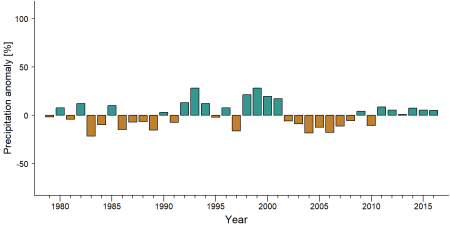
Precipitation anomaly in Lobéké National Park -
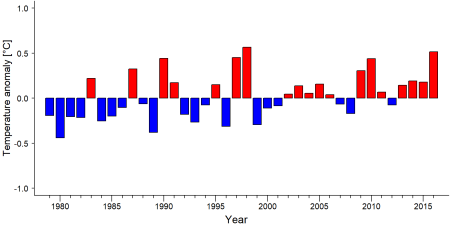
Temperature anomaly in Lobéké National Park


External links
The Sangha Tri-National Trust Fund
References
BirdLife International. (2020). Important Bird Areas factsheet: Lobéké National Park. Retrieved from http://www.birdlife.org on November 23, 2020. link
N'Goran, K. P. (2017). Summary report on WWF biomonitoring activities from 2014 to 2016: Status of forest elephant and great apes in Central Africa priority sites.
Yuh, Y. G., Dongmo, Z. N., N’Goran, P. K., Ekodeck, H., Mengamenya, A., Kuehl, H., …, & Elvis, T. (2019). Effects of Land cover change on Great Apes distribution at the Lobéké National Park and its surrounding Forest Management Units, South-East Cameroon. A 13 year time series analysis. Scientific Reports, 9(1), 1-19. doi:10.1038/s41598-018-36225-2
Kiribou, R., Tehoda, P., Chukwu, O., Bempah, G., Kühl, H. S., Ferreira, J., …, & Heinicke, S. (2024). Exposure of African ape sites to climate change impacts. PLOS Climate, 3(2), 1-19. doi:10.1371/journal.pclm.0000345
Page created by: APES Atlas Team Date: 2020-12-06
Page updated by: Dr. Tsakem Samuel Christian Date: 2025-07-22