
Southern Tanganyika: Difference between revisions
No edit summary Tag: Reverted |
No edit summary Tag: Manual revert |
||
| Line 345: | Line 345: | ||
<span id="R01727"></span>WCS (n.d.). Landscapes: The Southern Highlands. https://tanzania.wcs.org/Landscapes/Southern-Highlands.aspx | <span id="R01727"></span>WCS (n.d.). Landscapes: The Southern Highlands. https://tanzania.wcs.org/Landscapes/Southern-Highlands.aspx | ||
<span id="R02320"></span>Kiribou, R., Tehoda, P., Chukwu, O., Bempah, G., Kühl, H. S., Ferreira, J., …, & Heinicke, S. (2024). Exposure of African ape sites to climate change impacts. ''PLOS Climate'', 3(2), | <span id="R02320"></span>Kiribou, R., Tehoda, P., Chukwu, O., Bempah, G., Kühl, H. S., Ferreira, J., …, & Heinicke, S. (2024). Exposure of African ape sites to climate change impacts. ''PLOS Climate'', 3(2), e0000345. [https://doi.org/10.1371/journal.pclm.0000345 doi:10.1371/journal.pclm.0000345] | ||
'''Page created by: '''APES Atlas Team''' Date:''' 2021-11-14 | '''Page created by: '''APES Atlas Team''' Date:''' 2021-11-14 | ||
Latest revision as of 17:54, 15 October 2026
East Africa > Tanzania > Southern Tanganyika
Français | Português | Español | Bahasa Indonesia | Melayu
Summary
- Eastern chimpanzees (Pan troglodytes schweinfurthii) are present in Southern Tanganyika.
- It has been estimated that approximately 100 chimpanzees are found in the site.
- The population trend is unknown.
- Key threats to chimpanzees are logging, fires, and agricultural expansion.
- Conservation activities have focused on monitoring the population.
- The area holds the most southerly wild chimpanzee population in Africa.
Site characteristics
The site is located in western Tanzania, along the southern shores of Lake Tanganyika. The chimpanzee population in this area represents the most southerly wild chimpanzee population in Africa (TAWIRI 2018). The region contains large tracts of intact woodland characterised by Brachystegia sp. and Julbernardia spp. that provide high-quality habitat for a variety of species, including chimpanzees, savanna elephants and zebras (TAWIRI 2018).
Table 1. Basic site information for Southern Tanganyika
| Species | Pan troglodytes schweinfurthii |
| Area | |
| Coordinates | Lat: -7.937187 , Lon: 30.970704 |
| Type of site | Non-protected area |
| Habitat types | Subtropical/tropical dry forest, Grassland |
| Type of governance |
Types of sites Governance types Habitat types
Ape status
Approximately 100 chimpanzees survive in the area, which spans from the south of Kipili to the north of Kalambo Falls, across two protected areas i.e., Lwafi Game Reserve and Loasi Forest Reserve. However, most of them are found outside protected areas (TAWIRI 2018).
Table 2. Ape population estimates reported for Southern Tanganyika
| Species | Year | Occurrence | Encounter or vistation rate (nests/km; ind/day) | Density estimate [ind./ km²] (95% CI) | Abundance estimate (95% CI) | Survey area | Sampling method | Analytical framework | Source | Comments | A.P.E.S. database ID |
|---|---|---|---|---|---|---|---|---|---|---|---|
| Pan troglodytes schweinfurthii | Southern Tanganyika |
Sampling methods Analytical frameworks
Threats
Chimpanzees in the area are highly threatened by habitat loss. Destruction and degradation of their habitat, especially loss of riparian forest, comes from the expansion of agricultural activities and logging for timber and charcoal production (TAWIRI 2018).
Table 3. Threats to apes reported for Southern Tanganyika
| Category | Specific threats | Threat level | Description | Year of threat |
|---|---|---|---|---|
| 2 Agriculture & aquaculture | 2.1 Annual & perennial non-timber crops | High (more than 70% of population affected) | Forests and grasslands are cleared for commercial agriculture (WCS n.d., TAWIRI 2018). | Ongoing (2018) |
| 5 Biological resource use | 5.3 Logging & wood harvesting | High (more than 70% of population affected) | Logging related to charcoal and timber production (WCS n.d., TAWIRI 2018). | Ongoing (2018) |
| 7 Natural system modifications | 7.1 Fire & fire suppression | Present (unknown severity) | Uncontrolled fires (WCS n.d.). | Unknown |
Conservation activities
The area is included in WCS' Southern Highlands Conservation Program, which was set up in 2000 to conserve key upland habitats and endangered species across southwest Tanzania (WCS n.d.). Chimpanzees are the focus of research and monitoring along the southern shores of Lake Tanganyika, and the first nationwide census and assessment of their habitat has been performed (WCS n.d.). The IUCN's "Eastern Chimpanzee Status Survey and Conservation Action Plan 2010–2020" and the "Tanzania Chimpanzee Conservation Action Plan 2018-2023" identified southern Tanganyka as an important target for conservation actions (TAWIRI 2018, Plumptre et al. 2010).
Challenges
Table 5. Challenges reported for Southern Tanganyika
| Challenges | Specific challenges | Source | Year(s) |
|---|---|---|---|
| Not reported |
Enablers
Table 6. Enablers reported for Southern Tanganyika
| Enablers | Specific enablers | Source | Year(s) |
|---|---|---|---|
| 1 Site management | |||
| 2 Resources and capacity | |||
| 3 Engaged community | |||
| 4 Institutional support | |||
| 5 Ecological context | |||
| 6 Safety and stability |
Research activities
Documented behaviours
Table 7. Behaviours documented for Southern Tanganyika
| Category | Behavior | Observation type | Prevalence | Observation dates | Source | Habituation | Species | Comment |
|---|---|---|---|---|---|---|---|---|
| Not reported |
Exposure to climate change impacts
As part of a study on the exposure of African great ape sites to climate change impacts, Kiribou et al. (2024) extracted climate data and data on projected extreme climate impact events for the site. Climatological characteristics were derived from observation-based climate data provided by the Inter-Sectoral Impact Model Intercomparison Project (ISIMIP, www.isimip.org). Parameters were calculated as the average across each 30-year period. For 1981-2010, the EWEMBI dataset from ISIMIP2a was used. For the two future periods (2021-2050 and 2071-2099) ISIMIP2b climate data based on four CMIP5 global climate models were used. For future projections, two Representative Concentration Pathways (RCP) were used. RCP 2.6 is a scenario with strong mitigation measures in which global temperatures would likely rise below 2C. RCP 6.0 is a scenario with medium emissions in which global temperatures would likely rise up to 3C by 2100. For the number of days with heavy precipitation events, the 98th percentile of all precipitation days (>1mm/d) was calculated for the 1979-2013 reference period as a threshold for a heavy precipitation event. Then, for each year, the number of days above that threshold was derived. The figures on temperature and precipitation anomaly show the deviation from the mean temperature and mean precipitation for the 1979-2013 reference period.
The estimated exposure to future extreme climate impact events (crop failure, drought, river flood, wildfire, tropical cyclone, and heatwave) is based on a published dataset by Lange et al. 2020 derived from ISIMIP2b data. The same global climate models and RCPs as described above were used. Within each 30-year period, the number of years with an extreme event and the average proportion of the site affected were calculated (Kiribou et al. 2024).
Table 8. Estimated past and projected climatological characteristics in Southern Tanganyika
| Value | 1981-2010 | 2021-2050, RCP 2.6 | 2021-2050, RCP 6.0 | 2071-2099, RCP 2.6 | 2071-2099, RCP 6.0 |
|---|---|---|---|---|---|
| Mean temperature [C] | 23.6 | 24.7 | 24.7 | 24.8 | 26.3 |
| Annual precipitation [mm] | 1092 | 1134 | 1152 | 1114 | 1150 |
| Max no. consecutive dry days (per year) | 144 | 138.6 | 136.3 | 146.1 | 144 |
| No. days with heavy precipitation (per year) | 3.5 | 2.9 | 2.5 | 2.5 | 2.8 |
Table 9. Projected exposure of apes to extreme climate impact events in Southern Tanganyika
| Type | No. of years with event (2021-2050, RCP 2.6) | % of site exposed (2021-2050, RCP 2.6) | No. of years with event (2021-2050, RCP 6.0) | % of site exposed (2021-2050, RCP 6.0) | No. of years with event (2070-2099, RCP 2.6) | % of site exposed (2070-2099, RCP 2.6) | No. of years with event (2070-2099, RCP 6.0) | % of site exposed (2070-2099, RCP 6.0) |
|---|---|---|---|---|---|---|---|---|
| Crop failure | 0 | 0 | 1 | 0 | 1 | 0 | 4 | 0 |
| Drought | 0 | 0 | 0 | 0 | 0 | 0 | 0 | 0 |
| Heatwave | 0 | 0 | 0 | 0 | 0 | 0 | 0 | 0 |
| River flood | 2.75 | 12.2 | 2.25 | 16.13 | 2 | 10.06 | 2.75 | 6.3 |
| Tropical cyclone | 0 | 0 | 0 | 0 | 0 | 0 | 0 | 0 |
| Wildfire | 30 | 2.33 | 30 | 2.13 | 29 | 2.44 | 29 | 2.41 |
-
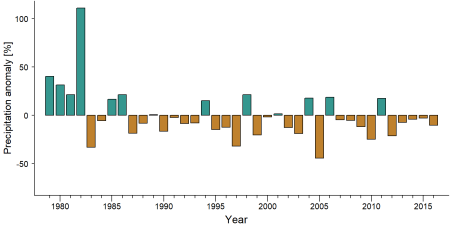
Precipitation anomaly in Southern Tanganyika -
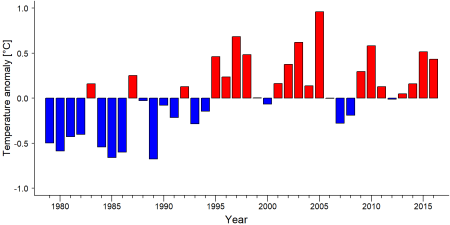
Temperature anomaly in Southern Tanganyika


External links
References
Plumptre, A.J., Rose, R., Nangendo, G., Williamson, E.A., Didier, K., Hart, J., Mulindahabi, F., Hicks, C., Griffin, B., Ogawa, H., Nixon, S., Pintea, L., Vosper, A., McClennan, M., Amsini, F., McNeilage, A., Makana, J.R., Kanamori, M., Hernandez, A., Piel, A., Stewart, F., Moore, J., Zamma, K., Nakamura, M., Kamenya, S., Idani, G., Sakamaki, T., Yoshikawa, M., Greer, D., Tranquilli, S., Beyers, R., Furuichi, T., Hashimoto, C. and Bennett, E. (2010). Eastern Chimpanzee (Pan troglodytes schweinfurthii): Status Survey and Conservation Action Plan 2010–2020. IUCN/SSC Primate Specialist Group, Gland, Switzerland. 52pp. link
TAWIRI. (2018). Tanzania Chimpanzee Conservation Action Plan 2018-2023. TAWIRI Contact: info@tawiri.or.tz
WCS (n.d.). Landscapes: The Southern Highlands. https://tanzania.wcs.org/Landscapes/Southern-Highlands.aspx
Kiribou, R., Tehoda, P., Chukwu, O., Bempah, G., Kühl, H. S., Ferreira, J., …, & Heinicke, S. (2024). Exposure of African ape sites to climate change impacts. PLOS Climate, 3(2), e0000345. doi:10.1371/journal.pclm.0000345
Page created by: APES Atlas Team Date: 2021-11-14