
Comoé National Park: Difference between revisions
No edit summary |
No edit summary |
||
| Line 14: | Line 14: | ||
* Conservation activities implemented include law enforcement, education, habitat restoration, biomonitoring and permanent presence of researchers. | * Conservation activities implemented include law enforcement, education, habitat restoration, biomonitoring and permanent presence of researchers. | ||
* Comoé National Park is one of the largest protected areas in West Africa. | * Comoé National Park is one of the largest protected areas in West Africa. | ||
| Line 52: | Line 53: | ||
[[Types of sites]] [[Governance types]] [[Habitat types]] | [[Types of sites]] [[Governance types]] [[Habitat types]] | ||
= Ape status = | = Ape status = | ||
| Line 177: | Line 179: | ||
[[Sampling methods]] [[Analytical frameworks]] | [[Sampling methods]] [[Analytical frameworks]] | ||
= Threats = | = Threats = | ||
| Line 239: | Line 242: | ||
[[Threats]] | [[Threats]] | ||
= Conservation activities = | = Conservation activities = | ||
| Line 289: | Line 293: | ||
[[Conservation activities]] | [[Conservation activities]] | ||
= Challenges = | = Challenges = | ||
| Line 332: | Line 337: | ||
[[Challenges]] | [[Challenges]] | ||
= Enablers = | = Enablers = | ||
| Line 395: | Line 401: | ||
[[Enablers]] | [[Enablers]] | ||
= Research activities = | = Research activities = | ||
The [https://www.biozentrum.uni-wuerzburg.de/comoe-research-station Comoé National Park Research Station] conducts a diversity of research projects on ecophysiology, behavioral, chemical and evolutionary ecology. In 2014 a research project, the Comoé Chimpanzee Conservation Project ([https://www.facebook.com/comoechimpanzeecp CCCP]), was established at the site focusing on chimpanzee behavior, tool use and ecology (Lapuente et al. 2017, 2019). | The [https://www.biozentrum.uni-wuerzburg.de/comoe-research-station Comoé National Park Research Station] conducts a diversity of research projects on ecophysiology, behavioral, chemical and evolutionary ecology. In 2014 a research project, the Comoé Chimpanzee Conservation Project ([https://www.facebook.com/comoechimpanzeecp CCCP]), was established at the site focusing on chimpanzee behavior, tool use and ecology (Lapuente et al. 2017, 2019). | ||
= Documented behaviours = | = Documented behaviours = | ||
| Line 517: | Line 525: | ||
[[Behaviours]] | [[Behaviours]] | ||
= Exposure to climate change impacts = | = Exposure to climate change impacts = | ||
| Line 635: | Line 644: | ||
|} | |} | ||
<div><ul><li style="display: inline-block; vertical-align: top;"> [[File:PrecipAnomaly_Comoe_NP.png| 450px | thumb| none | Precipitation anomaly inComoé National Park]] </li><li style="display: inline-block; vertical-align: top;"> [[File:TempAnomaly_Comoe_NP.png | 450px | thumb| none | Temperature anomaly inComoé National Park]] </li></ul></div> | |||
= External links = | = External links = | ||
Revision as of 02:48, 6 November 2025
West Africa > Côte d'Ivoire > Comoé National Park
Français | Português | Español | Bahasa Indonesia | Melayu
Summary
- Western chimpanzees (Pan troglodytes verus) are present in Comoé National Park.
- It has been estimated that a minimum of 135 weaned individuals occur in the site.
- The chimpanzee population trend is unknown.
- This site has a total size of 1,1487.56 km².
- Key reported threats include illegal hunting, agricultural encroachment, illegal logging, livestock farming, and human wildlife conflict.
- Conservation activities implemented include law enforcement, education, habitat restoration, biomonitoring and permanent presence of researchers.
- Comoé National Park is one of the largest protected areas in West Africa.
Site characteristics
Comoé National Park was established in 1968 and became Natural World Heritage Site in 1983 (UNESCO 2005). It is located in north-eastern Côte d’Ivoire, between the towns of Bouna and Kong, and close to the border with Burkina Faso and Ghana. The park is managed by the Office Ivoirien des Parcs et Réserves (OIPR).
The topography of Comoé NP is described as a peneplain, meaning a large area with a relief shaped by erosion, with a series of ridges and granite inselbergs up to 600m altitude (UNESCO 2005). The river Comoé flows south through the park for about 230 km (BirdLife International 2019).
The habitat is mostly characterized by savanna habitat with gallery forests and some areas with dense dry forests. Comoé NP is listed as an Important Bird Area and 494 bird species have been recorded for this site (BirdLife International 2019). Notably, five species of global conservation concern have been recorded, among them the three rare migrants pallid harrier (Circus macrourus), lesser kestrel (Falco naumanni) and great snipe (Gallinago media), two hornbill species which are now very rare at the site, the yellow-casqued hornbill (Ceratogymna elata) and brown-cheeked hornbill (C. cylindricus, BirdLife International 2019).
The presence of 69 species of larger mammals has been reported, including white-thighed colobus (Colobus vellerosus), white-naped mangabey (Cercocebus lunulatus), Roloway monkey (Cercopithecus roloway), olive baboons (Papio anubis), Gambian mongoose (Mungos gambianus), African elephant (Loxodonta africana), leopard (Panthera pardus), lion (Panthera leo), hippopotamus (Hippopotamus amphibious), Maxwell’s duiker (Philantomba maxwellii), red-flanked duiker (Cephalophus rufilatus), black duiker (Cephalophus niger), and bay duiker (Cephalophus dorsalis) and roan antelope (Hippotragus equinus, Fischer et al. 2002).
Comoé NP was listed as “World Heritage in Danger” from 2003 until 2017, because of the political and military crisis in Côte d’Ivoire from 2002 to 2011, which resulted in the absence of an effective management of the park. Poaching and bushfires were widespread, as was overgrazing by cattle herds and illegal gold mining (UNESC 2019). Since 2012, the situation stabilized, authorities regained access to the entire park, and enforced management of the park. In 2017, an IUCN mission obtained confirmation from a CCCP report that chimpanzee and elephant populations were present. As a consequence, Comoé was taken off the list of endangered world heritage sites (IUCN 2017).
Table 1. Basic site information for Comoé National Park
| Species | Pan troglodytes verus |
| Area | 1,1487.56 km² |
| Coordinates | Lat: 9.10 , Lon: -3.72 |
| Type of site | Protected area (National Park) |
| Habitat types | Savanna, Subtropical/tropical dry forest, Wetlands (lakes, rivers, streams, bogs, marshes) |
| Type of governance | Governance by government |
Types of sites Governance types Habitat types
Ape status
Marchesi et al. (1995) estimated chimpanzees in this park to number 470 individuals, which would represent the largest population of chimpanzees in the Soudanian Belt in Côte d’Ivoire. However, this was based on a survey effort of only 30 km. Fischer et al. (2002) confirmed the presence of chimpanzees in the area. In the following years, surveys found few or no signs of chimpanzees. A detailed survey of the area was implemented by the Comoé Chimpanzee Conservation Project (CCCP) in 2014-2015 and confirmed the permanent presence of several chimpanzee communities, notably also east of the river Comoé (Lapuente et al. 2017). From 2015 to 2017, CCCP collaborated with the Pan African Programme: The Cultured Chimpanzee (PanAf) to study many aspects of the ecology of the chimpanzees.
Table 2. Ape population estimates reported for Comoé National Park
| Species | Year | Occurrence | Encounter or vistation rate (nests/km; ind/day) | Density estimate [ind./ km²] (95% CI) | Abundance estimate (95% CI) | Survey area | Sampling method | Analytical framework | Source | Comments | A.P.E.S. database ID |
|---|---|---|---|---|---|---|---|---|---|---|---|
| Pan troglodytes verus | 2010 | Present | Comoé National Park | Aerial (drones/plane/helicopter) | WCF 2010 | Total survey effort: 2,955.7 km | |||||
| Pan troglodytes verus | 2014 | 0 | Comoé National Park | Aerial (drones/plane/helicopter) | WCF 2014 | Total survey effort: 2,955.7 km | |||||
| Pan troglodytes verus | 1993-2000 | Present | Comoé National Park | Interviews | Fischer et al. 2002 | ||||||
| Pan troglodytes verus | 1990 | 4.73 | 3.35 | Three locations in the park | Line transects | Marchesi et al. 1995 | Total survey effort: 30 km | ||||
| Pan troglodytes verus | 2008 | 0 | West of Comoé river | Line transects | WCF 2008 | Total survey effort: 32 km | |||||
| Pan troglodytes verus | 2009 | 0.38 | West of Comoé river | Line transects | WCF 2009 | Total survey effort: 143.5 km | |||||
| Pan troglodytes verus | 2012 | Present | Comoé National Park | Line transects | WCF 2012 | Total survey effort: 296 km. One nest recorded. | |||||
| Pan troglodytes verus | 2014-2015 | 0.14 | 127 (92-176) | Comoé National Park | Line transects & recces | Lapuente et al. (2020) | Minimum estimate, methods used included line transect sampling, reconnaissance walks and camera traps |
Sampling methods Analytical frameworks
Threats
Human population has grown significantly around the park in the past decades and communities that live close to the park rely on the park for agriculture, fishing, cattle grazing and hunting of wildlife (BirdLife International 2019). During political instability from 2001 to 2010 it was too dangerous for local authorities to enter the park and law enforcement was virtually absent (UNESCO 2019). As a result poaching was widespread, likely taking a heavy toll on animal populations and in 2003 Comoé was listed as a “World Heritage in Danger” (UNESCO 2005, UNESCO 2019). It was taken off the list in 2017 since the situation has improved markedly and law enforcement had been reestablished (IUCN 2017). In a 2014 survey, agricultural activities were recorded in the western part of the park (WCF 2014), but in 2017 the limits of the park were changed, so that the few remaining fields were then outside the park (Lapuente et al. in review).
Table 3. Threats to apes reported for Comoé National Park
| Category | Specific threats | Threat level | Description | Year of threat |
|---|---|---|---|---|
| 6 Human intrusions & disturbance | 6.2 War, civil unrest & military exercises | Low (up to 30% of population affected) | During times of political instability militias were present in the park (UNESCO 2019) | 2001-2010 |
| 2 Agriculture & aquaculture | 2.3 Livestock farming & ranching | Medium (30-70% of population affected) | Cows recorded during aerial surveys, though numbers seem to have decreased from 2010 to 2014 (WCF 2014). Still frequent in the North and the East of the CNP (Lapuente et al. in review). The small livestock is therefore found almost exclusively in the biodiversity area, whereas the northern part of the park itself is already heavily impacted by the presence of cattle herds (Linchant et al. 2022) | 2019-Ongoing (2022) |
| 3 Energy production & mining | 3.2 Mining & quarrying | High (more than 70% of population affected) | Artisanal gold mining (IUCN 2017, Lapuente et al. in review). Illegal gold mining is the most immediate and serious threat to the CNP. No mountain in the park has been spared by miners. The extraction sites are particularly vast and tend to remain very shallow (Linchant et al. 2022). | 2019-Ongoing (2022) |
| 5 Biological resource use | 5.1 Hunting & collecting terrestrial animals | High (more than 70% of population affected) | Poaching widespread (Lapuente et al. 2017, UNESCO 2019, Linchant et al. 2022). A significant number of trails are regularly used by bicycles and motorcycles throughout the entire park (Linchant et al. 2022). | 2019-Ongoing (2022) |
| 5 Biological resource use | 5.3 Logging & wood harvesting | Low (up to 30% of population affected) | Illegal fishing in Comoé river (Lapuente et al. 2017, BirdLife International 2019). | 2019-Ongoing (2022) |
| 7 Natural system modifications | 7.1 Fire & fire suppression | Present (unknown severity) | Fires caused by poachers (UNESCO 2019) | Ongoing (2019) |
| 2 Agriculture & aquaculture | 2.1 Annual & perennial non-timber crops | Low (up to 30% of population affected) | The presence of agricultural activities indicates encroachment on the protected area. However, this encroachment remains minimal and is primarily localized along the southwestern border, near the Mont Tingui Biodiversity Zone (Linchant et al. 2022). | Ongoing (2022) |
| 5 Biological resource use | 5.1.5 Persecution/human wildlife conflict | Present (unknown severity) | Great apes attacks on livestock reported (APES Atlas team pers. comm. 2025). | Ongoing (2025) |
Conservation activities
Comoé NP is one of the largest protected areas in West Africa and is managed by the Office Ivoirien des Parcs et Réserves (OIPR). In 1989/1990 Prof. Linsenmair from the University Würzburg in Germany, founded the Comoé National Park Research Station. The construction of a permanent research station started in 2000. During the political crisis the park could not be accessed regularly by government authorities or researchers. Since the political situation stabilized in 2010, OIPR resumed its activities. This resulted in a decline in illegal activities and an increase in wildlife populations (WCF 2014). Comoé National Park Research Station has also resumed its activities since. In 2014, Juan Lapuente, in collaboration with Prof. Linsenmair and OIPR, started the Comoé Chimpanzee Conservation Project (CCCP). This ongoing project involves local and foreign students, and assistants, that study chimpanzees of CNP and work for their conservation. Their work focuses on a 900 km2 area in the south-west of the park. Currently, OIPR is conducting a study on the fire regime (OIPR 2019).
Table 4. Conservation activities reported for Comoé National Park
| Category | Specific activity | Description | Implementing organization(s) | Year of activity |
|---|---|---|---|---|
| 5 Protection & restoration | 5.2 Legally protect ape habitat | Designated as National Park since 1968 (UNESCO 2005) | 1968-Ongoing | |
| 8 Permanent presence | 8.3 Permanent presence of staff/manager | Comoé National Park Research Station and Comoé Chimpanzee Conservation Project (since 2014) | 1989-Ongoing | |
| 2 Counter-wildlife crime | 2.11 Implement monitoring surveillance strategies (e.g., SMART) or use monitoring data to improve effectiveness of patrols | Biomonitoring surveys by WCF and OIPR, permanent research and conservation activities by the Comoé Chimpanzee Conservation Project (WCF 2010, 2012, 2014, Lapuente et al. 2017, 2019). Aerial inventories carried out (Linchant et al. 2022) | Office ivoirien des Parcs et Réserves (OIPR) | 2019-Ongoing (2022) |
| 4 Education & awareness | 4.1 Educate local communities about apes and sustainable use | Awareness raising activities implemented by OIPR and CCCP (OIPR 2019) | Ongoing (2019) | |
| 2 Counter-wildlife crime | 2.3 Conduct regular anti-poaching patrols | Ongoing patrols and law enforcement activities reported (APES Atlas team pers. comm. 2025). | Ongoing (2025) | |
| 4 Education & awareness | 4.2 Involve local community in ape research and conservation management | Local communities participate in conservation programs through their involvement in ecological monitoring activities (APES Atlas team pers. comm. 2025). | Ongoing (2025) |
Challenges
Table 5. Challenges reported for Comoé National Park
| Challenges | Specific challenges | Source | Year(s) |
|---|---|---|---|
| 2 Resources and capacity | 2.2 Lack of staff | Linchant et al. 2022 | Ongoing (2022) |
| 2 Resources and capacity | 2.5 Lack of equipment/transportation | Linchant et al. 2022 | Ongoing (2022) |
| 2 Resources and capacity | 2.7 Lack of infrastructure | Linchant et al. 2022 | Ongoing (2022) |
| 4 Institutional support | 4.4 Lack of transboundary cooperation | Linchant et al. 2022 | Ongoing (2022) |
| 5 Ecological context | 5.1 Ecological constraints (e.g., susceptibility to climate change, difficult terrain) | Linchant et al. 2022 | Ongoing (2022) |
| 6 Safety and stability | 6.2 Insecurity | Linchant et al. 2022 | Ongoing (2022) |
Enablers
Table 6. Enablers reported for Comoé National Park
| Enablers | Specific enablers | Source | Year(s) |
|---|---|---|---|
| 1 Site management | 1.2 Effective coordination | Linchant et al. 2022 | Ongoing (2022) |
| 2 Resources and capacity | 2.3 Continuous/long-term funding | Linchant et al. 2022 | Ongoing (2022) |
| 2 Resources and capacity | 2.4 Adequate data to inform and evaluate conservation actions | Linchant et al. 2022 | Ongoing (2022) |
| 2 Resources and capacity | 2.6 External partnerships that add expertise or resources | Linchant et al. 2022 | Ongoing (2022) |
| 2 Resources and capacity | 2.2 Sufficient funding | APES Atlas team pers. comm. 2025 | Ongoing (2025) |
| 2 Resources and capacity | 2.5 Sufficient capacity/expertise to advise, design, or implement actions | APES Atlas team pers. comm. 2025 | Ongoing (2025) |
| 3 Engaged community | |||
| 4 Institutional support | |||
| 5 Ecological context | |||
| 6 Safety and stability |
Research activities
The Comoé National Park Research Station conducts a diversity of research projects on ecophysiology, behavioral, chemical and evolutionary ecology. In 2014 a research project, the Comoé Chimpanzee Conservation Project (CCCP), was established at the site focusing on chimpanzee behavior, tool use and ecology (Lapuente et al. 2017, 2019).
Documented behaviours
Table 7. Behaviours documented for Comoé National Park
| Category | Behavior | Observation type | Prevalence | Observation dates | Source | Habituation | Species | Comment |
|---|---|---|---|---|---|---|---|---|
| Accumulative stone throwing | Kühl et al. 2016 | |||||||
| Ant dipping | Lapuente et al. 2017, Kühl et al. 2019 | |||||||
| Ant eating | Lapuente et al. 2017, Kühl et al. 2019 | |||||||
| Cave use | Galat et al. 2008, Kühl et al. 2019 | |||||||
| Honey eating | Lapuente et al. 2017, Kühl et al. 2019 | |||||||
| Honey extraction with tools | Lapuente et al. 2017, Kühl et al. 2019 | |||||||
| Leaf sponging for drinking water | Lapuente et al. 2017, Kühl et al. 2019 | |||||||
| Termite eating | Lapuente et al. 2017, Kühl et al. 2019 | |||||||
| Termite fishing | Lapuente et al. 2017, Kühl et al. 2019 | |||||||
| Water dipping | Lapuente et al. 2017, Kühl et al. 2019 |
Exposure to climate change impacts
As part of a study on the exposure of African great ape sites to climate change impacts, Kiribou et al. subm. extracted climate data and data on projected extreme climate impact events for the site. Climatological characteristics were derived from observation-based climate data provided by the Inter-Sectoral Impact Model Intercomparison Project (ISIMIP, www.isimip.org). Parameters were calculated as the average across each 30-year period. For 1981-2010, the EWEMBI dataset from ISIMIP2a was used. For the two future periods (2021-2050 and 2071-2099) ISIMIP2b climate data based on four CMIP5 global climate models were used. For future projections, two Representative Concentration Pathways (RCP) were used. RCP 2.6 is a scenario with strong mitigation measures in which global temperatures would likely rise below 2C. RCP 6.0 is a scenario with medium emissions in which global temperatures would likely rise up to 3C by 2100. For the number of days with heavy precipitation events, the 98th percentile of all precipitation days (>1mm/d) was calculated for the 1979-2013 reference period as a threshold for a heavy precipitation event. Then, for each year, the number of days above that threshold was derived. The figures on temperature and precipitation anomaly show the deviation from the mean temperature and mean precipitation for the 1979-2013 reference period.
The estimated exposure to future extreme climate impact events (crop failure, drought, river flood, wildfire, tropical cyclone, and heatwave) is based on a published dataset by Lange et al. 2020 derived from ISIMIP2b data. The same global climate models and RCPs as described above were used. Within each 30-year period, the number of years with an extreme event and the average proportion of the site affected were calculated (see Kiribou et al. subm. for details).
Table 8. Estimated past and projected climatological characteristics in Comoé National Park
| Value | 1981-2010 | 2021-2050, RCP 2.6 | 2021-2050, RCP 6.0 | 2071-2099, RCP 2.6 | 2071-2099, RCP 6.0 |
|---|---|---|---|---|---|
| Mean temperature [C] | 27.2 | 28.3 | 28.1 | 28.6 | 29.7 |
| Annual precipitation [mm] | 1078 | 1114 | 1114 | 1102 | 1158 |
| Max no. consecutive dry days (per year) | 46 | 49.3 | 52.1 | 50.5 | 50.7 |
| No. days with heavy precipitation (per year) | 5.6 | 7.7 | 7.7 | 8 | 7.8 |
Table 9. Projected exposure of apes to extreme climate impact events in Comoé National Park
| Type | No. of years with event (2021-2050, RCP 2.6) | % of site exposed (2021-2050, RCP 2.6) | No. of years with event (2021-2050, RCP 6.0) | % of site exposed (2021-2050, RCP 6.0) | No. of years with event (2070-2099, RCP 2.6) | % of site exposed (2070-2099, RCP 2.6) | No. of years with event (2070-2099, RCP 6.0) | % of site exposed (2070-2099, RCP 6.0) |
|---|---|---|---|---|---|---|---|---|
| Crop failure | 7.5 | 0.03 | 6 | 0.03 | 6 | 0.03 | 12 | 0.03 |
| Drought | 1.75 | 33.33 | 0.5 | 16.67 | 1.25 | 33.33 | 0 | 0 |
| Heatwave | 2 | 35.19 | 2.5 | 66.67 | 0 | 0 | 5 | 70 |
| River flood | 2 | 0.34 | 1 | 0.19 | 2 | 0.64 | 2 | 0.13 |
| Tropical cyclone | 0 | 0 | 0 | 0 | 0 | 0 | 0 | 0 |
| Wildfire | 30 | 1.69 | 30 | 1.32 | 29 | 1.82 | 29 | 1.36 |
-
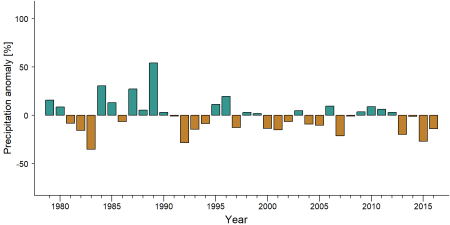
Precipitation anomaly inComoé National Park -
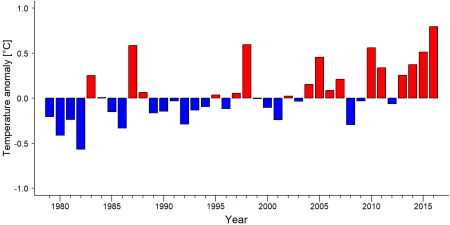
Temperature anomaly inComoé National Park


External links
References
BirdLife International. 2019. Important Bird Areas factsheet: Cavally and Goin - Debe Forest Reserves. Online: www.birdlife.org
Fischer F et al. 2002 Updated list of the larger mammals of the Comoé National Park, Ivory Coast. Mammalia 66(1): 83-92
Galat et al. 2008. Our Cousins Chimpanzees and Baboons Face Global Warming by Digging Wells to Filtrate Drinking Water. Proceedings 13th International Water Resource Association Congress, Nanterre, France
IUCN. 2017. African national park taken off World Heritage ‘danger list’ following IUCN advice. IUCN News. Online: www.iucn.org/news
Kühl, H. S., Kalan, A. K., Arandjelovic, M., Aubert, F., D’Auvergne, L., Goedmakers, A., … Boesch, C. 2016. Chimpanzee accumulative stone throwing. Scientific Reports 6:1–8.
Kühl HS et al. 2019. Human impact erodes chimpanzee behavioral diversity. Science. 363, 1453–1455.
Lapuente J. et al. 2017. Fluid dipping technology of chimpanzees in Comoé National Park, Ivory Coast. American Journal of Primatology. 79: e22628
Lapuente J. 2018. Recherche et travaux effectués par le Comoé chimpanzee Conservation Project. Juillet 2017 - Juillet 2018. Report for OIPR, 39 pp.
Lapuente, J., Ouattara, A., Köster, P. C., & Linsenmair, K. E. (2020). Status and distribution of Comoé Chimpanzees: combined use of transects and camera traps to quantify a low-density population in savanna-forest mosaic. Primates, 61(5), 647-659.
OIPR. 2019. Parc national de la Comoé. Online : www.oipr.ci
UNEP-WCMC, IUCN. 2018. Protected Planet: The World Database on Protected Areas (WDPA), Cambridge, UK: UNEP-WCMC and IUCN Online: www.protectedplanet.net
UNESCO. 2005. UNESCO – MAB Biosphere Reserves Directory: Biosphere Reserve Information Côte d’Ivoire Comoé. Online: www.unesco.org
UNESCO. 2019. State of Conservation – Comoé National Park (Côte d’Ivoire). Online: whc.unesco.org
WCF. 2008. Evaluation rapide de l’état du parc national de la Comoé : les grands mammifères et les activités illégales humaines. Online: Wild Chimpanzee Foundation
WCF. 2009. Rapport sur le recensement des chimpanzés dans le Parc National de la Comoé, Côte d’Ivoire. Online: Wild Chimpanzee Foundation
WCF. 2010. Etat des ressources naturelles du parc national de la Comoé et de sa zone périphérique, rapport de l’inventaire faunique par survol aérien (Mars 2010). Online: Wild Chimpanzee Foundation
WCF. 2012. Suivi écologique au parc national de la Comoé, rapport de l’inventaire pédestre de la faune (Mars-Août 2012. Online: Wild Chimpanzee Foundation
WCF. 2014. Etat de conservation du parc national de la Comoé et de sa zone périphérique, rapport de l’inventaire faunique par survol du 17 au 24 Avril 2014. Online: Wild Chimpanzee Foundation
Linchant, J., Sabdano, N., Eisendrath, L., & Vincke X. (2022). Rapport d'inventaire aérien du Parc National de la Comoé 2022, version révisée du 14.11.22. KfW/OIPR, 100p.
Page created by: APES Atlas Team Date: 2019-10-29
Page updated by: Diorne Zausa Date: 2024-11-28