
Margibi Mangrove Proposed Protected Area: Difference between revisions
No edit summary |
No edit summary |
||
| Line 14: | Line 14: | ||
* The chimpanzees on Marshall Island depend on a team of caretakers for survival, as there is no food or fresh water on the islands. | * The chimpanzees on Marshall Island depend on a team of caretakers for survival, as there is no food or fresh water on the islands. | ||
* Margibi Mangrove forms part of a Key Biodiversity Area (KBA) spanning Kpelle Forest and Lorma National Forest. | * Margibi Mangrove forms part of a Key Biodiversity Area (KBA) spanning Kpelle Forest and Lorma National Forest. | ||
| Line 44: | Line 45: | ||
[[Types of sites]] [[Governance types]] [[Habitat types]] | [[Types of sites]] [[Governance types]] [[Habitat types]] | ||
= Ape status = | = Ape status = | ||
| Line 68: | Line 70: | ||
| | | | ||
| | | | ||
|63 | |63.0 | ||
|Margibi Mangrove Proposed Protected Area | |Margibi Mangrove Proposed Protected Area | ||
|Full count | |Full count | ||
| Line 78: | Line 80: | ||
[[Sampling methods]] [[Analytical frameworks]] | [[Sampling methods]] [[Analytical frameworks]] | ||
= Threats = | = Threats = | ||
The chimpanzees who are trapped on the islands (which is artificial habitat for them) depend on humans to bring them food and drinking water on a daily basis for survival. If funding ends or if there is nobody taking care of them, they will die of thirst or starve to death. | The chimpanzees who are trapped on the islands (which is artificial habitat for them) depend on humans to bring them food and drinking water on a daily basis for survival. If funding ends or if there is nobody taking care of them, they will die of thirst or starve to death. | ||
= Conservation activities = | = Conservation activities = | ||
Although chimpanzee reintroduction/translocation and rehabilitation are conservation activities listed for primates (Junker et al. 2017), we refrain from listing the release of the Liberian laboratory chimpanzees on Marshall islands as a conservation activity, as this was a way for the NYBC to allow these chimpanzees to “retire” from the invasive research that was done on them in the center for more than 30 years. It was not a conservation activity per se. | Although chimpanzee reintroduction/translocation and rehabilitation are conservation activities listed for primates (Junker et al. 2017), we refrain from listing the release of the Liberian laboratory chimpanzees on Marshall islands as a conservation activity, as this was a way for the NYBC to allow these chimpanzees to “retire” from the invasive research that was done on them in the center for more than 30 years. It was not a conservation activity per se. | ||
= Challenges = | = Challenges = | ||
| Line 104: | Line 109: | ||
[[Challenges]] | [[Challenges]] | ||
= Enablers = | = Enablers = | ||
| Line 147: | Line 153: | ||
[[Enablers]] | [[Enablers]] | ||
= Research activities = | = Research activities = | ||
No information on research activities has been documented. | No information on research activities has been documented. | ||
= Documented behaviours = | = Documented behaviours = | ||
| Line 179: | Line 187: | ||
[[Behaviours]] | [[Behaviours]] | ||
= Exposure to climate change impacts = | = Exposure to climate change impacts = | ||
| Line 297: | Line 306: | ||
|} | |} | ||
<div><ul><li style="display: inline-block; vertical-align: top;"> [[File:PrecipAnomaly_Margibi_Mangrove.png| 450px | thumb| none | Precipitation anomaly inMargibi Mangrove Proposed Protected Area]] </li><li style="display: inline-block; vertical-align: top;"> [[File:TempAnomaly_Margibi_Mangrove.png | 450px | thumb| none | Temperature anomaly inMargibi Mangrove Proposed Protected Area]] </li></ul></div> | |||
= External links = | = External links = | ||
Revision as of 02:52, 6 November 2025
West Africa > Liberia > Margibi Mangrove Proposed Protected Area
Français | Português | Español | Bahasa Indonesia | Melayu
Summary
- Western chimpanzees (Pan troglodytes verus) are present in Margibi Mangrove Proposed Protected Area.
- It has been estimated that more than 60 individuals occur at the site.
- The chimpanzee population trend is unknown.
- This site has a total size of 238.13 km².
- Key threats to chimpanzees are.
- The chimpanzees on Marshall Island depend on a team of caretakers for survival, as there is no food or fresh water on the islands.
- Margibi Mangrove forms part of a Key Biodiversity Area (KBA) spanning Kpelle Forest and Lorma National Forest.
Site characteristics
Margibi Mangrove Proposed Protected Area is an important mangrove area and estuary of the Junk and Farmington Rivers, Margibi Mangrove is home to the Liberia Chimpanzee Colony (Johnson 2015). The area has approximately 35 kilometres of Atlantic coastline. The six islands on the wetland have been used by New York Blood Center (NYBC) who established a chimpanzee virus laboratory in West Africa in 1974. One of the purposes of VILAB II, at the Liberian Institute for Biomedical Research in Robertsfield, Liberia, was to develop the hepatitis B vaccine in chimpanzees. Chimpanzees were captured from various parts of West Africa and brought to VILAB. When the lab closed down in 2005, the remaining chimpanzees were released on islands in Marshall Wetland. Currently, more than 60 chimpanzees inhabit the islands. Their original carers, many of whom have worked with the chimps since the 1970s, were paid to take them food and water every other day. Then, at the height of the Ebola epidemic in 2014, the caretakers stopped going to the island and the apes began to starve. In 2015, the Humane Society decided to take on the care of the chimps and in 2017 the NYBC pledged £5 million to pay for their future food and medical needs.
Table 1. Basic site information for Margibi Mangrove Proposed Protected Area
| Species | Pan troglodytes verus |
| Area | 238.13 km² |
| Coordinates | Lat: 6.160000 , Lon: -10.370000 |
| Type of site | Proposed protected area |
| Habitat types | Subtropical/tropical moist lowland forest |
| Type of governance |
Types of sites Governance types Habitat types
Ape status
No information was found about how many chimpanzees were initially released on the islands. Apparently, 63 chimpanzees currently still inhabit the islands. They are taken care of by staff of the Humane Society, financed by the NYBC after much public outcry in 2015, when NYBCs original funding to care for the released lab chimpanzees ran out Mail Online.
Table 2. Ape population estimates reported for Margibi Mangrove Proposed Protected Area
| Species | Year | Occurrence | Encounter or vistation rate (nests/km; ind/day) | Density estimate [ind./ km²] (95% CI) | Abundance estimate (95% CI) | Survey area | Sampling method | Analytical framework | Source | Comments | A.P.E.S. database ID |
|---|---|---|---|---|---|---|---|---|---|---|---|
| Pan troglodytes verus | 2017 | 63.0 | Margibi Mangrove Proposed Protected Area | Full count | Mail Online 2017 | Chimpanzees introduced into non-inhabited habitat on islands on the Liberian coast |
Sampling methods Analytical frameworks
Threats
The chimpanzees who are trapped on the islands (which is artificial habitat for them) depend on humans to bring them food and drinking water on a daily basis for survival. If funding ends or if there is nobody taking care of them, they will die of thirst or starve to death.
Conservation activities
Although chimpanzee reintroduction/translocation and rehabilitation are conservation activities listed for primates (Junker et al. 2017), we refrain from listing the release of the Liberian laboratory chimpanzees on Marshall islands as a conservation activity, as this was a way for the NYBC to allow these chimpanzees to “retire” from the invasive research that was done on them in the center for more than 30 years. It was not a conservation activity per se.
Challenges
Table 5. Challenges reported for Margibi Mangrove Proposed Protected Area
| Challenges | Specific challenges | Source | Year(s) |
|---|---|---|---|
| Not reported |
Enablers
Table 6. Enablers reported for Margibi Mangrove Proposed Protected Area
| Enablers | Specific enablers | Source | Year(s) |
|---|---|---|---|
| 1 Site management | |||
| 2 Resources and capacity | |||
| 3 Engaged community | |||
| 4 Institutional support | |||
| 5 Ecological context | |||
| 6 Safety and stability |
Research activities
No information on research activities has been documented.
Documented behaviours
Table 7. Behaviours documented for Margibi Mangrove Proposed Protected Area
| Category | Behavior | Observation type | Prevalence | Observation dates | Source | Habituation | Species | Comment |
|---|---|---|---|---|---|---|---|---|
| Not reported |
Exposure to climate change impacts
As part of a study on the exposure of African great ape sites to climate change impacts, Kiribou et al. subm. extracted climate data and data on projected extreme climate impact events for the site. Climatological characteristics were derived from observation-based climate data provided by the Inter-Sectoral Impact Model Intercomparison Project (ISIMIP, www.isimip.org). Parameters were calculated as the average across each 30-year period. For 1981-2010, the EWEMBI dataset from ISIMIP2a was used. For the two future periods (2021-2050 and 2071-2099) ISIMIP2b climate data based on four CMIP5 global climate models were used. For future projections, two Representative Concentration Pathways (RCP) were used. RCP 2.6 is a scenario with strong mitigation measures in which global temperatures would likely rise below 2C. RCP 6.0 is a scenario with medium emissions in which global temperatures would likely rise up to 3C by 2100. For the number of days with heavy precipitation events, the 98th percentile of all precipitation days (>1mm/d) was calculated for the 1979-2013 reference period as a threshold for a heavy precipitation event. Then, for each year, the number of days above that threshold was derived. The figures on temperature and precipitation anomaly show the deviation from the mean temperature and mean precipitation for the 1979-2013 reference period.
The estimated exposure to future extreme climate impact events (crop failure, drought, river flood, wildfire, tropical cyclone, and heatwave) is based on a published dataset by Lange et al. 2020 derived from ISIMIP2b data. The same global climate models and RCPs as described above were used. Within each 30-year period, the number of years with an extreme event and the average proportion of the site affected were calculated (see Kiribou et al. subm. for details).
Table 8. Estimated past and projected climatological characteristics in Margibi Mangrove Proposed Protected Area
| Value | 1981-2010 | 2021-2050, RCP 2.6 | 2021-2050, RCP 6.0 | 2071-2099, RCP 2.6 | 2071-2099, RCP 6.0 |
|---|---|---|---|---|---|
| Mean temperature [C] | 25.8 | 26.8 | 26.8 | 26.9 | 28 |
| Annual precipitation [mm] | 2913 | 2973 | 3051 | 3009 | 3079 |
| Max no. consecutive dry days (per year) | 23 | 26 | 24.2 | 25.1 | 25.9 |
| No. days with heavy precipitation (per year) | 6.3 | 6.9 | 7.2 | 7.1 | 8.5 |
Table 9. Projected exposure of apes to extreme climate impact events in Margibi Mangrove Proposed Protected Area
| Type | No. of years with event (2021-2050, RCP 2.6) | % of site exposed (2021-2050, RCP 2.6) | No. of years with event (2021-2050, RCP 6.0) | % of site exposed (2021-2050, RCP 6.0) | No. of years with event (2070-2099, RCP 2.6) | % of site exposed (2070-2099, RCP 2.6) | No. of years with event (2070-2099, RCP 6.0) | % of site exposed (2070-2099, RCP 6.0) |
|---|---|---|---|---|---|---|---|---|
| Crop failure | 3.5 | 0.12 | 4.5 | 0.12 | 1 | 0.12 | 6 | 0.12 |
| Drought | 0 | 0 | 0 | 0 | 0 | 0 | 0 | 0 |
| Heatwave | 11 | 100 | 8.5 | 100 | 18 | 100 | 20.5 | 100 |
| River flood | 3 | 4.14 | 2.75 | 4.1 | 3 | 5.26 | 7.25 | 6.23 |
| Tropical cyclone | 0 | 0 | 0.5 | 3.53 | 0 | 0 | 0.5 | 2.01 |
| Wildfire | 30 | 0.39 | 30 | 0.36 | 29 | 0.41 | 29 | 0.37 |
-
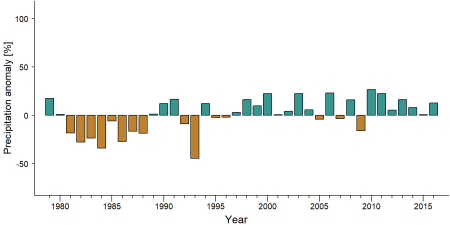
Precipitation anomaly inMargibi Mangrove Proposed Protected Area -
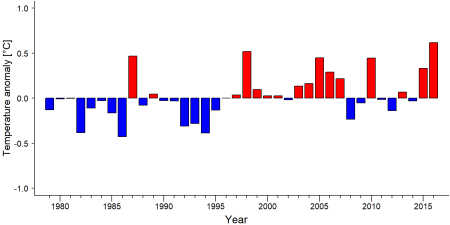
Temperature anomaly inMargibi Mangrove Proposed Protected Area


External links
References
Johnson S. 2015. Aggregated Biodiversity Offsets: A Roadmap for Liberia’s Mining Sector. Unpublished report by the World Bank Group (WBG) and Program On Forests (PROFOR).
Junker J, Orth L, Kühl H S, Smith R K, Sutherland W J 2017. Primate Conservation: Global Evidence for the Effects of Interventions. University of Cambridge.
Mail Online. 2017. Hand of friendship: Chimps left to starve on monkey island by health research company are thriving after volunteers canoe in to feed them bananas and coconuts. Online: www.dailymail.co.uk
Page created by: APES Atlas Team Date: 2019-10-25