
Sobeya: Difference between revisions
Created page with "West Africa > Republic of Guinea > Sobeya '''[https://apesatlas-iucnapesportal-org.translate.goog/index.php/Sobeya?_x_tr_sl=auto&_x_tr_tl=fr&_x_tr_hl=en&_x_tr_pto=wapp Français]''' | '''[https://apesatlas-iucnapesportal-org.translate.goog/index.php/Sobeya?_x_tr_sl=auto&_x_tr_tl=pt&_x_tr_hl=en&_x_tr_pto=wapp Português]''' | '''[https://apesatlas-iucnapesportal-org.translate.goog/index.php/Sobeya?_x_tr_sl=auto&_x_tr_tl=es&_x_tr_hl=en&_x_tr_pto=wapp Español]..." |
No edit summary |
||
| Line 14: | Line 14: | ||
* Conservation activities were not reported. | * Conservation activities were not reported. | ||
* Sobeya was a temporary research site of the Pan African Programme: The Cultured Chimpanzee (PanAf). | * Sobeya was a temporary research site of the Pan African Programme: The Cultured Chimpanzee (PanAf). | ||
| Line 44: | Line 45: | ||
[[Types of sites]] [[Governance types]] [[Habitat types]] | [[Types of sites]] [[Governance types]] [[Habitat types]] | ||
= Ape status = | = Ape status = | ||
| Line 78: | Line 80: | ||
[[Sampling methods]] [[Analytical frameworks]] | [[Sampling methods]] [[Analytical frameworks]] | ||
= Threats = | = Threats = | ||
| Line 116: | Line 119: | ||
[[Threats]] | [[Threats]] | ||
= Conservation activities = | = Conservation activities = | ||
Conservation interventions were not reported for Sobeya. | Conservation interventions were not reported for Sobeya. | ||
= Challenges = | = Challenges = | ||
| Line 138: | Line 143: | ||
[[Challenges]] | [[Challenges]] | ||
= Enablers = | = Enablers = | ||
| Line 181: | Line 187: | ||
[[Enablers]] | [[Enablers]] | ||
= Research activities = | = Research activities = | ||
Data collected by the PanAf at Sobeya was used to for studies on chimpanzee behavior (Kühl et al. 2016, Kühl et al. 2019, Tagg et al. 2018) and diseases in apes (Murthy et al. 2019). | Data collected by the PanAf at Sobeya was used to for studies on chimpanzee behavior (Kühl et al. 2016, Kühl et al. 2019, Tagg et al. 2018) and diseases in apes (Murthy et al. 2019). | ||
= Documented behaviours = | = Documented behaviours = | ||
| Line 243: | Line 251: | ||
[[Behaviours]] | [[Behaviours]] | ||
= Exposure to climate change impacts = | = Exposure to climate change impacts = | ||
| Line 361: | Line 370: | ||
|} | |} | ||
<div><ul><li style="display: inline-block; vertical-align: top;"> [[File:PrecipAnomaly_Sobeya.png| 450px | thumb| none | Precipitation anomaly inSobeya]] </li><li style="display: inline-block; vertical-align: top;"> [[File:TempAnomaly_Sobeya.png | 450px | thumb| none | Temperature anomaly inSobeya]] </li></ul></div> | |||
= External links = | = External links = | ||
Revision as of 02:54, 6 November 2025
West Africa > Republic of Guinea > Sobeya
Français | Português | Español | Bahasa Indonesia | Melayu
Summary
- Western chimpanzees (Pan troglodytes verus) are present in Sobeya.
- A population size estimate for western chimpanzees has not been reported.
- The chimpanzee population trend is unknown.
- This site has a total size of 96 km².
- Key threats to chimpanzees are agriculture and livestock farming.
- Conservation activities were not reported.
- Sobeya was a temporary research site of the Pan African Programme: The Cultured Chimpanzee (PanAf).
Site characteristics
Sobeya is a temporary research site of the Pan African Programme: The Cultured Chimpanzee (PanAf) close to the village Sobeya in Guinea. More specifically this site located in the southern part of the Fouta Djallon. Research was conducted for 12 months in 2012 and 2013. The area is characterized by savanna and gallery forests. Species encountered include the Guinea baboon (Papio papio).
Table 1. Basic site information for Sobeya
| Species | Pan troglodytes verus |
| Area | 96 km² |
| Coordinates | Lat: 10.26 , Lon: -11.71 |
| Type of site | Non-protected area |
| Habitat types | Savanna, Shrubland, Subtropical/tropical dry forest, Agricultural land |
| Type of governance |
Types of sites Governance types Habitat types
Ape status
As part of the PanAf data collection protocol recce and line transect surveys were conducted in 2012 and 2013. However, chimpanzee density or abundance was not analyzed/not published (PanAf 2019).
Table 2. Ape population estimates reported for Sobeya
| Species | Year | Occurrence | Encounter or vistation rate (nests/km; ind/day) | Density estimate [ind./ km²] (95% CI) | Abundance estimate (95% CI) | Survey area | Sampling method | Analytical framework | Source | Comments | A.P.E.S. database ID |
|---|---|---|---|---|---|---|---|---|---|---|---|
| Pan troglodytes verus | 2012-2013 | Present | Sobeya | Line transects | PanAf 2019 | Abundance estimate was not published |
Sampling methods Analytical frameworks
Threats
The area is used by farmers and herders from nearby villages. There was a breeder settlement within the study area and the village Sobeya. Cows were frequently captured on camera traps (unpublished PanAf report).
Table 3. Threats to apes reported for Sobeya
| Category | Specific threats | Threat level | Description | Year of threat |
|---|---|---|---|---|
| 1 Residential & commercial development | 1.1 Residential areas | Present (unknown severity) | Village Sobeya, breeder settlement (unpublished PanAf report from 2013). | Ongoing (2013) |
| 2 Agriculture & aquaculture | 2.1 Annual & perennial non-timber crops | Present (unknown severity) | Plantations encountered on transects (unpublished PanAf report from 2013) | Ongoing (2013) |
| 2 Agriculture & aquaculture | 2.3 Livestock farming & ranching | Present (unknown severity) | Cows captured on camera traps(unpublished PanAf report from 2013). | Ongoing (2013) |
| 7 Natural system modifications | 7.1 Fire & fire suppression | Present (unknown severity) | Presence of fire reported (unpublished PanAf report from 2013). | Ongoing (2013) |
Conservation activities
Conservation interventions were not reported for Sobeya.
Challenges
Table 5. Challenges reported for Sobeya
| Challenges | Specific challenges | Source | Year(s) |
|---|---|---|---|
| Not reported |
Enablers
Table 6. Enablers reported for Sobeya
| Enablers | Specific enablers | Source | Year(s) |
|---|---|---|---|
| 1 Site management | |||
| 2 Resources and capacity | |||
| 3 Engaged community | |||
| 4 Institutional support | |||
| 5 Ecological context | |||
| 6 Safety and stability |
Research activities
Data collected by the PanAf at Sobeya was used to for studies on chimpanzee behavior (Kühl et al. 2016, Kühl et al. 2019, Tagg et al. 2018) and diseases in apes (Murthy et al. 2019).
Documented behaviours
Table 7. Behaviours documented for Sobeya
| Category | Behavior | Observation type | Prevalence | Observation dates | Source | Habituation | Species | Comment |
|---|---|---|---|---|---|---|---|---|
| Algae fishing | Kühl et al. 2016, Kühl et al. 2019 | |||||||
| Ant eating | Kühl et al. 2016, Kühl et al. 2019 | |||||||
| Stone throwing | Kühl et al. 2016, Kühl et al. 2019 | |||||||
| Termite fishing | Kühl et al. 2016, Kühl et al. 2019 |
Exposure to climate change impacts
As part of a study on the exposure of African great ape sites to climate change impacts, Kiribou et al. subm. extracted climate data and data on projected extreme climate impact events for the site. Climatological characteristics were derived from observation-based climate data provided by the Inter-Sectoral Impact Model Intercomparison Project (ISIMIP, www.isimip.org). Parameters were calculated as the average across each 30-year period. For 1981-2010, the EWEMBI dataset from ISIMIP2a was used. For the two future periods (2021-2050 and 2071-2099) ISIMIP2b climate data based on four CMIP5 global climate models were used. For future projections, two Representative Concentration Pathways (RCP) were used. RCP 2.6 is a scenario with strong mitigation measures in which global temperatures would likely rise below 2C. RCP 6.0 is a scenario with medium emissions in which global temperatures would likely rise up to 3C by 2100. For the number of days with heavy precipitation events, the 98th percentile of all precipitation days (>1mm/d) was calculated for the 1979-2013 reference period as a threshold for a heavy precipitation event. Then, for each year, the number of days above that threshold was derived. The figures on temperature and precipitation anomaly show the deviation from the mean temperature and mean precipitation for the 1979-2013 reference period.
The estimated exposure to future extreme climate impact events (crop failure, drought, river flood, wildfire, tropical cyclone, and heatwave) is based on a published dataset by Lange et al. 2020 derived from ISIMIP2b data. The same global climate models and RCPs as described above were used. Within each 30-year period, the number of years with an extreme event and the average proportion of the site affected were calculated (see Kiribou et al. subm. for details).
Table 8. Estimated past and projected climatological characteristics in Sobeya
| Value | 1981-2010 | 2021-2050, RCP 2.6 | 2021-2050, RCP 6.0 | 2071-2099, RCP 2.6 | 2071-2099, RCP 6.0 |
|---|---|---|---|---|---|
| Mean temperature [C] | 25.6 | 26.8 | 26.6 | 26.9 | 28.1 |
| Annual precipitation [mm] | 1592 | 1575 | 1606 | 1628 | 1612 |
| Max no. consecutive dry days (per year) | 67.2 | 60.2 | 62 | 66.8 | 65.3 |
| No. days with heavy precipitation (per year) | 4.2 | 5.3 | 5.4 | 5.4 | 5.8 |
Table 9. Projected exposure of apes to extreme climate impact events in Sobeya
| Type | No. of years with event (2021-2050, RCP 2.6) | % of site exposed (2021-2050, RCP 2.6) | No. of years with event (2021-2050, RCP 6.0) | % of site exposed (2021-2050, RCP 6.0) | No. of years with event (2070-2099, RCP 2.6) | % of site exposed (2070-2099, RCP 2.6) | No. of years with event (2070-2099, RCP 6.0) | % of site exposed (2070-2099, RCP 6.0) |
|---|---|---|---|---|---|---|---|---|
| Crop failure | 8.5 | 2.06 | 5.5 | 2.06 | 11.5 | 2.06 | 13 | 2.06 |
| Drought | 0 | 0 | 0 | 0 | 0 | 0 | 0 | 0 |
| Heatwave | 1 | 50 | 0 | 0 | 1 | 50 | 3 | 100 |
| River flood | 0.5 | 0.09 | 0.5 | 1.03 | 0.25 | 0.05 | 1 | 0.04 |
| Tropical cyclone | 0 | 0 | 0 | 0 | 0 | 0 | 0 | 0 |
| Wildfire | 30 | 0.92 | 30 | 0.85 | 29 | 0.8 | 29 | 1.01 |
-
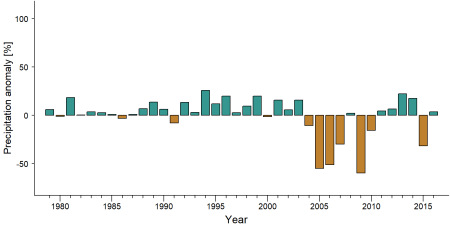
Precipitation anomaly inSobeya -
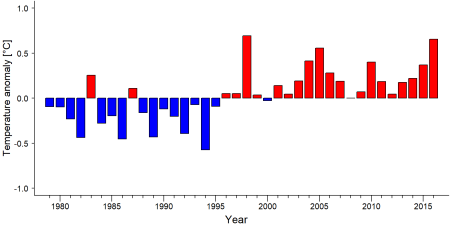
Temperature anomaly inSobeya


External links
References
Kühl HS et al. 2016. Chimpanzee accumulative stone throwing. Scientific Reports. 6:1–8.
Kühl HS et al. 2019. Human impact erodes chimpanzee behavioral diversity. Science. 363:1453–1455.
Murthy S. et al. 2019. Cytomegalovirus distribution and evolution in hominines. Virus Evolution 5(2):vez015
PanAf. 2019. Pan African Programme: The Cultured Chimpanzee. Online: panafrican.eva.mpg.de
Tagg N et al. 2018. Nocturnal activity in wild chimpanzees (Pan troglodytes): Evidence for flexible sleeping patterns and insights into human evolution. American Journal of Physical Anthropology. 166:510-529
Page created by: APES Atlas Team Date: 2019-10-14