
Djoua-Ivindo forest: Difference between revisions
No edit summary |
No edit summary |
||
| Line 10: | Line 10: | ||
* In 2015, it was estimated that 7,704 (95% CI 4,195-14,151) gorillas and 8,108 (95% CI 5,463-12,034) chimpanzees inhabit the site. | * In 2015, it was estimated that 7,704 (95% CI 4,195-14,151) gorillas and 8,108 (95% CI 5,463-12,034) chimpanzees inhabit the site. | ||
* The population trend is unknown. | * The population trend is unknown. | ||
Revision as of 10:43, 25 March 2026
Central Africa > Republic of the Congo > Djoua-Ivindo forest
Français | Português | Español | Bahasa Indonesia | Melayu
Summary
- Central chimpanzees (Pan troglodytes troglodytes) & western lowland gorillas (Gorilla gorilla gorilla) are present in Djoua-Ivindo.
- In 2015, it was estimated that 7,704 (95% CI 4,195-14,151) gorillas and 8,108 (95% CI 5,463-12,034) chimpanzees inhabit the site.
- The population trend is unknown.
Site characteristics
The Djoua Ivindo Forest is a sparsely populated region situated at the heart of the Tri-National Dja Odzala Minkebe (TRIDOM) Forest Landscape, which spans across Cameroon, Gabon, and the Republic of Congo. It is home to a significant population of forest elephants, a large number of great apes, various monkey species, rare aquatic life, and a diverse range of other wildlife (Fondation Segré).
Table 1. Basic site information for Djoua-Ivindo forest
| Species | Pan troglodytes troglodytes, Gorilla gorilla gorilla |
| Area | 11,415 km² |
| Coordinates | Lat: 1.51735 , Lon: 13.55800 |
| Type of site | Logging concession |
| Habitat types | Subtropical/tropical dry forest, Subtropical/tropical swamp forest |
| Type of governance | Private governance |
Types of sites Governance types Habitat types
Ape status
Table 2. Ape population estimates reported for Djoua-Ivindo forest
| Species | Year | Occurrence | Encounter or vistation rate (nests/km; ind/day) | Density estimate [ind./ km²] (95% CI) | Abundance estimate (95% CI) | Survey area | Sampling method | Analytical framework | Source | Comments | A.P.E.S. database ID |
|---|---|---|---|---|---|---|---|---|---|---|---|
| Pan troglodytes troglodytes | 2014-2015 | Present | 1.16 | 0.711 (0.478-1.054) | 8,108 (5,463-12,034) | Djoua-Ivindo forest (11,415 km²) | Line transects | Distance sampling | Allam et al. 2016 | ||
| Gorilla gorilla gorilla | 2014-2015 | Present | 0.72 | 0.675 (0.368-1.240) | 7,704 (4,195-14,151) | Djoua-Ivindo forest (11,415 km²) | Line transects | Distance sampling | Allam et al. 2016 |
Sampling methods Analytical frameworks
Threats
Table 3. Threats to apes reported for Djoua-Ivindo forest
| Category | Specific threats | Threat level | Description | Year of threat |
|---|---|---|---|---|
| 1 Residential & commercial development | 1.2 Commercial & industrial areas | Present (unknown severity) | Large-scale infrastructure development represents a significant threat to great apes and other wildlife in the region (Fondation Segré 2024). | 2018-2020 |
| 3 Energy production & mining | 3.2 Mining & quarrying | Present (unknown severity) | Mining also represent significant threat to great apes and other wildlife in the region (Fondation Segré 2024). | 2018-2020 |
| 5 Biological resource use | 5.1 Hunting & collecting terrestrial animals | Medium (30-70% of population affected) | Poaching signs (traps, cartridge cases and poachers' camps) detected during a survey in 2014-2015 (Allam et al. 2016). | Ongoing (2014) |
| 5 Biological resource use | 5.2 Gathering terrestrial plants | Medium (30-70% of population affected) | Signs of extraction of non-timber forest products documented in 2014-2015 (Allam et al. 2016). | Ongoing (2014) |
| 5 Biological resource use | 5.3 Logging & wood harvesting | Medium (30-70% of population affected) | Signs of logging were documented in 2014-2015 (Allam et al. 2016). | Ongoing (2014) |
Conservation activities
Table 4. Conservation activities reported for Djoua-Ivindo forest
| Category | Specific activity | Description | Implementing organization(s) | Year of activity |
|---|---|---|---|---|
| 2 Counter-wildlife crime | 2.3 Conduct regular anti-poaching patrols | The primary objectives are to enhance patrolling efforts and prevent poaching in this remote region, while also ensuring the arrest, prosecution, and conviction of wildlife criminals to the fullest extent of the law. The outcome will be a significant boost in anti-poaching capabilities in the Djoua Ivindo Forest, leading to better protection for threatened elephant and great ape populations, as well as other wildlife species (Fondation Segre). | WWF | 2018-2020 |
| 5 Protection & restoration | 5.4 Create natural habitat patches (including corridors) | Preservation of the ecological functions and connectivity of the TRIDOM area, ensuring the long-term conservation of its protected areas system through an integrated, sustainable, and participatory management approach in the interzone between protected areas. A COMIFAC project promotes a land-use matrix that will help conserve globally significant biodiversity through sustainable exploitation, while preserving it by designating land within the production forest as protected. The project aims to strengthen resource exploitation control capacities, monitor trends in biodiversity and ecosystems through an effective law enforcement system, foster collaborative management frameworks with the private sector and local communities, especially indigenous populations, and establish an efficient and cost-effective monitoring system (COMIFAC 2023). | Commission des Forêts d'Afrique Centrale | Ongoing (2023) |
Challenges
Table 5. Challenges reported for Djoua-Ivindo forest
| Challenges | Specific challenges | Source | Year(s) |
|---|---|---|---|
| 4 Institutional support | 4.4 Lack of transboundary cooperation | Allam et al. 2016, COMIFAC 2023 | 2014-Ongoing (2023) |
| 2 Resources and capacity | 2.4 Lack of continuous/long-term funding | Allam et al. 2016, COMIFAC 2023 | 2014-Ongoing (2023) |
| 3 Engaged community | 3.1 General lack of community engagement or support | Allam et al. 2016, COMIFAC 2023 | 2014-Ongoing (2023) |
| 2 Resources and capacity | 2.6 Lack of biomonitoring/survey data | Allam et al. 2016, COMIFAC 2023 | 2014-Ongoing (2023) |
Enablers
Research activities
Documented behaviours
Table 7. Behaviours documented for Djoua-Ivindo forest
| Category | Behavior | Observation type | Prevalence | Observation dates | Source | Habituation | Species | Comment |
|---|---|---|---|---|---|---|---|---|
| Not reported |
Exposure to climate change impacts
As part of a study on the exposure of African great ape sites to climate change impacts, Kiribou et al. subm. extracted climate data and data on projected extreme climate impact events for the site. Climatological characteristics were derived from observation-based climate data provided by the Inter-Sectoral Impact Model Intercomparison Project (ISIMIP, www.isimip.org). Parameters were calculated as the average across each 30-year period. For 1981-2010, the EWEMBI dataset from ISIMIP2a was used. For the two future periods (2021-2050 and 2071-2099) ISIMIP2b climate data based on four CMIP5 global climate models were used. For future projections, two Representative Concentration Pathways (RCP) were used. RCP 2.6 is a scenario with strong mitigation measures in which global temperatures would likely rise below 2C. RCP 6.0 is a scenario with medium emissions in which global temperatures would likely rise up to 3C by 2100. For the number of days with heavy precipitation events, the 98th percentile of all precipitation days (>1mm/d) was calculated for the 1979-2013 reference period as a threshold for a heavy precipitation event. Then, for each year, the number of days above that threshold was derived. The figures on temperature and precipitation anomaly show the deviation from the mean temperature and mean precipitation for the 1979-2013 reference period.
The estimated exposure to future extreme climate impact events (crop failure, drought, river flood, wildfire, tropical cyclone, and heatwave) is based on a published dataset by Lange et al. 2020 derived from ISIMIP2b data. The same global climate models and RCPs as described above were used. Within each 30-year period, the number of years with an extreme event and the average proportion of the site affected were calculated (see Kiribou et al. subm. for details).
Table 8. Estimated past and projected climatological characteristics in Djoua-Ivindo forest
| Value | 1981-2010 | 2021-2050, RCP 2.6 | 2021-2050, RCP 6.0 | 2071-2099, RCP 2.6 | 2071-2099, RCP 6.0 |
|---|---|---|---|---|---|
| Mean temperature [C] | 24 | 25.3 | 25.1 | 25.5 | 26.4 |
| Annual precipitation [mm] | 2724 | 2769 | 2754 | 2779 | 2758 |
| Max no. consecutive dry days (per year) | 14.9 | 9.8 | 9.6 | 9.9 | 10.1 |
| No. days with heavy precipitation (per year) | 7.3 | 8.5 | 8.4 | 8.7 | 9.1 |
Table 9. Projected exposure of apes to extreme climate impact events in Djoua-Ivindo forest
| Type | No. of years with event (2021-2050, RCP 2.6) | % of site exposed (2021-2050, RCP 2.6) | No. of years with event (2021-2050, RCP 6.0) | % of site exposed (2021-2050, RCP 6.0) | No. of years with event (2070-2099, RCP 2.6) | % of site exposed (2070-2099, RCP 2.6) | No. of years with event (2070-2099, RCP 6.0) | % of site exposed (2070-2099, RCP 6.0) |
|---|---|---|---|---|---|---|---|---|
| Crop failure | 24.5 | 0.02 | 19 | 0.02 | 22 | 0.01 | 28 | 0.03 |
| Drought | 0 | 0 | 0 | 0 | 0 | 0 | 0 | 0 |
| Heatwave | 6 | 56.25 | 7 | 54.71 | 4.5 | 67.29 | 15 | 69.22 |
| River flood | 1 | 0.33 | 1.5 | 0.49 | 3.5 | 1.38 | 3.5 | 1.54 |
| Tropical cyclone | 0 | 0 | 0 | 0 | 0 | 0 | 0 | 0 |
| Wildfire | 30 | 0.2 | 30 | 0.23 | 29 | 0.23 | 29 | 0.22 |
-
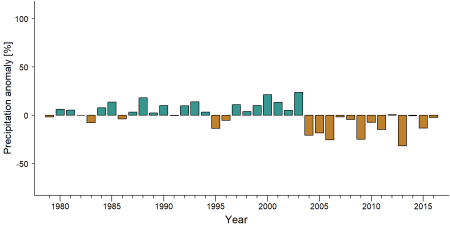
Precipitation anomaly in Djoua-Ivindo forest -
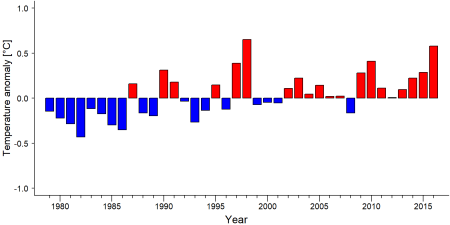
Temperature anomaly in Djoua-Ivindo forest


External links
References
Allam A., N’goran K. P., Mahoungou S. & Ikoa B. (2016). Rapport d'inventaire des grands et moyens mammifères dans la forêt de Djoua-Ivindo. WWF, p57.
COMIFAC (2023). Présentation du Projet TRIDOM. Online: https://comifac.org/projet-tridom/ _ 26/11/2024.
Fondation Segré. Saving threatened elephant and great ape populations in the Djoua Ivindo Forest. Online: https://www.fondationsegre.org/saving-threatened-elephant-and-great-ape-populations-in-the-djoua-ivindo-forest/_ 26/11/2024.
Page created by: Zausa Diorne Date: 2024-11-26 08:08:00