
Sankuru Nature Reserve: Difference between revisions
No edit summary |
No edit summary |
||
| Line 162: | Line 162: | ||
!Source | !Source | ||
!Year(s) | !Year(s) | ||
|- | |||
|4 Institutional support | |||
|4.1 Lack of law enforcement | |||
|Nyembo et al. 2020 | |||
|Ongoing (2020) | |||
|- | |- | ||
|6 Safety and stability | |6 Safety and stability | ||
| Line 167: | Line 172: | ||
|Nyembo et al. 2020 | |Nyembo et al. 2020 | ||
|2006 | |2006 | ||
|} | |} | ||
Revision as of 05:24, 21 April 2026
Central Africa > Democratic Republic of the Congo > Sankuru Nature Reserve
Français | Português | Español | Bahasa Indonesia | Melayu
Summary
- Bonobos (Pan paniscus) are present in Sankuru Nature Reserve.
- The population size is unknown.
- The population trend is unknown.
- The site has a total size of 30,570 km².
- Key threats to bonobos are logging and wood harvesting.
- Conservation activities have focused on the implementation of a REDD+ project.
Site characteristics
The Sankuru Nature Reserve is located in central Democratic Republic of Congo. The diversity of wildlife in Sankuru is remarkable; in addition to the bonobo, other species of conservation concern found at the site include the okapi (Okapia johnstoni), and at least 10 other species of primates, including the rare owl faced monkey and blue monkey. Sankuru also contains elephants, which have been hunted out in many other areas of the Congo forest (BCI).
At 30,570 square kilometers (11,800 square miles), the Sankuru Nature Reserve is the world’s largest continuous protected area for great apes. This important site began at the grassroots level with local communities and is the first large-scale reserve in Congo to be co-managed by the indigenous people. In addition to protecting great apes, this reserve is also a vital part of our environmental initiatives: REDD+, watershed protection, and species conservation (BCI 2024).
Table 1. Basic site information for Sankuru Nature Reserve
| Species | Pan paniscus |
| Area | 30,570 km² |
| Coordinates | Lat: -2.675223 , Lon: 24.334955 |
| Type of site | Protected area (Nature Reserve) |
| Habitat types | Subtropical/tropical moist lowland forest, Subtropical/tropical swamp forest |
| Type of governance | Shared governance |
Types of sites Governance types Habitat types
Ape status
Table 2. Ape population estimates reported for Sankuru Nature Reserve
| Species | Year | Occurrence | Encounter or vistation rate (nests/km; ind/day) | Density estimate [ind./ km²] (95% CI) | Abundance estimate (95% CI) | Survey area | Sampling method | Analytical framework | Source | Comments | A.P.E.S. database ID |
|---|---|---|---|---|---|---|---|---|---|---|---|
| Pan paniscus | 2007-2009 | Present | 0.02 | ~6,900 km² (30% of Sankuru Nature Reserve) | Reconnaissance walk | Liengola et al. 2009 |
Sampling methods Analytical frameworks
Threats
Table 3. Threats to apes reported for Sankuru Nature Reserve
| Category | Specific threats | Threat level | Description | Year of threat |
|---|---|---|---|---|
| 1 Residential & commercial development | 1.1 Residential areas | High (more than 70% of population affected) | Concentrated near towns and along roads crossing the reserve; leads to habitat fragmentation and reduced food plant availability for bonobos (Nyembo et al. 2020). | 2000,2010-Ongoing (2018) |
| 2 Agriculture & aquaculture | 2.1.2 Small-holder farming | Present (unknown severity) | Smallholder, low-input agriculture causing forest conversion (Future Carbon International 2022). | 2001-Ongoing (2022) |
| 5 Biological resource use | 5.1.3 Commercial bushmeat trade | High (more than 70% of population affected) | Bushmeat hunting and commercial hunting pressure are reported, with organized hunting supplying the bushmeat trade and targeting bonobos, other primates, elephants, and various mammals. This has remained a major concern since the early days of the reserve (Bonobo Conservation Initiative 2007). Bonobo groups experience immediate and significant impacts, while the underground market trade continues (evidenced by a bonobo carcass found in Lomela, 2018) (Nyembo et al. 2020). The reserve suffers from continuous deforestation and hunting of wild animals. From 2001 to
2021 (Future Carbon International 2022). |
2001-Ongoing (2022) |
| 5 Biological resource use | 5.3 Logging & wood harvesting | High (more than 70% of population affected) | Forest loss in the region (Global Forest Watch). Since 2001, the main drivers of forest degradation in the DRC are slash-and-burn agriculture, followed by
logging, charcoal production and artisanal loggers (Future Carbon International 2022). |
2001-Ongoing (2023) |
| 7 Natural system modifications | 7.1 Fire & fire suppression | Present (unknown severity) | In 2020, more than 1,500 km² of old-growth forest within Sankuru was reportedly burned - part of broader fires affecting Sankuru Province. The 2020 wildfires exacerbated habitat loss, raising serious concerns over the effectiveness of protection and enforcement inside Sankuru (Mongabay 2020). Slash and burning forests reported (Future Carbon International 2022). | 2020-Ongoing (2022) |
Conservation activities
Table 4. Conservation activities reported for Sankuru Nature Reserve
| Category | Specific activity | Description | Implementing organization(s) | Year of activity |
|---|---|---|---|---|
| 5 Protection & restoration | 5.2 Legally protect ape habitat | The site is a protected area, a nature reserve established through a partnership between the government, the Bonobo Conservation Initiative (BCI), and local communities, including its Congolese partner ACOPRIK (Bonobo Conservation Initiative 2007). | Bonobo Conservation Initiative (BCI), local communities, Congolese partner ACOPRIK, DRC government | 2007-Ongoing (2026) |
| 7 Economic & other incentives | 7.1 Provide monetary benefits to local communities for sustainably managing their forest and its wildlife (e.g., REDD, alternative income, employment) | Sankuru is the recipient of the first REDD+ (Reduced Emissions from Deforestation and Degradation) contract in the DRC, indicating its vital role in pioneering a new paradigm for community-led conservation. In addition to combating climate change, the REDD+ aims to protect ecosystem diversity and helps to ensure the livelihoods and welfare of the local people (BCI, Future Carbon International 2022). | Bonobo Conservation Initiative (BCI), local communities, Congolese partner ACOPRIK, DRC government | 2022-Ongoing (2025) |
Challenges
Table 5. Challenges reported for Sankuru Nature Reserve
| Challenges | Specific challenges | Source | Year(s) |
|---|---|---|---|
| 4 Institutional support | 4.1 Lack of law enforcement | Nyembo et al. 2020 | Ongoing (2020) |
| 6 Safety and stability | 6.1 Political/economic instabilty | Nyembo et al. 2020 | 2006 |
Enablers
Table 6. Enablers reported for Sankuru Nature Reserve
| Enablers | Specific enablers | Source | Year(s) |
|---|---|---|---|
| 1 Site management | |||
| 2 Resources and capacity | |||
| 3 Engaged community | 3.6 Local community engagement and support | BCI | Ongoing 2025 |
| 4 Institutional support | |||
| 5 Ecological context | |||
| 6 Safety and stability |
Research activities
Documented behaviours
Table 7. Behaviours documented for Sankuru Nature Reserve
| Category | Behavior | Observation type | Prevalence | Observation dates | Source | Habituation | Species | Comment |
|---|---|---|---|---|---|---|---|---|
| Not reported |
Exposure to climate change impacts
As part of a study on the exposure of African great ape sites to climate change impacts, Kiribou et al. subm. extracted climate data and data on projected extreme climate impact events for the site. Climatological characteristics were derived from observation-based climate data provided by the Inter-Sectoral Impact Model Intercomparison Project (ISIMIP, www.isimip.org). Parameters were calculated as the average across each 30-year period. For 1981-2010, the EWEMBI dataset from ISIMIP2a was used. For the two future periods (2021-2050 and 2071-2099) ISIMIP2b climate data based on four CMIP5 global climate models were used. For future projections, two Representative Concentration Pathways (RCP) were used. RCP 2.6 is a scenario with strong mitigation measures in which global temperatures would likely rise below 2C. RCP 6.0 is a scenario with medium emissions in which global temperatures would likely rise up to 3C by 2100. For the number of days with heavy precipitation events, the 98th percentile of all precipitation days (>1mm/d) was calculated for the 1979-2013 reference period as a threshold for a heavy precipitation event. Then, for each year, the number of days above that threshold was derived. The figures on temperature and precipitation anomaly show the deviation from the mean temperature and mean precipitation for the 1979-2013 reference period.
The estimated exposure to future extreme climate impact events (crop failure, drought, river flood, wildfire, tropical cyclone, and heatwave) is based on a published dataset by Lange et al. 2020 derived from ISIMIP2b data. The same global climate models and RCPs as described above were used. Within each 30-year period, the number of years with an extreme event and the average proportion of the site affected were calculated (see Kiribou et al. subm. for details).
Table 8. Estimated past and projected climatological characteristics in Sankuru Nature Reserve
| Value | 1981-2010 | 2021-2050, RCP 2.6 | 2021-2050, RCP 6.0 | 2071-2099, RCP 2.6 | 2071-2099, RCP 6.0 |
|---|---|---|---|---|---|
| Mean temperature [C] | 24.6 | 25.8 | 25.7 | 26.1 | 27.1 |
| Annual precipitation [mm] | 1750 | 1717 | 1743 | 1736 | 1779 |
| Max no. consecutive dry days (per year) | 12.2 | 21.1 | 20.7 | 24.8 | 19.6 |
| No. days with heavy precipitation (per year) | 6.7 | 10.1 | 10 | 10.8 | 12.1 |
Table 9. Projected exposure of apes to extreme climate impact events in Sankuru Nature Reserve
| Type | No. of years with event (2021-2050, RCP 2.6) | % of site exposed (2021-2050, RCP 2.6) | No. of years with event (2021-2050, RCP 6.0) | % of site exposed (2021-2050, RCP 6.0) | No. of years with event (2070-2099, RCP 2.6) | % of site exposed (2070-2099, RCP 2.6) | No. of years with event (2070-2099, RCP 6.0) | % of site exposed (2070-2099, RCP 6.0) |
|---|---|---|---|---|---|---|---|---|
| Crop failure | 13 | 0.06 | 11 | 0.01 | 11.5 | 0.04 | 26.5 | 0.04 |
| Drought | 0 | 0 | 0 | 0 | 0 | 0 | 0 | 0 |
| Heatwave | 7 | 40.18 | 5.5 | 23.33 | 7.5 | 56.77 | 18.5 | 46.35 |
| River flood | 4.75 | 0.06 | 3 | 0.22 | 4 | 0.17 | 5 | 0.45 |
| Tropical cyclone | 0 | 0 | 0 | 0 | 0 | 0 | 0 | 0 |
| Wildfire | 30 | 0.72 | 30 | 0.7 | 29 | 0.8 | 29 | 0.64 |
-
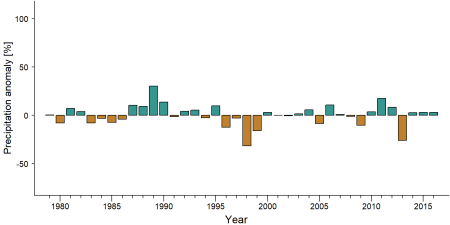
Precipitation anomaly in Sankuru Nature Reserve -
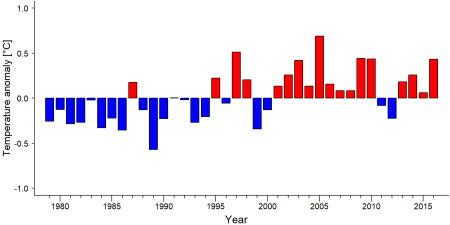
Temperature anomaly in Sankuru Nature Reserve


External links
BCI
L.A.-sized tract of primary forest went up in flames in DRC province in 2020-MONGABAY
Rainforest Reserve Established in DR Congo to save bonobo-MONGABAY 2007
References
Bonobo Conservation Initiative. (2007, November 19). Rainforest reserve established in DR Congo to save bonobo. Mongabay. https://news.mongabay.com/2007/11/rainforest-reserve-established-in-dr-congo-to-save-bonobo/
Future Carbon International LLC. (2022). Sankuru Peace Forest grouped REDD project (Version 1.0; VCS Version 4.1) [Project description]. Future Carbon International.
Nyembo, F., Mertens, B., Cherif, M., & Koné, I. (2020). Menaces d’origine anthropique et habitat de Pan paniscus dans la Réserve Naturelle de Sankuru, en République démocratique du Congo. HAL — Centre pour la communication scientifique ouverte. https://hal.science/hal-03285049/document
Liengola, I., Vosper, A., Maisels, F., Bonyenge, A., & Nkumu, P. (2009). Conserving Bonobos in the Last Unexplored Forest of the Democratic Republic of Congo–the Tshuapa-Lomami-Lualaba Landscape. Unpublished report, Wildlife Conservation Society: New York, USA.
Page created by: APES Atlas Team Date: 2023-02-27