
Fongoli Savanna Chimpanzee Project: Difference between revisions
No edit summary Tag: Reverted |
No edit summary Tag: Manual revert |
||
| Line 62: | Line 62: | ||
|- | |- | ||
|''Pan troglodytes verus'' | |''Pan troglodytes verus'' | ||
| | |2005-2016 | ||
| | |||
| | | | ||
| | | | ||
| | |32 (28-36) | ||
| | |90 km² | ||
|Full count | |||
| | | | ||
|Pruetz | |Pruetz 2018 | ||
| | |Based on data collected on identified individuals | ||
| | | | ||
|- | |- | ||
| Line 88: | Line 88: | ||
|- | |- | ||
|''Pan troglodytes verus'' | |''Pan troglodytes verus'' | ||
| | |2000 | ||
| | | | ||
|49 | |||
|0.09 | |||
| | | | ||
|Fongoli | |||
|Strip transect, Reconnaissance walk | |||
| | | | ||
|Pruetz et al. 2002 | |||
|*note, not traditional line transect estimation , identified as Tomboronkoto in the article. Transects targeted likely chimpanzee locations. Encounter rate (nests/km) 285 nests/5.8 km | |||
|Pruetz | |||
| | |||
| | | | ||
|} | |} | ||
Revision as of 10:45, 1 September 2026
West Africa > Senegal > Fongoli Savanna Chimpanzee Project
Français | Português | Español | Bahasa Indonesia | Melayu
Summary
- Western chimpanzees (Pan troglodytes verus) are present in the Fongoli Savanna Chimpanzee Project (FSCP) area.
- As of 2019, 32 individuals occur in the site.
- The chimpanzee population trend is stable.
- This site has a total size of 90 km².
- Key threats to chimpanzees are artisanal mining, resource competition, and habitat loss.
- This community of chimpanzees has been studied since 2001 and habituated since 2005. They are the only known chimpanzee community to hunt their prey with sharpened sticks. These chimpanzees also evade the heat of their environment by soaking in free-standing water, using caves, and staying active after night fall.

Site characteristics
The Fongoli Savanna Research Project (FSCP) was established by Dr. Jill Pruetz following the identification of a strong local chimpanzee population near to the Gambia River and north of Kedougou, in the Kedougou Region of Southeastern Senegal. The research site is located outside of any formal protected area but the area designated as ‘Zone d'Intérêt Cynégétique Faleme’ (ZIC Faleme), zone within which hunting is strictly regulated. The site overlaps with several villages, and lies in relatively close proximity to the regional capital of Kedougou. The habitat can be described as a savanna-woodland mosaic, located within the vegetation Sudano-Guniean belt (Ba et al. 1997). Fongoli, like the broader region, experiences marked seasonality in climate, with rainfall concentrated to a short wet season and a lengthy dry season. Temperatures during the dry season frequently exceed 40deg C, often exceeding 45C in the months of April and May (Wessling et al. 2018). Other primates living at Fongoli are Guinea baboons (Papio papio), green monkeys (Chlorocebus aethiops), patas monkeys (Erythrocebus patas), and bushbabies (Galago senegalensis). All four sympatric primates are consumed by the chimpanzee research community. In addition to these primates, warthog (Phacochoerus africanus), banded mongoose (Mungos mungo), bushbuck (Tragelaphus scriptus), porcupine (Hystrix cristata), hyena (Crocuta crocuta), leopards (Panthera pardus), and honey badgers (Mellivora capensis) can be found at the site (Lindshield et al. 2019).
Table 1. Basic site information for Fongoli Savanna Chimpanzee Project
| Species | Pan troglodytes verus |
| Area | 90 km² |
| Coordinates | Lat: 12.65 , Lon: -12.20 |
| Type of site | Non-protected area |
| Habitat types | Subtropical/tropical dry forest, Savanna, Agricultural land |
| Type of governance |
Types of sites Governance types Habitat types
Ape status
The Fongoli chimpanzees have been under research since initial surveying in 2001 (Pruetz et al. 2001), and males have been fully-habituated to researcher presence since 2005. The chimpanzee community ranges in size between 28 and 36 individuals. Density estimates for the site have also been formally conducted in 2013 (0.29 indiv./km²), although they underestimated true chimpanzee densities at the time (0.35 indiv / km²; Wessling et al. in review).
Table 2. Ape population estimates reported for Fongoli Savanna Chimpanzee Project
| Species | Year | Occurrence | Encounter or vistation rate (nests/km; ind/day) | Density estimate [ind./ km²] (95% CI) | Abundance estimate (95% CI) | Survey area | Sampling method | Analytical framework | Source | Comments | A.P.E.S. database ID |
|---|---|---|---|---|---|---|---|---|---|---|---|
| Pan troglodytes verus | 2005-2016 | 32 (28-36) | 90 km² | Full count | Pruetz 2018 | Based on data collected on identified individuals | |||||
| Pan troglodytes verus | 2014 | 0.29 | 20 km² | Line transects | Wessling et al. in review | Total survey effort: 20km² | |||||
| Pan troglodytes verus | 2000 | 49 | 0.09 | Fongoli | Strip transect, Reconnaissance walk | Pruetz et al. 2002 | *note, not traditional line transect estimation , identified as Tomboronkoto in the article. Transects targeted likely chimpanzee locations. Encounter rate (nests/km) 285 nests/5.8 km |
Sampling methods Analytical frameworks
Threats
Saba senegalensis is an important food resource for the Fongoli chimpanzees while likewise consistently extracted for sale in local and national markets (Waller and Pruetz 2014). In the last decade Fongoli has become a target of timber extraction, likely due to its proximity to the regional capital and ease of access. Transient pastoral communities pass through Fongoli and cut branches from an assortment of tree species to be used as fodder for their livestock. The Kedougou Region, in which Fongoli is located, has experienced a mining boom since the early 2010s, and temporary to semi-permanent mining camps have been established within the research area, with demonstrated effects on the home range use of the research community (Boyer-Ontl 2017). Poaching is not a consistent threat at the site, however in 2009 a poacher obtained an infant of the research community, which was later returned to the group by researchers (Pruetz and Kante 2010).
Table 3. Threats to apes reported for Fongoli Savanna Chimpanzee Project
| Category | Specific threats | Threat level | Description | Year of threat |
|---|---|---|---|---|
| 11 Climate change & severe weather | 11.3 Temperature extremes | High (more than 70% of population affected) | Naturally high temperature extremes: Pruetz and Bertolani 2009; Wessling et al. 2018 | 2009-Ongoing (2018) |
| 2 Agriculture & aquaculture | 2.1 Annual & perennial non-timber crops | Medium (30-70% of population affected) | Bogart and Pruetz 2012, Pruetz 2006, Pruetz and Bertolani 2009 | 2006-Ongoing (2012) |
| 2 Agriculture & aquaculture | 2.3 Livestock farming & ranching | Medium (30-70% of population affected) | Nomadic grazing (Wessling pers. obs. 2019) | Ongoing (2019) |
| 3 Energy production & mining | 3.2 Mining & quarrying | High (more than 70% of population affected) | Artisanal Gold Mining: Boyer-Ontl 2017; Lindshield et al. 2019 | Ongoing (2019) |
| 5 Biological resource use | 5.1 Hunting & collecting terrestrial animals | Low (up to 30% of population affected) | Pruetz and Kante 2010 | Ongoing (2010) |
| 5 Biological resource use | 5.2 Gathering terrestrial plants | Medium (30-70% of population affected) | Saba Extraction: Waller and Pruetz 2016 | Ongoing (2016) |
| 5 Biological resource use | 5.3 Logging & wood harvesting | Present (unknown severity) | Wood harvesting: Boyer-Ontl 2017 | Ongoing (2017) |
| 7 Natural system modifications | 7.1 Fire & fire suppression | High (more than 70% of population affected) | Pruetz and Herzog 2017; Pruetz and LaDuke 2010 | 2010-Ongoing (2017) |
| 9 Pollution | 9.2 Industrial & military effluents | Medium (30-70% of population affected) | Seepage from mining, known mercury pollution in the immediate region (Gerson et al. 2018) | Ongoing (2018) |
Conservation activities
Since the inception of the research project, a permanent research presence has existed at the Fongoli site since 2001. Local personnel are employed with the project, and sensibilization programmes began at Fongoli and in the region to educate local populations about chimpanzees. Researchers take care to prevent communicable diseases to the apes, including strict minimum distance guidelines, wearing face masks, and requirement of vaccinations and good health to access the site. Neighbor Ape, a non-profit for the conservation of chimpanzees in Senegal, was established by Fongoli Director Dr. Jill Pruetz, and conducts frequent assistance programs to local communities of the immediate and broader Fongoli region. Details on smaller projects are listed here.
Table 4. Conservation activities reported for Fongoli Savanna Chimpanzee Project
| Category | Specific activity | Description | Implementing organization(s) | Year of activity |
|---|---|---|---|---|
| 3 Species health | 3.1 Wear face-masks to avoid transmission of viral and bacterial diseases to primates | Researchers must wear face masks while in the presence of chimpanzees (Pruetz and Kante 2010) | 2012-Ongoing | |
| 3 Species health | 3.10 Treat sick/injured apes | A confiscated 9-months old female was treated for its injured eye before being released back to its natal group (Pruetz and Kante 2010) | 2010 | |
| 3 Species health | 3.14 Reduce garbage/human food waste to avoid ape injuries and disease transmission | Researchers do not leave food waste during research day | 2001-Ongoing | |
| 3 Species health | 3.2 Keep safety distance to habituated apes | Minimum 10m distance between researchers and chimpanzees | 2001-Ongoing | |
| 3 Species health | 3.6 Ensure that researchers/tourists are up-to-date with vaccinations and healthy | Integral to research program | 2001-Ongoing | |
| 4 Education & awareness | 4.2 Involve local community in ape research and conservation management | People hired for research and conservation with the FSCP | Ongoing (2019) | |
| 4 Education & awareness | 4.5 Implement multimedia campaigns using theatre, film, print media, discussions | Sensibilisation programme for several locations throughout Senegal, incl. Fongoli | 2010 | |
| 6 Species management | 6.1 Habituate primates to human presence to reduce stress from tourists/researchers | Chimpanzees were habituated for research | 2001-2005 | |
| 6 Species management | 6.8 Reintroduction of apes (captively-bred or rehabilitated indviduals) | A confiscated 9-months old female was released close to its natal group and the group retrieved it immediately (Pruetz and Kante 2010) | 2010 | |
| 6 Species management | 6.8 Reintroduction of apes (captively-bred or rehabilitated indviduals) | A confiscated 9-months old female was released close to its natal group and the group retrieved it immediately (Pruetz and Kante 2010) | 2010 | |
| 7 Economic & other incentives | 7.1 Provide monetary benefits to local communities for sustainably managing their forest and its wildlife (e.g., REDD, alternative income, employment) | People hired for research and conservation with the FSCP | 2001-Ongoing (2019) | |
| 8 Permanent presence | 8.1 Run research project and ensure permanent human presence at site | Fongoli Savanna Research Project | 2001-Ongoing (2019) |
Challenges
Table 5. Challenges reported for Fongoli Savanna Chimpanzee Project
| Challenges | Specific challenges | Source | Year(s) |
|---|---|---|---|
| Not reported |
Enablers
Table 6. Enablers reported for Fongoli Savanna Chimpanzee Project
| Enablers | Specific enablers | Source | Year(s) |
|---|---|---|---|
| 1 Site management | |||
| 2 Resources and capacity | |||
| 3 Engaged community | |||
| 4 Institutional support | |||
| 5 Ecological context | |||
| 6 Safety and stability |
Research activities
The Fongoli chimpanzees have been under study since 2001 and were fully habituated by 2005. A permanent research presence has existed at the site since the start of the project. A wide range of topics have been studied at the Fongoli site, including aspects related to behavior, culture, feeding ecology, physiology, isotopes, parasite loading, enthoprimatology, and sociality, among many others.
Documented behaviours
Table 7. Behaviours documented for Fongoli Savanna Chimpanzee Project
| Category | Behavior | Observation type | Prevalence | Observation dates | Source | Habituation | Species | Comment |
|---|---|---|---|---|---|---|---|---|
| Ant dipping | Pruetz and Bertolani 2009 | |||||||
| Ant eating | Pruetz and Bertolani 2009 | |||||||
| Cave use | Pruetz 2007 | |||||||
| Lethal intragroup aggression | Pruetz et al. 2017 | |||||||
| Making ground nests | Pruetz et al. 2008 | |||||||
| Nighttime activity | Pruetz 2018 | |||||||
| Pool use | Pruetz and Bertolani 2009 | |||||||
| Termite fishing | McGrew et al. 2005; Bogart and Pruetz 2008, 2012 | |||||||
| Tool assisted hunting | Pruetz and Bertolani 2007; Pruetz et al. 2015 |
Exposure to climate change impacts
As part of a study on the exposure of African great ape sites to climate change impacts, Kiribou et al. subm. extracted climate data and data on projected extreme climate impact events for the site. Climatological characteristics were derived from observation-based climate data provided by the Inter-Sectoral Impact Model Intercomparison Project (ISIMIP, www.isimip.org). Parameters were calculated as the average across each 30-year period. For 1981-2010, the EWEMBI dataset from ISIMIP2a was used. For the two future periods (2021-2050 and 2071-2099) ISIMIP2b climate data based on four CMIP5 global climate models were used. For future projections, two Representative Concentration Pathways (RCP) were used. RCP 2.6 is a scenario with strong mitigation measures in which global temperatures would likely rise below 2C. RCP 6.0 is a scenario with medium emissions in which global temperatures would likely rise up to 3C by 2100. For the number of days with heavy precipitation events, the 98th percentile of all precipitation days (>1mm/d) was calculated for the 1979-2013 reference period as a threshold for a heavy precipitation event. Then, for each year, the number of days above that threshold was derived. The figures on temperature and precipitation anomaly show the deviation from the mean temperature and mean precipitation for the 1979-2013 reference period.
The estimated exposure to future extreme climate impact events (crop failure, drought, river flood, wildfire, tropical cyclone, and heatwave) is based on a published dataset by Lange et al. 2020 derived from ISIMIP2b data. The same global climate models and RCPs as described above were used. Within each 30-year period, the number of years with an extreme event and the average proportion of the site affected were calculated (see Kiribou et al. subm. for details).
Table 8. Estimated past and projected climatological characteristics in Fongoli Savanna Chimpanzee Project
| Value | 1981-2010 | 2021-2050, RCP 2.6 | 2021-2050, RCP 6.0 | 2071-2099, RCP 2.6 | 2071-2099, RCP 6.0 |
|---|---|---|---|---|---|
| Mean temperature [C] | 28.5 | 29.8 | 29.6 | 30 | 31.5 |
| Annual precipitation [mm] | 1082 | 1080 | 1029 | 1043 | 969 |
| Max no. consecutive dry days (per year) | 122.9 | 119 | 123.5 | 122.6 | 125.1 |
| No. days with heavy precipitation (per year) | 2.8 | 3.6 | 3 | 3.7 | 2.9 |
Table 9. Projected exposure of apes to extreme climate impact events in Fongoli Savanna Chimpanzee Project
| Type | No. of years with event (2021-2050, RCP 2.6) | % of site exposed (2021-2050, RCP 2.6) | No. of years with event (2021-2050, RCP 6.0) | % of site exposed (2021-2050, RCP 6.0) | No. of years with event (2070-2099, RCP 2.6) | % of site exposed (2070-2099, RCP 2.6) | No. of years with event (2070-2099, RCP 6.0) | % of site exposed (2070-2099, RCP 6.0) |
|---|---|---|---|---|---|---|---|---|
| Crop failure | 2 | 0.55 | 1 | 0.55 | 2.5 | 0.55 | 6 | 0.55 |
| Drought | 2 | 100 | 1.25 | 75 | 1 | 50 | 1.75 | 50 |
| Heatwave | 0.5 | 50 | 0.5 | 50 | 0.5 | 50 | 0.5 | 50 |
| River flood | 1.25 | 0.11 | 0.5 | 0.04 | 0.75 | 0.03 | 0.5 | 0.04 |
| Tropical cyclone | 0 | 0 | 0 | 0 | 0 | 0 | 0 | 0 |
| Wildfire | 30 | 0.99 | 30 | 0.93 | 29 | 0.95 | 29 | 1.21 |
-
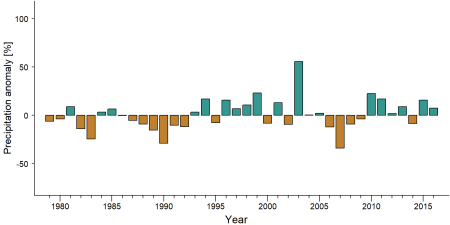
Precipitation anomaly in Fongoli Savanna Chimpanzee Project -
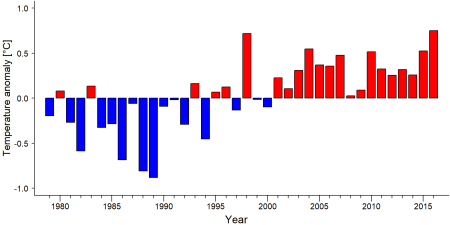
Temperature anomaly in Fongoli Savanna Chimpanzee Project


External links
References
Bogart, S. L., & Pruetz, J. D. (2008). Ecological context of savanna chimpanzee (Pan troglodytes verus) termite fishing at Fongoli, Senegal. American Journal of Primatology: Official Journal of the American Society of Primatologists, 70(6), 605-612. v
Bogart, S. L., & Pruetz, J. D. (2011). Insectivory of savanna chimpanzees (Pan troglodytes verus) at Fongoli, Senegal. American Journal of Physical Anthropology, 145(1), 11-20.
Lindshield, S., Bogart, S. L., Gueye, M., Ndiaye, P. I., & Pruetz, J. D. (2019). Informing Protection Efforts for Critically Endangered Chimpanzees (Pan troglodytes verus) and Sympatric Mammals amidst Rapid Growth of Extractive Industries in Senegal. Folia Primatologica, 90(2), 124-136.
McGrew, W. C., Pruetz, J. D., & Fulton, S. J. (2005). Chimpanzees use tools to harvest social insects at Fongoli, Senegal. Folia Primatologica, 76(4), 222-226.
Ontl, K. M. B. (2017). Chimpanzees in the Island Of Gold: Impacts of artisanal small-scale gold mining on chimpanzees (Pan troglodytes verus) in Fongoli, Senegal.
Pruetz, J. D. (2006). Feeding ecology of savanna chimpanzees (Pan troglodytes verus) at Fongoli, Senegal. Feeding ecology in apes and other primates, 326-364.
Pruetz, J. D. (2007). Evidence of cave use by savanna chimpanzees (Pan troglodytes verus) at Fongoli, Senegal: implications for thermoregulatory behavior. Primates, 48(4), 316-319.
Pruetz, J. D. (2018). Nocturnal behavior by a diurnal ape, the West African chimpanzee (Pan troglodytes verus), in a savanna environment at Fongoli, Senegal. American journal of physical anthropology, 166(3), 541-548.
Pruetz, J. D., & Bertolani, P. (2007). Savanna chimpanzees, Pan troglodytes verus, hunt with tools. Current biology, 17(5), 412-417.
Pruetz, J. D., & Bertolani, P. (2009). Chimpanzee (Pan troglodytes verus) behavioral responses to stresses associated with living in a savanna-mosaic environment: implications for hominin adaptations to open habitats. PaleoAnthropology, 252.
Pruetz, J. D., & Herzog, N. M. (2017). Savanna chimpanzees at Fongoli, Senegal, navigate a fire landscape. Current Anthropology, 58(S16), S337-S350.
Pruetz, J. D., & Kante, D. (2010). Successful return of a wild infant chimpanzee (Pan troglodytes verus) to its natal group after capture by poachers. African Primates, 7(1), 35.
Pruetz, J. D., & LaDuke, T. C. (2010). Brief communication: Reaction to fire by savanna chimpanzees (Pan troglodytes verus) at Fongoli, Senegal: Conceptualization of" fire behavior" and the case for a chimpanzee model. American Journal of Physical Anthropology, 141(4), 646-650.
Pruetz, J. D., Bertolani, P., Ontl, K. B., Lindshield, S., Shelley, M., & Wessling, E. G. (2015). New evidence on the tool-assisted hunting exhibited by chimpanzees (Pan troglodytes verus) in a savannah habitat at Fongoli, Sénégal. Royal Society Open Science, 2(4), 140507.
Pruetz, J. D., Fulton, S. J., Marchant, L. F., McGrew, W. C., Schiel, M., & Waller, M. (2008). Arboreal nesting as anti-predator adaptation by savanna chimpanzees (Pan troglodytes verus) in southeastern Senegal. American Journal of Primatology: Official Journal of the American Society of Primatologists, 70(4), 393-401.
Pruetz, J. D., Marchant, L. F., Arno, J., & McGrew, W. C. (2002). Survey of savanna chimpanzees (Pan troglodytes verus) in southeastern Senegal. American Journal of Primatology: Official Journal of the American Society of Primatologists, 58(1), 35-43.
Waller, M. T., & Pruetz, J. (2016). Competition between chimpanzees and humans: the effects of harvesting non-timber forest products. In Ethnoprimatology (pp. 157-177). Springer, Cham.
Wessling, E. G., Kühl, H. S., Mundry, R., Deschner, T., & Pruetz, J. D. (2018). The costs of living at the edge: Seasonal stress in wild savanna-dwelling chimpanzees. Journal of human evolution, 121, 1-11.
Wessling, E.G., Eshuis, H., Llana, M., Pacheco, L., Pruetz, J.D., & H.S. Kühl. (In Review). Ecological and climatic gradients correlate with decreasing savanna chimpanzee (Pan trodglodytes verus) densities at the range limit. Int J Primatol.
Page created by: APES Atlas Team Date: 2019-11-20