
Chinko Nature Reserve: Difference between revisions
No edit summary |
No edit summary |
||
| Line 279: | Line 279: | ||
= Exposure to climate change impacts = | = Exposure to climate change impacts = | ||
As part of a study on the exposure of African great ape sites to climate change impacts, Kiribou et al. | As part of a study on the exposure of African great ape sites to climate change impacts, Kiribou et al. (2024) extracted climate data and data on projected extreme climate impact events for the site. Climatological characteristics were derived from observation-based climate data provided by the Inter-Sectoral Impact Model Intercomparison Project (ISIMIP, www.isimip.org). Parameters were calculated as the average across each 30-year period. For 1981-2010, the EWEMBI dataset from ISIMIP2a was used. For the two future periods (2021-2050 and 2071-2099) ISIMIP2b climate data based on four CMIP5 global climate models were used. For future projections, two Representative Concentration Pathways (RCP) were used. RCP 2.6 is a scenario with strong mitigation measures in which global temperatures would likely rise below 2C. RCP 6.0 is a scenario with medium emissions in which global temperatures would likely rise up to 3C by 2100. For the number of days with heavy precipitation events, the 98th percentile of all precipitation days (>1mm/d) was calculated for the 1979-2013 reference period as a threshold for a heavy precipitation event. Then, for each year, the number of days above that threshold was derived. The figures on temperature and precipitation anomaly show the deviation from the mean temperature and mean precipitation for the 1979-2013 reference period. | ||
The estimated exposure to future extreme climate impact events (crop failure, drought, river flood, wildfire, tropical cyclone, and heatwave) is based on a published dataset by Lange et al. 2020 derived from ISIMIP2b data. The same global climate models and RCPs as described above were used. Within each 30-year period, the number of years with an extreme event and the average proportion of the site affected were calculated ( | The estimated exposure to future extreme climate impact events (crop failure, drought, river flood, wildfire, tropical cyclone, and heatwave) is based on a published dataset by Lange et al. 2020 derived from ISIMIP2b data. The same global climate models and RCPs as described above were used. Within each 30-year period, the number of years with an extreme event and the average proportion of the site affected were calculated (Kiribou et al. 2024). | ||
'''Table 8. Estimated past and projected climatological characteristics in Chinko Nature Reserve''' | '''Table 8. Estimated past and projected climatological characteristics in Chinko Nature Reserve''' | ||
Revision as of 08:13, 3 September 2026
Central Africa > Central African Republic > Chinko Nature Reserve
Français | Português | Español | Bahasa Indonesia | Melayu
Summary
- Eastern chimpanzees (Pan troglodytes schweinfurthii) are present in Chinko Nature Reserve.
- It has been estimated that 907 (CI: 538-1,534) individuals occur in the site.
- The chimpanzee population trend is unknown.
- The site has a total size of 24,387 km².
- Key threats to chimpanzees are bushmeat hunting and cattle herding.
- Conservation activities have focused on law enforcement and supporting the local communities by providing employment and salary contributions, habitat restoration, awareness raising and education.
Site characteristics
Chinko is located in the Chinko-Mbari drainage basin, in eastern Central African Republic. The area comprises a mosaic of Medio-Sudanian and Sudano-Guinean savanna with some patches of Congolian lowland rainforest. This diversity of ecosystems makes the site remarkably rich and unique in biodiversity. More than 400 bird species have been recorded at the site. Chinko is also home to more than 10 primate species, four ant-eating mammals, forest and savanna elephants, 21 carnivores including the African wild dog, lion and mongooses, and large antelopes, notably the giant eland and bongo (USAID 2019). In 2017, ethnic violence in the country resulted in a humanitarian crisis, which forced more than 300 people into the reserve, where they were protected and assisted by the reserve's rangers and management (African Parks).
Table 1. Basic site information for Chinko Nature Reserve
| Species | Pan troglodytes schweinfurthii |
| Area | 24,387 km² |
| Coordinates | Lat: 6.021974 , Lon: 24.077838 |
| Type of site | Protected area (Nature Reserve) |
| Habitat types | Savanna, Subtropical/tropical moist lowland forest |
| Type of governance | Shared governance |
Types of sites Governance types Habitat types
Ape status
Table 2. Ape population estimates reported for Chinko Nature Reserve
| Species | Year | Occurrence | Encounter or vistation rate (nests/km; ind/day) | Density estimate [ind./ km²] (95% CI) | Abundance estimate (95% CI) | Survey area | Sampling method | Analytical framework | Source | Comments | A.P.E.S. database ID |
|---|---|---|---|---|---|---|---|---|---|---|---|
| Pan troglodytes schweinfurthii | 2012-2016 | 907 (538-1,534) | Chinko Nature Reserve | Camera trap, Line transects, Genetic (dung/hair) | Aebischer et al. 2017 |
Sampling methods Analytical frameworks
Threats
Table 3. Threats to apes reported for Chinko Nature Reserve
| Category | Specific threats | Threat level | Description | Year of threat |
|---|---|---|---|---|
| 2 Agriculture & aquaculture | 2.3 Livestock farming & ranching | High (more than 70% of population affected) | Chinko’s recent 2023 aerial survey of cattle around the site revealed 35,000 cattle and over 650 nomadic tents (African Parks 2023, Reitz 2022). | 2013-Ongoing (2023) |
| 5 Biological resource use | 5.1 Hunting & collecting terrestrial animals | High (more than 70% of population affected) | Professional poaching and bushmeat hunting by local populations (African Parks, USAID 2019, Reitz 2022). | 2013-Ongoing (2022) |
Conservation activities
African Parks was awarded the mandate to manage Chinko in 2014, for 50 years. Since then, Chinko has provided employment to hundreds of people in the region, fueling a conservation-led economy. A core protection zone of 6,000 sq. km, free of threats, has seen the return of wildlife at the site. Wildlife surveys have documented more than 1,000 chimpanzees, at least 60 elephants, more than 3,000 West African buffalo, and over 600 Lord Derby’s eland have been documented. Over 75 African wild dogs and 30 Northern lions also inhabit the reserve (African Parks).
Table 4. Conservation activities reported for Chinko Nature Reserve
| Category | Specific activity | Description | Implementing organization(s) | Year of activity |
|---|---|---|---|---|
| 1 Development impact mitigation | 1.3 Prohibit (livestock) farmers from entering protected areas | Chinko recruited, trained and deployed 45 Transhumance Sensitization Officers to monitor and educate transhumant herders coming into reserve, which is a major threat in the area. These Officers guide herders towards designated corridors to avoid sensitive wildlife habitats (African Parks). | African Parks | Ongoing (2018) |
| 2 Counter-wildlife crime | 2.3 Conduct regular anti-poaching patrols | African Parks established Chinko’s first law enforcement unit, currently comprising over 60 rangers, who conduct patrols (African Parks). | African Parks | Ongoing (2017) |
| 4 Education & awareness | 4.1 Educate local communities about apes and sustainable use | Local communities are educated on the great apes and their conservation (Conservation Manager AP-RCA pers. comm. 2025). | African Parks | Ongoing (2025) |
| 5 Protection & restoration | 5.2 Legally protect ape habitat | Designated as a protected area in 2014. | African Parks | 2014-Ongoing (2026) |
| 5 Protection & restoration | 5.6 Habitat restoration | Forest rehabilitation and protection activities are reported (Conservation Manager AP-RCA pers. comm. 2025). | African Parks | Ongoing (2025) |
| 7 Economic & other incentives | 7.1 Provide monetary benefits to local communities for sustainably managing their forest and its wildlife (e.g., REDD, alternative income, employment) | Salaries for school teachers, doctors and nurses are being provided. In 2019 Chinko financially supported 58 farmers and 27 soap makers (the majority of whom are women), and refurbished a local market as well as a vehicle ferry, to support the local economy. Forty-five schoolteachers and three medical staff from the local communities were provided with salary contributions and additional training (African Parks). | African Parks | Ongoing (2025) |
| 7 Economic & other incentives | 7.2 Provide non-monetary benefits to local communities for sustainably managing their forest and its wildlife (e.g., better education, infrastructure development) | Community members receive foundational education and practical life training (Conservation Manager AP-RCA pers. comm. 2025). | African Parks | Ongoing (2025) |
Challenges
Table 5. Challenges reported for Chinko Nature Reserve
| Challenges | Specific challenges | Source | Year(s) |
|---|---|---|---|
| Not reported |
Enablers
Table 6. Enablers reported for Chinko Nature Reserve
| Enablers | Specific enablers | Source | Year(s) |
|---|---|---|---|
| 2 Resources and capacity | 2.1 Sufficient staff | Conservation Manager AP-RCA pers. comm. 2025 | Ongoing (2025) |
| 2 Resources and capacity | 2.2 Sufficient funding | Conservation Manager AP-RCA pers. comm. 2025 | Ongoing (2025) |
| 2 Resources and capacity | 2.3 Continuous/long-term funding | Conservation Manager AP-RCA pers. comm. 2025 | Ongoing (2025) |
| 2 Resources and capacity | 2.6 External partnerships that add expertise or resources | Conservation Manager AP-RCA pers. comm. 2025 | Ongoing (2025) |
| 1 Site management | |||
| 3 Engaged community | |||
| 4 Institutional support | |||
| 5 Ecological context | |||
| 6 Safety and stability |
Research activities
Wildlife Poaching and Trafficking Prevalent Across Central Africa’s Garamba-Bili-Chinko Landscape
Documented behaviours
Table 7. Behaviours documented for Chinko Nature Reserve
| Category | Behavior | Observation type | Prevalence | Observation dates | Source | Habituation | Species | Comment |
|---|---|---|---|---|---|---|---|---|
| Not reported |
Exposure to climate change impacts
As part of a study on the exposure of African great ape sites to climate change impacts, Kiribou et al. (2024) extracted climate data and data on projected extreme climate impact events for the site. Climatological characteristics were derived from observation-based climate data provided by the Inter-Sectoral Impact Model Intercomparison Project (ISIMIP, www.isimip.org). Parameters were calculated as the average across each 30-year period. For 1981-2010, the EWEMBI dataset from ISIMIP2a was used. For the two future periods (2021-2050 and 2071-2099) ISIMIP2b climate data based on four CMIP5 global climate models were used. For future projections, two Representative Concentration Pathways (RCP) were used. RCP 2.6 is a scenario with strong mitigation measures in which global temperatures would likely rise below 2C. RCP 6.0 is a scenario with medium emissions in which global temperatures would likely rise up to 3C by 2100. For the number of days with heavy precipitation events, the 98th percentile of all precipitation days (>1mm/d) was calculated for the 1979-2013 reference period as a threshold for a heavy precipitation event. Then, for each year, the number of days above that threshold was derived. The figures on temperature and precipitation anomaly show the deviation from the mean temperature and mean precipitation for the 1979-2013 reference period.
The estimated exposure to future extreme climate impact events (crop failure, drought, river flood, wildfire, tropical cyclone, and heatwave) is based on a published dataset by Lange et al. 2020 derived from ISIMIP2b data. The same global climate models and RCPs as described above were used. Within each 30-year period, the number of years with an extreme event and the average proportion of the site affected were calculated (Kiribou et al. 2024).
Table 8. Estimated past and projected climatological characteristics in Chinko Nature Reserve
| Value | 1981-2010 | 2021-2050, RCP 2.6 | 2021-2050, RCP 6.0 | 2071-2099, RCP 2.6 | 2071-2099, RCP 6.0 |
|---|---|---|---|---|---|
| Mean temperature [C] | 24.5 | 25.7 | 25.5 | 25.9 | 27 |
| Annual precipitation [mm] | 1909 | 1982 | 2013 | 2024 | 2083 |
| Max no. consecutive dry days (per year) | 42.5 | 45.1 | 43.7 | 45.3 | 47.6 |
| No. days with heavy precipitation (per year) | 5.8 | 8.1 | 9.6 | 9.1 | 10 |
Table 9. Projected exposure of apes to extreme climate impact events in Chinko Nature Reserve
| Type | No. of years with event (2021-2050, RCP 2.6) | % of site exposed (2021-2050, RCP 2.6) | No. of years with event (2021-2050, RCP 6.0) | % of site exposed (2021-2050, RCP 6.0) | No. of years with event (2070-2099, RCP 2.6) | % of site exposed (2070-2099, RCP 2.6) | No. of years with event (2070-2099, RCP 6.0) | % of site exposed (2070-2099, RCP 6.0) |
|---|---|---|---|---|---|---|---|---|
| Crop failure | 11.5 | 0.12 | 7.5 | 0.09 | 13 | 0.14 | 18 | 0.15 |
| Drought | 0 | 0 | 0 | 0 | 0 | 0 | 0 | 0 |
| Heatwave | 1.5 | 44.44 | 2.5 | 44.44 | 1.5 | 49.4 | 6 | 44.79 |
| River flood | 1.75 | 0.18 | 1 | 0.11 | 1.75 | 1.33 | 2.25 | 0.62 |
| Tropical cyclone | 0 | 0 | 0 | 0 | 0 | 0 | 0 | 0 |
| Wildfire | 30 | 0.78 | 30 | 0.76 | 29 | 0.77 | 29 | 0.78 |
-
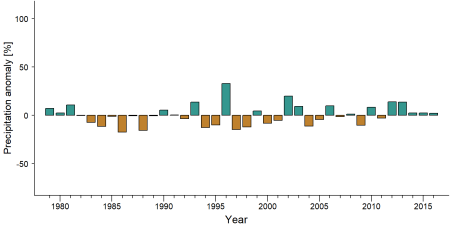
Precipitation anomaly in Chinko Nature Reserve -
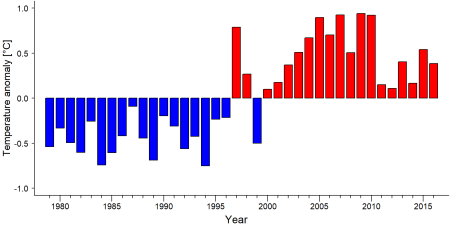
Temperature anomaly in Chinko Nature Reserve


External links
African Parks Chinko Nature Reserve
References
Aebischer, T., Siguindo, G., Rochat, E., Arandjelovic, M., Heilman, A., Hickisch, R., Vigilant, L., Joost, S., & Wegmann, D. (2017). First quantitative survey delineates the distribution of chimpanzees in the Eastern Central African Republic. Biological Conservation, 213, 84–94. https://doi.org/10.1016/j.biocon.2017.06.031
USAID. (2019). Garamba Chinko Landscape fact sheet. https://www.usaid.gov/documents/1860/garamba-chinko-fact-sheet
Page created by: APES Atlas Team Date: 2020-12-29
Page updated by: Conservation Manager of the Chinko Conservation Area AP-RCA. Date: 2025-09-08