
Luki Biosphere Reserve: Difference between revisions
No edit summary |
No edit summary |
||
| Line 274: | Line 274: | ||
= Exposure to climate change impacts = | = Exposure to climate change impacts = | ||
As part of a study on the exposure of African great ape sites to climate change impacts, Kiribou et al. | As part of a study on the exposure of African great ape sites to climate change impacts, Kiribou et al. (2024) extracted climate data and data on projected extreme climate impact events for the site. Climatological characteristics were derived from observation-based climate data provided by the Inter-Sectoral Impact Model Intercomparison Project (ISIMIP, www.isimip.org). Parameters were calculated as the average across each 30-year period. For 1981-2010, the EWEMBI dataset from ISIMIP2a was used. For the two future periods (2021-2050 and 2071-2099) ISIMIP2b climate data based on four CMIP5 global climate models were used. For future projections, two Representative Concentration Pathways (RCP) were used. RCP 2.6 is a scenario with strong mitigation measures in which global temperatures would likely rise below 2C. RCP 6.0 is a scenario with medium emissions in which global temperatures would likely rise up to 3C by 2100. For the number of days with heavy precipitation events, the 98th percentile of all precipitation days (>1mm/d) was calculated for the 1979-2013 reference period as a threshold for a heavy precipitation event. Then, for each year, the number of days above that threshold was derived. The figures on temperature and precipitation anomaly show the deviation from the mean temperature and mean precipitation for the 1979-2013 reference period. | ||
The estimated exposure to future extreme climate impact events (crop failure, drought, river flood, wildfire, tropical cyclone, and heatwave) is based on a published dataset by Lange et al. 2020 derived from ISIMIP2b data. The same global climate models and RCPs as described above were used. Within each 30-year period, the number of years with an extreme event and the average proportion of the site affected were calculated ( | The estimated exposure to future extreme climate impact events (crop failure, drought, river flood, wildfire, tropical cyclone, and heatwave) is based on a published dataset by Lange et al. 2020 derived from ISIMIP2b data. The same global climate models and RCPs as described above were used. Within each 30-year period, the number of years with an extreme event and the average proportion of the site affected were calculated (Kiribou et al. 2024). | ||
'''Table 8. Estimated past and projected climatological characteristics in Luki Biosphere Reserve''' | '''Table 8. Estimated past and projected climatological characteristics in Luki Biosphere Reserve''' | ||
Revision as of 08:17, 3 September 2026
Central Africa > Democratic Republic of the Congo > Luki Biosphere Reserve
Français | Português | Español | Bahasa Indonesia | Melayu
Summary
- Central chimpanzees (Pan troglodytes troglodytes) are present in Luki Biosphere Reserve.
- The population size is unknown.
- The population trend is unknown.
Site characteristics
The Luki Biosphere Reserve is home to 26 animal species, 17 of which are considered flagship species for the Congo Basin Ecoregion and are protected under Congolese law. Key species include various duikers such as the black-banded duiker (Cephalophus dorsalis), black-fronted duiker (Cephalophus nigrifons), and blue duiker (Cephalophus monticola). Other notable mammals include the harnessed bushbuck (Tragelaphus scriptus), red-legged squirrel (Funisciurus pyrrhopus leonis), large Stanger's squirrel (Protoxerus stangeri), African brush-tailed porcupine (Atherurus africanus), giant Emin's rat (Cricetomys eminii), and the aulacode (Thryonomys swinderianus). Carnivores and unique species include the long-tailed mongoose (Herpestes naso), long-tailed pangolin (Manis tetradactyla), and Bosman's potto (Perodicticus potto). Among primates, the chimpanzee (Pan troglodytes verus) is particularly significant. Bird species such as the blue turaco (Corythaeola cristata), African palm civet (Nandinia binotata), whistling hornbill (Bycanistes fistulator), crested kingfisher (Alcedo cristata), and pygmy kingfisher (Ceyx pictus) also inhabit the reserve (ERAIFT n.d.).
Table 1. Basic site information for Luki Biosphere Reserve
| Species | Pan troglodytes troglodytes |
| Area | 32 km² |
| Coordinates | Lat: -5.707967 , Lon: 13.201186 |
| Type of site | Protected area (Nature Reserve) |
| Habitat types | Subtropical/tropical dry forest |
| Type of governance | Shared governance |
Types of sites Governance types Habitat types
Ape status
Table 2. Ape population estimates reported for Luki Biosphere Reserve
| Species | Year | Occurrence | Encounter or vistation rate (nests/km; ind/day) | Density estimate [ind./ km²] (95% CI) | Abundance estimate (95% CI) | Survey area | Sampling method | Analytical framework | Source | Comments | A.P.E.S. database ID |
|---|---|---|---|---|---|---|---|---|---|---|---|
| Pan troglodytes troglodytes | 2021 | Present | Core area of the Biosphere Reserve | Camera trap | Djami et al. 2021 | Chimpanzees were captured on camera. |
Sampling methods Analytical frameworks
Threats
Table 3. Threats to apes reported for Luki Biosphere Reserve
| Category | Specific threats | Threat level | Description | Year of threat |
|---|---|---|---|---|
| 5 Biological resource use | 5.1 Hunting & collecting terrestrial animals | High (more than 70% of population affected) | Commercial and subsistence hunting is one of the main activities carried out by the local population (Nyange 2014; Ngabinzeke & Tongo 2019) and extends into the core zone of the reserve, which is in principle strictly off-limits to human activity (Djami et al. 2023). | 2014-Ongoing (2023) |
| 5 Biological resource use | 5.3 Logging & wood harvesting | Medium (30-70% of population affected) | A briefing highlights the rapid deforestation driven by the charcoal trade, illegal logging, and the bushmeat trade, which fuels large-scale poaching (Kabemba 2024). Data from the Global Forest Watch indicates that the Luki Biosphere Reserve has lost 42% of its forest cover between 2001 and 2022, amounting to over 2,434 hectares. The peak of this deforestation occurred in 2014 (Kabemba 2024). | 2001-Ongoing (2024) |
| 7 Natural system modifications | 7.1 Fire & fire suppression | Low (up to 30% of population affected) | The vicinities of the reserve are dominated by savannas, which are regularly set on fire by local populations (Cizungu et al. 2021). Totally, 4,602 fires were recorded in and around the site from 2001 to 2019 (Cizungu et al. 2021). | 2001-Ongoing (2021) |
Conservation activities
Table 4. Conservation activities reported for Luki Biosphere Reserve
| Category | Specific activity | Description | Implementing organization(s) | Year of activity |
|---|---|---|---|---|
| 2 Counter-wildlife crime | 2.3 Conduct regular anti-poaching patrols | Includes tracking of animal populations and implementing measures to prevent poaching, particularly of protected species (Nyange 2014). | WWF-DRC, INERA, local authorities | Ongoing (2004) |
| 4 Education & awareness | 4.1 Educate local communities about apes and sustainable use | Educate local communities and students about biodiversity conservation, reforestation, and sustainable resource use through workshops, school programs, and community outreach (ERAIFT n.d.). | ERAIFT, WWF-DRC | Ongoing (2019) |
| 4 Education & awareness | 4.2 Involve local community in ape research and conservation management | The Luki Biosphere Reserve is managed by a Steering Committee comprising INERA (Ministry of Scientific Research and Technological Innovation), the MAB program (MEDD), representatives of traditional chiefs, the provincial administration, and local civil society (ERAIFT n.d.). | Ongoing (2019) | |
| 5 Protection & restoration | 5.2 Legally protect ape habitat | Officially designated as a UNESCO Biosphere Reserve in 1979. Prior to this, it was established as a forest research station in 1937. | 1979-Ongoing (2026) | |
| 7 Economic & other incentives | 7.1 Provide monetary benefits to local communities for sustainably managing their forest and its wildlife (e.g., REDD, alternative income, employment) | The LUKI REDD + project implemented from 2013 - 2016 in the framework of the Reduction of Emissions due to Deforestation and Forest Degradation, financed by the Congo Basin Forest Fund and supervised by the African Development Bank. | 2013-2016 | |
| 7 Economic & other incentives | 7.2 Provide non-monetary benefits to local communities for sustainably managing their forest and its wildlife (e.g., better education, infrastructure development) | Promote sustainable agricultural practices, reforestation, and income-generating alternatives to reduce dependency on forest exploitation (IUCN 2013; [https://www.wwfdrc.org/en/?25602/The-saving-of-the-Luki-Biosphere-Reserve-with-WWF-support WWF n.d.) | ERAIFT (RDC), Gembloux Agro-Bio Tech ULiège (Belgique), Institut National pour l’Étude et la Recherche Agronomiques (INERA) -RDC, WWF-DRC | 2004-2018 |
| 8 Permanent presence | 8.1 Run research project and ensure permanent human presence at site | In synergy with WWF, ERAIFT is enhancing research infrastructure—including a library, laboratories, and herbarium—while ensuring free access to Congolese and international researchers, and conducting studies in the Luki Biosphere Reserve on land tenure systems, non-timber forest products, forest regeneration, biodiversity (including chimpanzees), agroecological practices, bushfire monitoring, and forest carbon, with all findings made available to benefit local communities (ERAIFT n.d.). | Ongoing (2019) | |
| 8 Permanent presence | 8.2 Run tourist projects and ensure permanent human presence at site | This initiative focuses on expanding and enhancing the ecotourism offerings of the reserve. In collaboration with WWF, ERAIFT trains ecotourism guides, identifies and maps the area's ecotourism potential, enhances visitor facilities, and helps tailor ecotourism activities to improve the overall experience (ERAIFT n.d.). | Ongoing (2019) |
Challenges
Table 5. Challenges reported for Luki Biosphere Reserve
| Challenges | Specific challenges | Source | Year(s) |
|---|---|---|---|
| 1 Site management | 1.2 Need for improved coordination | ERAIFT | Ongoing (2014) |
| 2 Resources and capacity | 2.1 Lack of capacity/training | Nyange 2014 | Ongoing (2014) |
| 2 Resources and capacity | 2.2 Lack of staff | Nyange 2014 | Ongoing (2014) |
| 4 Institutional support | 4.1 Lack of law enforcement | Nyange 2014 | Ongoing (2014) |
| Other (The lack of a legal and institutional framework for management) | Nyange 2014 | 2001-2014 |
Enablers
Table 6. Enablers reported for Luki Biosphere Reserve
| Enablers | Specific enablers | Source | Year(s) |
|---|---|---|---|
| 2 Resources and capacity | 2.6 External partnerships that add expertise or resources | ERAIFT | Unknown |
| 4 Institutional support | 4.2 Strong government support | ERAIFT | Unknown |
Research activities
Research is conducted in the reserve in the follwing areas: climate change and biodiversity studies are conducted by ERAIFT and research partners since 2010 (ERAIFT), and Ecosystem Services Valuation (ERAIFT, INERA, University of Liège) since 2010.
Documented behaviours
Table 7. Behaviours documented for Luki Biosphere Reserve
| Category | Behavior | Observation type | Prevalence | Observation dates | Source | Habituation | Species | Comment |
|---|---|---|---|---|---|---|---|---|
| Not reported |
Exposure to climate change impacts
As part of a study on the exposure of African great ape sites to climate change impacts, Kiribou et al. (2024) extracted climate data and data on projected extreme climate impact events for the site. Climatological characteristics were derived from observation-based climate data provided by the Inter-Sectoral Impact Model Intercomparison Project (ISIMIP, www.isimip.org). Parameters were calculated as the average across each 30-year period. For 1981-2010, the EWEMBI dataset from ISIMIP2a was used. For the two future periods (2021-2050 and 2071-2099) ISIMIP2b climate data based on four CMIP5 global climate models were used. For future projections, two Representative Concentration Pathways (RCP) were used. RCP 2.6 is a scenario with strong mitigation measures in which global temperatures would likely rise below 2C. RCP 6.0 is a scenario with medium emissions in which global temperatures would likely rise up to 3C by 2100. For the number of days with heavy precipitation events, the 98th percentile of all precipitation days (>1mm/d) was calculated for the 1979-2013 reference period as a threshold for a heavy precipitation event. Then, for each year, the number of days above that threshold was derived. The figures on temperature and precipitation anomaly show the deviation from the mean temperature and mean precipitation for the 1979-2013 reference period.
The estimated exposure to future extreme climate impact events (crop failure, drought, river flood, wildfire, tropical cyclone, and heatwave) is based on a published dataset by Lange et al. 2020 derived from ISIMIP2b data. The same global climate models and RCPs as described above were used. Within each 30-year period, the number of years with an extreme event and the average proportion of the site affected were calculated (Kiribou et al. 2024).
Table 8. Estimated past and projected climatological characteristics in Luki Biosphere Reserve
| Value | 1981-2010 | 2021-2050, RCP 2.6 | 2021-2050, RCP 6.0 | 2071-2099, RCP 2.6 | 2071-2099, RCP 6.0 |
|---|---|---|---|---|---|
| Mean temperature [C] | 24.8 | 25.8 | 25.7 | 26 | 27 |
| Annual precipitation [mm] | 1098 | 1121 | 1105 | 1126 | 1138 |
| Max no. consecutive dry days (per year) | 82.8 | 69.4 | 69.2 | 72.9 | 70.1 |
| No. days with heavy precipitation (per year) | 4.5 | 5.5 | 5.8 | 5.8 | 7.2 |
Table 9. Projected exposure of apes to extreme climate impact events in Luki Biosphere Reserve
| Type | No. of years with event (2021-2050, RCP 2.6) | % of site exposed (2021-2050, RCP 2.6) | No. of years with event (2021-2050, RCP 6.0) | % of site exposed (2021-2050, RCP 6.0) | No. of years with event (2070-2099, RCP 2.6) | % of site exposed (2070-2099, RCP 2.6) | No. of years with event (2070-2099, RCP 6.0) | % of site exposed (2070-2099, RCP 6.0) |
|---|---|---|---|---|---|---|---|---|
| Crop failure | 12 | 0.06 | 9 | 0.05 | 11 | 0.02 | 23.5 | 0.06 |
| Drought | 0 | 0 | 0.25 | 25 | 0 | 0 | 0 | 0 |
| Heatwave | 6.5 | 100 | 3.5 | 100 | 7 | 100 | 8 | 100 |
| River flood | 1.25 | 0 | 2.5 | 0.02 | 1.5 | 0.02 | 2.75 | 6.04 |
| Tropical cyclone | 0.5 | 0.17 | 0 | 0 | 0 | 0 | 1 | 8.47 |
| Wildfire | 30 | 0.6 | 30 | 0.6 | 29 | 0.61 | 29 | 0.59 |
-
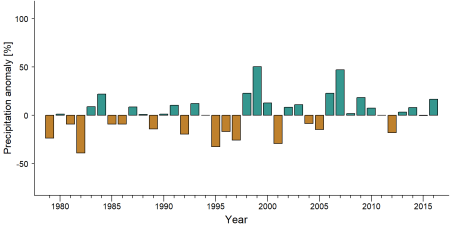
Precipitation anomaly in Luki Biosphere Reserve -
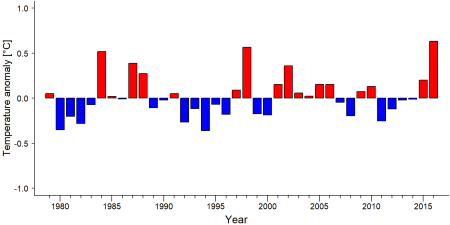
Temperature anomaly in Luki Biosphere Reserve


External links
References
Cizungu, N. C., Tshibasu, E., Lutete, E., Mushagalusa, C. A., Mugumaarhahama, Y., Ganza, D., ... & Bogaert, J. (2021). Fire risk assessment, spatiotemporal clustering and hotspot analysis in the Luki Biosphere Reserve region, western DR Congo. Trees, Forests and People, 5, 100104.
Djami, Y. K., Fonteyn, D., Ngabinzeke, J. S., Meeys, M. N., Poulain, F., Tipi, E. L., & Vermeulen, C. (2023). État des populations des mammifères terrestres dans la Réserve de Biosphère de Luki (République démocratique du Congo).
ERAIFT. (n.d.). Réserve de biosphère de Luki. Retrieved November 27, 2024, from https://www.eraift-rdc.org/en/recherche/reserve-de-biosphere-de-luki
International Union for Conservation of Nature (IUCN). (2013). Mayombe Forest Transboundary Protected Area – Strategic Plan (5 years). https://portals.iucn.org/library/sites/library/files/documents/2013-029-En.pdf
Kabemba, S.-G. (2024, August). La disparition de la réserve de biosphère de Luki en RDC: Une menace pour les chimpanzés à face blanche. Retrieved November 26, 2024, from https://fr.mongabay.com/2024/08/la-disparition-de-la-reserve-de-biosphere-de-luki-en-rdc-une-menace-pour-les-chimpanzes-a-face-blanche/
Nyange, N. M. (2014). Participation des communautés locales et gestion durable des forêts: Cas de la réserve de la biosphère de Luki en République Démocratique du Congo.
WWF DRC. (n.d.). The saving of the Luki Biosphere Reserve with WWF support. https://www.wwfdrc.org/en/?25602/The-saving-of-the-Luki-Biosphere-Reserve-with-WWF-support
Page created by: Tene Sop Date: 2024-11-25 14:37:00
Page updated by: Isa Ordaz-Nemeth Date: 2025-04-16