
Bafing Faunal Reserve: Difference between revisions
No edit summary |
No edit summary |
||
| Line 17: | Line 17: | ||
= Site characteristics = | = Site characteristics = | ||
Bafing Faunal Reserve is situated in southern Mali. The current status of the site is not known. This site is 5000 km² (World Database on Protected Areas 2019). Woodlands dominate most of the landscape. During his survey of south-western Mali, Moore (1985) regularly observed buffalo ''Syncerus caffer'', roan '' Hippotragus equinus'', hartebeest '' Alcelaphus buselaphus'', and warthog '' Phacochoerus africanus''. Sayer (1977) encountered giant eland ''Tragelaphus derbianus'' and giraffe ''Giraffa camelopardalis'' in this area. Lion ''Panthera leo'', leopard ''Panthera pardus'', and African wild dog ''Lycaon pictus'' also probably occur at very low densities (Moore 1985). The current state of biodiversity is not known. Although this is the hottest and driest place in which western chimpanzees are known to exist (Kortlandt 1983), chimpanzees at this site do not seem to be restricted to riverine forest, but are spread widely through the woodland (Moore 1985). | Bafing Faunal Reserve is situated in southern Mali. The current status of the site is not known. This site is 5000 km² (World Database on Protected Areas 2019). Woodlands dominate most of the landscape. During his survey of south-western Mali, [[#R00058|Moore (1985)]] regularly observed buffalo ''Syncerus caffer'', roan '' Hippotragus equinus'', hartebeest '' Alcelaphus buselaphus'', and warthog '' Phacochoerus africanus''. [[#R00059|Sayer (1977)]] encountered giant eland ''Tragelaphus derbianus'' and giraffe ''Giraffa camelopardalis'' in this area. Lion ''Panthera leo'', leopard ''Panthera pardus'', and African wild dog ''Lycaon pictus'' also probably occur at very low densities ([[#R00058|Moore 1985]]). The current state of biodiversity is not known. Although this is the hottest and driest place in which western chimpanzees are known to exist ([[#R00056|Kortlandt 1983]]), chimpanzees at this site do not seem to be restricted to riverine forest, but are spread widely through the woodland ([[#R00058|Moore 1985]]). | ||
'''Table 1. Basic site information for Bafing Faunal Reserve''' | '''Table 1. Basic site information for Bafing Faunal Reserve''' | ||
| Line 44: | Line 44: | ||
= Ape status = | = Ape status = | ||
In the 1970’s and 80’s, surveys conducted from vehicles or on foot confirmed chimpanzee presence in this area and estimated chimpanzee density at 0.08 chimpanzees per km2, resulting in a population of several hundred chimpanzees for the site (Sayer 1977, Moore 1985). More recent surveys by Pavy (1993) and Granier and Martinez (2004) estimated chimpanzee density at 0.27 and 0.35-0.4, respectively, yielding a population closer to, or above 1,000 individuals. | In the 1970’s and 80’s, surveys conducted from vehicles or on foot confirmed chimpanzee presence in this area and estimated chimpanzee density at 0.08 chimpanzees per km2, resulting in a population of several hundred chimpanzees for the site ([[#R00059|Sayer 1977]], [[#R00058|Moore 1985]]). More recent surveys by Pavy (1993) and [[#R00053|Granier and Martinez (2004)]] estimated chimpanzee density at 0.27 and 0.35-0.4, respectively, yielding a population closer to, or above 1,000 individuals. | ||
'''Table 2. Ape population estimates reported for Bafing Faunal Reserve''' | '''Table 2. Ape population estimates reported for Bafing Faunal Reserve''' | ||
| Line 70: | Line 70: | ||
|Reconnaissance walk | |Reconnaissance walk | ||
| | | | ||
|Duvall 2008 | |[[#R00052|Duvall 2008]] | ||
|Duvall (2008) walked loops of 62 km twice weekly for several months, encountered chimpanzee groups directly (48) or indirectly (224) on 272 occasions (Duvall 2008) | |Duvall (2008) walked loops of 62 km twice weekly for several months, encountered chimpanzee groups directly (48) or indirectly (224) on 272 occasions (Duvall 2008) | ||
| | | | ||
| Line 83: | Line 83: | ||
|Line transects | |Line transects | ||
| | | | ||
|Granier & Martinez 2004 | |[[#R00053|Granier & Martinez 2004]] | ||
|Survey effort: 29 km on 18 line transects; 190 nests observed | |Survey effort: 29 km on 18 line transects; 190 nests observed | ||
| | |MLI0001, MLI0004 | ||
|- | |- | ||
|''Pan troglodytes verus'' | |''Pan troglodytes verus'' | ||
| Line 96: | Line 96: | ||
|Informed guess | |Informed guess | ||
| | | | ||
|Pavy 1993, in Kormos et al. 2003 | |Pavy 1993, in [[#R00055|Kormos et al. 2003]] | ||
|Results of a “nest survey” were extrapolated to probable chimpanzee habitat | |Results of a “nest survey” were extrapolated to probable chimpanzee habitat | ||
| | | | ||
| Line 109: | Line 109: | ||
|Reconnaissance walk | |Reconnaissance walk | ||
| | | | ||
|Moore 1985 | |[[#R00058|Moore 1985]] | ||
|Survey effort road: 650 km; survey effort foot: 100 km; extrapolation based on similar habitat types | |Survey effort road: 650 km; survey effort foot: 100 km; extrapolation based on similar habitat types | ||
| | | | ||
| Line 122: | Line 122: | ||
|Reconnaissance walk | |Reconnaissance walk | ||
| | | | ||
|Sayer 1977 | |[[#R00059|Sayer 1977]] | ||
|Reconnaissance walk | |Reconnaissance walk | ||
| | | | ||
| Line 131: | Line 131: | ||
= Threats = | = Threats = | ||
Populations of several other species of large wild animals in Mali have declined drastically (Sayer 1977, Moore 1985), and it therefore seems probable that Mali’s chimpanzee population has also declined, although there is | Populations of several other species of large wild animals in Mali have declined drastically ([[#R00059|Sayer 1977]], [[#R00058|Moore 1985]]), and it therefore seems probable that Mali’s chimpanzee population has also declined, although there is | ||
no information on demographic trends to prove this (Kormos et al. 2003). The main causes of this population decline are hunting and agricultural expansion (Kormos et al. 2003), but road construction, human settlement, mining, and natural system modification causing flooding (Moor 1985, Kormos et al. 2003) are additional threats to chimpanzees and other wildlife species in this area. | no information on demographic trends to prove this ([[#R00055|Kormos et al. 2003]]). The main causes of this population decline are hunting and agricultural expansion ([[#R00055|Kormos et al. 2003]]), but road construction, human settlement, mining, and natural system modification causing flooding (Moor 1985, [[#R00055|Kormos et al. 2003]]) are additional threats to chimpanzees and other wildlife species in this area. | ||
'''Table 3. Threats to apes reported for Bafing Faunal Reserve''' | '''Table 3. Threats to apes reported for Bafing Faunal Reserve''' | ||
| Line 146: | Line 146: | ||
|1.1 Residential areas | |1.1 Residential areas | ||
|Medium (30-70% of population affected) | |Medium (30-70% of population affected) | ||
|Settlement and agriculture are allowed inside the parks and reserves in Mali (Sayer 1977, Duvall 2008) | |Settlement and agriculture are allowed inside the parks and reserves in Mali ([[#R00059|Sayer 1977]], [[#R00052|Duvall 2008]]) | ||
|Ongoing (2008) | |Ongoing (2008) | ||
|- | |- | ||
| Line 152: | Line 152: | ||
|2.3 Livestock farming & ranching | |2.3 Livestock farming & ranching | ||
|High (more than 70% of population affected) | |High (more than 70% of population affected) | ||
|Settlement and agriculture are allowed inside the parks and reserves in Mali (Sayer 1977) | |Settlement and agriculture are allowed inside the parks and reserves in Mali ([[#R00059|Sayer 1977]]) | ||
|1977-2000 | |1977-2000 | ||
|- | |- | ||
| Line 158: | Line 158: | ||
|3.2 Mining & quarrying | |3.2 Mining & quarrying | ||
|Medium (30-70% of population affected) | |Medium (30-70% of population affected) | ||
|Gold-mining near Kéniéba and Sadiola (Caspary et al. 1998, in Kormos et al. 2003) | |Gold-mining near Kéniéba and Sadiola (Caspary et al. 1998, in [[#R00055|Kormos et al. 2003]]) | ||
|Ongoing (2003) | |Ongoing (2003) | ||
|- | |- | ||
| Line 164: | Line 164: | ||
|4.1 Roads & railroads | |4.1 Roads & railroads | ||
|Medium (30-70% of population affected) | |Medium (30-70% of population affected) | ||
|Proposed road connecting Bamako and Dakar passing through Kouroukoto (Kormos et al. 2003) | |Proposed road connecting Bamako and Dakar passing through Kouroukoto ([[#R00055|Kormos et al. 2003]]) | ||
|Ongoing (2003) | |Ongoing (2003) | ||
|- | |- | ||
| Line 170: | Line 170: | ||
|5.1 Hunting & collecting terrestrial animals | |5.1 Hunting & collecting terrestrial animals | ||
|Present (unknown severity) | |Present (unknown severity) | ||
|The killing of chimpanzees to protect crops and wild fruit trees has been reported for parts of Mali (Duvall 2008, Moore 1985, Sayer 1977), in other areas there are taboos against hunting chimpanzees (Terrade pers. obs.) | |The killing of chimpanzees to protect crops and wild fruit trees has been reported for parts of Mali ([[#R00052|Duvall 2008]], [[#R00058|Moore 1985]], [[#R00059|Sayer 1977]]), in other areas there are taboos against hunting chimpanzees (Terrade pers. obs.) | ||
|Ongoing (2008) | |Ongoing (2008) | ||
|- | |- | ||
| Line 188: | Line 188: | ||
|7.2 Dams & water management/use | |7.2 Dams & water management/use | ||
|High (more than 70% of population affected) | |High (more than 70% of population affected) | ||
|A large dam constructed on Bafing river at Manantali flooding some 500 km2 (Moore 1985) | |A large dam constructed on Bafing river at Manantali flooding some 500 km2 ([[#R00058|Moore 1985]]) | ||
|1990 | |1990 | ||
|- | |- | ||
| Line 194: | Line 194: | ||
|9.3 Agricultural & forestry effluents | |9.3 Agricultural & forestry effluents | ||
|Low (up to 30% of population affected) | |Low (up to 30% of population affected) | ||
|Area to be freed from onchocerciasis and trypanosomiasis; programmes to eliminate the vectors of the diseases are scheduled to take 20 years to complete (Sayer 1977). | |Area to be freed from onchocerciasis and trypanosomiasis; programmes to eliminate the vectors of the diseases are scheduled to take 20 years to complete ([[#R00059|Sayer 1977]]). | ||
|1977-1997 | |1977-1997 | ||
|} | |} | ||
| Line 337: | Line 337: | ||
| | | | ||
| | | | ||
|Kühl et al. 2019 | |[[#R00057|Kühl et al. 2019]] | ||
| | | | ||
| | | | ||
| Line 347: | Line 347: | ||
| | | | ||
| | | | ||
|Kühl et al. 2019 | |[[#R00057|Kühl et al. 2019]] | ||
| | | | ||
| | | | ||
| Line 357: | Line 357: | ||
| | | | ||
| | | | ||
|Kühl et al. 2019 | |[[#R00057|Kühl et al. 2019]] | ||
| | | | ||
| | | | ||
| Line 367: | Line 367: | ||
= Exposure to climate change impacts = | = Exposure to climate change impacts = | ||
As part of a study on the exposure of African great ape sites to climate change impacts, Kiribou et al. (2024) extracted climate data and data on projected extreme climate impact events for the site. Climatological characteristics were derived from observation-based climate data provided by the Inter-Sectoral Impact Model Intercomparison Project (ISIMIP, www.isimip.org). Parameters were calculated as the average across each 30-year period. For 1981-2010, the EWEMBI dataset from ISIMIP2a was used. For the two future periods (2021-2050 and 2071-2099) ISIMIP2b climate data based on four CMIP5 global climate models were used. For future projections, two Representative Concentration Pathways (RCP) were used. RCP 2.6 is a scenario with strong mitigation measures in which global temperatures would likely rise below 2°C. RCP 6.0 is a scenario with medium emissions in which global temperatures would likely rise up to 3°C by 2100. For the number of days with heavy precipitation events, the 98th percentile of all precipitation days (>1mm/d) was calculated for the 1979-2013 reference period as a threshold for a heavy precipitation event. Then, for each year, the number of days above that threshold was derived. The figures on temperature and precipitation anomaly show the deviation from the mean temperature and mean precipitation for the 1979-2013 reference period. | As part of a study on the exposure of African great ape sites to climate change impacts, [[#R00054|Kiribou et al. (2024)]] extracted climate data and data on projected extreme climate impact events for the site. Climatological characteristics were derived from observation-based climate data provided by the Inter-Sectoral Impact Model Intercomparison Project (ISIMIP, www.isimip.org). Parameters were calculated as the average across each 30-year period. For 1981-2010, the EWEMBI dataset from ISIMIP2a was used. For the two future periods (2021-2050 and 2071-2099) ISIMIP2b climate data based on four CMIP5 global climate models were used. For future projections, two Representative Concentration Pathways (RCP) were used. RCP 2.6 is a scenario with strong mitigation measures in which global temperatures would likely rise below 2°C. RCP 6.0 is a scenario with medium emissions in which global temperatures would likely rise up to 3°C by 2100. For the number of days with heavy precipitation events, the 98th percentile of all precipitation days (>1mm/d) was calculated for the 1979-2013 reference period as a threshold for a heavy precipitation event. Then, for each year, the number of days above that threshold was derived. The figures on temperature and precipitation anomaly show the deviation from the mean temperature and mean precipitation for the 1979-2013 reference period. | ||
The estimated exposure to future extreme climate impact events (crop failure, drought, river flood, wildfire, tropical cyclone, and heatwave) is based on a published dataset by Lange et al. 2020 derived from ISIMIP2b data. The same global climate models and RCPs as described above were used. Within each 30-year period, the number of years with an extreme event and the average proportion of the site affected were calculated (Kiribou et al. 2024). | The estimated exposure to future extreme climate impact events (crop failure, drought, river flood, wildfire, tropical cyclone, and heatwave) is based on a published dataset by Lange et al. 2020 derived from ISIMIP2b data. The same global climate models and RCPs as described above were used. Within each 30-year period, the number of years with an extreme event and the average proportion of the site affected were calculated ([[#R00054|Kiribou et al. 2024]]). | ||
'''Table 8. Estimated past and projected climatological characteristics in Bafing Faunal Reserve''' | '''Table 8. Estimated past and projected climatological characteristics in Bafing Faunal Reserve''' | ||
| Line 492: | Line 492: | ||
= References = | = References = | ||
Duvall, C. S. (2008). Human settlement ecology and chimpanzee habitat selection in Mali. Landscape Ecology, 23, | <span id="R00052"></span>Duvall, C. S. (2008). Human settlement ecology and chimpanzee habitat selection in Mali. ''Landscape Ecology'', 23(6), 699-716. [https://doi.org/10.1007/s10980-008-9231-x doi:10.1007/s10980-008-9231-x] | ||
Granier, N., & Martinez, L. (2004). Première reconnaissance des chimpanzés Pan troglodytes verus dans la zone transfrontalière entre la Guinée et le Mali (Afrique de l’Ouest). Primatologie, 6, 423–447. | <span id="R00053"></span>Granier, N., & Martinez, L. (2004). Première reconnaissance des chimpanzés Pan troglodytes verus dans la zone transfrontalière entre la Guinée et le Mali (Afrique de l’Ouest). Primatologie, 6, 423–447. | ||
Kiribou, R., Tehoda, P., Chukwu, O., Bempah, G., Kühl, H. S., Ferreira, J., | <span id="R00054"></span>Kiribou, R., Tehoda, P., Chukwu, O., Bempah, G., Kühl, H. S., Ferreira, J., …, & Heinicke, S. (2024). Exposure of African ape sites to climate change impacts. ''PLOS Climate'', 3(2), e0000345. [https://doi.org/10.1371/journal.pclm.0000345 doi:10.1371/journal.pclm.0000345] | ||
Kormos, R., Boesch, C., Bakarr, M. I., & Butynski, T. (Eds.). (2003). West African chimpanzees: Status survey and conservation action plan. IUCN/SSC Primate Specialist Group. IUCN. | <span id="R00055"></span>Kormos, R., Boesch, C., Bakarr, M. I., & Butynski, T. (Eds.). (2003). West African chimpanzees: Status survey and conservation action plan. IUCN/SSC Primate Specialist Group. IUCN. [https://web.archive.org/web/20120514150708/http://data.iucn.org/dbtw-wpd/edocs/2003-059.pdf link] | ||
Kortlandt, A. (1983). Marginal habitats of chimpanzees. Journal of Human Evolution, 12, | <span id="R00056"></span>Kortlandt, A. (1983). Marginal habitats of chimpanzees. ''Journal of Human Evolution'', 12(3), 231-278. [https://doi.org/10.1016/s0047-2484(83)80149-3 doi:10.1016/s0047-2484(83)80149-3] | ||
Kühl, H. S., Boesch, C., Kulik, L., | <span id="R00057"></span>Kühl, H. S., Boesch, C., Kulik, L., Haas, F., Arandjelovic, M., Dieguez, P., …, & Kalan, A. K. (2019). Human impact erodes chimpanzee behavioral diversity. ''Science'', 363(6434), 1453-1455. [https://doi.org/10.1126/science.aau4532 doi:10.1126/science.aau4532] | ||
Moore, J. J. (1985). Chimpanzee survey in Mali, West Africa. Primate Conservation, 6, 59–63. | <span id="R00058"></span>Moore, J. J. (1985). Chimpanzee survey in Mali, West Africa. Primate Conservation, 6, 59–63. | ||
Sayer, J. A. (1977). Conservation of large mammals in the Republic of Mali. Biological Conservation, 12, | <span id="R00059"></span>Sayer, J. A. (1977). Conservation of large mammals in the Republic of Mali. ''Biological Conservation'', 12(4), 245-263. [https://doi.org/10.1016/0006-3207(77)90045-3 doi:10.1016/0006-3207(77)90045-3] | ||
Revision as of 16:26, 12 October 2026
West Africa > Mali > Bafing Faunal Reserve
Français | Português | Español | Bahasa Indonesia | Melayu
Summary
- Western chimpanzees (Pan troglodytes verus) are present in Bafing Faunal Reserve.
- It has been estimated that between 417-1,408 individuals occurred in the site in 1993.
- The chimpanzee population trend is unknown.
- This site has a total size of 2,504.09 km².
- Key threats to chimpanzees is habitat degradation due to subsistence farming.
- Key conservation activities are awareness raising and education.
- Hottest and driest place in which western chimpanzees exist. Chimpanzees do not seem to be restricted to riverine forest, but are spread widely through woodland.
Site characteristics
Bafing Faunal Reserve is situated in southern Mali. The current status of the site is not known. This site is 5000 km² (World Database on Protected Areas 2019). Woodlands dominate most of the landscape. During his survey of south-western Mali, Moore (1985) regularly observed buffalo Syncerus caffer, roan Hippotragus equinus, hartebeest Alcelaphus buselaphus, and warthog Phacochoerus africanus. Sayer (1977) encountered giant eland Tragelaphus derbianus and giraffe Giraffa camelopardalis in this area. Lion Panthera leo, leopard Panthera pardus, and African wild dog Lycaon pictus also probably occur at very low densities (Moore 1985). The current state of biodiversity is not known. Although this is the hottest and driest place in which western chimpanzees are known to exist (Kortlandt 1983), chimpanzees at this site do not seem to be restricted to riverine forest, but are spread widely through the woodland (Moore 1985).
Table 1. Basic site information for Bafing Faunal Reserve
| Species | Pan troglodytes verus |
| Area | 2,504.09 km² |
| Coordinates | Lat: 12.90 , Lon: -10.58 |
| Type of site | Protected area (National Park) |
| Habitat types | Rocky areas (inland cliffs, mountain peaks), Grassland, Subtropical/tropical dry forest |
| Type of governance | Governance by government |
Types of sites Governance types Habitat types

Ape status
In the 1970’s and 80’s, surveys conducted from vehicles or on foot confirmed chimpanzee presence in this area and estimated chimpanzee density at 0.08 chimpanzees per km2, resulting in a population of several hundred chimpanzees for the site (Sayer 1977, Moore 1985). More recent surveys by Pavy (1993) and Granier and Martinez (2004) estimated chimpanzee density at 0.27 and 0.35-0.4, respectively, yielding a population closer to, or above 1,000 individuals.
Table 2. Ape population estimates reported for Bafing Faunal Reserve
| Species | Year | Occurrence | Encounter or vistation rate (nests/km; ind/day) | Density estimate [ind./ km²] (95% CI) | Abundance estimate (95% CI) | Survey area | Sampling method | Analytical framework | Source | Comments | A.P.E.S. database ID |
|---|---|---|---|---|---|---|---|---|---|---|---|
| Pan troglodytes verus | 2004 | Present | Area around Solo village in Bafing; study area size: 183 km² | Reconnaissance walk | Duvall 2008 | Duvall (2008) walked loops of 62 km twice weekly for several months, encountered chimpanzee groups directly (48) or indirectly (224) on 272 occasions (Duvall 2008) | |||||
| Pan troglodytes verus | 2003- 2004 | 6.5 | 0.35-0.4 | Area near camps Fari, Faragama, Djakoli | Line transects | Granier & Martinez 2004 | Survey effort: 29 km on 18 line transects; 190 nests observed | MLI0001, MLI0004 | |||
| Pan troglodytes verus | 1993 | 0.27 | 1408.0 | Bafing; study area size: 5,200 km² | Informed guess | Pavy 1993, in Kormos et al. 2003 | Results of a “nest survey” were extrapolated to probable chimpanzee habitat | ||||
| Pan troglodytes verus | 1984 | 0.08 | 700.0 | South-west Mali; study area size: 5,000 km² | Reconnaissance walk | Moore 1985 | Survey effort road: 650 km; survey effort foot: 100 km; extrapolation based on similar habitat types | ||||
| Pan troglodytes verus | 1972-1974 | Present | Parc National du Baoulé and its three adjacent reserves of Fina, Badinnko and Kongossombougou, and the surrounding controlled hunting areas; study area size: 10,000 km² | Reconnaissance walk | Sayer 1977 | Reconnaissance walk |
Sampling methods Analytical frameworks
Threats
Populations of several other species of large wild animals in Mali have declined drastically (Sayer 1977, Moore 1985), and it therefore seems probable that Mali’s chimpanzee population has also declined, although there is
no information on demographic trends to prove this (Kormos et al. 2003). The main causes of this population decline are hunting and agricultural expansion (Kormos et al. 2003), but road construction, human settlement, mining, and natural system modification causing flooding (Moor 1985, Kormos et al. 2003) are additional threats to chimpanzees and other wildlife species in this area.
Table 3. Threats to apes reported for Bafing Faunal Reserve
| Category | Specific threats | Threat level | Description | Year of threat |
|---|---|---|---|---|
| 1 Residential & commercial development | 1.1 Residential areas | Medium (30-70% of population affected) | Settlement and agriculture are allowed inside the parks and reserves in Mali (Sayer 1977, Duvall 2008) | Ongoing (2008) |
| 2 Agriculture & aquaculture | 2.3 Livestock farming & ranching | High (more than 70% of population affected) | Settlement and agriculture are allowed inside the parks and reserves in Mali (Sayer 1977) | 1977-2000 |
| 3 Energy production & mining | 3.2 Mining & quarrying | Medium (30-70% of population affected) | Gold-mining near Kéniéba and Sadiola (Caspary et al. 1998, in Kormos et al. 2003) | Ongoing (2003) |
| 4 Transportation & service corridors | 4.1 Roads & railroads | Medium (30-70% of population affected) | Proposed road connecting Bamako and Dakar passing through Kouroukoto (Kormos et al. 2003) | Ongoing (2003) |
| 5 Biological resource use | 5.1 Hunting & collecting terrestrial animals | Present (unknown severity) | The killing of chimpanzees to protect crops and wild fruit trees has been reported for parts of Mali (Duvall 2008, Moore 1985, Sayer 1977), in other areas there are taboos against hunting chimpanzees (Terrade pers. obs.) | Ongoing (2008) |
| 5 Biological resource use | 5.1.2 Unintentional effects | Present (unknown severity) | Great apes are being injured by traps likely set for other wildlife (Sanogo S. pers. comm. 2025). | Ongoing (2025) |
| 5 Biological resource use | 5.1.5 Persecution/human wildlife conflict | Present (unknown severity) | Humans and great apes often share natural resources like water sources and forest fruits, leading to frequent encounters along paths or trails; however, this overlap sometimes results in harmful consequences, including instances where great apes are deliberately killed for trade or cultural practices (Sanogo S. pers. comm. 2025). | Ongoing (2025) |
| 7 Natural system modifications | 7.2 Dams & water management/use | High (more than 70% of population affected) | A large dam constructed on Bafing river at Manantali flooding some 500 km2 (Moore 1985) | 1990 |
| 9 Pollution | 9.3 Agricultural & forestry effluents | Low (up to 30% of population affected) | Area to be freed from onchocerciasis and trypanosomiasis; programmes to eliminate the vectors of the diseases are scheduled to take 20 years to complete (Sayer 1977). | 1977-1997 |
Conservation activities
Table 4. Conservation activities reported for Bafing Faunal Reserve
| Category | Specific activity | Description | Implementing organization(s) | Year of activity |
|---|---|---|---|---|
| 4 Education & awareness | 4.1 Educate local communities about apes and sustainable use | Awareness raising and educating local people about great apes (Sanogo S. pers. comm. 2025). | Ongoing (2025) | |
| 4 Education & awareness | 4.2 Involve local community in ape research and conservation management | Local communities are often involved in conservation programs through awareness-raising activities, anti-erosion efforts, anti-poaching initiatives, and education on bush fires (Sanogo S. pers. comm. 2025). | Ongoing (2025) | |
| 7 Economic & other incentives | 7.2 Provide non-monetary benefits to local communities for sustainably managing their forest and its wildlife (e.g., better education, infrastructure development) | Local people are provided with general education and life skills (Sanogo S. pers. comm. 2025). | Ongoing (2025) |
Challenges
Table 5. Challenges reported for Bafing Faunal Reserve
| Challenges | Specific challenges | Source | Year(s) |
|---|---|---|---|
| 2 Resources and capacity | 2.1 Lack of capacity/training | Sanogo S. pers. comm. 2025 | Ongoing (2025) |
| 2 Resources and capacity | 2.2 Lack of staff | Sanogo S. pers. comm. 2025 | Ongoing (2025) |
| 2 Resources and capacity | 2.3 General lack of funding | Sanogo S. pers. comm. 2025 | Ongoing (2025) |
| 2 Resources and capacity | 2.4 Lack of continuous/long-term funding | Sanogo S. pers. comm. 2025 | Ongoing (2025) |
Enablers
Table 6. Enablers reported for Bafing Faunal Reserve
| Enablers | Specific enablers | Source | Year(s) |
|---|---|---|---|
| 1 Site management | 1.2 Effective coordination | Sanogo S. pers. comm. 2025 | Ongoing (2025) |
| 2 Resources and capacity | 2.6 External partnerships that add expertise or resources | Sanogo S. pers. comm. 2025 | Ongoing (2025) |
| 3 Engaged community | 3.6 Local community engagement and support | Sanogo S. pers. comm. 2025 | Ongoing (2025) |
| 4 Institutional support | |||
| 5 Ecological context | |||
| 6 Safety and stability |
Research activities
Documented behaviours
Table 7. Behaviours documented for Bafing Faunal Reserve
| Category | Behavior | Observation type | Prevalence | Observation dates | Source | Habituation | Species | Comment |
|---|---|---|---|---|---|---|---|---|
| Honey eating | Kühl et al. 2019 | |||||||
| Termite fishing | Kühl et al. 2019 | |||||||
| Termite eating | Kühl et al. 2019 |
Exposure to climate change impacts
As part of a study on the exposure of African great ape sites to climate change impacts, Kiribou et al. (2024) extracted climate data and data on projected extreme climate impact events for the site. Climatological characteristics were derived from observation-based climate data provided by the Inter-Sectoral Impact Model Intercomparison Project (ISIMIP, www.isimip.org). Parameters were calculated as the average across each 30-year period. For 1981-2010, the EWEMBI dataset from ISIMIP2a was used. For the two future periods (2021-2050 and 2071-2099) ISIMIP2b climate data based on four CMIP5 global climate models were used. For future projections, two Representative Concentration Pathways (RCP) were used. RCP 2.6 is a scenario with strong mitigation measures in which global temperatures would likely rise below 2°C. RCP 6.0 is a scenario with medium emissions in which global temperatures would likely rise up to 3°C by 2100. For the number of days with heavy precipitation events, the 98th percentile of all precipitation days (>1mm/d) was calculated for the 1979-2013 reference period as a threshold for a heavy precipitation event. Then, for each year, the number of days above that threshold was derived. The figures on temperature and precipitation anomaly show the deviation from the mean temperature and mean precipitation for the 1979-2013 reference period.
The estimated exposure to future extreme climate impact events (crop failure, drought, river flood, wildfire, tropical cyclone, and heatwave) is based on a published dataset by Lange et al. 2020 derived from ISIMIP2b data. The same global climate models and RCPs as described above were used. Within each 30-year period, the number of years with an extreme event and the average proportion of the site affected were calculated (Kiribou et al. 2024).
Table 8. Estimated past and projected climatological characteristics in Bafing Faunal Reserve
| Value | 1981-2010 | 2021-2050, RCP 2.6 | 2021-2050, RCP 6.0 | 2071-2099, RCP 2.6 | 2071-2099, RCP 6.0 |
|---|---|---|---|---|---|
| Mean temperature [°C] | 28 | 29.2 | 29.1 | 29.5 | 30.9 |
| Annual precipitation [mm] | 1083 | 1099 | 1058 | 1045 | 985 |
| Max no. consecutive dry days (per year) | 112.4 | 111.1 | 119 | 116.1 | 119.7 |
| No. days with heavy precipitation (per year) | 2.6 | 4 | 4 | 3.9 | 3 |
Table 9. Projected exposure of apes to extreme climate impact events in Bafing Faunal Reserve
| Type | No. of years with event (2021-2050, RCP 2.6) | % of site exposed (2021-2050, RCP 2.6) | No. of years with event (2021-2050, RCP 6.0) | % of site exposed (2021-2050, RCP 6.0) | No. of years with event (2070-2099, RCP 2.6) | % of site exposed (2070-2099, RCP 2.6) | No. of years with event (2070-2099, RCP 6.0) | % of site exposed (2070-2099, RCP 6.0) |
|---|---|---|---|---|---|---|---|---|
| Crop failure | 6 | 0.01 | 2 | 0.01 | 4.5 | 0.01 | 11 | 0.01 |
| Drought | 1 | 50 | 1 | 75 | 0.25 | 25 | 2.25 | 100 |
| Heatwave | 0.5 | 50 | 0 | 0 | 0 | 0 | 0.5 | 50 |
| River flood | 0 | 0 | 0 | 0 | 0 | 0 | 0.25 | 0.02 |
| Tropical cyclone | 0 | 0 | 0 | 0 | 0 | 0 | 0 | 0 |
| Wildfire | 30 | 1.09 | 30 | 1.06 | 29 | 0.97 | 29 | 1.28 |
-
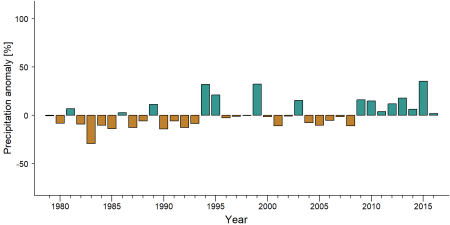
Precipitation anomaly in Bafing -
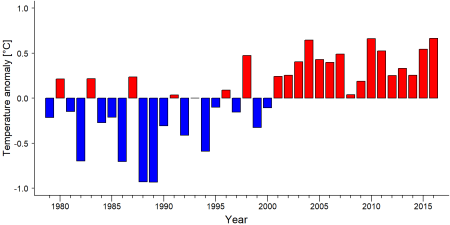
Temperature anomaly in Bafing


External links
References
Duvall, C. S. (2008). Human settlement ecology and chimpanzee habitat selection in Mali. Landscape Ecology, 23(6), 699-716. doi:10.1007/s10980-008-9231-x
Granier, N., & Martinez, L. (2004). Première reconnaissance des chimpanzés Pan troglodytes verus dans la zone transfrontalière entre la Guinée et le Mali (Afrique de l’Ouest). Primatologie, 6, 423–447.
Kiribou, R., Tehoda, P., Chukwu, O., Bempah, G., Kühl, H. S., Ferreira, J., …, & Heinicke, S. (2024). Exposure of African ape sites to climate change impacts. PLOS Climate, 3(2), e0000345. doi:10.1371/journal.pclm.0000345
Kormos, R., Boesch, C., Bakarr, M. I., & Butynski, T. (Eds.). (2003). West African chimpanzees: Status survey and conservation action plan. IUCN/SSC Primate Specialist Group. IUCN. link
Kortlandt, A. (1983). Marginal habitats of chimpanzees. Journal of Human Evolution, 12(3), 231-278. doi:10.1016/s0047-2484(83)80149-3
Kühl, H. S., Boesch, C., Kulik, L., Haas, F., Arandjelovic, M., Dieguez, P., …, & Kalan, A. K. (2019). Human impact erodes chimpanzee behavioral diversity. Science, 363(6434), 1453-1455. doi:10.1126/science.aau4532
Moore, J. J. (1985). Chimpanzee survey in Mali, West Africa. Primate Conservation, 6, 59–63.
Sayer, J. A. (1977). Conservation of large mammals in the Republic of Mali. Biological Conservation, 12(4), 245-263. doi:10.1016/0006-3207(77)90045-3
Page created by: APES Atlas Team & E. Terrade Date: 2019-11-18
Page updated by: Dr. Saibou Sanogo Date: 2025-09-08