
Krokosua Hills Forest Reserve: Difference between revisions
No edit summary |
No edit summary |
||
| Line 17: | Line 17: | ||
= Site characteristics = | = Site characteristics = | ||
Krokosua Hills Forest Reserve is located in southwestern Ghana, to the east of Bia National Park. The reserve was established in 1935 (UNEP-WCMC and IUCN 2019), and it consists of two forest blocks, one above and one below the Asempaneye-Kumasi road (Ernst et al. 2008). The highest peak at the site is 594 m (Ernst et al. 2008). In addition to the western chimpanzee (''Pan troglodytes verus''), other fauna found at the site include the western tree hyrax (''Dendrohyrax dorsalis''), royal antelope (''Neotragus pygmaeus'') (Oates 2006), olive colobus (''Procolobus verus''), black and white colobus (''Colobus vellerosus'') (Danquah et al. 2012), and a frog species discovered in the reserve, ''Arthroleptis krokosua'' (Ernst et al. 2008). | Krokosua Hills Forest Reserve is located in southwestern Ghana, to the east of Bia National Park. The reserve was established in 1935 ([[#R00952|UNEP-WCMC and IUCN 2019]]), and it consists of two forest blocks, one above and one below the Asempaneye-Kumasi road ([[#R00949|Ernst et al. 2008]]). The highest peak at the site is 594 m ([[#R00949|Ernst et al. 2008]]). In addition to the western chimpanzee (''Pan troglodytes verus''), other fauna found at the site include the western tree hyrax (''Dendrohyrax dorsalis''), royal antelope (''Neotragus pygmaeus'') ([[#R00951|Oates 2006]]), olive colobus (''Procolobus verus''), black and white colobus (''Colobus vellerosus'') ([[#R00948|Danquah et al. 2012]]), and a frog species discovered in the reserve, ''Arthroleptis krokosua'' ([[#R00949|Ernst et al. 2008]]). | ||
'''Table 1. Basic site information for Krokosua Hills Forest Reserve''' | '''Table 1. Basic site information for Krokosua Hills Forest Reserve''' | ||
| Line 44: | Line 44: | ||
= Ape status = | = Ape status = | ||
Traces of chimpanzees have been encountered during surveys, in 2005 (Oates 2006), 2006-2008 (Gatti 2010), and more recently in 2009 (Danquah et al. 2012), but population estimates are not available. The site has also been identified as the most likely to support a fairly large population of chimpanzees in Ghana (Caldecott & Miles 2005). | Traces of chimpanzees have been encountered during surveys, in 2005 ([[#R00951|Oates 2006]]), 2006-2008 ([[#R00950|Gatti 2010]]), and more recently in 2009 ([[#R00948|Danquah et al. 2012]]), but population estimates are not available. The site has also been identified as the most likely to support a fairly large population of chimpanzees in Ghana ([[#R00947|Caldecott & Miles 2005]]). | ||
'''Table 2. Ape population estimates reported for Krokosua Hills Forest Reserve''' | '''Table 2. Ape population estimates reported for Krokosua Hills Forest Reserve''' | ||
| Line 70: | Line 70: | ||
|Line transects | |Line transects | ||
| | | | ||
|Danquah et al. 2012 | |[[#R00948|Danquah et al. 2012]] | ||
| | | | ||
| | | | ||
| Line 83: | Line 83: | ||
|Interviews, Reconnaissance walk | |Interviews, Reconnaissance walk | ||
| | | | ||
|Oates 2006 | |[[#R00951|Oates 2006]] | ||
|Reconnaissance walk | |Reconnaissance walk | ||
| | | | ||
| Line 96: | Line 96: | ||
|Line transects & recces | |Line transects & recces | ||
| | | | ||
|Gatti 2010 | |[[#R00950|Gatti 2010]] | ||
|Reconnaissance walks were also conducted, and the total survey effort was 448.24 km | |Reconnaissance walks were also conducted, and the total survey effort was 448.24 km | ||
| | |GHA0001, GHA0007, GHA0012, GHA0013, GHA0015, GHA0024, GHA0027, GHA0028, GHA0029 | ||
|} | |} | ||
| Line 105: | Line 105: | ||
= Threats = | = Threats = | ||
The lowlands in Krokosua Hills Forest Reserve have been heavily logged in the past, but the forest in steeper areas has been less affected (Oates 2006). Illegal farming activities have also been found inside the reserve (Oates 2006). Another major threat to chimpanzees at the site is hunting, which appears to be very high (Oates 2006, Danquah et al. 2012). | The lowlands in Krokosua Hills Forest Reserve have been heavily logged in the past, but the forest in steeper areas has been less affected ([[#R00951|Oates 2006]]). Illegal farming activities have also been found inside the reserve ([[#R00951|Oates 2006]]). Another major threat to chimpanzees at the site is hunting, which appears to be very high ([[#R00951|Oates 2006]], [[#R00948|Danquah et al. 2012]]). | ||
'''Table 3. Threats to apes reported for Krokosua Hills Forest Reserve''' | '''Table 3. Threats to apes reported for Krokosua Hills Forest Reserve''' | ||
| Line 118: | Line 118: | ||
|1.1 Residential areas | |1.1 Residential areas | ||
|Present (unknown severity) | |Present (unknown severity) | ||
|Villages are present in the reserve (Ernst et al. 2008) | |Villages are present in the reserve ([[#R00949|Ernst et al. 2008]]) | ||
|Ongoing (2008) | |Ongoing (2008) | ||
|- | |- | ||
| Line 124: | Line 124: | ||
|2.1 Annual & perennial non-timber crops | |2.1 Annual & perennial non-timber crops | ||
|Present (unknown severity) | |Present (unknown severity) | ||
|Illegal cultivations patches of plantain, cocoyam, pepper, and marijuana found in the site (Oates 2006) | |Illegal cultivations patches of plantain, cocoyam, pepper, and marijuana found in the site ([[#R00951|Oates 2006]]) | ||
|Ongoing (2006) | |Ongoing (2006) | ||
|- | |- | ||
| Line 130: | Line 130: | ||
|5.1 Hunting & collecting terrestrial animals | |5.1 Hunting & collecting terrestrial animals | ||
|High (more than 70% of population affected) | |High (more than 70% of population affected) | ||
|Hunting signs at the site have been frequently found, especially wire-snare traps (Oates 2006, Danquah et al. 2012). | |Hunting signs at the site have been frequently found, especially wire-snare traps ([[#R00951|Oates 2006]], [[#R00948|Danquah et al. 2012]]). | ||
|2006-Ongoing (2012) | |2006-Ongoing (2012) | ||
|- | |- | ||
| Line 136: | Line 136: | ||
|5.3 Logging & wood harvesting | |5.3 Logging & wood harvesting | ||
|High (more than 70% of population affected) | |High (more than 70% of population affected) | ||
|The area has been heavily logged (Oates 2006) | |The area has been heavily logged ([[#R00951|Oates 2006]]) | ||
|Ongoing (2006) | |Ongoing (2006) | ||
|} | |} | ||
| Line 156: | Line 156: | ||
|5 Protection & restoration | |5 Protection & restoration | ||
|5.2 Legally protect ape habitat | |5.2 Legally protect ape habitat | ||
|The site is designated as forest reserve since 1935 (UNEP-WCMC and IUCN 2019) | |The site is designated as forest reserve since 1935 ([[#R00952|UNEP-WCMC and IUCN 2019]]) | ||
| | | | ||
|1935-Ongoing (2026) | |1935-Ongoing (2026) | ||
| Line 176: | Line 176: | ||
|1 Site management | |1 Site management | ||
|1.3 Corruption | |1.3 Corruption | ||
|Oates 2006 | |[[#R00951|Oates 2006]] | ||
| | | | ||
|} | |} | ||
| Line 262: | Line 262: | ||
= Exposure to climate change impacts = | = Exposure to climate change impacts = | ||
As part of a study on the exposure of African great ape sites to climate change impacts, Kiribou et al. (2024) extracted climate data and data on projected extreme climate impact events for the site. Climatological characteristics were derived from observation-based climate data provided by the Inter-Sectoral Impact Model Intercomparison Project (ISIMIP, www.isimip.org). Parameters were calculated as the average across each 30-year period. For 1981-2010, the EWEMBI dataset from ISIMIP2a was used. For the two future periods (2021-2050 and 2071-2099) ISIMIP2b climate data based on four CMIP5 global climate models were used. For future projections, two Representative Concentration Pathways (RCP) were used. RCP 2.6 is a scenario with strong mitigation measures in which global temperatures would likely rise below 2C. RCP 6.0 is a scenario with medium emissions in which global temperatures would likely rise up to 3C by 2100. For the number of days with heavy precipitation events, the 98th percentile of all precipitation days (>1mm/d) was calculated for the 1979-2013 reference period as a threshold for a heavy precipitation event. Then, for each year, the number of days above that threshold was derived. The figures on temperature and precipitation anomaly show the deviation from the mean temperature and mean precipitation for the 1979-2013 reference period. | As part of a study on the exposure of African great ape sites to climate change impacts, [[#R02235|Kiribou et al. (2024)]] extracted climate data and data on projected extreme climate impact events for the site. Climatological characteristics were derived from observation-based climate data provided by the Inter-Sectoral Impact Model Intercomparison Project (ISIMIP, www.isimip.org). Parameters were calculated as the average across each 30-year period. For 1981-2010, the EWEMBI dataset from ISIMIP2a was used. For the two future periods (2021-2050 and 2071-2099) ISIMIP2b climate data based on four CMIP5 global climate models were used. For future projections, two Representative Concentration Pathways (RCP) were used. RCP 2.6 is a scenario with strong mitigation measures in which global temperatures would likely rise below 2C. RCP 6.0 is a scenario with medium emissions in which global temperatures would likely rise up to 3C by 2100. For the number of days with heavy precipitation events, the 98th percentile of all precipitation days (>1mm/d) was calculated for the 1979-2013 reference period as a threshold for a heavy precipitation event. Then, for each year, the number of days above that threshold was derived. The figures on temperature and precipitation anomaly show the deviation from the mean temperature and mean precipitation for the 1979-2013 reference period. | ||
The estimated exposure to future extreme climate impact events (crop failure, drought, river flood, wildfire, tropical cyclone, and heatwave) is based on a published dataset by Lange et al. 2020 derived from ISIMIP2b data. The same global climate models and RCPs as described above were used. Within each 30-year period, the number of years with an extreme event and the average proportion of the site affected were calculated (Kiribou et al. 2024). | The estimated exposure to future extreme climate impact events (crop failure, drought, river flood, wildfire, tropical cyclone, and heatwave) is based on a published dataset by Lange et al. 2020 derived from ISIMIP2b data. The same global climate models and RCPs as described above were used. Within each 30-year period, the number of years with an extreme event and the average proportion of the site affected were calculated ([[#R02235|Kiribou et al. 2024]]). | ||
'''Table 8. Estimated past and projected climatological characteristics in Krokosua Hills Forest Reserve''' | '''Table 8. Estimated past and projected climatological characteristics in Krokosua Hills Forest Reserve''' | ||
| Line 387: | Line 387: | ||
= References = | = References = | ||
Caldecott, J. O., & Miles, L. (Eds.). (2005). World atlas of great apes and their conservation. Berkeley, Calif: University of California Press. | <span id="R00947"></span>Caldecott, J. O., & Miles, L. (Eds.). (2005). World atlas of great apes and their conservation. Berkeley, Calif: University of California Press. | ||
<span id="R00948"></span>Danquah, E., Oppong, S.K., Akom, E., and Sam, M. (2012) Preliminary Survey of Chimpanzees and Threatened Monkeys in the Bia-Goaso Forest Block in Southwestern Ghana. African Primates 7 (2): 163-174. [http://journals.sfu.ca/afrprims/index.php/AfricanPrimates/article/view/55/40 link] | |||
<span id="R00949"></span>Ernst, R., Agyei, A. C., & Rödel, M. (2008). A new giant species of Arthroleptis (Amphibia: Anura: Arthroleptidae) from the Krokosua Hills Forest Reserve, south-western Ghana. ''Zootaxa'', 1697(1), 58-68. [https://doi.org/10.11646/zootaxa.1697.1.2 doi:10.11646/zootaxa.1697.1.2] | |||
<span id="R00950"></span>Gatti, S. (2010) Community Forest Biodiversity Project: Status of primate populations in Protected Areas targeted under CFBP.W APCA and WD/FC, Accra. p. 42. | |||
<span id="R00951"></span>Oates, J. (2006) Primate Conservation in the Forests of Western Ghana. Unpublished report to the Wildlife Division, Forestry Commission, Ghana. | |||
<span id="R00952"></span>UNEP-WCMC and IUCN (2019), Protected Planet: [Krokosua Hills FoR*; The World Database on Protected Areas (WDPA)/The Global Database on Protected Areas Management Effectiveness (GD-PAME)] [On-line], [11/2019], Cambridge, UK: UNEP-WCMC and IUCN. Available at: www.protectedplanet.net. [http://www.protectedplanet.net link] | |||
<span id="R02130"></span>Miles, J. O. C. L., & Annan, K. (2005). World atlas of great apes and their conservation. University of California Press. | |||
<span id="R02235"></span>Kiribou, R., Tehoda, P., Chukwu, O., Bempah, G., Kühl, H. S., Ferreira, J., …, & Heinicke, S. (2024). Exposure of African ape sites to climate change impacts. ''PLOS Climate'', 3(2), e0000345. [https://doi.org/10.1371/journal.pclm.0000345 doi:10.1371/journal.pclm.0000345] | |||
'''Page created by: '''APES Atlas Team''' Date:''' 2019-11-22 | '''Page created by: '''APES Atlas Team''' Date:''' 2019-11-22 | ||
Revision as of 16:28, 12 October 2026
West Africa > Ghana > Krokosua Hills Forest Reserve
Français | Português | Español | Bahasa Indonesia | Melayu
Summary
- Western chimpanzees (Pan troglodytes verus) are present in Krokosua Hills Forest Reserve.
- The population size is unknown.
- The chimpanzee population trend is unknown.
- This site has a total size of 481.7 km².
- Key threats to chimpanzees are logging, farming, and hunting.
- Information on conservation activities implemented at the site is lacking.
Site characteristics
Krokosua Hills Forest Reserve is located in southwestern Ghana, to the east of Bia National Park. The reserve was established in 1935 (UNEP-WCMC and IUCN 2019), and it consists of two forest blocks, one above and one below the Asempaneye-Kumasi road (Ernst et al. 2008). The highest peak at the site is 594 m (Ernst et al. 2008). In addition to the western chimpanzee (Pan troglodytes verus), other fauna found at the site include the western tree hyrax (Dendrohyrax dorsalis), royal antelope (Neotragus pygmaeus) (Oates 2006), olive colobus (Procolobus verus), black and white colobus (Colobus vellerosus) (Danquah et al. 2012), and a frog species discovered in the reserve, Arthroleptis krokosua (Ernst et al. 2008).
Table 1. Basic site information for Krokosua Hills Forest Reserve
| Species | Pan troglodytes verus |
| Area | 481.7 km² |
| Coordinates | Lat: 6.54 , Lon: -2.86 |
| Type of site | Protected area (Forest Reserve) |
| Habitat types | Subtropical/tropical dry forest, Subtropical/tropical moist lowland forest |
| Type of governance |
Types of sites Governance types Habitat types
Ape status
Traces of chimpanzees have been encountered during surveys, in 2005 (Oates 2006), 2006-2008 (Gatti 2010), and more recently in 2009 (Danquah et al. 2012), but population estimates are not available. The site has also been identified as the most likely to support a fairly large population of chimpanzees in Ghana (Caldecott & Miles 2005).
Table 2. Ape population estimates reported for Krokosua Hills Forest Reserve
| Species | Year | Occurrence | Encounter or vistation rate (nests/km; ind/day) | Density estimate [ind./ km²] (95% CI) | Abundance estimate (95% CI) | Survey area | Sampling method | Analytical framework | Source | Comments | A.P.E.S. database ID |
|---|---|---|---|---|---|---|---|---|---|---|---|
| Pan troglodytes verus | 2009 | Present | Krokosua Hills Forest Reserve | Line transects | Danquah et al. 2012 | ||||||
| Pan troglodytes verus | 2005 | Present | Krokosua Hills Forest Reserve | Interviews, Reconnaissance walk | Oates 2006 | Reconnaissance walk | |||||
| Pan troglodytes verus | 2006-2008 | 0.0045 | Krokosua Hills Forest Reserve | Line transects & recces | Gatti 2010 | Reconnaissance walks were also conducted, and the total survey effort was 448.24 km | GHA0001, GHA0007, GHA0012, GHA0013, GHA0015, GHA0024, GHA0027, GHA0028, GHA0029 |
Sampling methods Analytical frameworks
Threats
The lowlands in Krokosua Hills Forest Reserve have been heavily logged in the past, but the forest in steeper areas has been less affected (Oates 2006). Illegal farming activities have also been found inside the reserve (Oates 2006). Another major threat to chimpanzees at the site is hunting, which appears to be very high (Oates 2006, Danquah et al. 2012).
Table 3. Threats to apes reported for Krokosua Hills Forest Reserve
| Category | Specific threats | Threat level | Description | Year of threat |
|---|---|---|---|---|
| 1 Residential & commercial development | 1.1 Residential areas | Present (unknown severity) | Villages are present in the reserve (Ernst et al. 2008) | Ongoing (2008) |
| 2 Agriculture & aquaculture | 2.1 Annual & perennial non-timber crops | Present (unknown severity) | Illegal cultivations patches of plantain, cocoyam, pepper, and marijuana found in the site (Oates 2006) | Ongoing (2006) |
| 5 Biological resource use | 5.1 Hunting & collecting terrestrial animals | High (more than 70% of population affected) | Hunting signs at the site have been frequently found, especially wire-snare traps (Oates 2006, Danquah et al. 2012). | 2006-Ongoing (2012) |
| 5 Biological resource use | 5.3 Logging & wood harvesting | High (more than 70% of population affected) | The area has been heavily logged (Oates 2006) | Ongoing (2006) |
Conservation activities
Information on conservation activities implemented at the site is lacking.
Table 4. Conservation activities reported for Krokosua Hills Forest Reserve
| Category | Specific activity | Description | Implementing organization(s) | Year of activity |
|---|---|---|---|---|
| 5 Protection & restoration | 5.2 Legally protect ape habitat | The site is designated as forest reserve since 1935 (UNEP-WCMC and IUCN 2019) | 1935-Ongoing (2026) |
Challenges
Table 5. Challenges reported for Krokosua Hills Forest Reserve
| Challenges | Specific challenges | Source | Year(s) |
|---|---|---|---|
| 1 Site management | 1.3 Corruption | Oates 2006 |
Enablers
Table 6. Enablers reported for Krokosua Hills Forest Reserve
| Enablers | Specific enablers | Source | Year(s) |
|---|---|---|---|
| 1 Site management | |||
| 2 Resources and capacity | |||
| 3 Engaged community | |||
| 4 Institutional support | |||
| 5 Ecological context | |||
| 6 Safety and stability |
Research activities
No information on research activities has been documented.
Documented behaviours
Table 7. Behaviours documented for Krokosua Hills Forest Reserve
| Category | Behavior | Observation type | Prevalence | Observation dates | Source | Habituation | Species | Comment |
|---|---|---|---|---|---|---|---|---|
| Not reported |
Exposure to climate change impacts
As part of a study on the exposure of African great ape sites to climate change impacts, Kiribou et al. (2024) extracted climate data and data on projected extreme climate impact events for the site. Climatological characteristics were derived from observation-based climate data provided by the Inter-Sectoral Impact Model Intercomparison Project (ISIMIP, www.isimip.org). Parameters were calculated as the average across each 30-year period. For 1981-2010, the EWEMBI dataset from ISIMIP2a was used. For the two future periods (2021-2050 and 2071-2099) ISIMIP2b climate data based on four CMIP5 global climate models were used. For future projections, two Representative Concentration Pathways (RCP) were used. RCP 2.6 is a scenario with strong mitigation measures in which global temperatures would likely rise below 2C. RCP 6.0 is a scenario with medium emissions in which global temperatures would likely rise up to 3C by 2100. For the number of days with heavy precipitation events, the 98th percentile of all precipitation days (>1mm/d) was calculated for the 1979-2013 reference period as a threshold for a heavy precipitation event. Then, for each year, the number of days above that threshold was derived. The figures on temperature and precipitation anomaly show the deviation from the mean temperature and mean precipitation for the 1979-2013 reference period.
The estimated exposure to future extreme climate impact events (crop failure, drought, river flood, wildfire, tropical cyclone, and heatwave) is based on a published dataset by Lange et al. 2020 derived from ISIMIP2b data. The same global climate models and RCPs as described above were used. Within each 30-year period, the number of years with an extreme event and the average proportion of the site affected were calculated (Kiribou et al. 2024).
Table 8. Estimated past and projected climatological characteristics in Krokosua Hills Forest Reserve
| Value | 1981-2010 | 2021-2050, RCP 2.6 | 2021-2050, RCP 6.0 | 2071-2099, RCP 2.6 | 2071-2099, RCP 6.0 |
|---|---|---|---|---|---|
| Mean temperature [C] | 26.9 | 28 | 27.8 | 28.2 | 29.3 |
| Annual precipitation [mm] | 1323 | 1265 | 1330 | 1275 | 1349 |
| Max no. consecutive dry days (per year) | 27.3 | 26.2 | 30 | 30.6 | 30.8 |
| No. days with heavy precipitation (per year) | 6.7 | 6.6 | 6.7 | 6.3 | 8.5 |
Table 9. Projected exposure of apes to extreme climate impact events in Krokosua Hills Forest Reserve
| Type | No. of years with event (2021-2050, RCP 2.6) | % of site exposed (2021-2050, RCP 2.6) | No. of years with event (2021-2050, RCP 6.0) | % of site exposed (2021-2050, RCP 6.0) | No. of years with event (2070-2099, RCP 2.6) | % of site exposed (2070-2099, RCP 2.6) | No. of years with event (2070-2099, RCP 6.0) | % of site exposed (2070-2099, RCP 6.0) |
|---|---|---|---|---|---|---|---|---|
| Crop failure | 3 | 5.18 | 1 | 2.59 | 2.5 | 5.18 | 4.5 | 5.18 |
| Drought | 1.5 | 50 | 0.75 | 75 | 1.75 | 100 | 0 | 0 |
| Heatwave | 7.5 | 100 | 7 | 100 | 8 | 50 | 2 | 100 |
| River flood | 0.5 | 0.17 | 1 | 0.19 | 1 | 0.38 | 1 | 0.75 |
| Tropical cyclone | 0 | 0 | 0 | 0 | 0 | 0 | 0 | 0 |
| Wildfire | 30 | 0.47 | 30 | 0.44 | 29 | 0.47 | 29 | 0.53 |
-
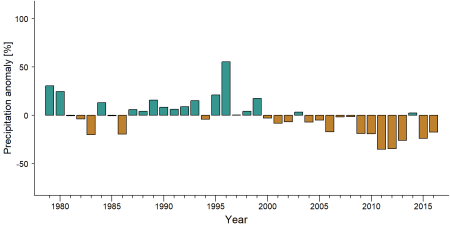
Precipitation anomaly in Krokosua Hills Forest Reserve -
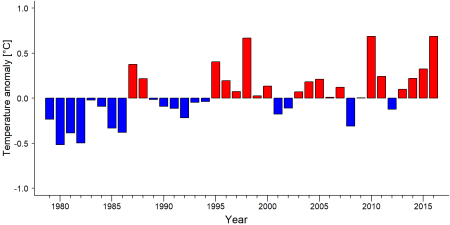
Temperature anomaly in Krokosua Hills Forest Reserve


External links
References
Caldecott, J. O., & Miles, L. (Eds.). (2005). World atlas of great apes and their conservation. Berkeley, Calif: University of California Press.
Danquah, E., Oppong, S.K., Akom, E., and Sam, M. (2012) Preliminary Survey of Chimpanzees and Threatened Monkeys in the Bia-Goaso Forest Block in Southwestern Ghana. African Primates 7 (2): 163-174. link
Ernst, R., Agyei, A. C., & Rödel, M. (2008). A new giant species of Arthroleptis (Amphibia: Anura: Arthroleptidae) from the Krokosua Hills Forest Reserve, south-western Ghana. Zootaxa, 1697(1), 58-68. doi:10.11646/zootaxa.1697.1.2
Gatti, S. (2010) Community Forest Biodiversity Project: Status of primate populations in Protected Areas targeted under CFBP.W APCA and WD/FC, Accra. p. 42.
Oates, J. (2006) Primate Conservation in the Forests of Western Ghana. Unpublished report to the Wildlife Division, Forestry Commission, Ghana.
UNEP-WCMC and IUCN (2019), Protected Planet: [Krokosua Hills FoR*; The World Database on Protected Areas (WDPA)/The Global Database on Protected Areas Management Effectiveness (GD-PAME)] [On-line], [11/2019], Cambridge, UK: UNEP-WCMC and IUCN. Available at: www.protectedplanet.net. link
Miles, J. O. C. L., & Annan, K. (2005). World atlas of great apes and their conservation. University of California Press.
Kiribou, R., Tehoda, P., Chukwu, O., Bempah, G., Kühl, H. S., Ferreira, J., …, & Heinicke, S. (2024). Exposure of African ape sites to climate change impacts. PLOS Climate, 3(2), e0000345. doi:10.1371/journal.pclm.0000345
Page created by: APES Atlas Team Date: 2019-11-22