
Diécké Classified Forest: Difference between revisions
No edit summary |
No edit summary Tag: Reverted |
||
| Line 467: | Line 467: | ||
<span id="R00459"></span>WCF. 2012. Etat de la faune et des menaces dans les aires protégées terrestres et principales zones de forte biodiversité de Rep. de Guinée. Report. Wild Chimpanzee Foundation, Sangaredi, Republic of Guinea. Online: [http://www.wildchimps.org www.wildchimps.org] | <span id="R00459"></span>WCF. 2012. Etat de la faune et des menaces dans les aires protégées terrestres et principales zones de forte biodiversité de Rep. de Guinée. Report. Wild Chimpanzee Foundation, Sangaredi, Republic of Guinea. Online: [http://www.wildchimps.org www.wildchimps.org] | ||
<span id="R02180"></span>Kiribou, R., Tehoda, P., Chukwu, O., Bempah, G., Kühl, H. S., Ferreira, J., …, & Heinicke, S. (2024). Exposure of African ape sites to climate change impacts. ''PLOS Climate'', 3(2), | <span id="R02180"></span>Kiribou, R., Tehoda, P., Chukwu, O., Bempah, G., Kühl, H. S., Ferreira, J., …, & Heinicke, S. (2024). Exposure of African ape sites to climate change impacts. ''PLOS Climate'', 3(2), 1-19. [https://doi.org/10.1371/journal.pclm.0000345 doi:10.1371/journal.pclm.0000345] | ||
Revision as of 10:33, 15 October 2026
West Africa > Republic of Guinea > Diécké Classified Forest
Français | Português | Español | Bahasa Indonesia | Melayu
Summary
- Western chimpanzees (Pan troglodytes verus) are present in Diécké Classified Forest.
- It has been estimated that 80 (CI: 25-253) individuals occur in the forest.
- The chimpanzee population trend is unknown.
- This site has a total size of 640 km².
- Key threats to chimpanzees are poaching and habitat destruction.
- The following conservation activities were conducted by the Centre Forestier de N'Zérékoré: land-use planning, reforestation and monitoring of illegal hunting.
- Diécké Classified Forest is one of the last biodiversity rich forest blocks remaining in southern Guinea.
Site characteristics
Diécké is a forest in southern Guinea close to the border with Liberia (7°39'N - 7°21'N and 9°06'W - 8°47'W) and was designated as a Classified Forest in 1945 (IUCN category not reported, UNEP-WCMC and IUCN 2018). The forest is located in Guinée forestière, one of four Guinean natural regions, and is part of the region N'Zérékoré. It is about 100 km west of Bossou and 950 km from the capital Conakry (Carvalho 2011). The forest has a size of 640 km², 70% of which are dense forest and the remainder being sparsely forested areas, fallows, and open land (WCF 2012). Diécké forest has a rich biodiversity with hippopotamus (Hippopotamus amphibius), duikers, and several primate species, including chimpanzees (WCF 2012). It is also listed as an Important Bird Area and harbors several species of plants and amphibians. Together with Ziama forest, this is one of the last remaining large forest blocks in southern Guinea. The terrain is partly hilly and ranges in altitude from 50-800m (Carvalho 2012).
Table 1. Basic site information for Diécké Classified Forest
| Species | Pan troglodytes verus |
| Area | 640 km² |
| Coordinates | Lat: 7.54 , Lon: -8.94 |
| Type of site | Protected area (Classified Forest) |
| Habitat types | Subtropical/tropical moist lowland forest, Subtropical/tropical moist montane forest |
| Type of governance | Governance by government |
Types of sites Governance types Habitat types
Ape status
Based on a nation-wide questionnaire survey, the presence of western chimpanzees was confirmed by Sugiyama & Soumah (1988). In a nationwide survey Rebecca Kormos identified Ziama Biosphere Reserve as the second most important priority area for western chimpanzee conservation in Guinea due to high chimpanzee densities encountered during reconnaissance surveys (Ham 1998). A nationwide survey by the Wild Chimpanzee Foundation estimated the chimpanzee population size at around 80 individuals (WCF 2012).
Table 2. Ape population estimates reported for Diécké Classified Forest
| Species | Year | Occurrence | Encounter or vistation rate (nests/km; ind/day) | Density estimate [ind./ km²] (95% CI) | Abundance estimate (95% CI) | Survey area | Sampling method | Analytical framework | Source | Comments | A.P.E.S. database ID |
|---|---|---|---|---|---|---|---|---|---|---|---|
| Pan troglodytes verus | 2018 | Present | 0.05 | Diécké forest | Line transects & recces | Almeida-Warren et al., 2024 | Total survey effort : 21.7 km | GIN0012, GIN0013 | |||
| Pan troglodytes verus | 2012 | Present | 0.3 | 0.14 | 80 (25-253) | Diécké forest | Line transects | WCF 2012 | Total survey effort:144.8km | GIN0002, GIN0010 GIN0016, GIN0020, GIN0023, GIN0024, GIN0025, GIN0027, GIN0029, GIN0036, GIN0069
| |
| Pan troglodytes verus | 2003.0 | Present | 1.49 | 776 (210-2864) | Diécké forest | Line transects | Distance sampling (decay time unknown) | Herbinger et Tounkara, 2006 | They used the standing crop nest count method to calculate chimpanzee density. | ||
| Pan troglodytes verus | 1997 | Present | 2.6 | 0.17 | 209-307 | Diécké forest | Line transects | Ham 1998 | Total survey effort: 5.2 km | GIN0019, GIN0021 | |
| Pan troglodytes verus | 1988 | Present | 50.0 | Diécké forest | Interviews | Sugiyama & Soumah 1988 | Questionnaire survey |
Sampling methods Analytical frameworks
Threats
Illegal poaching represents the major threat to the chimpanzee population in the park (WCF 2012, Ham 1998). More than 500,000 immigrants migrated to this area beginning in 1989 from Sierra Leone and Liberia resulting in a strong increase in illegal logging (Carvalho 2011). There was also an increase in plantations of oil palm, rubber, and crops (Carvalho 2011).
Table 3. Threats to apes reported for Diécké Classified Forest
| Category | Specific threats | Threat level | Description | Year of threat |
|---|---|---|---|---|
| 2 Agriculture & aquaculture | 2.1 Annual & perennial non-timber crops | High (more than 70% of population affected) | Plantations for oil palm and rubber, and other crops (Carvalho 2011, UNEP-WCMC and IUCN 2018). | 2011-Ongoing (2018) |
| 4 Transportation & service corridors | 4.1 Roads & railroads | Medium (30-70% of population affected) | Second highest encounter rate of all anthropogenic signs (WCF 2012). | Ongoing (2012) |
| 5 Biological resource use | 5.1 Hunting & collecting terrestrial animals | High (more than 70% of population affected) | Illegal poaching is consistently mentioned as the most prevalent threat across reports (Herbinger et Tounkara 2006, Carvalho 2011, UNEP-WCMC and IUCN 2018, Almeida-Warren et al. 2024). | 2003-Ongoing (2024) |
| 5 Biological resource use | 5.2 Gathering terrestrial plants | Present (unknown severity) | There is harvesting of several species of rattan by local populations which impacts other tree species and the integrity of the forest (Monemou et al., 2024). | Ongoing (2024) |
| 5 Biological resource use | 5.3 Logging & wood harvesting | Present (unknown severity) | Logging increased strongly when migrants arrived from Sierra Leone and Liberia in 1989 (Carvalho 2011). Signs of logging and charcoal production were found in a survey in 2011 (WCF 2012). | 1989-Ongoing (2012) |
Conservation activities
The Centre Forestier de N'Zérékoré is responsible for Diécké Classified Forest. In the 1990’s the forest was divided into three land-use zones, the outer two allowing for different degrees of human activities, while the core of the forest was designated a ‘integrally protected area’ (WCF 2012). After 2000 Progerfor (the Projet de Gestion des Ressources Forestières), a cooperation between Centre Forestier de N'Zérékoré and German partners, conducted conservation activities, including reforestation and monitoring of illegal hunting (Carvalho 2011).
Table 4. Conservation activities reported for Diécké Classified Forest
| Category | Specific activity | Description | Implementing organization(s) | Year of activity |
|---|---|---|---|---|
| 2 Counter-wildlife crime | 2.11 Implement monitoring surveillance strategies (e.g., SMART) or use monitoring data to improve effectiveness of patrols | Monitoring of illegal hunting was conducted (Carvalho 2011), but it is not clear whether these activities are still ongoing | Unknown | |
| 5 Protection & restoration | 5.1 Create buffer zones around protected ape habitat | Forest was divided into three land-use zones, with the core of the forest being (25% of total areas) designated as an ‘integrally protected area’ (Carvalho 2011). | Unknown | |
| 5 Protection & restoration | 5.2 Legally protect ape habitat | Designated as Classified Forest since 1945 (UNEP-WCMC and IUCN 2018) | 1945-Ongoing (2018) | |
| 5 Protection & restoration | 5.6 Habitat restoration | Reforestation activities by Progerfor (Carvalho 2011). | Unknown |
Challenges
Table 5. Challenges reported for Diécké Classified Forest
| Challenges | Specific challenges | Source | Year(s) |
|---|---|---|---|
| 2 Resources and capacity | 2.2 Lack of staff | Herbinger et Tounkara, 2006 | 2003-Ongoing (2006) |
| 2 Resources and capacity | 2.5 Lack of equipment/transportation | Herbinger et Tounkara, 2006 | 2003-Ongoing (2006) |
| 2 Resources and capacity | 2.6 Lack of biomonitoring/survey data | Herbinger et Tounkara, 2006 | 2003-Ongoing (2006) |
Enablers
Table 6. Enablers reported for Diécké Classified Forest
| Enablers | Specific enablers | Source | Year(s) |
|---|---|---|---|
| 1 Site management | |||
| 2 Resources and capacity | |||
| 3 Engaged community | |||
| 4 Institutional support | |||
| 5 Ecological context | |||
| 6 Safety and stability |
Research activities
From 1996 to 1997 Rebecca Kormos (née Ham) did a nationwide surveys on chimpanzees across Guinea (Ham 1998). She identified Diécké Classified Forest as a priority site. In 1999 Tetsuro Matsuzawa did a preliminary survey in Diécké to scope for a possible future research site (Matsuzawa et al. 1999) and discovered that the chimpanzees crack panda nuts. To inform the extension of the protected area network Brugiere and Kormos (2009) identified 16 Key Biodiversity Areas across Guinea based on the occurrence of globally threatened large and medium-sized mammals, among which Diécké Classified Forest ranked second. From 2006 to 2008 Sousa and Carvalho conducted research in Diécké to study the nut-cracking behavior of chimpanzees (Carvalho 2011). The Wild Chimpanzee Foundation did a nationwide inventory of chimpanzee populations in Guinea between 2009 and 2011. The WCF monitoring team covered a total of 10 sites, including Diécké Classified Forest, using transect surveys (WCF 2012).
Documented behaviours
Table 7. Behaviours documented for Diécké Classified Forest
| Category | Behavior | Observation type | Prevalence | Observation dates | Source | Habituation | Species | Comment |
|---|---|---|---|---|---|---|---|---|
| foraging | Nut cracking | Matsuzawa et al. 1999, Carvalho 2011 | Pan troglodytes verus |
Exposure to climate change impacts
As part of a study on the exposure of African great ape sites to climate change impacts, Kiribou et al. (2024) extracted climate data and data on projected extreme climate impact events for the site. Climatological characteristics were derived from observation-based climate data provided by the Inter-Sectoral Impact Model Intercomparison Project (ISIMIP, www.isimip.org). Parameters were calculated as the average across each 30-year period. For 1981-2010, the EWEMBI dataset from ISIMIP2a was used. For the two future periods (2021-2050 and 2071-2099) ISIMIP2b climate data based on four CMIP5 global climate models were used. For future projections, two Representative Concentration Pathways (RCP) were used. RCP 2.6 is a scenario with strong mitigation measures in which global temperatures would likely rise below 2C. RCP 6.0 is a scenario with medium emissions in which global temperatures would likely rise up to 3C by 2100. For the number of days with heavy precipitation events, the 98th percentile of all precipitation days (>1mm/d) was calculated for the 1979-2013 reference period as a threshold for a heavy precipitation event. Then, for each year, the number of days above that threshold was derived. The figures on temperature and precipitation anomaly show the deviation from the mean temperature and mean precipitation for the 1979-2013 reference period.
The estimated exposure to future extreme climate impact events (crop failure, drought, river flood, wildfire, tropical cyclone, and heatwave) is based on a published dataset by Lange et al. 2020 derived from ISIMIP2b data. The same global climate models and RCPs as described above were used. Within each 30-year period, the number of years with an extreme event and the average proportion of the site affected were calculated (Kiribou et al. 2024).
Table 8. Estimated past and projected climatological characteristics in Diécké Classified Forest
| Value | 1981-2010 | 2021-2050, RCP 2.6 | 2021-2050, RCP 6.0 | 2071-2099, RCP 2.6 | 2071-2099, RCP 6.0 |
|---|---|---|---|---|---|
| Mean temperature [C] | 25 | 26.1 | 26.1 | 26.2 | 27.3 |
| Annual precipitation [mm] | 1930 | 1955 | 1991 | 1998 | 2070 |
| Max no. consecutive dry days (per year) | 33.9 | 31.6 | 30.4 | 33 | 33.8 |
| No. days with heavy precipitation (per year) | 6 | 8 | 7.3 | 8.2 | 9.7 |
Table 9. Projected exposure of apes to extreme climate impact events in Diécké Classified Forest
| Type | No. of years with event (2021-2050, RCP 2.6) | % of site exposed (2021-2050, RCP 2.6) | No. of years with event (2021-2050, RCP 6.0) | % of site exposed (2021-2050, RCP 6.0) | No. of years with event (2070-2099, RCP 2.6) | % of site exposed (2070-2099, RCP 2.6) | No. of years with event (2070-2099, RCP 6.0) | % of site exposed (2070-2099, RCP 6.0) |
|---|---|---|---|---|---|---|---|---|
| Crop failure | 7.5 | 5.96 | 6.5 | 5.96 | 7.5 | 5.96 | 17.5 | 5.96 |
| Drought | 0 | 0 | 0 | 0 | 0 | 0 | 0 | 0 |
| Heatwave | 7.5 | 100 | 5.5 | 100 | 6.5 | 100 | 6 | 100 |
| River flood | 0.5 | 0.08 | 1.75 | 0.88 | 2 | 1.46 | 4.5 | 1.39 |
| Tropical cyclone | 0 | 0 | 0 | 0 | 0 | 0 | 0 | 0 |
| Wildfire | 30 | 0.42 | 30 | 0.43 | 29 | 0.42 | 29 | 0.43 |
-
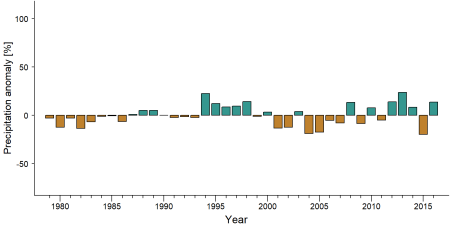
Precipitation anomaly in Diécké Classified Forest -
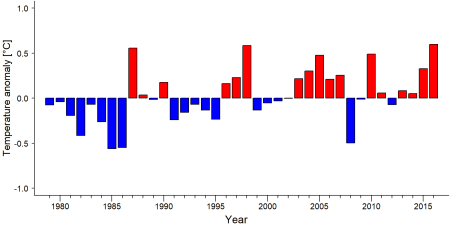
Temperature anomaly in Diécké Classified Forest


External links
References
Almeida-Warren, K., Camara, H. D., Cherif, P., Doré, J., Goumy, P., Kpomi, J., ... & Fitzgerald, M. (2024). Revisiting the Second Largest Forest of Guinea a Decade Later: Conservation Status, Chimpanzee Presence, and Threats in Diécké, Korohouan Area. African Primates, 18(1). link
Brugiere D, Kormos R. 2009. Review of the protected area network in Guinea, West Africa, and recommendations for new sites for biodiversity conservation, Biodiversity and Conservation, 18:847 doi:10.1007/s10531-008-9508-z
Carvalho, S. (2011). Diécké Forest, Guinea: Delving into Chimpanzee Behavior Using Stone Tool Surveys. In Primatology Monographs (pp. 301-312). Springer Japan. doi:10.1007/978-4-431-53921-6_31
Ham R. 1998. Nationwide chimpanzee census and large mammal survey Republic of Guinea. Unpublished report for the European Communion, Guinea-Conakry.
Herbinger, I., & Tounkara, E. O. 2006. Forestière: les Forêts Classées de Déré, de Diécké et du Mont Béro. RAP, 97. link
Matsuzawa, T., Takemoto, H., Hayakawa, S., & Shimada, M. (1999). Diecke Forest in Guinea. Pan Africa News, 6(1), 10-11. doi:10.5134/143391
Monemou, P., Soumaoro, G. P., Soropogui, Z., Mamy, L., Magassouba, D., & Camara, A. (2023). Effet de l’exploitation des rotins sur les espèces compagnes à la périphérie de la forêt classée de Diécké, Sud-Est de la République de Guinée. Afrique SCIENCE, 23(1), 45-56. link
Sugiyama, Y., & Soumah, A. G. (1988). Preliminary survey of the distribution and population of chimpanzees in the Republic of Guinea. Primates, 29(4), 569-574. doi:10.1007/bf02381144
UNEP-WCMC, IUCN. 2018. Protected Planet: The World Database on Protected Areas (WDPA), Cambridge, UK: UNEP-WCMC and IUCN Online: diecke-classified-forest www.protectedplanet.net
WCF. 2012. Etat de la faune et des menaces dans les aires protégées terrestres et principales zones de forte biodiversité de Rep. de Guinée. Report. Wild Chimpanzee Foundation, Sangaredi, Republic of Guinea. Online: www.wildchimps.org
Kiribou, R., Tehoda, P., Chukwu, O., Bempah, G., Kühl, H. S., Ferreira, J., …, & Heinicke, S. (2024). Exposure of African ape sites to climate change impacts. PLOS Climate, 3(2), 1-19. doi:10.1371/journal.pclm.0000345
Page created by: APES Atlas Team Date: 2018-11-15
Page updated by: Zausa Diorne Date: 2025-10-15