
Grebo-Krahn National Park: Difference between revisions
No edit summary |
No edit summary |
||
| Line 520: | Line 520: | ||
<span id="R00678"></span>Kouakou, Y. C., Dowd, D., Tweh, C., Zoro Gone, B.I. I. B., Vergnes, V., Normand, E., & Boesch, C. (2014). Biomonitoring in the Proposed Grebo National Park, Liberia: REPORT ON PHASE 1 IN THE PROPOSED GREBO NATIONAL PARK (February-July 2014). Wild Chimpanzee Foundation (WCF) ;Forestry Development Authority (FDA). | <span id="R00678"></span>Kouakou, Y. C., Dowd, D., Tweh, C., Zoro Gone, B.I. I. B., Vergnes, V., Normand, E., & Boesch, C. (2014). Biomonitoring in the Proposed Grebo National Park, Liberia: REPORT ON PHASE 1 IN THE PROPOSED GREBO NATIONAL PARK (February-July 2014). Wild Chimpanzee Foundation (WCF) ;Forestry Development Authority (FDA). | ||
<span id="R00679"></span>Kühl, H. S., Sop, T., Williamson, E. A., Mundry, R., Brugière, D., Campbell, G., …, & Boesch, C. (2017). The Critically Endangered western chimpanzee declines by 80%. ''American Journal of Primatology'', 79(9). [https://doi.org/10.1002/ajp.22681 doi:10.1002/ajp.22681] | <span id="R00679"></span>Kühl, H. S., Sop, T., Williamson, E. A., Mundry, R., Brugière, D., Campbell, G., …, & Boesch, C. (2017). The Critically Endangered western chimpanzee declines by 80%. ''American Journal of Primatology'', 79(9), e22681. [https://doi.org/10.1002/ajp.22681 doi:10.1002/ajp.22681] | ||
<span id="R00680"></span>Tweh, C. G., Lormie, M. M., Kouakou, C. Y., Hillers, A., Kühl, H. S., & Junker, J. ( | <span id="R00680"></span>Tweh, C. G., Lormie, M. M., Kouakou, C. Y., Hillers, A., Kühl, H. S., & Junker, J. (2015). Conservation status of chimpanzees Pan troglodytes verus and other large mammals in Liberia: a nationwide survey. ''Oryx'', 49(4), 710-718. [https://doi.org/10.1017/s0030605313001191 doi:10.1017/s0030605313001191] | ||
<span id="R00681"></span>Wild Chimpanzee Foundation. 2019. Activities of the Wild Chimpanzee Foundation for improved conservation of chimpanzees and their habitat in West Africa. Annual Report 2018. | <span id="R00681"></span>Wild Chimpanzee Foundation. 2019. Activities of the Wild Chimpanzee Foundation for improved conservation of chimpanzees and their habitat in West Africa. Annual Report 2018. | ||
| Line 530: | Line 530: | ||
<span id="R00683"></span>Wild Chimpanzee Foundation. 2017. Activities of the Wild Chimpanzee Foundation for improved conservation of chimpanzees and their habitat in West Africa. Annual Report 2016. | <span id="R00683"></span>Wild Chimpanzee Foundation. 2017. Activities of the Wild Chimpanzee Foundation for improved conservation of chimpanzees and their habitat in West Africa. Annual Report 2016. | ||
<span id="R02208"></span>Kiribou, R., Tehoda, P., Chukwu, O., Bempah, G., Kühl, H. S., Ferreira, J., …, & Heinicke, S. (2024). Exposure of African ape sites to climate change impacts. ''PLOS Climate'', 3(2), | <span id="R02208"></span>Kiribou, R., Tehoda, P., Chukwu, O., Bempah, G., Kühl, H. S., Ferreira, J., …, & Heinicke, S. (2024). Exposure of African ape sites to climate change impacts. ''PLOS Climate'', 3(2), 1-19. [https://doi.org/10.1371/journal.pclm.0000345 doi:10.1371/journal.pclm.0000345] | ||
'''Page created by: '''APES Atlas Team''' Date:''' 2019-08-30 | '''Page created by: '''APES Atlas Team''' Date:''' 2019-08-30 | ||
Revision as of 10:34, 15 October 2026
West Africa > Liberia > Grebo-Krahn National Park
Français | Português | Español | Bahasa Indonesia | Melayu
Summary
- Western chimpanzees (Pan troglodytes verus) are present in Grebo-Krahn National Park.
- It has been estimated that 313 (CI: 186-449) individuals occur in the site.
- The chimpanzee population trend is stable.
- This site has a total size of 971 km².
- Key threats to chimpanzees are poaching, illegal mining and farming activities.
- Conservation activities, led primarily by the Wild Chimpanzee Foundation (WCF), have focused on law enforcement, awareness campaigns, and supporting sustainable small-scale aquaculture activities in local communities.
Site characteristics
Located in southeastern Liberia, the site is part of the Tai-Grebo-Sapo Forest Complex, a biodiversity hotspot and conservation priority in West Africa (Kouakou et al. 2012). In addition to the western chimpanzee, several endangered species inhabit Grebo-Krahn National park, including Jentink’s duiker (Cephalophus jentinki), forest elephants (Loxodonta africana), pygmy hippos (Hexaprotodon liberiensis), and Diana monkeys (Cercopithecus diana diana, Kouakou et al. 2012, Barrie et al. 2007).
Table 1. Basic site information for Grebo-Krahn National Park
| Species | Pan troglodytes verus |
| Area | 971.36 km² |
| Coordinates | Lat: 5.66 , Lon: -7.53 |
| Type of site | Protected area (National Park) |
| Habitat types | Subtropical/tropical moist lowland forest |
| Type of governance |
Types of sites Governance types Habitat types
Ape status
In 2012, the Wild Chimpanzee Foundation (WCF) and the Forestry Development Authority (FDA) conducted the first complete survey of chimpanzees and other large mammals of the Grebo National Forest (Kouakou et al. 2012). The estimated abundance has remained relatively stable since then; the most recent survey estimated a total population of approximately 313 individuals in 2015 (Furnell et al. 2015). Based on two population surveys in 2005 (Kouakou et al. 2012) and 2014 (Kouakou et al. 2014), Kühl et al. (2017) estimated a stable chimpanzee population trend for this site.
Table 2. Ape population estimates reported for Grebo-Krahn National Park
| Species | Year | Occurrence | Encounter or vistation rate (nests/km; ind/day) | Density estimate [ind./ km²] (95% CI) | Abundance estimate (95% CI) | Survey area | Sampling method | Analytical framework | Source | Comments | A.P.E.S. database ID |
|---|---|---|---|---|---|---|---|---|---|---|---|
| Pan troglodytes verus | 2015 | 1.01 | 0.230 | 313 (186-449) | Proposed Grebo-Krahn National Park (including Glaro Native Reserve) | Line transects | Furnell et al. 2015 | Total survey effort: 249.32 km | |||
| Pan troglodytes verus | 2014 | 0.91 | 0.161 | 247 (155-396) | Proposed Grebo-Krahn National Park (including Glaro Native Reserve) | Line transects | Kouakou et al. 2014 | Total survey effort: 242.73 km | LBR0020 | ||
| Pan troglodytes verus | 2013 | 0.289 | 341 (139-836) | Proposed Grebo-Krahn National Park (including Glaro Native Reserve) | Line transects | Kouakou et al. 2013 | Total survey effort: 51.5 km | LBR0019 | |||
| Pan troglodytes verus | 2012 | 0.10 | 352 (214-578) | Grebo National Forest | Line transects | Tweh et al. 2014 | LBR0026 | ||||
| Pan troglodytes verus | 2012 | 0.111 | 412 (216-787) | Grebo National Forest | Line transects | Kouakou et al. 2012 | Total survey effort: 178.21 km | LBR0018, LBR0020 | |||
| Pan troglodytes verus | 2005 | Present | Grebo National Forest | Reconnaissance walk | Barrie et al. 2007 | Camera traps and reconnaissance walk, nut-cracking sites and vocalizations |
Sampling methods Analytical frameworks
Threats
Grebo-Krahn National Park is mainly threatened by illegal hunting, mining, and farming activities (WCF 2019). The park has also been highly threatened by chewing-stick (Garcinia spp.) harvesting, which developed into industrial-scale operations in some areas of the park (WCF 2017).
Table 3. Threats to apes reported for Grebo-Krahn National Park
| Category | Specific threats | Threat level | Description | Year of threat |
|---|---|---|---|---|
| 1 Residential & commercial development | 1.1 Residential areas | Low (up to 30% of population affected) | Illegal settlements (Furnell et al. 2015) | Ongoing (2015) |
| 2 Agriculture & aquaculture | 2.1 Annual & perennial non-timber crops | Present (unknown severity) | Farming activities, including cocoa production in southern areas of the park (Furnell et al. 2015, WCF 2017) | 2015-Ongoing (2017) |
| 3 Energy production & mining | 3.2 Mining & quarrying | Medium (30-70% of population affected) | Mining activities have increased (WCF 2017) | Ongoing (2017) |
| 4 Transportation & service corridors | 4.1 Roads & railroads | High (more than 70% of population affected) | Logging roads and paths leading to mining, farming, and logging sites (Furnell et al. 2015) | Ongoing (2015) |
| 5 Biological resource use | 5.1 Hunting & collecting terrestrial animals | High (more than 70% of population affected) | Although hunting levels decreased in 2015 due to the Ebola outbreak, hunting for bushmeat continues to be a main threat in the site (Barrie et al. 2007, WCF 2017) | 2007-Ongoing (2017) |
| 5 Biological resource use | 5.2 Gathering terrestrial plants | High (more than 70% of population affected) | Harvest of chewing stick (roots of Garcinia spp. (WCF 2017) | Ongoing (2017) |
| 5 Biological resource use | 5.3 Logging & wood harvesting | Low (up to 30% of population affected) | Logging (Furnell et al. 2015) | Ongoing (2015) |
| 6 Human intrusions & disturbance | 6.3 Other human disturbances | High (more than 70% of population affected) | Human encroachment due to mining, hunting, farming activities, as well as harvesting of chewing stick (WCF 2017) | Ongoing (2017) |
Conservation activities
The WCF has invested much effort in conservation activities in the Tai-Grebo-Sapo Forest Complex, including Grebo-Krahn National Park. In 2018 WCF worked alongside two theatre companies to produce plays aiming to sensitize the communities surrounding the park to issues of deforestation and wildlife protection (WCF 2019). The WCF also works together with Liberia’s Forestry Development Authority (FDA) to systematically survey the park and collect signs of large mammals, as well as hunting and habitat disturbance signs. Sustainable fish farming has also been facilitated by the WCF to provide an alternative protein source to bushmeat. In addition, the WCF is evaluating the feasibility of establishing a conservation corridor between Sapo National park and Grebo-Krahn National Park (WCF 2019).
Table 4. Conservation activities reported for Grebo-Krahn National Park
| Category | Specific activity | Description | Implementing organization(s) | Year of activity |
|---|---|---|---|---|
| 1 Development impact mitigation | 1.4 Farm more intensively and effectively in selected areas and spare more natural land | A survey conducted by the Society for the Conservation of Nature of Liberia (SCNL) and Multi-Agrosystems Promoters (MAP) identified top priorities for agricultural projects; the FDA is already working on developing sustainable cocoa farming with local communities outside the park (WCF 2019) | Ongoing (2019) | |
| 2 Counter-wildlife crime | 2.11 Implement monitoring surveillance strategies (e.g., SMART) or use monitoring data to improve effectiveness of patrols | Starting in 2016, SMART data collection methods are being used during patrols (WCF 2017) | 2016-Ongoing (2017) | |
| 2 Counter-wildlife crime | 2.13 Provide sustainable alternative livelihoods; establish fish- or domestic meat farms | The WCF is supporting sustainable aquaculture activities in two communities next to the national park to increase revenues and supply an alternative to bushmeat (WCF 2018); in addition, farmers were trained in bee-keeping in 2018 by the Universal Outreach Foundation (WCF 2019) | Ongoing (2019) | |
| 2 Counter-wildlife crime | 2.3 Conduct regular anti-poaching patrols | As part of the community eco-guard program, patrol missions are conducted (WCF 2019) | Ongoing (2019) | |
| 2 Counter-wildlife crime | 2.6 Regularly de-activate/remove ground snares | Community eco-guards remove snares during patrols (WCF 2019) | Ongoing (2019) | |
| 2 Counter-wildlife crime | 2.8 Provide training to anti-poaching ranger patrols | Trainings are conducted for new eco-guards (WCF 2019) | Ongoing (2019) | |
| 4 Education & awareness | 4.1 Educate local communities about apes and sustainable use | Awareness campaigns carried out by community eco-guards (WCF 2019) | Ongoing (2019) | |
| 4 Education & awareness | 4.5 Implement multimedia campaigns using theatre, film, print media, discussions | Theater plays to sensitize local communities to issues of wildlife protection and deforestation (WCF 2019) | Ongoing (2019) | |
| 5 Protection & restoration | 5.2 Legally protect ape habitat | Grebo-Krahn National Park was established in 2017 (WCF 2018) | 2017-Ongoing (2026) | |
| 5 Protection & restoration | 5.5 Demarcate and enforce boundaries of protected areas | Demarcation of national park boundary implemented in close collaboration with local communities (WCF 2019, WCF 2017) | 2017-Ongoing (2019) | |
| 5 Protection & restoration | 5.9 Resettle illegal human communities (i.e., in a protected area) to another location | Community eco-guards report any illegal settlements (e.g., bushmeat tents) that they come across to the FDA (WCF 2019) | Ongoing (2019) |
Challenges
Table 5. Challenges reported for Grebo-Krahn National Park
| Challenges | Specific challenges | Source | Year(s) |
|---|---|---|---|
| Not reported |
Enablers
Table 6. Enablers reported for Grebo-Krahn National Park
| Enablers | Specific enablers | Source | Year(s) |
|---|---|---|---|
| 1 Site management | |||
| 2 Resources and capacity | |||
| 3 Engaged community | |||
| 4 Institutional support | |||
| 5 Ecological context | |||
| 6 Safety and stability |
Research activities
Documented behaviours
Table 7. Behaviours documented for Grebo-Krahn National Park
| Category | Behavior | Observation type | Prevalence | Observation dates | Source | Habituation | Species | Comment |
|---|---|---|---|---|---|---|---|---|
| Not reported |
Exposure to climate change impacts
As part of a study on the exposure of African great ape sites to climate change impacts, Kiribou et al. (2024) extracted climate data and data on projected extreme climate impact events for the site. Climatological characteristics were derived from observation-based climate data provided by the Inter-Sectoral Impact Model Intercomparison Project (ISIMIP, www.isimip.org). Parameters were calculated as the average across each 30-year period. For 1981-2010, the EWEMBI dataset from ISIMIP2a was used. For the two future periods (2021-2050 and 2071-2099) ISIMIP2b climate data based on four CMIP5 global climate models were used. For future projections, two Representative Concentration Pathways (RCP) were used. RCP 2.6 is a scenario with strong mitigation measures in which global temperatures would likely rise below 2C. RCP 6.0 is a scenario with medium emissions in which global temperatures would likely rise up to 3C by 2100. For the number of days with heavy precipitation events, the 98th percentile of all precipitation days (>1mm/d) was calculated for the 1979-2013 reference period as a threshold for a heavy precipitation event. Then, for each year, the number of days above that threshold was derived. The figures on temperature and precipitation anomaly show the deviation from the mean temperature and mean precipitation for the 1979-2013 reference period.
The estimated exposure to future extreme climate impact events (crop failure, drought, river flood, wildfire, tropical cyclone, and heatwave) is based on a published dataset by Lange et al. 2020 derived from ISIMIP2b data. The same global climate models and RCPs as described above were used. Within each 30-year period, the number of years with an extreme event and the average proportion of the site affected were calculated (Kiribou et al. 2024).
Table 8. Estimated past and projected climatological characteristics in Grebo-Krahn National Park
| Value | 1981-2010 | 2021-2050, RCP 2.6 | 2021-2050, RCP 6.0 | 2071-2099, RCP 2.6 | 2071-2099, RCP 6.0 |
|---|---|---|---|---|---|
| Mean temperature [C] | 25.3 | 26.4 | 26.3 | 26.5 | 27.5 |
| Annual precipitation [mm] | 2031 | 2006 | 2091 | 2052 | 2123 |
| Max no. consecutive dry days (per year) | 18.3 | 18.4 | 16.9 | 18.5 | 18.1 |
| No. days with heavy precipitation (per year) | 6.3 | 8.9 | 10.1 | 10.9 | 13.1 |
Table 9. Projected exposure of apes to extreme climate impact events in Grebo-Krahn National Park
| Type | No. of years with event (2021-2050, RCP 2.6) | % of site exposed (2021-2050, RCP 2.6) | No. of years with event (2021-2050, RCP 6.0) | % of site exposed (2021-2050, RCP 6.0) | No. of years with event (2070-2099, RCP 2.6) | % of site exposed (2070-2099, RCP 2.6) | No. of years with event (2070-2099, RCP 6.0) | % of site exposed (2070-2099, RCP 6.0) |
|---|---|---|---|---|---|---|---|---|
| Crop failure | 7 | 0.58 | 6.5 | 0.43 | 6 | 0.53 | 16.5 | 0.41 |
| Drought | 0 | 0 | 0 | 0 | 0 | 0 | 0 | 0 |
| Heatwave | 15.5 | 80.1 | 16 | 69.32 | 20.5 | 79.25 | 20.5 | 80.96 |
| River flood | 1 | 0.9 | 3 | 3.83 | 3.5 | 2.68 | 3.75 | 2.25 |
| Tropical cyclone | 0 | 0 | 0.5 | 0.13 | 0 | 0 | 0 | 0 |
| Wildfire | 30 | 0.43 | 30 | 0.39 | 29 | 0.41 | 29 | 0.41 |
-
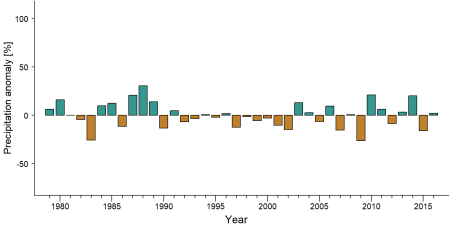
Precipitation anomaly in Grebo-Krahn National Park -
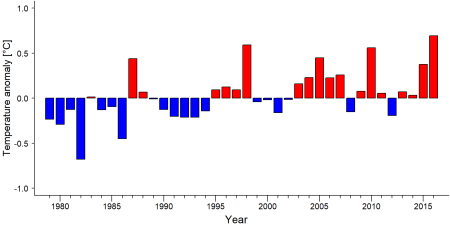
Temperature anomaly in Grebo-Krahn National Park


External links
References
Barrie, A., Zwuen, S., Kota, A.N., Lou, M. Sr, Luke, R. 2007. Rapid survey of large mammals of North Lorma, Gola and Grebo National Forests. In A Rapid Biological Assessment of North Lorma, Gola and Grebo National Forests, Liberia (eds P. Hoke, R. Demey & A. Peal), pp. 59–64. Conservation International, Washington, DC, USA.
Furnell, S., Dowd, D., Tweh, C., Zoro Gone Bi, I.B., Vergenes, V., Normand, E., Boesch, C. 2015. Report on phase 2 in the proposed Grebo-Krahn National Park (February-June 2015) Report. Wild Chimpanzee Foundation, Abidjan, Côted’Ivoire.
Kouakou, C.Y., Vergnes, V., V., Dowd D., Normand, E., Boesch, C. 2012. Large mammal survey and monitoring of chimpanzees in Grebo National Forest, Liberia (February-August 2012) Report. Wild Chimpanzee Foundation & the Forestry Development Authority, Monrovia, Liberia.
Kouakou, C.Y., Vergnes, Normand, E., Boesch, C. 2013. Report of the survey undertaken in the proposed Grebo National Park (February-March 2013) Report. Wild Chimpanzee Foundation, Abidjan, Côted’Ivoire.
Kouakou, Y. C., Dowd, D., Tweh, C., Zoro Gone, B.I. I. B., Vergnes, V., Normand, E., & Boesch, C. (2014). Biomonitoring in the Proposed Grebo National Park, Liberia: REPORT ON PHASE 1 IN THE PROPOSED GREBO NATIONAL PARK (February-July 2014). Wild Chimpanzee Foundation (WCF) ;Forestry Development Authority (FDA).
Kühl, H. S., Sop, T., Williamson, E. A., Mundry, R., Brugière, D., Campbell, G., …, & Boesch, C. (2017). The Critically Endangered western chimpanzee declines by 80%. American Journal of Primatology, 79(9), e22681. doi:10.1002/ajp.22681
Tweh, C. G., Lormie, M. M., Kouakou, C. Y., Hillers, A., Kühl, H. S., & Junker, J. (2015). Conservation status of chimpanzees Pan troglodytes verus and other large mammals in Liberia: a nationwide survey. Oryx, 49(4), 710-718. doi:10.1017/s0030605313001191
Wild Chimpanzee Foundation. 2019. Activities of the Wild Chimpanzee Foundation for improved conservation of chimpanzees and their habitat in West Africa. Annual Report 2018.
Wild Chimpanzee Foundation. 2018. Activities of the Wild Chimpanzee Foundation for improved conservation of chimpanzees and their habitat in West Africa. Annual Report 2017.
Wild Chimpanzee Foundation. 2017. Activities of the Wild Chimpanzee Foundation for improved conservation of chimpanzees and their habitat in West Africa. Annual Report 2016.
Kiribou, R., Tehoda, P., Chukwu, O., Bempah, G., Kühl, H. S., Ferreira, J., …, & Heinicke, S. (2024). Exposure of African ape sites to climate change impacts. PLOS Climate, 3(2), 1-19. doi:10.1371/journal.pclm.0000345
Page created by: APES Atlas Team Date: 2019-08-30