
Mont Fouari: Difference between revisions
No edit summary Tag: Reverted |
No edit summary Tag: Manual revert |
||
| Line 385: | Line 385: | ||
<span id="R01236"></span>Inkamba, N. C., Nganga, I., Diahouakou, R. et Moussoukou Mpemba, E. (2007). Sondage écologique des mammifères dans quelques aires protégées dans le district de Nyanga. Rapport WCS-CNIAF, 37p. | <span id="R01236"></span>Inkamba, N. C., Nganga, I., Diahouakou, R. et Moussoukou Mpemba, E. (2007). Sondage écologique des mammifères dans quelques aires protégées dans le district de Nyanga. Rapport WCS-CNIAF, 37p. | ||
<span id="R02267"></span>Kiribou, R., Tehoda, P., Chukwu, O., Bempah, G., Kühl, H. S., Ferreira, J., …, & Heinicke, S. (2024). Exposure of African ape sites to climate change impacts. ''PLOS Climate'', 3(2), | <span id="R02267"></span>Kiribou, R., Tehoda, P., Chukwu, O., Bempah, G., Kühl, H. S., Ferreira, J., …, & Heinicke, S. (2024). Exposure of African ape sites to climate change impacts. ''PLOS Climate'', 3(2), e0000345. [https://doi.org/10.1371/journal.pclm.0000345 doi:10.1371/journal.pclm.0000345] | ||
'''Page created by: '''Clement Inkamba Nkulu, Principal investigator for WCS Bateke plateau''' Date:''' 2022-04-04 | '''Page created by: '''Clement Inkamba Nkulu, Principal investigator for WCS Bateke plateau''' Date:''' 2022-04-04 | ||
Latest revision as of 17:54, 15 October 2026
Central Africa > Republic of the Congo > Mont Fouari
Français | Português | Español | Bahasa Indonesia | Melayu
Summary
- Central chimpanzees (Pan troglodytes troglodytes) are present in Mont Fouari.
- The population size is unknown.
- The chimpanzee population trend is unknown.
- The site has a total size of 156 km².
- Key threats to chimpanzees are hunting, logging, and agricultural expansion.
- Conservation activities have focused on raising awareness in local communities.

Site characteristics
The site is located in southwestern Republic of Congo, bordering Gabon, in the Department of Niari, Nyanga district. Wildlife species inhabiting the area include forest elephants (Loxodonta cyclotis), buffalos (Syncerus caffer nanus), sitatungas (Tragelaphus spekei), Defassa waterbuck (Kobus ellipsiprymnus defassa), Harnessed bushbucks (Tragelaphus scriptus), red river hogs (Potamochoerus porcus), six duiker species (Cephalophus sp.), wild cats and diurnal monkeys (e.g., Cercopithecus nictitans, C. cephus and Miopithecus ogouensis) (Inkamba Nkulu pers. comm. 2022).
Table 1. Basic site information for Mont Fouari
| Species | Pan troglodytes troglodytes |
| Area | 156 km² |
| Coordinates | Lat: -2.765613 , Lon: 11.686915 |
| Type of site | Unknown |
| Habitat types | Subtropical/tropical moist lowland forest, Savanna |
| Type of governance |
Types of sites Governance types Habitat types
Ape status
Table 2. Ape population estimates reported for Mont Fouari
| Species | Year | Occurrence | Encounter or vistation rate (nests/km; ind/day) | Density estimate [ind./ km²] (95% CI) | Abundance estimate (95% CI) | Survey area | Sampling method | Analytical framework | Source | Comments | A.P.E.S. database ID |
|---|---|---|---|---|---|---|---|---|---|---|---|
| Pan troglodytes troglodytes | 2005 | 0.07 | Mont Fouari | Reconnaissance walk | WCS 2007 as cited by Inkamba Nkulu pers. comm. 2022 |
Sampling methods Analytical frameworks
Threats
The main threats at the site include poaching for consumption and bushmeat trade, and destruction of habitat due to logging and agricultural expansion (Inkamba Nkulu pers. comm. 2022).
Table 3. Threats to apes reported for Mont Fouari
| Category | Specific threats | Threat level | Description | Year of threat |
|---|---|---|---|---|
| 2 Agriculture & aquaculture | 2.1 Annual & perennial non-timber crops | Present (unknown severity) | Presence of agricultural fields (Inkamba Nkulu pers. comm. 2022). | Ongoing (2022) |
| 4 Transportation & service corridors | 4.1 Roads & railroads | Present (unknown severity) | Presence of roads from Madanda to the west of the Mont Fouari reserve and from Dolisie to Ngongo village, which is the border of Gabon (Inkamba Nkulu pers. comm. 2022). | Ongoing (2022) |
| 5 Biological resource use | 5.1 Hunting & collecting terrestrial animals | Present (unknown severity) | Poachers are hunting chimps in the area for bushmeat consumption and trade (Inkamba Nkulu pers. comm. 2022). | Ongoing (2022) |
| 5 Biological resource use | 5.3 Logging & wood harvesting | Present (unknown severity) | Presence of a bulldozer destined for logging, from a Gabonese operator (Inkamba Nkulu pers. comm. 2022). | 2005 |
Conservation activities
WCS and CNIAF organised an ecological survey in 2005 in several protected areas and protection zones in order to assess the conservation status of these sites (Inkamba Nkulu pers. comm. 2022).
Table 4. Conservation activities reported for Mont Fouari
| Category | Specific activity | Description | Implementing organization(s) | Year of activity |
|---|---|---|---|---|
| 2 Counter-wildlife crime | 2.10 Inform hunters of the dangers (e.g., disease transmission) of handling ape meat | Community members are asked not to hunt and consume chimpanzees because primates in general may transmit Ebola (Inkamba Nkulu pers. comm. 2022). | Ongoing (2022) | |
| 4 Education & awareness | 4.1 Educate local communities about apes and sustainable use | Communications to the public for the protection of primate habitats (Inkamba Nkulu pers. comm. 2022). | Ongoing (2022) | |
| 5 Protection & restoration | 5.2 Legally protect ape habitat | The site is a protected area (Inkamba Nkulu pers. comm. 2022). | Ongoing (2022) |

Challenges
Table 5. Challenges reported for Mont Fouari
| Challenges | Specific challenges | Source | Year(s) |
|---|---|---|---|
| 2 Resources and capacity | 2.2 Lack of staff | Inkamba Nkulu pers. comm. 2022 | |
| 2 Resources and capacity | 2.3 General lack of funding | Inkamba Nkulu pers. comm. 2022 | |
| 4 Institutional support | 4.1 Lack of law enforcement | Inkamba Nkulu pers. comm. 2022 |
Enablers
Table 6. Enablers reported for Mont Fouari
| Enablers | Specific enablers | Source | Year(s) |
|---|---|---|---|
| 1 Site management | |||
| 2 Resources and capacity | |||
| 3 Engaged community | |||
| 4 Institutional support | |||
| 5 Ecological context | |||
| 6 Safety and stability |
Research activities
The only known study at the site is the 2005 inventory conducted by WCS and CNIAF with the objective to investigate wildlife conservation status and human impact on the protected area in this region (Inkamba et al. 2007).
Documented behaviours
Table 7. Behaviours documented for Mont Fouari
| Category | Behavior | Observation type | Prevalence | Observation dates | Source | Habituation | Species | Comment |
|---|---|---|---|---|---|---|---|---|
| Not reported |
Exposure to climate change impacts
As part of a study on the exposure of African great ape sites to climate change impacts, Kiribou et al. (2024) extracted climate data and data on projected extreme climate impact events for the site. Climatological characteristics were derived from observation-based climate data provided by the Inter-Sectoral Impact Model Intercomparison Project (ISIMIP, www.isimip.org). Parameters were calculated as the average across each 30-year period. For 1981-2010, the EWEMBI dataset from ISIMIP2a was used. For the two future periods (2021-2050 and 2071-2099) ISIMIP2b climate data based on four CMIP5 global climate models were used. For future projections, two Representative Concentration Pathways (RCP) were used. RCP 2.6 is a scenario with strong mitigation measures in which global temperatures would likely rise below 2C. RCP 6.0 is a scenario with medium emissions in which global temperatures would likely rise up to 3C by 2100. For the number of days with heavy precipitation events, the 98th percentile of all precipitation days (>1mm/d) was calculated for the 1979-2013 reference period as a threshold for a heavy precipitation event. Then, for each year, the number of days above that threshold was derived. The figures on temperature and precipitation anomaly show the deviation from the mean temperature and mean precipitation for the 1979-2013 reference period.
The estimated exposure to future extreme climate impact events (crop failure, drought, river flood, wildfire, tropical cyclone, and heatwave) is based on a published dataset by Lange et al. 2020 derived from ISIMIP2b data. The same global climate models and RCPs as described above were used. Within each 30-year period, the number of years with an extreme event and the average proportion of the site affected were calculated (Kiribou et al. 2024).
Table 8. Estimated past and projected climatological characteristics in Mont Fouari
| Value | 1981-2010 | 2021-2050, RCP 2.6 | 2021-2050, RCP 6.0 | 2071-2099, RCP 2.6 | 2071-2099, RCP 6.0 |
|---|---|---|---|---|---|
| Mean temperature [C] | 25.1 | 26.2 | 26.1 | 26.3 | 27.4 |
| Annual precipitation [mm] | 2104 | 2164 | 2093 | 2148 | 2077 |
| Max no. consecutive dry days (per year) | 81.3 | 50.5 | 45.8 | 50.2 | 43.7 |
| No. days with heavy precipitation (per year) | 6.1 | 8.1 | 6.8 | 7.6 | 7.4 |
Table 9. Projected exposure of apes to extreme climate impact events in Mont Fouari
| Type | No. of years with event (2021-2050, RCP 2.6) | % of site exposed (2021-2050, RCP 2.6) | No. of years with event (2021-2050, RCP 6.0) | % of site exposed (2021-2050, RCP 6.0) | No. of years with event (2070-2099, RCP 2.6) | % of site exposed (2070-2099, RCP 2.6) | No. of years with event (2070-2099, RCP 6.0) | % of site exposed (2070-2099, RCP 6.0) |
|---|---|---|---|---|---|---|---|---|
| Crop failure | 6 | 0.3 | 6 | 0.31 | 3.5 | 0.3 | 12.5 | 0.32 |
| Drought | 0 | 0 | 0 | 0 | 0 | 0 | 0 | 0 |
| Heatwave | 14 | 67.86 | 14.5 | 79.17 | 11 | 74.17 | 17 | 90.44 |
| River flood | 0.5 | 0.31 | 1.5 | 0.8 | 2 | 0.65 | 5.25 | 2.12 |
| Tropical cyclone | 0 | 0 | 0 | 0 | 0 | 0 | 0 | 0 |
| Wildfire | 30 | 0.14 | 30 | 0.14 | 29 | 0.14 | 29 | 0.14 |
-
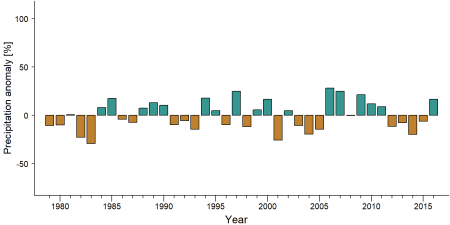
Precipitation anomaly in Mont Fouari -
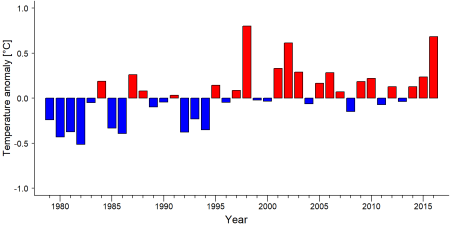
Temperature anomaly in Mont Fouari


External links
References
Inkamba, N. C., Nganga, I., Diahouakou, R. et Moussoukou Mpemba, E. (2007). Sondage écologique des mammifères dans quelques aires protégées dans le district de Nyanga. Rapport WCS-CNIAF, 37p.
Kiribou, R., Tehoda, P., Chukwu, O., Bempah, G., Kühl, H. S., Ferreira, J., …, & Heinicke, S. (2024). Exposure of African ape sites to climate change impacts. PLOS Climate, 3(2), e0000345. doi:10.1371/journal.pclm.0000345
Page created by: Clement Inkamba Nkulu, Principal investigator for WCS Bateke plateau Date: 2022-04-04