
UFA 10-012 ZIC30
Central Africa > Cameroon > UFA 10-012_ZIC30
Français | Português | Español | Bahasa Indonesia | Melayu
Summary
Site characteristics
UFA 10-012 / ZIC 30, part of the Tri-National de la Sangha (TNS) UNESCO World Heritage site, harbors endangered species like gorillas and elephants. Its forests are ecologically vital as carbon sinks and culturally significant to local communities. Research supports conservation strategies addressing habitat loss and hunting (Beukou et al., 2019).
Table 1. Basic site information for UFA 10-012_ZIC30
| Species | Pan troglodytes troglodytes, Gorilla gorilla gorilla |
| Area | 745.04 km² |
| Coordinates | Lat: 2.523267 , Lon: 15.827954 |
| Type of site | Logging concession and community managed hunting interest zone |
| Habitat types | Subtropical/tropical moist lowland forest |
| Type of governance | Shared governance |
Types of sites Governance types Habitat types
Ape status
Table 2. Ape population estimates reported for UFA 10-012_ZIC30
| Species | Year | Occurrence | Encounter or vistation rate (nests/km; ind/day) | Density estimate [ind./ km²] (95% CI) | Abundance estimate (95% CI) | Survey area | Sampling method | Analytical framework | Source | Comments | A.P.E.S. database ID |
|---|---|---|---|---|---|---|---|---|---|---|---|
| Gorilla gorilla gorilla | 2018 | 1.82 (1.25-2.65) | 1,358 (933-1,977) | UFA 10-012_ZIC30 (745 km²) | Line transects | Distance sampling with survey specific decay time | Beukou et al. 2019, WWF Cameroon | ||||
| Pan troglodytes troglodytes & Gorilla gorilla gorilla | 2018 | 2.28 (1.64-3.19) | 1,703 (1,221-2,375) | UFA 10-012_ZIC30 (745 km²) | Line transects | Distance sampling with survey specific decay time | Beukou et al. 2019, WWF Cameroon | ||||
| Gorilla gorilla gorilla | 2015 | 2.07 (1.41-3.03) | 1,544 (1,055-2,261) | UFA 10-012_ZIC30 (745 km²) | Line transects | Distance sampling with survey specific decay time | Beukou et al. 2019, WWF Cameroon | ||||
| Pan troglodytes troglodytes & Gorilla gorilla gorilla | 2015 | 2.06 (1.42-2.95) | 1,524 (1,058-2,197) | UFA 10-012_ZIC30 (745 km²) | Line transects | Distance sampling with survey specific decay time | Beukou et al. 2019, WWF Cameroon |
Sampling methods Analytical frameworks
Threats
Table 3. Threats to apes reported for UFA 10-012_ZIC30
| Category | Specific threats | Threat level | Description | Year of threat |
|---|---|---|---|---|
| 5 Biological resource use | 5.1 Hunting & collecting terrestrial animals | High (more than 70% of population affected) | Intensified poaching due to increased access from logging activities and the spread of hunting zones in the periphery (Beukou et al. 2019). Increased sport hunting pressure in the periphery of the zone, particularly affecting large mammal populations (Beukou et al. 2019). | 2005-Ongoing (2018) |
| 5 Biological resource use | 5.3 Logging & wood harvesting | High (more than 70% of population affected) | Logging activities contribute to habitat fragmentation and increased human access, leading to more poaching and disturbances in ape habitats (Beukou et al. 2019). | 2015-Ongoing (2018) |
| 6 Human intrusions & disturbance | 6.2 War, civil unrest & military exercises | Medium (30-70% of population affected) | Increased conflict and poaching pressures in areas bordering the Central African Republic, particularly due to the illegal circulation of arms (Beukou et al. 2019). | 2015-Ongoing (2018) |
Conservation activities
Table 4. Conservation activities reported for UFA 10-012_ZIC30
| Category | Specific activity | Description | Implementing organization(s) | Year of activity |
|---|---|---|---|---|
| 2 Counter-wildlife crime | 2.3 Conduct regular anti-poaching patrols | Regular patrols to reduce poaching and illegal hunting, supported by local and military teams (Beukou et al. 2019). | Faro Lobéké, World Wildlife Fund, Local authorities, , | 2015-Ongoing (2018) |
| 2 Counter-wildlife crime | 2.6 Regularly de-activate/remove ground snares | Regular monitoring and removal of snares to prevent accidental injuries to apes and other wildlife (Beukou et al. 2019). | Faro Lobéké, World Wildlife Fund, Local Community Rangers | 2015-Ongoing (2018) |
| 4 Education & awareness | 4.1 Educate local communities about apes and sustainable use | Environmental education programs to involve local communities in the management of ape populations and ecosystems (Beukou et al. 2019). | World Wildlife Fund, Local authorities, Community Leaders | 2015-Ongoing (2018) |
| 5 Protection & restoration | 5.5 Demarcate and enforce boundaries of protected areas | Marking boundaries of the ZIC to minimize illegal encroachment, ensuring sustainable use of resources (Beukou et al. 2019). | World Wildlife Fund, Minitry of Forestry and Wildlife | 2015-Ongoing (2018) |
| 7 Economic & other incentives | 7.1 Provide monetary benefits to local communities for sustainably managing their forest and its wildlife (e.g., REDD, alternative income, employment) | Engage communities through eco-tourism and sustainable forest management programs, offering economic alternatives (Beukou et al. 2019). | Worldwildlife Fund, Local Authorities, International Donors | 2015-Ongoing (2018) |
Challenges
Table 5. Challenges reported for UFA 10-012_ZIC30
| Challenges | Specific challenges | Source | Year(s) |
|---|---|---|---|
| 2 Resources and capacity | 2.3 General lack of funding | Beukou et al. 2019 | 2005-Ongoing (2018) |
| 2 Resources and capacity | 2.7 Lack of infrastructure | Beukou et al. 2019 | 2005-Ongoing (2018) |
| 3 Engaged community | 3.1 General lack of community engagement or support | Beukou et al. 2019 | 2005-Ongoing (2018) |
| 4 Institutional support | 4.1 Lack of law enforcement | Beukou et al. 2019 | 2005-Ongoing (2018) |
| 6 Safety and stability | 6.2 Insecurity | Beukou et al. 2019 | 2005-Ongoing (2018) |
Enablers
Table 6. Enablers reported for UFA 10-012_ZIC30
| Enablers | Specific enablers | Source | Year(s) |
|---|---|---|---|
| 1 Site management | 1.2 Effective coordination | Beukou et al. 2019 | 2005-Ongoing (2018) |
| 2 Resources and capacity | 2.6 External partnerships that add expertise or resources | Beukou et al. 2019 | 2005-Ongoing (2018) |
| 4 Institutional support | 4.2 Strong government support | Beukou et al. 2019 | 2005-Ongoing (2018) |
Research activities
Research activities are conducted in UFA 10-012 / ZIC 30, focusing on wildlife monitoring, including elephants and great apes, and assessing human pressures like hunting. These efforts, led by the WWF Jengi-TNS program in collaboration with MINFOF, utilize methods like distance sampling to guide conservation strategies, Beukou et al. 2019.
Documented behaviours
Table 7. Behaviours documented for UFA 10-012_ZIC30
| Category | Behavior | Observation type | Prevalence | Observation dates | Source | Habituation | Species | Comment |
|---|---|---|---|---|---|---|---|---|
| Nest Building | Beukou et al. 2019 | |||||||
| Feeding patterns | Beukou et al. 2019 |
Exposure to climate change impacts
As part of a study on the exposure of African great ape sites to climate change impacts, Kiribou et al. subm. extracted climate data and data on projected extreme climate impact events for the site. Climatological characteristics were derived from observation-based climate data provided by the Inter-Sectoral Impact Model Intercomparison Project (ISIMIP, www.isimip.org). Parameters were calculated as the average across each 30-year period. For 1981-2010, the EWEMBI dataset from ISIMIP2a was used. For the two future periods (2021-2050 and 2071-2099) ISIMIP2b climate data based on four CMIP5 global climate models were used. For future projections, two Representative Concentration Pathways (RCP) were used. RCP 2.6 is a scenario with strong mitigation measures in which global temperatures would likely rise below 2C. RCP 6.0 is a scenario with medium emissions in which global temperatures would likely rise up to 3C by 2100. For the number of days with heavy precipitation events, the 98th percentile of all precipitation days (>1mm/d) was calculated for the 1979-2013 reference period as a threshold for a heavy precipitation event. Then, for each year, the number of days above that threshold was derived. The figures on temperature and precipitation anomaly show the deviation from the mean temperature and mean precipitation for the 1979-2013 reference period.
The estimated exposure to future extreme climate impact events (crop failure, drought, river flood, wildfire, tropical cyclone, and heatwave) is based on a published dataset by Lange et al. 2020 derived from ISIMIP2b data. The same global climate models and RCPs as described above were used. Within each 30-year period, the number of years with an extreme event and the average proportion of the site affected were calculated (see Kiribou et al. subm. for details).
Table 8. Estimated past and projected climatological characteristics in UFA 10-012_ZIC30
| Value | 1981-2010 | 2021-2050, RCP 2.6 | 2021-2050, RCP 6.0 | 2071-2099, RCP 2.6 | 2071-2099, RCP 6.0 |
|---|---|---|---|---|---|
| Mean temperature [C] | 24.7 | 26 | 25.9 | 26.3 | 27.3 |
| Annual precipitation [mm] | 1523 | 1520 | 1567 | 1583 | 1572 |
| Max no. consecutive dry days (per year) | 23.3 | 22.3 | 23.6 | 18.8 | 22.8 |
| No. days with heavy precipitation (per year) | 6.6 | 9.9 | 11.4 | 10.9 | 12.7 |
Table 9. Projected exposure of apes to extreme climate impact events in UFA 10-012_ZIC30
| Type | No. of years with event (2021-2050, RCP 2.6) | % of site exposed (2021-2050, RCP 2.6) | No. of years with event (2021-2050, RCP 6.0) | % of site exposed (2021-2050, RCP 6.0) | No. of years with event (2070-2099, RCP 2.6) | % of site exposed (2070-2099, RCP 2.6) | No. of years with event (2070-2099, RCP 6.0) | % of site exposed (2070-2099, RCP 6.0) |
|---|---|---|---|---|---|---|---|---|
| Crop failure | 13 | 0 | 6 | 0 | 13 | 0 | 17 | 0 |
| Drought | 0 | 0 | 0 | 0 | 0 | 0 | 0.5 | 25 |
| Heatwave | 4 | 50 | 3 | 100 | 4 | 100 | 10.5 | 100 |
| River flood | 0 | 0 | 0.75 | 0.34 | 0.5 | 0 | 1 | 0.05 |
| Tropical cyclone | 0 | 0 | 0 | 0 | 0 | 0 | 0 | 0 |
| Wildfire | 30 | 0.65 | 30 | 0.76 | 29 | 0.58 | 29 | 0.65 |
-
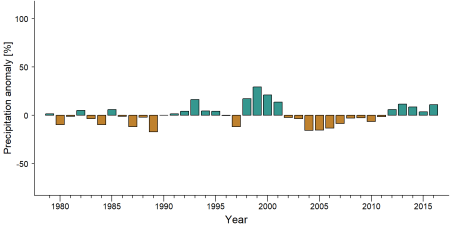
Precipitation anomaly in UFA 10-012_ZIC30 -
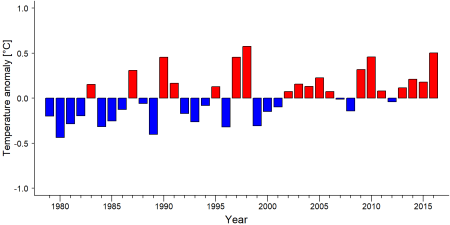
Temperature anomaly in UFA 10-012_ZIC30


External links
References
Beukou, B., Sombambo, M., Nzooh, Z., N’Goran, K. P., Hessana, D., Sebogo, L., & Mengamenya, A. (2019). Population dynamics of large and medium-sized mammals in the Cameroon segment of the Sangha Tri-National (TNS) landscape (MINFOF–WWF technical report). MINFOF – WWF.
Page created by: Onella Mundi Date: 2024-11-30 08:36:00