
Loango National Park
Central Africa > Gabon > Loango National Park
Français | Português | Español | Bahasa Indonesia | Melayu
Summary
- Central chimpanzees (Pan troglodytes troglodytes) & western lowland gorillas (Gorilla gorilla gorilla) are present in Loango National Park.
- The population sizes are unknown.
- The population trends are unknown.
- The site has a total size of 1,550 km².
- Key threats to great apes include poaching, disturbance due to tourism and human presence and oil exploration.
- Conservation activities have focused on anti-poaching patrols and involving local communities in research activities.

Site characteristics
Loango National Park is located in the south west of Gabon and borders the Atlantic Ocean. It consists of a mosaic of different habitat types varying from marine, coastal lagoons, mangrove swamps, coastal forest, secondary and primary forest and open savannah. It is ecologically distinct from other long-term chimpanzee sites thereby providing the rare opportunity to enable unique insights into chimpanzees’ behavioral plasticity (REF). In addition to central chimpanzees, the national park is also home to western low-land gorillas (Gorilla gorilla gorilla), forest buffaloes (Syncerus caffer), forest elephants (Loxodonta cyclotis), as well as several resident and migratory bird species, such as rosy bee-eaters (Merops malimbicus) (REF).
Table 1. Basic site information for Loango National Park
| Species | Pan troglodytes troglodytes |
| Area | 1,550 km² |
| Coordinates | Lat: -2.118840 , Lon: 9.605397 |
| Type of site | Protected area (National Park) |
| Habitat types | Subtropical/tropical moist lowland forest, Subtropical/tropical swamp forest, Marine coastal/supratidal |
| Type of governance |
Types of sites Governance types Habitat types

Ape status
To date there has only been one survey conducted regarding chimpanzee abundance in Loango National park. This was done through the collection of wild chimpanzee fecal samples for genetic capture-recapture analyses over a four-year period (2005-2008) in a 132 km2 area of the National Park (Arandjelovic et al. 2011).
Table 2. Ape population estimates reported for Loango National Park
| Species | Year | Occurrence | Encounter or vistation rate (nests/km; ind/day) | Density estimate [ind./ km²] (95% CI) | Abundance estimate (95% CI) | Survey area | Sampling method | Analytical framework | Source | Comments | A.P.E.S. database ID |
|---|---|---|---|---|---|---|---|---|---|---|---|
| Pan troglodytes troglodytes | 2005-2008 | 2.14 (1.57-2.39) | 283 (208-316) | 132 km² | Reconnaissance walk | Arandjelovic et al. 2011 |
Sampling methods Analytical frameworks
Threats
Gabon boasts an important store of natural resources, the most prominent being oil. In 2006 and 2007 a petroleum company conducted seismic exploration inside Loango National Park (Rabanal et al. 2010). It has been shown that the most common behavioral change exhibited by wildlife to intense human-produced noise is active avoidance. The study modeled seismic impact over different spatial scales (small, intermediate and large) and found that apes avoided seismic activity on the intermediate and small scales (REF).
Additionally, hunting, although relatively non-existent around the study site, may pose a threat to ape populations in other areas of the park such as the forest inlets boarding the lagoon (REF).
Lastly, health risks related to human-chimpanzee disease transmission may be increased due to increased human presence in the park and the potential for new ecotourism ventures (REF).
Table 3. Threats to apes reported for Loango National Park
| Category | Specific threats | Threat level | Description | Year of threat |
|---|---|---|---|---|
| 3 Energy production & mining | 3.1 Oil & gas drilling | Medium (30-70% of population affected) | Effect of seismic oil exploration on large mammal distribution (Rabanal et al. 2010) | 2006-2007 |
| 5 Biological resource use | 5.1 Hunting & collecting terrestrial animals | Low (up to 30% of population affected) | Signs of poacher trails in the far North of the territory (Southern pers obs 2021). | Ongoing (2021) |
| 6 Human intrusions & disturbance | 6.1 Recreational activities | Low (up to 30% of population affected) | Loango National park is open to tourism and therefore there is the possibility of exposure of apes to humans outside of the research area. Additionally, vehicles for safari outings may pose a disturbance to ape populations along these routes. | Ongoing (2021) |
| 6 Human intrusions & disturbance | 6.3 Other human disturbances | Low (up to 30% of population affected) | The very presence of the research camp itself poses a disturbance to great apes and territory avoidance may take place. | Ongoing (2021) |

Conservation activities
In 2005 the first research camp was set up as a Pan African Programme (PanAf) study site, and this later became the Ozouga camp and base of the Loango Chimpanzee Project. The establishment of this site ensures the continued presence of researchers in the study area, which, at other sites, has been shown to have a positive influence on local chimpanzee densities (Campbell et al. 2011).
There is a strong connection and collaboration between the local people, primarily of the Miene (Myene) ethnicity, and the research site. At present, five permanent eco-guides native to the area are employed. Their direct involvement at this research site make them important stakeholders for the future of the park and the livelihood of those living around it. Additionally, educational programs and activities have been conducted in the village that borders the Northern edge of the park; these were performed in partnership with WCS (Southern pers. comm.).
Table 4. Conservation activities reported for Loango National Park
| Category | Specific activity | Description | Implementing organization(s) | Year of activity |
|---|---|---|---|---|
| 2 Counter-wildlife crime | 2.3 Conduct regular anti-poaching patrols | Anti-poaching patrols are conducted regularly by the ANPN. | Ongoing (2021) | |
| 4 Education & awareness | 4.2 Involve local community in ape research and conservation management | The Loango Chimpanzee project has recruited members of the local community as guides who are trained to collect data since 2006. | 2006-Ongoing (2021) | |
| 5 Protection & restoration | 5.2 Legally protect ape habitat | 2002-Ongoing (2025) |

Challenges
Table 5. Challenges reported for Loango National Park
| Challenges | Specific challenges | Source | Year(s) |
|---|---|---|---|
| Not reported |
Enablers
Table 6. Enablers reported for Loango National Park
| Enablers | Specific enablers | Source | Year(s) |
|---|---|---|---|
| 1 Site management | |||
| 2 Resources and capacity | |||
| 3 Engaged community | |||
| 4 Institutional support | |||
| 5 Ecological context | |||
| 6 Safety and stability |
Research activities
Documented behaviours
Table 7. Behaviours documented for Loango National Park
| Category | Behavior | Observation type | Prevalence | Observation dates | Source | Habituation | Species | Comment |
|---|---|---|---|---|---|---|---|---|
| Ant eating without tools | SOURCE | |||||||
| Bathing | SOURCE | |||||||
| Branch dragging | SOURCE | |||||||
| Branch shaking | SOURCE | |||||||
| Buttress beating | SOURCE | |||||||
| Fruit cleaning | SOURCE | |||||||
| Honey eating | SOURCE | |||||||
| Honey eating with tools | Estienne et al. 2015, 2017, 2019 | |||||||
| Honey extraction with tools | Estienne et al. 2015, 2017, 2019; Boesch et al. 2009 | |||||||
| Honey extraction without tools | Estienne et al. 2015, 2017, 2019 | |||||||
| Hunting and meat eating | Pika et al. 2019 | |||||||
| Leaf cushion | SOURCE | |||||||
| Leaf sponging for drinking water | SOURCE | |||||||
| Lethal intragroup aggression | Martinez-inigo et al. (in press) | |||||||
| Termite eating without tools | SOURCE |
Exposure to climate change impacts
As part of a study on the exposure of African great ape sites to climate change impacts, Kiribou et al. subm. extracted climate data and data on projected extreme climate impact events for the site. Climatological characteristics were derived from observation-based climate data provided by the Inter-Sectoral Impact Model Intercomparison Project (ISIMIP, www.isimip.org). Parameters were calculated as the average across each 30-year period. For 1981-2010, the EWEMBI dataset from ISIMIP2a was used. For the two future periods (2021-2050 and 2071-2099) ISIMIP2b climate data based on four CMIP5 global climate models were used. For future projections, two Representative Concentration Pathways (RCP) were used. RCP 2.6 is a scenario with strong mitigation measures in which global temperatures would likely rise below 2C. RCP 6.0 is a scenario with medium emissions in which global temperatures would likely rise up to 3C by 2100. For the number of days with heavy precipitation events, the 98th percentile of all precipitation days (>1mm/d) was calculated for the 1979-2013 reference period as a threshold for a heavy precipitation event. Then, for each year, the number of days above that threshold was derived. The figures on temperature and precipitation anomaly show the deviation from the mean temperature and mean precipitation for the 1979-2013 reference period.
The estimated exposure to future extreme climate impact events (crop failure, drought, river flood, wildfire, tropical cyclone, and heatwave) is based on a published dataset by Lange et al. 2020 derived from ISIMIP2b data. The same global climate models and RCPs as described above were used. Within each 30-year period, the number of years with an extreme event and the average proportion of the site affected were calculated (see Kiribou et al. subm. for details).
Table 8. Estimated past and projected climatological characteristics in Loango National Park
| Value | 1981-2010 | 2021-2050, RCP 2.6 | 2021-2050, RCP 6.0 | 2071-2099, RCP 2.6 | 2071-2099, RCP 6.0 |
|---|---|---|---|---|---|
| Mean temperature [C] | 26.1 | 27.1 | 27 | 27.2 | 28.3 |
| Annual precipitation [mm] | 3654 | 3670 | 3569 | 3862 | 3553 |
| Max no. consecutive dry days (per year) | 67.7 | 51.9 | 48 | 49.5 | 42.7 |
| No. days with heavy precipitation (per year) | 5.7 | 9.9 | 10.1 | 10.4 | 10.5 |
Table 9. Projected exposure of apes to extreme climate impact events in Loango National Park
| Type | No. of years with event (2021-2050, RCP 2.6) | % of site exposed (2021-2050, RCP 2.6) | No. of years with event (2021-2050, RCP 6.0) | % of site exposed (2021-2050, RCP 6.0) | No. of years with event (2070-2099, RCP 2.6) | % of site exposed (2070-2099, RCP 2.6) | No. of years with event (2070-2099, RCP 6.0) | % of site exposed (2070-2099, RCP 6.0) |
|---|---|---|---|---|---|---|---|---|
| Crop failure | 1.5 | 0 | 2 | 0 | 3 | 0 | 12 | 0 |
| Drought | 0 | 0 | 0 | 0 | 0 | 0 | 0 | 0 |
| Heatwave | 3 | 100 | 7 | 100 | 5.5 | 100 | 7.5 | 100 |
| River flood | 3.75 | 3.3 | 1.5 | 1.28 | 1.5 | 1.46 | 2.75 | 2.35 |
| Tropical cyclone | 0 | 0 | 0 | 0 | 0 | 0 | 0 | 0 |
| Wildfire | 11 | 0 | 10 | 0 | 11 | 0 | 9.5 | 0.01 |
-
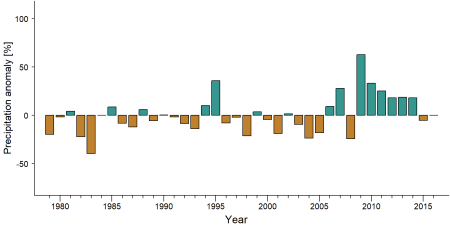
Precipitation anomaly in Loango National Park -
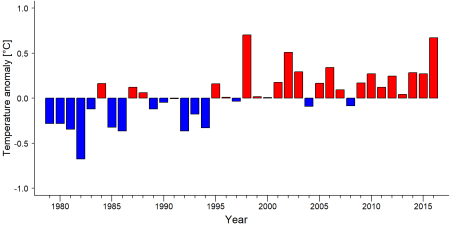
Temperature anomaly in Loango National Park


External links
The Loango Chimpanzee Project in Gabon
References
Arandjelovic, M., Head, J., Rabanal, L. I., Schubert, G., Mettke, E., Boesch, C., Robbins, M. M., & Vigilant, L. (2011). Non-Invasive genetic monitoring of wild central chimpanzees. PLoS ONE,6(3): e14761.
Boesch, C., Head, J., & Robbins, M. M. (2009). Complex tool sets for honey extraction among chimpanzees in Loango National Park, Gabon. Journal of Human Evolution, 56(6), 560-569.
Estienne, V. L., Robira, B., Mundry, R., Deschner, T., & Boesch, C. (2019). Acquisition of a complex extractive technique by the immature chimpanzees of Loango National Park, Gabon. Animal Behaviour, 147, 61-76.
Estienne, V., Mundry, R., Kuehl, H.S., Boesch, C. (2017). Exploitation of underground bee nests by three sympatric consumers in Loango National Park, Gabon. Biotropica, 49(1), 101-109.
Estienne V, Stephens C, Boesch C. (2017). Extraction of honey from underground bee nests by central African chimpanzees (Pan troglodytes troglodytes) in Loango National Park, Gabon: Techniques and individual differences. Am J Primatol, 79(1).
Estienne, V. L. (2017). Tool-use technique for the extraction of underground honey by central African chimpanzees in Loango National Park, Gabon. PhD Thesis, Universität, Leipzig.
Estienne, V., & Boesch, C. (2015). Underground honey extraction by chimpanzees, honey badgers and forest elephants in Loango National Park, Gabon. Folia Primatologica, 86(4), 276-277.
Martinez-inigo, L., Baas, P., Klein, H., Pika, S., Deschner T. (in press). Intercommunity interactions and killings in central chimpanzees (Pan troglodytes troglodytes) from Loango National Park, Gabon. Primates.
Rabanal, L. I., Kuehl, H., Mundry, R., Robbins, M. M., & Boesch, C. (2010). Oil prospecting and its impact on large rainforest mammals in Loango National Park, Gabon. Biological Conservation, 143(4), 1017-1024.
Pika, S., Klein, H., Bunel, S., Baas, P., Théleste, E., & Deschner, T. (2019). Wild chimpanzees (Pan troglodytes troglodytes) exploit tortoises (Kinixys erosa) via percussive technology. Scientific Reports, 9(1).
Page created by: Lara Southern Date: 2021-10-13