
Bossou
West Africa > Republic of Guinea > Bossou
Français | Português | Español | Bahasa Indonesia | Melayu
Summary
- Western chimpanzees (Pan troglodytes verus) are present in Bossou.
- The last population estimate was 7 individuals.
- The chimpanzee population trend is declining.
- This site has a total size of 20 km².
- Key threats to chimpanzees are isolation due to habitat destruction and fragmentation.
- The following conservation activities were implemented: establishing a habitat corridor and environmental education.
- Bossou is one of the longest-running research sites on chimpanzees.
Site characteristics
Bossou is a long-term research site in south-eastern Guinea located 6 km west of the foot of the Nimba mountains (Kormos et al. 2003). The site was established in 1976 by Sugiyama and colleagues from the Kyoto University Primate Research Institute in Japan (Sugiyama 1979). Prior, Kortlandt was the first researcher to study chimpanzees at Bossou in 1960, but continuous research has been ongoing since 1976 (Kormos et al. 2003). Research conducted at Bossou has contributed to the understanding of chimpanzee ecology and behavior through numerous studies as diverse as population dynamics, social structure, feeding behavior, grooming behavior, genetics, tool use (as detailed in Kormos et al. 2003, The chimpanzees of Bossou and Nimba 2019). In 2001 the Institut de Recherche Environnementale de Bossou was established to foster collaboration between the Guinean government and Japanese researchers (Kormos et al. 2003).
Only one chimpanzee community remains in the forest surrounding the village of Bossou and ranges in an area of about 20 km2 (Humle 2011). The area is characterized by agricultural areas, secondary forests, savanna and interspersed gallery forests (Sugiyama 1979). The site is not under any formal protection. It was identified as a priority site for conservation in the regional action plan for western chimpanzees (Kormos et al. 2003).
Table 1. Basic site information for Bossou
| Species | Pan troglodytes verus |
| Area | 20 km² |
| Coordinates | Lat: 7.65 , Lon: -8.49 |
| Type of site | Non-protected area |
| Habitat types | Agricultural land, Subtropical/tropical heavily degraded former forest, Subtropical/tropical moist lowland forest, Savanna |
| Type of governance |
Types of sites Governance types Habitat types
Ape status
Since the chimpanzee community at Bossou is habituated to the presence of researchers, exact population estimates have been recorded since the 1970s. From 1976 to 2003 chimpanzee abundance fluctuated around 20 individuals (Sugiyama 1981, Kormos et al. 2003, The chimpanzees of Bossou and Nimba 2019). In 2004 the size of the chimpanzee community started to decline and is now at 7 individuals (The chimpanzees of Bossou and Nimba 2019).
Table 2. Ape population estimates reported for Bossou
| Species | Year | Occurrence | Encounter or vistation rate (nests/km; ind/day) | Density estimate [ind./ km²] (95% CI) | Abundance estimate (95% CI) | Survey area | Sampling method | Analytical framework | Source | Comments | A.P.E.S. database ID |
|---|---|---|---|---|---|---|---|---|---|---|---|
| Pan troglodytes verus | 1967 | 17.0 | Bossou | Full count | Sugiyama 1979 | likely underestimate as chimpanzees were not yet habituated to human observers (Sugiyama 1979) | |||||
| Pan troglodytes verus | 1976 | 21.0 | Bossou | Full count | Sugiyama 1979 | ||||||
| Pan troglodytes verus | 1979-1980 | 20 (19-21) | Bossou | Full count | Sugiyama 1981 | ||||||
| Pan troglodytes verus | 2004 | 14.0 | Bossou | Full count | The chimpanzees of Bossou and Nimba 2019 | ||||||
| Pan troglodytes verus | 2018 | 7.0 | Bossou | Full count | The chimpanzees of Bossou and Nimba 2019 |
Sampling methods Analytical frameworks
Threats
The key threat to chimpanzees is the destruction and fragmentation of habitat which led to the complete isolation of the Bossou chimpanzee community from other chimpanzee groups. The last male chimpanzee migrated into the research group in 1982 (Hirata et al. 1998). In the 1980s other chimpanzee groups in the surrounding area have likely gone extinct (Hirata at el. 1998).
1,500 people live in the village of Bossou. During the civil war in Liberia in the 1990s there was a large influx of migrants from Liberia to Bossou, and the local population almost doubled leading to further deforestation (Matsuzawa et al. 2011a). During the outbreak of a flu-like respiratory disease in 2003 five chimpanzees died (Humle 2011 b). The local population is tolerant towards chimpanzees based on the belief that chimpanzees are reincarnation of their ancestors (Matsuzawa et al. 2011a). Consequently, chimpanzees are not hunted, nor have retaliatory killings as a result of crop raiding by chimpanzees been reported.
Table 3. Threats to apes reported for Bossou
| Category | Specific threats | Threat level | Description | Year of threat |
|---|---|---|---|---|
| 1 Residential & commercial development | 1.1 Residential areas | Medium (30-70% of population affected) | humans live in close proximity chimpanzees, but do not hunt them (Matsuzawa et al. 2011a) | Ongoing (2011) |
| 2 Agriculture & aquaculture | 2.1 Annual & perennial non-timber crops | High (more than 70% of population affected) | widespread agriculture (Hockings et al. 2012) | Ongoing (2012) |
| 4 Transportation & service corridors | 4.1 Roads & railroads | Medium (30-70% of population affected) | chimpanzees need to cross roads to move between habitat patches (Matsuzawa et al. 2011a) | Ongoing (2011) |
| 5 Biological resource use | 5.3 Logging & wood harvesting | High (more than 70% of population affected) | most of the forest has been destroyed or degraded, especially when many people moved to the area during the Liberian civil war (Matsuzawa et al. 2011a) | 1989-2003 |
| 7 Natural system modifications | 7.1 Fire & fire suppression | Low (up to 30% of population affected) | fire do occur in the area (Matsuzawa et al. 2011a) | Ongoing (2011) |
| 8 Invasive & other problematic species, genes & diseases | 8.4 Pathogens | Medium (30-70% of population affected) | outbreak of flu-like respiratory disease killing five chimpanzees (Humle 2011b) | 2003 |
Conservation activities
Conservation activities focus on reestablishing habitat connectivity between Bossou and the Nimba mountains to end the isolation of the chimpanzee community (Hirata et al. 1998). In 1997 the [“Green Corridor Project” https://www.greencorridor.info/] started. To overcome the 10 km distance to the Nimba mountains a habitat corridor is being planted of a length of 4 km and 300m wide through savanna areas.
Conservation activities also include environmental awareness raising since 1993 through video screenings, pamphlets, educational material for schools and environmental education sessions at schools (Hirata et al. 1998, Humle 2011c). The research project also provided financial support to the construction of schools and latrines, and material donations to schools (e.g., books, benches etc. Humle 2011c).
After the outbreak of a respiratory disease in 2003, several measures preventing the spread of human diseases to chimpanzees were implemented: a minimum distance between chimpanzees and humans of 20 m, compulsory wear of a masks, reinforcement of guidelines on disposal of human waste and debris, promoting the construction and usage of latrines in villages, health screening of staff, researchers and tourists working with chimpanzees, and the requirement of up-to-date vaccination by people working with the chimpanzees (Humle 2011b).
Table 4. Conservation activities reported for Bossou
| Category | Specific activity | Description | Implementing organization(s) | Year of activity |
|---|---|---|---|---|
| 3 Species health | 3.1 Wear face-masks to avoid transmission of viral and bacterial diseases to primates | since the outbreak of the respiratory disease all people observing chimpanzees have to wear masks (Humle 2011b) | 2003-Ongoing (2011) | |
| 3 Species health | 3.2 Keep safety distance to habituated apes | a minimum distance of 20 m is enforced (Humle 2011b) | 2003-Ongoing (2011) | |
| 3 Species health | 3.6 Ensure that researchers/tourists are up-to-date with vaccinations and healthy | up-to-date vaccinations are required (Humle 2011b) | 2003-Ongoing (2011) | |
| 4 Education & awareness | 4.1 Educate local communities about apes and sustainable use | video screenings, pamphlets, educational material for schools and environmental education sessions at schools (Hirata et al. 1998, Humle 2011c) | 1993-Ongoing (2011) | |
| 5 Protection & restoration | 5.6 Habitat restoration | the Green Corridor Project aims to reestablish habitat connectivity between Bossou and the Nimba mountains (Matsuzawa et al. 2011a) | 1997-Ongoing (2011) | |
| 7 Economic & other incentives | 7.2 Provide non-monetary benefits to local communities for sustainably managing their forest and its wildlife (e.g., better education, infrastructure development) | Financial support for the construction of schools and latrines, material donations to schools (Humle 2011c) | 1999-Ongoing (2011) |
Challenges
Table 5. Challenges reported for Bossou
| Challenges | Specific challenges | Source | Year(s) |
|---|---|---|---|
| Not reported |
Enablers
Table 6. Enablers reported for Bossou
| Enablers | Specific enablers | Source | Year(s) |
|---|---|---|---|
| 1 Site management | |||
| 2 Resources and capacity | |||
| 3 Engaged community | |||
| 4 Institutional support | |||
| 5 Ecological context | |||
| 6 Safety and stability |
Research activities
Since 1976 research has been continuously conducted at Bossou covering a wide range of topics from ecology, demography and social organization, tool use, cognition, communication, culture, feeding behavior, genetics, and social behaviors (listed in more detail in Kormos et al. 2003, Matsuzawa et al. 2011b, The chimpanzees of Bossou and Nimba 2019). As chimpanzees at Bossou live in a landscape strongly impacted by anthropogenic activities, one focus of research activities was how chimpanzee are behaving in such a landscape, on crop-raiding behavior by chimpanzees and conflicts between chimpanzees and humans (e.g., Hockings et al. 2012, Hockings et al. 2010).
Documented behaviours
Table 7. Behaviours documented for Bossou
| Category | Behavior | Observation type | Prevalence | Observation dates | Source | Habituation | Species | Comment |
|---|---|---|---|---|---|---|---|---|
| Algae scooping | Humle et al. 2011 | |||||||
| Ant dipping | Matsuzawa & Humle 2011 | |||||||
| Branch shaking | Whiten et al. 1999 | |||||||
| Branch slapping | Whiten et al. 1999 | |||||||
| Buttress beating | Whiten et al. 1999 | |||||||
| Drinking palm wine | Hockings et al. 2015 | |||||||
| Hunting and meat eating | Sugiyama 1981 | |||||||
| Leaf clipping | Sugiyama 1981 | |||||||
| Leaf cushion | The chimpanzees of Bossou and Nimba 2019 | |||||||
| Leaf sponging for drinking water | Sugiyama 1981 | |||||||
| Medicinal uses of leaves | Matsuzawa & Yamakoshi 1996 | |||||||
| Nut cracking (palm nut) | Sugiyama 1981 | |||||||
| Pestle pounding | Matsuzawa & Humle 2011 | |||||||
| Stem pull-through | Whiten et al. 1999 | |||||||
| Stone throwing | Whiten et al. 1999 | |||||||
| Termite fishing | Whiten et al. 1999 | |||||||
| Wood pounding | Whiten et al. 1999 |
Exposure to climate change impacts
As part of a study on the exposure of African great ape sites to climate change impacts, Kiribou et al. subm. extracted climate data and data on projected extreme climate impact events for the site. Climatological characteristics were derived from observation-based climate data provided by the Inter-Sectoral Impact Model Intercomparison Project (ISIMIP, www.isimip.org). Parameters were calculated as the average across each 30-year period. For 1981-2010, the EWEMBI dataset from ISIMIP2a was used. For the two future periods (2021-2050 and 2071-2099) ISIMIP2b climate data based on four CMIP5 global climate models were used. For future projections, two Representative Concentration Pathways (RCP) were used. RCP 2.6 is a scenario with strong mitigation measures in which global temperatures would likely rise below 2C. RCP 6.0 is a scenario with medium emissions in which global temperatures would likely rise up to 3C by 2100. For the number of days with heavy precipitation events, the 98th percentile of all precipitation days (>1mm/d) was calculated for the 1979-2013 reference period as a threshold for a heavy precipitation event. Then, for each year, the number of days above that threshold was derived. The figures on temperature and precipitation anomaly show the deviation from the mean temperature and mean precipitation for the 1979-2013 reference period.
The estimated exposure to future extreme climate impact events (crop failure, drought, river flood, wildfire, tropical cyclone, and heatwave) is based on a published dataset by Lange et al. 2020 derived from ISIMIP2b data. The same global climate models and RCPs as described above were used. Within each 30-year period, the number of years with an extreme event and the average proportion of the site affected were calculated (see Kiribou et al. subm. for details).
Table 8. Estimated past and projected climatological characteristics in Bossou
| Value | 1981-2010 | 2021-2050, RCP 2.6 | 2021-2050, RCP 6.0 | 2071-2099, RCP 2.6 | 2071-2099, RCP 6.0 |
|---|---|---|---|---|---|
| Mean temperature [C] | 25 | 26.1 | 26.1 | 26.2 | 27.3 |
| Annual precipitation [mm] | 1930 | 1955 | 1991 | 1998 | 2070 |
| Max no. consecutive dry days (per year) | 33.9 | 31.6 | 30.4 | 33 | 33.8 |
| No. days with heavy precipitation (per year) | 6 | 8 | 7.3 | 8.2 | 9.7 |
Table 9. Projected exposure of apes to extreme climate impact events in Bossou
| Type | No. of years with event (2021-2050, RCP 2.6) | % of site exposed (2021-2050, RCP 2.6) | No. of years with event (2021-2050, RCP 6.0) | % of site exposed (2021-2050, RCP 6.0) | No. of years with event (2070-2099, RCP 2.6) | % of site exposed (2070-2099, RCP 2.6) | No. of years with event (2070-2099, RCP 6.0) | % of site exposed (2070-2099, RCP 6.0) |
|---|---|---|---|---|---|---|---|---|
| Crop failure | 7.5 | 5.96 | 6.5 | 5.96 | 7.5 | 5.96 | 17.5 | 5.96 |
| Drought | 0 | 0 | 0 | 0 | 0 | 0 | 0 | 0 |
| Heatwave | 7.5 | 100 | 5.5 | 100 | 6.5 | 100 | 6 | 100 |
| River flood | 0.5 | 0.08 | 1.75 | 0.88 | 2 | 1.46 | 4.5 | 1.39 |
| Tropical cyclone | 0 | 0 | 0 | 0 | 0 | 0 | 0 | 0 |
| Wildfire | 30 | 0.42 | 30 | 0.43 | 29 | 0.42 | 29 | 0.43 |
-
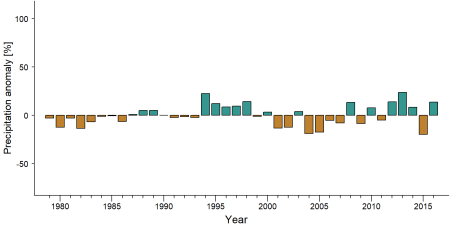
Precipitation anomaly in Bossou -
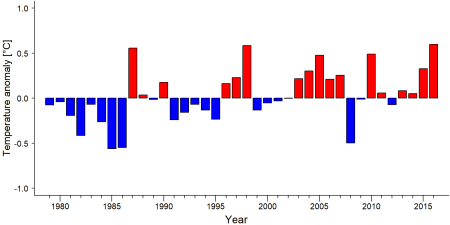
Temperature anomaly in Bossou


External links
References
Hirata S, Morimura N, and Matsuzawa T. 1998. Green passage plan (Tree planting project) and environmental education using documentary videos at Bossou: a progress report. Pan African News, 5, 18–20.
Hockings KJ et al. 2010. Attacks on local persons by chimpanzees in Bossou, Republic of Guinea: long-term perspectives, American Journal of Primatology, 72:887-896
Hockings KJ et al. 2012. Socioecological adaptations by chimpanzees, Pan troglodytes verus, inhabiting an anthropogenically impacted habitat, Animal Behaviour 83(3) 801-810
Hockings KJ et al. 2015. Tools to tipple: ethanol ingestion by wild chimpanzees using leaf-sponges. Royal Society Open Science, 2: 150150
Humle T. 2011a. Location and ecology, in Matsuzawa T, Humle T and Sugiyama Y, ed. The chimpanzees of Bossou and Nimba. Springer. Tokyo
Humle T. 2011b. The 2003 epidemic of a flu-like respiratory disease at Bossou, in Matsuzawa T, Humle T and Sugiyama Y, ed. The chimpanzees of Bossou and Nimba. Springer. Tokyo
Humle T. 2011c. Environmental education and community development in and around Bossou, in Matsuzawa T, Humle T and Sugiyama Y, ed. The chimpanzees of Bossou and Nimba. Springer. Tokyo
Humle T et al. 2011. Algae scooping remains a puzzle, in Matsuzawa T, Humle T and Sugiyama Y, ed. The chimpanzees of Bossou and Nimba. Springer. Tokyo
Kormos R et al. 2003. The Republic of Guinea, in Kormos, R. Boesch, C., Bakarr, M.I. & Butynski, T.M. [eds.] Status Survey and Conservation Action Plan, IUCN/SSC Primate Specialist Group. IUCN, Gland, Switzerland and Cambridge, UK
Matsuzawa T. and Yamakoshi G. 1996. Comparison of chimpanzee material culture between Bossou and Nimba, West Africa, in Russon AE, Bard KA and Parker ST, eds. Reaching into thought: the minds of the great apes. University Press, Cambridge
Matsuzawa T, Humle T. 2011. Bossou: 33 years, in Matsuzawa T, Humle T and Sugiyama Y, ed. The chimpanzees of Bossou and Nimba. Springer. Tokyo
Matsuzawa T et al. 2011a. Green corridor project: planting trees in the savanna between Bossou and Nimba, in Matsuzawa T, Humle T and Sugiyama Y, ed. The chimpanzees of Bossou and Nimba. Springer. Tokyo
Matsuzawa T et al. 2011b. The chimpanzees of Bossou and Nimba. Springer. Tokyo
Sugiyama, Y. (1979) Social structure and dynamics of wild chimpanzees at Bossou, Guinea. Primates 20(3) 323-339.
Sugiyama, Y. (1981) Observation on the population dynamics and behavior of wild chimpanzees at Bossou, Guinea, in 1979-1980. Primates 22(4) 435-444.
The chimpanzees of Bossou and Nimba (2019) [Green Corridor Project https://www.greencorridor.info/]
Whiten et al. 1999. Cultures in chimpanzees. Nature 399: 682-685
Page created by: APES Atlas Team Date: 2019-07-19