
Lagoas de Cufada Natural Park
West Africa > Guinea-Bissau > Lagoas de Cufada Natural Park
Français | Português | Español | Bahasa Indonesia | Melayu
Summary
- Western chimpanzees (Pan troglodytes verus) are present in Lagoas de Cufada Natural Park.
- It has been estimated that between 137 and 311 individuals occur at the site.
- The chimpanzee population trend is unknown.
- This site has a total size of 890 km².
- Key threats to chimpanzees are disturbance through human activities.
- Conservation activities conducted by the ”Instituto da Biodiversidade e das Areas Protegidas (IBAP)” include livelihood improvement and awareness raising.
Site characteristics
Lagoas de Cufada Natural Park [LCNP (11.70 N, -15.04 W)] was created in December 2000 in the region of Quinara, in southern Guinea-Bissau and is managed by the governmental organization “Institute for Biodiversity and Protected Areas (IBAP)”. LCNP is a Ramsar site and covers an area of 890 km 2 (including water areas) (Sousa C. et al. 2005). The average annual temperature is 26°C and the average annual rainfall 200 mm. The rain season reaches from June to October/ November (Catarino L. 2002). Consisting of three lakes (Biorna, Bedasse and Cufada itself), this park holds the country’s largest freshwater reserve, an important detail for the existence of several rare types of animals and plants. Overall, 33 villages are found in the park, inhabited by 3,534 people of different ethnic groups (Beafada (77.4%), Balanta (8.7%), Fula (3.6%), Manjaco (3.6%), Pepel (2.6%) and Bijagó, Mandiga and Mancanha (4.1%)) (Imbali F. 1997, IBAP. 2007, Carvalho, Marques, & Vicente 2013). The villagers’ livelihoods rely extensively on natural resources for their survival. Subsistence farming, and bushmeat hunting is common (Carvalho, Marques, & Vicente 2013). Chimpanzees are not hunted because of the similarity to humans (Amador et al. 2015).
Table 1. Basic site information for Lagoas de Cufada Natural Park
| Species | Pan troglodytes verus |
| Area | 890 km² |
| Coordinates | Lat: 11.70 , Lon: -15.04 |
| Type of site | Protected area (Natural Park) |
| Habitat types | Subtropical/tropical swamp forest, Savanna, Wetlands (lakes, rivers, streams, bogs, marshes) |
| Type of governance |
Types of sites Governance types Habitat types
Ape status
The Lagoas de Cufada Natural Park is delimited by two main rivers, the Corubal in the north and the Buba River in the south, which limits the chimpanzee distribution north and south of the protected area. Estimates for the chimpanzee population ranges from 137 individuals (Carvalho, Marques, & Vicente 2013) to 311 individuals (Carvalho, Marques, & Vicente 2013). The population trend is unknown. Nest decay rate was estimated to be 293.9 days (%CV = 58.80).
Table 2. Ape population estimates reported for Lagoas de Cufada Natural Park
| Species | Year | Occurrence | Encounter or vistation rate (nests/km; ind/day) | Density estimate [ind./ km²] (95% CI) | Abundance estimate (95% CI) | Survey area | Sampling method | Analytical framework | Source | Comments | A.P.E.S. database ID |
|---|---|---|---|---|---|---|---|---|---|---|---|
| Pan troglodytes verus | 2010 | 0.50 (0.18-1.39) | 311.0 | Lagoas de Cufada Natural Park | Line transects | Carvalho et al. 2013 | Total survey effort: 235.2 km. Estimate is for weaned individuals. | ||||
| Pan troglodytes verus | 2011 | 0.22 (0.08-0.63) | 137.0 | Lagoas de Cufada Natural Park | Line transects | Carvalho et al. 2013 | Total survey effort: 67.2 km. Estimate is for weaned individuals. | ||||
| Pan troglodytes verus | 2007 | 0.75 (0.27-1.67) | 281.0 | Lagoas de Cufada Natural Park | Unknown | Sousa 2008 |
Sampling methods Analytical frameworks
Threats
Most of the roads and settlements in LCNP are surrounded by extensive cashew monocultures, which reduces the availability of nesting trees for chimpanzees. Chimpanzees sometimes split branches while crop-raiding, when trying to reach the fruit, leading to irreversible damages of trees and often resulting in chimpanzee-human conflict (Carvalho et al. 2013). During cashew harvesting (March to late June), the number of people inside the park, as well as road traffic, usually increases and the temporary harvest workers show little awareness with respect to the conservation of park biodiversity (Carvalho et al. 2013). Hunting is allowed during the dry season (November until April) but forbidden during the rainy season, usually the reproductive periods (May until October). Chimpanzees and other non- human primates cannot be legally hunted and the trade in bushmeat is illegal at all times (Amador et al. 2015). However hunting for the trade and of primates happens inside the Park as a source of vital income and meat is traded in and outside the park, often to cities as Bissau, where wild meat, particularly big monkeys as baboons, can be sold at higher prices (Quecuta pers. Comm. 2023). The bushmeat trade takes place along the main roads or by boat, with Bissau as the primary destination. Although people from the Beafada ethnic do not eat bush pigs or monkeys due to religious restrictions (Muslims), they still hunt these animals for sale to others (Amador et al. 2015). Even though commercial hunting constitutes a threat to the primate populations, chimpanzees are usually not targeted or sold because of the similarity to humans (Amador et al. 2015). One third of the area of LCNP has been destroyed since 2003 for construction of a harbour for bauxite transport. This has also eroded local population’s respect for the NP’s integrity (IUCN & Chimbo 2016).
Table 3. Threats to apes reported for Lagoas de Cufada Natural Park
| Category | Specific threats | Threat level | Description | Year of threat |
|---|---|---|---|---|
| 1 Residential & commercial development | 1.1 Residential areas | Low (up to 30% of population affected) | Around 3534 people in 33 rural villages live in the park and heavily dependent on natural resources (Amador et al. 2015) | Ongoing (2015) |
| 3 Energy production & mining | 3.2 Mining & quarrying | Present (unknown severity) | Ongoing (2016) | |
| 4 Transportation & service corridors | 4.1 Roads & railroads | Low (up to 30% of population affected) | Roads used during cashew harvest (Carvalho et al. 2013) | Ongoing (2013) |
| 5 Biological resource use | 5.1 Hunting & collecting terrestrial animals | Low (up to 30% of population affected) | Even a commercial bushmeat trade exists; chimpanzees are usually not targeted because of similarities to humans (Amador et al. 2015, Quecuta pers. comm. 2023). | 2015-Ongoing (2023) |
| 5 Biological resource use | 5.1.5 Persecution/human wildlife conflict | Present (unknown severity) | Chimpanzees sometimes split branches while crop-raiding, when trying to reach the fruit, leading to irreversible damages of trees and often resulting in chimpanzee-human conflict (Carvalho et al. 2013). | Ongoing (2013) |
Conservation activities
The LCNP attempts to protect biodiversity and simultaneously provide for peoples’ livelihood and development needs (Catarina Casanova, 2015). The Park management provided livelihood related incentives, such as health infrastructures, boreholes, improvement of schools before the LCNP implementation, incentives for the raising and consumption of domestic animals and honey bee production (Amador et al. 2015). Educational approaches, such as engaging local people in pro-conservation behaviours, as well as value and attitude change through environmental education are implemented by Park Guards (Amador et al. 2015). In Long-term population monitoring in LCNP, an important refuge for coastal populations of the western chimpanzee, would be highly desirable and may be achieved by investing in local training and capacity building (Carvalho et al. 2013).
Table 4. Conservation activities reported for Lagoas de Cufada Natural Park
| Category | Specific activity | Description | Implementing organization(s) | Year of activity |
|---|---|---|---|---|
| 2 Counter-wildlife crime | 2.3 Conduct regular anti-poaching patrols | Not as regular (Amador et al. 2015) | Ongoing (2015) | |
| 4 Education & awareness | 4.1 Educate local communities about apes and sustainable use | Amador et al. 2015, Quecuta pers. comm. (2023) | 2015-Ongoing (2023) | |
| 5 Protection & restoration | 5.2 Legally protect ape habitat | Designated as natural park in 2000 (UNEP-WCMC & IUCN 2019) | 2000-Ongoing (2026) | |
| 7 Economic & other incentives | 7.2 Provide non-monetary benefits to local communities for sustainably managing their forest and its wildlife (e.g., better education, infrastructure development) | Amador et al. 2015 | Ongoing (2015) |
Challenges
The LCNP is managed by a governmental organization, the “Instituto da Biodiversidade e das Areas Protegidas (IBAP)”. IBAP faces severe funding and personnel limitations despite multiple threats to the park’s integrity (Carvalho et al. 2013).
Table 5. Challenges reported for Lagoas de Cufada Natural Park
| Challenges | Specific challenges | Source | Year(s) |
|---|---|---|---|
| 2 Resources and capacity | 2.2 Lack of staff | Carvalho et al. 2013 | |
| 2 Resources and capacity | 2.3 General lack of funding | Carvalho et al. 2013 |
Enablers
Table 6. Enablers reported for Lagoas de Cufada Natural Park
| Enablers | Specific enablers | Source | Year(s) |
|---|---|---|---|
| 1 Site management | |||
| 2 Resources and capacity | |||
| 3 Engaged community | |||
| 4 Institutional support | |||
| 5 Ecological context | |||
| 6 Safety and stability |
Research activities
Documented behaviours
Table 7. Behaviours documented for Lagoas de Cufada Natural Park
| Category | Behavior | Observation type | Prevalence | Observation dates | Source | Habituation | Species | Comment |
|---|---|---|---|---|---|---|---|---|
| Not reported |
Exposure to climate change impacts
As part of a study on the exposure of African great ape sites to climate change impacts, Kiribou et al. subm. extracted climate data and data on projected extreme climate impact events for the site. Climatological characteristics were derived from observation-based climate data provided by the Inter-Sectoral Impact Model Intercomparison Project (ISIMIP, www.isimip.org). Parameters were calculated as the average across each 30-year period. For 1981-2010, the EWEMBI dataset from ISIMIP2a was used. For the two future periods (2021-2050 and 2071-2099) ISIMIP2b climate data based on four CMIP5 global climate models were used. For future projections, two Representative Concentration Pathways (RCP) were used. RCP 2.6 is a scenario with strong mitigation measures in which global temperatures would likely rise below 2C. RCP 6.0 is a scenario with medium emissions in which global temperatures would likely rise up to 3C by 2100. For the number of days with heavy precipitation events, the 98th percentile of all precipitation days (>1mm/d) was calculated for the 1979-2013 reference period as a threshold for a heavy precipitation event. Then, for each year, the number of days above that threshold was derived. The figures on temperature and precipitation anomaly show the deviation from the mean temperature and mean precipitation for the 1979-2013 reference period.
The estimated exposure to future extreme climate impact events (crop failure, drought, river flood, wildfire, tropical cyclone, and heatwave) is based on a published dataset by Lange et al. 2020 derived from ISIMIP2b data. The same global climate models and RCPs as described above were used. Within each 30-year period, the number of years with an extreme event and the average proportion of the site affected were calculated (see Kiribou et al. subm. for details).
Table 8. Estimated past and projected climatological characteristics in Lagoas de Cufada Natural Park
| Value | 1981-2010 | 2021-2050, RCP 2.6 | 2021-2050, RCP 6.0 | 2071-2099, RCP 2.6 | 2071-2099, RCP 6.0 |
|---|---|---|---|---|---|
| Mean temperature [C] | 26.9 | 27.9 | 27.8 | 27.9 | 29.3 |
| Annual precipitation [mm] | 1737 | 1614 | 1467 | 1620 | 1341 |
| Max no. consecutive dry days (per year) | 136.3 | 133.2 | 130.7 | 136.1 | 134 |
| No. days with heavy precipitation (per year) | 3.4 | 4.3 | 4.8 | 4.2 | 3.7 |
Table 9. Projected exposure of apes to extreme climate impact events in Lagoas de Cufada Natural Park
| Type | No. of years with event (2021-2050, RCP 2.6) | % of site exposed (2021-2050, RCP 2.6) | No. of years with event (2021-2050, RCP 6.0) | % of site exposed (2021-2050, RCP 6.0) | No. of years with event (2070-2099, RCP 2.6) | % of site exposed (2070-2099, RCP 2.6) | No. of years with event (2070-2099, RCP 6.0) | % of site exposed (2070-2099, RCP 6.0) |
|---|---|---|---|---|---|---|---|---|
| Crop failure | 2.5 | 0.53 | 3 | 0.39 | 2.5 | 0.39 | 4.5 | 0.39 |
| Drought | 1 | 50 | 1.25 | 50 | 0 | 0 | 2.75 | 75 |
| Heatwave | 1 | 50 | 0 | 0 | 0 | 0 | 2 | 50 |
| River flood | 0 | 0 | 1 | 0.04 | 1 | 0.15 | 2.25 | 0.82 |
| Tropical cyclone | 1 | 7.77 | 1.5 | 9.08 | 2 | 5 | 1 | 1.49 |
| Wildfire | 30 | 0.95 | 30 | 1 | 29 | 0.96 | 29 | 1.26 |
-
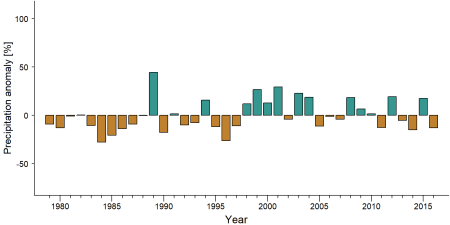
Precipitation anomaly in Lagoas de Cufada Natural Park -
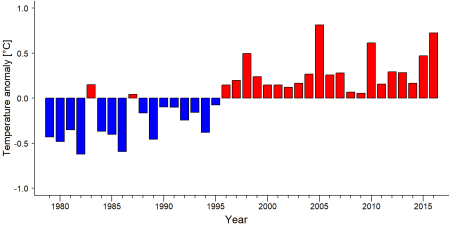
Temperature anomaly in Lagoas de Cufada Natural Park


External links
References
Amador R et al. 2015. Ethnicity and Perceptions of Bushmeat Hunting Inside Lagoas de Cufada Natural Park (LCNP), Guinea-Bissau. Journal of Primatology, 03(02). https://doi.org/10.4172/2167-6801.1000121
Catarino L, Martins ES, Diniz MA. 2002. Vegetation structure and ecology of the Cufada Lagoon (Guinea-Bissau) African Journal of Ecology. 40: 252–299.
Carvalho, J. S., Marques, T. A., & Vicente, L. 2013. Population Status of Pan troglodytes verus in Lagoas de Cufada Natural Park, Guinea-Bissau. PLoS ONE, 8(8), 1–10. https://doi.org/10.1371/journal.pone.0071527
IBAP 2007. Estratégia Nacional para as Áreas Protegidas e a Conservação da Biodiversidade na Guiné-Bissau 2007-2011, Instituto da Biodiversidade e das Áreas Protegidas, Bissau, República da Guiné- Bissau.47.
Imbali F 1997. Estudo do Impacto Sócio-Económico da Criação do Parque das lagoas de Cufada sobre as Populações Residentes, MTAA/ INEP, Bissau, República da Guiné-Bissau.
Sousa C, Gippoliti S, Akhlas M. 2005. Republic of Guinea-Bissau. In: Caldecott J, Miles L, World Atlas of Great Apes and Their Conservation. UNEP World Conservation: University of California Press, Berkeley, USA. 362–365.
Sousa J. 2008. Densidade de Pan troglodytes verus (Chimpanzé da África Ocidental) no Parque Natural das Lagoas de Cufada, República da Guiné-Bissau. Lisbon: Faculdade de Ciências Sociais e Humanas, Universidade Nova de Lisboa. 55 p.
UNEP-WCMC, IUCN. 2019. Protected Planet: The World Database on Protected Areas (WDPA), Cambridge, UK: UNEP-WCMC and IUCN Online: www.protectedplanet.net
Page created by: APES Atlas Team & Queba Quecuta Date: 2023-07-12