
Bia National Park
West Africa > Ghana > Bia National Park
Français | Português | Español | Bahasa Indonesia | Melayu
Summary
- Western chimpanzees (Pan troglodytes verus) may be present in Bia National Park.
- The population size is unknown.
- The chimpanzee population trend is unknown.
- This site has a total size of 306 km².
- Key threats to chimpanzees are poaching and logging.
- Conservation activities at the site focus on law enforcement.
- The site is a UNESCO Biospshere Reserve.
Site characteristics
The site is located in southwestern Ghana, nearing the border with Côte d’Ivoire. The Bia Resource Reserve (228 km²) lies to the south of the national park (Dowsett-Lemaire & Dowsett 2011). Together, the national park and the resource reserve form a contiguous forest block that was originally established as a national park in 1974 (Dowsett-Lemaire & Dowsett 2011). However, the area now comprising the resource reserve was de-gazetted in 1977 and selectively logged for several years (Dowsett-Lemaire & Dowsett 2011). In 1983, Bia National Park was designated as a UNESCO Biosphere Reserve (UNEP-WCMC and IUCN 2019). Sixty-two mammal species have been recorded in the site, including 10 primate species (e.g., red colobus Procolobus badius, black and white colobus Colobus vellerosus, and olive colobus, Procolobus verus) (Forestry Comission of Ghana 2019, Danquah et al. 2012). Forest elephants (Loxodonta cyclotis) and bongos (Tragelaphus euryceros) are also present (Forestry Comission of Ghana 2019).
Table 1. Basic site information for Bia National Park
| Species | Pan troglodytes verus |
| Area | 306km2 |
| Coordinates | Lat: 6.48 , Lon: -3.08 |
| Type of site | Protected area (National Park) |
| Habitat types | Subtropical/tropical moist lowland |
| Type of governance | Governance by government |
Types of sites Governance types Habitat types
Ape status
The presence of chimpanzees in Ghana is restricted to the forests in the southwestern part of the country (Kormos et al. 2003). Chimpanzees are thought to be present in Bia National Park, but the most recent survey only found traces of chimpanzees in the Bia Resource Reserve (Danquah et al. 2012). As part of the PanAf data collection, a survey was conducted at the site, but chimpanzee abundance and density are not published (PanAf 2019).
Table 2. Ape population estimates reported for Bia National Park
| Species | Year | Occurrence | Encounter or vistation rate (nests/km; ind/day) | Density estimate [ind./ km²] (95% CI) | Abundance estimate (95% CI) | Survey area | Sampling method | Analytical framework | Source | Comments | A.P.E.S. database ID |
|---|---|---|---|---|---|---|---|---|---|---|---|
| Pan troglodytes verus | 2012-2013 | Present | Bia National Park | Line transects | PanAf 2019 | Abundance estimate was not published | |||||
| Pan troglodytes verus | 2009 | Present | Bia National Park and Bia Resource Reserve | Line transects | Danquah et al. 2012 | Presence confirmed in the sourthern part of the resource reserve | |||||
| Pan troglodytes verus | 2006-2008 | 0.0028 | Bia National Park and Bia Resource Reserve | Line transects & recces | Gatti 2010 | Reconnaissance walks were also conducted, and the total survey effort was 1411.26 km | GHA0001, GHA0007 GHA0012, GHA0013, GHA0015, GHA0024, GHA0027, GHA0028, GHA0029
|
Sampling methods Analytical frameworks
Threats
Illegal logging until the late 90s caused severe degradation at the site, and the construction of logging trails and roads facilitated human access into the area (Dowsett-Lemaire & Dowsett 2011). Uncontrolled hunting has been a big problem at Bia National Park and surrounding areas; the park faces a lot of human pressure, as it is completely surrounded by farmland (Dowsett-Lemaire & Dowsett 2011, Danquah et al. 2012).
Table 3. Threats to apes reported for Bia National Park
| Category | Specific threats | Threat level | Description | Year of threat |
|---|---|---|---|---|
| 2 Agriculture & aquaculture | 2.1 Annual & perennial non-timber crops | Present (unknown severity) | The park is surrounded by farmland, and encroachment for agricultural expansion is a threat (Dowsett-Lemaire & Dowsett 2011) | Ongoing (2011) |
| 4 Transportation & service corridors | 4.1 Roads & railroads | Present (unknown severity) | Logging trails and roads (Dowsett-Lemaire & Dowsett 2011) | Ongoing (2011) |
| 5 Biological resource use | 5.1 Hunting & collecting terrestrial animals | High (more than 70% of population affected) | Snares were found in the park during a survey, and hunting signs were also present in nearby sites (Danquah et al. 2012). | Ongoing (2012) |
Conservation activities
Wildlife protection at the site is enforced by the Ghana Wildlife Division (Danquah & Oppong 2013). Compared other sites in the Goaso forest block, a study found poaching rates to be much lower in the Bia National Park and Resource Reserve between 2007 and 2009 (AfriMAB 2013). This is likely attributed to the higher protection status of the area, and the implementation of conservation-oriented projects, such as the Protected Areas Development Programme Phase II (PADP II) in 2009, funded by the European Union, under which law enforcement and monitoring were increased (AfriMAB 2013).
Table 4. Conservation activities reported for Bia National Park
| Category | Specific activity | Description | Implementing organization(s) | Year of activity |
|---|---|---|---|---|
| 2 Counter-wildlife crime | 2.3 Conduct regular anti-poaching patrols | As part of the Protected Areas Development Programme Phase II (PADP II), patrol staff were trained for increased law enforcement (AfriMAB 2013) | Ongoing (2013) | |
| 5 Protection & restoration | 5.2 Legally protect ape habitat | The site is designated as a national park since 1974 (Dowsett-Lemaire & Dowsett 2011) | 1974-Ongoing (2026) |
Challenges
Table 5. Challenges reported for Bia National Park
| Challenges | Specific challenges | Source | Year(s) |
|---|---|---|---|
| 2 Resources and capacity | 2.2 Lack of staff | Quansah P. K., pers. comm. 2025 | Ongoing 2025 |
| 2 Resources and capacity | 2.3 General lack of funding | Quansah P. K., pers. comm. 2025 | Ongoing 2025 |
Enablers
Table 6. Enablers reported for Bia National Park
| Enablers | Specific enablers | Source | Year(s) |
|---|---|---|---|
| 2 Resources and capacity | 2.3 Continuous/long-term funding | Quansah P. K., pers. comm. 2025 | Ongoing (2025) |
| 2 Resources and capacity | 2.5 Sufficient capacity/expertise to advise, design, or implement actions | Quansah P. K., pers. comm. 2025 | Ongoing (2025) |
| 1 Site management | |||
| 3 Engaged community | |||
| 4 Institutional support | |||
| 5 Ecological context | |||
| 6 Safety and stability |
Research activities
No information on research activities has been documented.
Documented behaviours
Table 7. Behaviours documented for Bia National Park
| Category | Behavior | Observation type | Prevalence | Observation dates | Source | Habituation | Species | Comment |
|---|---|---|---|---|---|---|---|---|
| Not reported |
Exposure to climate change impacts
As part of a study on the exposure of African great ape sites to climate change impacts, Kiribou et al. (2024) extracted climate data and data on projected extreme climate impact events for the site. Climatological characteristics were derived from observation-based climate data provided by the Inter-Sectoral Impact Model Intercomparison Project (ISIMIP, www.isimip.org). Parameters were calculated as the average across each 30-year period. For 1981-2010, the EWEMBI dataset from ISIMIP2a was used. For the two future periods (2021-2050 and 2071-2099) ISIMIP2b climate data based on four CMIP5 global climate models were used. For future projections, two Representative Concentration Pathways (RCP) were used. RCP 2.6 is a scenario with strong mitigation measures in which global temperatures would likely rise below 2C. RCP 6.0 is a scenario with medium emissions in which global temperatures would likely rise up to 3C by 2100. For the number of days with heavy precipitation events, the 98th percentile of all precipitation days (>1mm/d) was calculated for the 1979-2013 reference period as a threshold for a heavy precipitation event. Then, for each year, the number of days above that threshold was derived. The figures on temperature and precipitation anomaly show the deviation from the mean temperature and mean precipitation for the 1979-2013 reference period.
The estimated exposure to future extreme climate impact events (crop failure, drought, river flood, wildfire, tropical cyclone, and heatwave) is based on a published dataset by Lange et al. 2020 derived from ISIMIP2b data. The same global climate models and RCPs as described above were used. Within each 30-year period, the number of years with an extreme event and the average proportion of the site affected were calculated (Kiribou et al. 2024).
Table 8. Estimated past and projected climatological characteristics in Bia National Park
| Value | 1981-2010 | 2021-2050, RCP 2.6 | 2021-2050, RCP 6.0 | 2071-2099, RCP 2.6 | 2071-2099, RCP 6.0 |
|---|---|---|---|---|---|
| Mean temperature [C] | 27 | 28.1 | 27.9 | 28.2 | 29.4 |
| Annual precipitation [mm] | 1295 | 1253 | 1314 | 1258 | 1335 |
| Max no. consecutive dry days (per year) | 28.9 | 26.1 | 28.8 | 30.3 | 30.6 |
| No. days with heavy precipitation (per year) | 6.5 | 6.1 | 6.5 | 5.8 | 8.3 |
Table 9. Projected exposure of apes to extreme climate impact events in Bia National Park
| Type | No. of years with event (2021-2050, RCP 2.6) | % of site exposed (2021-2050, RCP 2.6) | No. of years with event (2021-2050, RCP 6.0) | % of site exposed (2021-2050, RCP 6.0) | No. of years with event (2070-2099, RCP 2.6) | % of site exposed (2070-2099, RCP 2.6) | No. of years with event (2070-2099, RCP 6.0) | % of site exposed (2070-2099, RCP 6.0) |
|---|---|---|---|---|---|---|---|---|
| Crop failure | 6.5 | 3.41 | 3.5 | 2.27 | 3.5 | 3.41 | 12 | 3.41 |
| Drought | 1.5 | 50 | 0.5 | 50 | 1.25 | 50 | 0 | 0 |
| Heatwave | 8 | 100 | 7.5 | 100 | 8.5 | 100 | 2.5 | 100 |
| River flood | 0.75 | 0.09 | 1.5 | 1.03 | 2.25 | 1.66 | 0.75 | 0.85 |
| Tropical cyclone | 0 | 0 | 0 | 0 | 0 | 0 | 0 | 0 |
| Wildfire | 30 | 0.44 | 30 | 0.42 | 29 | 0.44 | 29 | 0.46 |
-
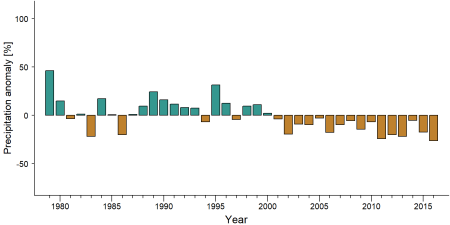
Precipitation anomaly in Bia National Park -
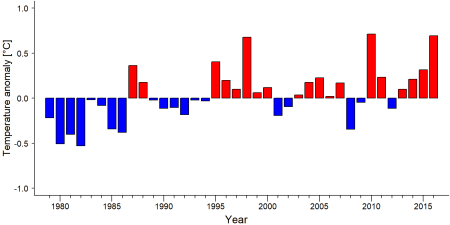
Temperature anomaly in Bia National Park


External links
References
AfriMAB (2013). Biosphere Reserves in Sub-Saharan Africa: Showcasing Sustainable Development. Pretoria, South Africa: Department of Environmental Affairs.
Danquah, E., Oppong, S. K., Akom, E., & Sam, M. (2012). Preliminary survey of chimpanzees and threatened monkeys in the Bia-Goaso Forest Block in southwestern Ghana. African Primates, 7(2), 163–174. link
Danquah, E., & Oppong, S. (2013). Elephant population trends and associated factors: a review of the situation in western Ghana. Pachyderm, 53, 81-90. doi:10.69649/pachyderm.v53i.327
Dowsett-Lemaire, F., & Dowsett, R. J. (2011). Ornithological surveys in Bia National Park and Resource Reserve, Ghana (January 2005, December 2009 and September 2010). Dowsett-Lemaire Miscellaneous Report, 73, 27 pp. https://www.fcghana.org/page.php?page=268§ion=32&typ=1&subs=274
Gatti, S. (2010). Community Forest Biodiversity Project: Status of primate populations in protected areas targeted under CFBP, WAPCA and WD/FC, Accra. p. 42.
Kormos, R., Boesch, C., Bakarr, M. I., & Butynski, T. (Eds.). (2003). West African chimpanzees: Status survey and conservation action plan. IUCN/SSC Primate Specialist Group. IUCN. link
PanAf. (2019). Pan African Programme: The Cultured Chimpanzee. http://panafrican.eva.mpg.de/
UNEP-WCMC & IUCN. (2019). Protected Planet: Bia National Park; The World Database on Protected Areas (WDPA)/The Global Database on Protected Areas Management Effectiveness (GD-PAME). UNEP-WCMC and IUCN. https://www.protectedplanet.net
Kiribou, R., Tehoda, P., Chukwu, O., Bempah, G., Kühl, H. S., Ferreira, J., …, & Heinicke, S. (2024). Exposure of African ape sites to climate change impacts. PLOS Climate, 3(2), e0000345. doi:10.1371/journal.pclm.0000345
Page created by: APES Atlas Team Date: 2019-11-25