
Ndoki-Likouala Landscape
Central Africa > Republic of the Congo > Ndoki-Likouala Landscape
Français | Português | Español | Bahasa Indonesia | Melayu
Summary
- Central chimpanzees (Pan troglodytes troglodytes) & western lowland gorillas (Gorilla gorilla gorilla) are present in the Ndoki-Likouala Landscape.
- It has been estimated that 11,541 (CI: 8,651‐15,396) chimpanzees and 46,264 (CI: 34,607‐61,849) gorillas occur in the site.
- The population trends are unknown.
- The site has a total size of 30,000 km².
- Key threats to great apes are hunting and logging.
- Conservation activities have focused on anti-poaching patrols, employing hunters, road planning, environmental education, tourism, and providing domestic meat.
Site characteristics
The site is located in northern Republic of the Congo, extending over 30,000 sq. km. The landscape includes Nouabalé-Ndoki National Park, Lac Télé Community Reserve, Bailly swamps, as well as Kabo, Pokola, Mokabi, and Loundougou Forest Management Units (Stokes 2007). Endangered species inhabiting the landscape include central chimpanzees, western lowland gorillas, forest elephants, and bongo. The Ndoki-Likouala Landscape is part of the Wildlife Conservation Society's (WCS) Biodiversity Conservation at the Landscape Scale (BCLS) Program (WCS n.d.). The WCS has been working in Ndoki-Likouala since the creation of the Nouabalé-Ndoki Project in 1991, which resulted in the creation of the Nouabalé-Ndoki National Park in 1993 (WCS n.d.).
Table 1. Basic site information for Ndoki-Likouala Landscape
| Species | Pan troglodytes troglodytes, Gorilla gorilla gorilla |
| Area | 30,000 km² |
| Coordinates | Lat: 2.565026 , Lon: 16.630013 |
| Type of site | Protected landscape |
| Habitat types | Subtropical/tropical moist lowland forest, Subtropical/tropical swamp forest, Wetlands (lakes, rivers, streams, bogs, marshes) |
| Type of governance |
Types of sites Governance types Habitat types
Ape status
Table 2. Ape population estimates reported for Ndoki-Likouala Landscape
| Species | Year | Occurrence | Encounter or vistation rate (nests/km; ind/day) | Density estimate [ind./ km²] (95% CI) | Abundance estimate (95% CI) | Survey area | Sampling method | Analytical framework | Source | Comments | A.P.E.S. database ID |
|---|---|---|---|---|---|---|---|---|---|---|---|
| Pan troglodytes troglodytes | 2006 | 0.41 (0.31‐0.55) | 11,541 (8,651‐15,396) | Ndoki-Likouala Landscape | Line transects & recces | Stokes 2007 | |||||
| Gorilla gorilla gorilla | 2006 | 1.65 (1.24‐2.21) | 46,264 (34,607‐61,849) | Ndoki-Likouala Landscape | Line transects & recces | Stokes 2007 |
Sampling methods Analytical frameworks
Threats
The following key direct threats have been identified at the site: unsustainable hunting (by villagers and also commercial hunting), timber offtake, forest loss, bai disturbance and damage. These threats are mostly caused or exacerbated by commercial timber extraction and the linked increase in human populations and access to the forest via new roads (WCS n.d.).
Table 3. Threats to apes reported for Ndoki-Likouala Landscape
| Category | Specific threats | Threat level | Description | Year of threat |
|---|---|---|---|---|
| 5 Biological resource use | 5.1 Hunting & collecting terrestrial animals | High (more than 70% of population affected) | Unsustainable hunting, both commercial & subsistence (WCS n.d.). | Ongoing (2020) |
| 5 Biological resource use | 5.3 Logging & wood harvesting | High (more than 70% of population affected) | Commercial timber extraction is increasing across the region, causing direct forest loss but also exacerbating hunting and habitat destruction (WCS n.d.). | Ongoing (2020) |
| 7 Natural system modifications | 7.3 Other ecosystem modifications | High (more than 70% of population affected) | Bai disturbance and physical damage (WCS n.d.). | Ongoing (2020) |
Conservation activities
The main goal of the Ndoki-Likouala Landscape project is to conserve biodiversity applying the Landscape Species Approach. Fundamental to this approach is the concept of Landscape Species, whose ecological roles and requirements help determine key management strategies across a mosaic of land-use-zones. For the Ndoki-Likouala Landscape, the selected Landscape Species include forest elephant (Loxodonta cyclotis), chimpanzee (Pan troglodytes), forest buffalo (Syncerus caffer), bongo (Tragelaphus euryceros) and dwarf crocodile (Ostaeolaemus tetraspis). These species represent the main habitat types and key threats across the landscape (WCS n.d.). In addition to the objectives formulated according to the Landscape Species Approach, the implementation of conservation activities in Ndoki-Likouala involve three main approaches: management of the protected areas, implementation of conservation on the broader landscape, and addressing policy issues and forming government partnerships (WCS n.d.).
Table 4. Conservation activities reported for Ndoki-Likouala Landscape
| Category | Specific activity | Description | Implementing organization(s) | Year of activity |
|---|---|---|---|---|
| 1 Development impact mitigation | 1.11 Avoid building roads in key habitat or migration routes | Road planning and close old roads (WCS n.d.). | Unknown | |
| 1 Development impact mitigation | 1.16 Provide domestic meat to workers of a logging/mining project to reduce hunting | Supply beef (WCS n.d.). | Unknown | |
| 2 Counter-wildlife crime | 2.14 Employ hunters in the conservation sector to reduce their impact | Hire locals/hunters (WCS n.d.). | Unknown | |
| 2 Counter-wildlife crime | 2.3 Conduct regular anti-poaching patrols | Anti-poaching patrols (WCS n.d.). | Unknown | |
| 2 Counter-wildlife crime | 2.8 Provide training to anti-poaching ranger patrols | Guard training (WCS n.d.). | Unknown | |
| 4 Education & awareness | 4.1 Educate local communities about apes and sustainable use | Environmental education (WCS n.d.). | Unknown | |
| 8 Permanent presence | 8.2 Run tourist projects and ensure permanent human presence at site | Tourism (WCS n.d.). | Unknown |
Challenges
Table 5. Challenges reported for Ndoki-Likouala Landscape
| Challenges | Specific challenges | Source | Year(s) |
|---|---|---|---|
| 4 Institutional support | 4.1 Lack of law enforcement | WCS n.d. |
Enablers
Table 6. Enablers reported for Ndoki-Likouala Landscape
| Enablers | Specific enablers | Source | Year(s) |
|---|---|---|---|
| 1 Site management | |||
| 2 Resources and capacity | |||
| 3 Engaged community | |||
| 4 Institutional support | |||
| 5 Ecological context | |||
| 6 Safety and stability |
Research activities
Documented behaviours
Table 7. Behaviours documented for Ndoki-Likouala Landscape
| Category | Behavior | Observation type | Prevalence | Observation dates | Source | Habituation | Species | Comment |
|---|---|---|---|---|---|---|---|---|
| Not reported |
Exposure to climate change impacts
As part of a study on the exposure of African great ape sites to climate change impacts, Kiribou et al. (2024) extracted climate data and data on projected extreme climate impact events for the site. Climatological characteristics were derived from observation-based climate data provided by the Inter-Sectoral Impact Model Intercomparison Project (ISIMIP, www.isimip.org). Parameters were calculated as the average across each 30-year period. For 1981-2010, the EWEMBI dataset from ISIMIP2a was used. For the two future periods (2021-2050 and 2071-2099) ISIMIP2b climate data based on four CMIP5 global climate models were used. For future projections, two Representative Concentration Pathways (RCP) were used. RCP 2.6 is a scenario with strong mitigation measures in which global temperatures would likely rise below 2C. RCP 6.0 is a scenario with medium emissions in which global temperatures would likely rise up to 3C by 2100. For the number of days with heavy precipitation events, the 98th percentile of all precipitation days (>1mm/d) was calculated for the 1979-2013 reference period as a threshold for a heavy precipitation event. Then, for each year, the number of days above that threshold was derived. The figures on temperature and precipitation anomaly show the deviation from the mean temperature and mean precipitation for the 1979-2013 reference period.
The estimated exposure to future extreme climate impact events (crop failure, drought, river flood, wildfire, tropical cyclone, and heatwave) is based on a published dataset by Lange et al. 2020 derived from ISIMIP2b data. The same global climate models and RCPs as described above were used. Within each 30-year period, the number of years with an extreme event and the average proportion of the site affected were calculated (Kiribou et al. 2024).
Table 8. Estimated past and projected climatological characteristics in Ndoki-Likouala Landscape
| Value | 1981-2010 | 2021-2050, RCP 2.6 | 2021-2050, RCP 6.0 | 2071-2099, RCP 2.6 | 2071-2099, RCP 6.0 |
|---|---|---|---|---|---|
| Mean temperature [C] | 24.7 | 26 | 25.9 | 26.3 | 27.3 |
| Annual precipitation [mm] | 1583 | 1630 | 1637 | 1644 | 1629 |
| Max no. consecutive dry days (per year) | 16.8 | 15.4 | 16.4 | 14.7 | 17 |
| No. days with heavy precipitation (per year) | 6.6 | 10.5 | 12.2 | 10.9 | 12.8 |
Table 9. Projected exposure of apes to extreme climate impact events in Ndoki-Likouala Landscape
| Type | No. of years with event (2021-2050, RCP 2.6) | % of site exposed (2021-2050, RCP 2.6) | No. of years with event (2021-2050, RCP 6.0) | % of site exposed (2021-2050, RCP 6.0) | No. of years with event (2070-2099, RCP 2.6) | % of site exposed (2070-2099, RCP 2.6) | No. of years with event (2070-2099, RCP 6.0) | % of site exposed (2070-2099, RCP 6.0) |
|---|---|---|---|---|---|---|---|---|
| Crop failure | 19.5 | 0 | 18.5 | 0 | 14.5 | 0 | 29 | 0 |
| Drought | 0 | 0 | 0.25 | 2.5 | 0 | 0 | 1 | 5 |
| Heatwave | 12 | 28.75 | 10 | 30 | 13.5 | 29.52 | 20.5 | 42.23 |
| River flood | 1.75 | 0.32 | 3 | 0.75 | 3 | 0.42 | 2.75 | 1.04 |
| Tropical cyclone | 0 | 0 | 0 | 0 | 0 | 0 | 0 | 0 |
| Wildfire | 30 | 0.7 | 30 | 0.72 | 29 | 0.61 | 29 | 0.63 |
-
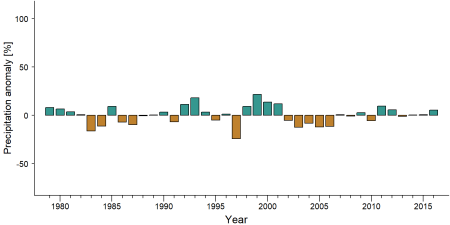
Precipitation anomaly in Ndoki-Likouala Landscape -
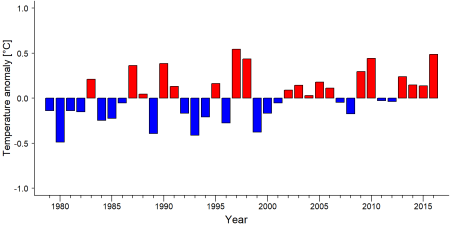
Temperature anomaly in Ndoki-Likouala Landscape


External links
WCS monitoring Ndoki-Likouala Landscape
References
Stokes, E. (2007). Ecological monitoring program Ndoki-Likouala Landscape. WCS report.
WCS. (n.d.). Achievements and Lessons Learned from 10 Years of Support for Threats-based Conservation at a Landscape and Seascape Scale: Ndoki-Likouala Landscape Conservation Area (Republic of Congo). WCS report.
Kiribou, R., Tehoda, P., Chukwu, O., Bempah, G., Kühl, H. S., Ferreira, J., …, & Heinicke, S. (2024). Exposure of African ape sites to climate change impacts. PLOS Climate, 3(2), e0000345. doi:10.1371/journal.pclm.0000345
Page created by: APES Atlas Team Date: 2020-12-29