
Odzala-Kokoua National Park
Central Africa > Republic of the Congo > Odzala-Kokoua National Park
Français | Português | Español | Bahasa Indonesia | Melayu
Summary
- Central chimpanzees (Pan troglodytes troglodytes) & western lowland gorillas (Gorilla gorilla gorilla) are present in Odzala-Kokoua National Park.
- The population estimates are unknown.
- The population trends are unknown.
- The site has a total size of 13,500 km².
- Key threats to great apes are hunting and diseases (Ebola Virus Disease).
- Conservation activities have focused on eco-tourism, anti-poaching patrols, and supporting local communities.
- Established in 1935, the site is one of the oldest national parks in Africa and is part of the transboundary TRIDOM conservation landscape.
Site characteristics
Established in 1935, Odzala-Kokoua National Park is one of the oldest national parks in Africa (BirdLife International 2020). The site is exceptionally high in biodiversity and is home to over 100 mammal species and more than 440 bird species, making it an Important Bird Area (BirdLife International 2020; African Parks n.d.). More than 10,000 plant species can also be found in Odzala-Kokoua (African Parks n.d.). In addition to chimpanzees and gorillas, other noteworthy primate species found at the site include the black and white colobus, two species of mangabey, and the De Brazza’s monkey (African Parks n.d.). The park is also an important refuge for forest elephants, African forest buffalo, bongo, spotted hyena, and African golden cat. The site forms part of the Tri-National Dja-Odzala-Minkébé (TRIDOM) landscape, which is spread over three countries: Cameroon, the Republic of Congo, and Gabon (WWF n.d.).
Table 1. Basic site information for Odzala-Kokoua National Park
| Species | Pan troglodytes troglodytes, Gorilla gorilla gorilla |
| Area | 13,500 km² |
| Coordinates | Lat: 1.318097 , Lon: 14.845204 |
| Type of site | Protected area (National Park) |
| Habitat types | Subtropical/tropical moist lowland forest, Subtropical/tropical swamp forest, Grassland |
| Type of governance |
Types of sites Governance types Habitat types
Ape status
Table 2. Ape population estimates reported for Odzala-Kokoua National Park
| Species | Year | Occurrence | Encounter or vistation rate (nests/km; ind/day) | Density estimate [ind./ km²] (95% CI) | Abundance estimate (95% CI) | Survey area | Sampling method | Analytical framework | Source | Comments | A.P.E.S. database ID |
|---|---|---|---|---|---|---|---|---|---|---|---|
| Pan troglodytes troglodytes | Odzala-Kokoua National Park | ||||||||||
| Gorilla gorilla gorilla | Odzala-Kokoua National Park |
Sampling methods Analytical frameworks
Threats
Table 3. Threats to apes reported for Odzala-Kokoua National Park
| Category | Specific threats | Threat level | Description | Year of threat |
|---|---|---|---|---|
| 5 Biological resource use | 5.1 Hunting & collecting terrestrial animals | High (more than 70% of population affected) | Ongoing (2019) | |
| 8 Invasive & other problematic species, genes & diseases | 8.4 Pathogens | High (more than 70% of population affected) | In 2004, a large population of gorillas was affected by Ebola Virus Disease (Caillaud et al. 2006). | 2004 |
Conservation activities
Table 4. Conservation activities reported for Odzala-Kokoua National Park
| Category | Specific activity | Description | Implementing organization(s) | Year of activity |
|---|---|---|---|---|
| 2 Counter-wildlife crime | 2.3 Conduct regular anti-poaching patrols | Rangers conduct regular anti-poaching patrols and enforce laws. In 2019 there were 94 rangers (African Parks). | Ongoing (2019) | |
| 5 Protection & restoration | 5.2 Legally protect ape habitat | 1935-Ongoing (2026) | ||
| 7 Economic & other incentives | 7.2 Provide non-monetary benefits to local communities for sustainably managing their forest and its wildlife (e.g., better education, infrastructure development) | A mobile clinic visits communities at the periphery of the park to provide healthcare (African Parks; European Public Health 2016). | Ongoing (2016) | |
| 8 Permanent presence | 8.2 Run tourist projects and ensure permanent human presence at site | Tourist lodges managed by Odzala Discovery Camps (African Parks). | Unknown |
Challenges
Table 5. Challenges reported for Odzala-Kokoua National Park
| Challenges | Specific challenges | Source | Year(s) |
|---|---|---|---|
| Not reported |
Enablers
Table 6. Enablers reported for Odzala-Kokoua National Park
| Enablers | Specific enablers | Source | Year(s) |
|---|---|---|---|
| 1 Site management | |||
| 2 Resources and capacity | |||
| 3 Engaged community | |||
| 4 Institutional support | |||
| 5 Ecological context | |||
| 6 Safety and stability |
Research activities
Documented behaviours
Table 7. Behaviours documented for Odzala-Kokoua National Park
| Category | Behavior | Observation type | Prevalence | Observation dates | Source | Habituation | Species | Comment |
|---|---|---|---|---|---|---|---|---|
| Not reported |
Exposure to climate change impacts
As part of a study on the exposure of African great ape sites to climate change impacts, Kiribou et al. (2024) extracted climate data and data on projected extreme climate impact events for the site. Climatological characteristics were derived from observation-based climate data provided by the Inter-Sectoral Impact Model Intercomparison Project (ISIMIP, www.isimip.org). Parameters were calculated as the average across each 30-year period. For 1981-2010, the EWEMBI dataset from ISIMIP2a was used. For the two future periods (2021-2050 and 2071-2099) ISIMIP2b climate data based on four CMIP5 global climate models were used. For future projections, two Representative Concentration Pathways (RCP) were used. RCP 2.6 is a scenario with strong mitigation measures in which global temperatures would likely rise below 2C. RCP 6.0 is a scenario with medium emissions in which global temperatures would likely rise up to 3C by 2100. For the number of days with heavy precipitation events, the 98th percentile of all precipitation days (>1mm/d) was calculated for the 1979-2013 reference period as a threshold for a heavy precipitation event. Then, for each year, the number of days above that threshold was derived. The figures on temperature and precipitation anomaly show the deviation from the mean temperature and mean precipitation for the 1979-2013 reference period.
The estimated exposure to future extreme climate impact events (crop failure, drought, river flood, wildfire, tropical cyclone, and heatwave) is based on a published dataset by Lange et al. 2020 derived from ISIMIP2b data. The same global climate models and RCPs as described above were used. Within each 30-year period, the number of years with an extreme event and the average proportion of the site affected were calculated (Kiribou et al. 2024).
Table 8. Estimated past and projected climatological characteristics in Odzala-Kokoua National Park
| Value | 1981-2010 | 2021-2050, RCP 2.6 | 2021-2050, RCP 6.0 | 2071-2099, RCP 2.6 | 2071-2099, RCP 6.0 |
|---|---|---|---|---|---|
| Mean temperature [C] | 24 | 25.4 | 25.2 | 25.6 | 26.6 |
| Annual precipitation [mm] | 1771 | 1811 | 1805 | 1852 | 1813 |
| Max no. consecutive dry days (per year) | 14.1 | 10.5 | 11 | 9.6 | 10.2 |
| No. days with heavy precipitation (per year) | 7.1 | 12.8 | 12.5 | 12.6 | 13.8 |
Table 9. Projected exposure of apes to extreme climate impact events in Odzala-Kokoua National Park
| Type | No. of years with event (2021-2050, RCP 2.6) | % of site exposed (2021-2050, RCP 2.6) | No. of years with event (2021-2050, RCP 6.0) | % of site exposed (2021-2050, RCP 6.0) | No. of years with event (2070-2099, RCP 2.6) | % of site exposed (2070-2099, RCP 2.6) | No. of years with event (2070-2099, RCP 6.0) | % of site exposed (2070-2099, RCP 6.0) |
|---|---|---|---|---|---|---|---|---|
| Crop failure | 18.5 | 0 | 18 | 0 | 14.5 | 0 | 29 | 0.01 |
| Drought | 0 | 0 | 0 | 0 | 0 | 0 | 0 | 0 |
| Heatwave | 3 | 58.33 | 3 | 58.33 | 5 | 48.08 | 14.5 | 58.44 |
| River flood | 0.5 | 0.26 | 2.5 | 0.79 | 4 | 1.15 | 2 | 1.28 |
| Tropical cyclone | 0 | 0 | 0 | 0 | 0 | 0 | 0 | 0 |
| Wildfire | 30 | 0.37 | 30 | 0.38 | 29 | 0.3 | 29 | 0.29 |
-
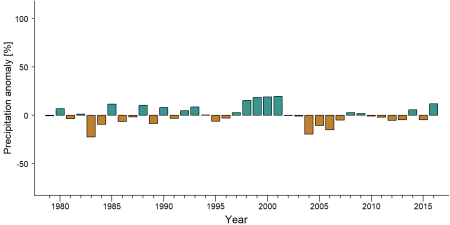
Precipitation anomaly in Odzala-Kokoua National Park -
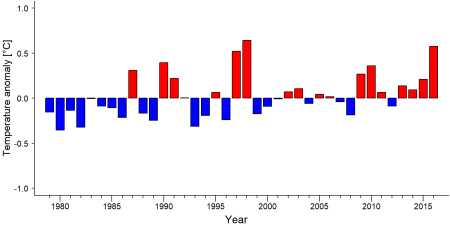
Temperature anomaly in Odzala-Kokoua National Park


External links
African Parks Odzala-Kokoua National Park
https://www.sciencedirect.com/science/article/abs/pii/S0006320717321948
https://academic.oup.com/jmammal/article/95/4/882/888461
References
African Parks. (n.d.). Odzala-Kokoua. Retrieved from: https://www.africanparks.org/the-parks/odzala-kokoua
BirdLife International. (2020). Important Bird Areas factsheet: Odzala National Park complex. Retrieved from http://www.birdlife.org on 03/11/2020.
Caillaud, D., Levréro, F., Cristescu, R., Gatti, S., Dewas, M., Douadi, M., …, & Ménard, N. (2006). Gorilla susceptibility to Ebola virus: The cost of sociality. Current Biology, 16(13), R489-R491. doi:10.1016/j.cub.2006.06.017
European Public Health (2016, April 24). Field Mission: Republic of the Congo. Retrieved from:http://www.europeanpublichealth.com/news-and-opinion/field-mission-republic-congo/
WWF. (n.d.). TRIDOM: Tri-National Dja-Odzala-Minkébé. Retrieved from: https://www.wwf-congobasin.org/where_we_work/tridom___tri_national_dja_odzala_minkebe/ link
Kiribou, R., Tehoda, P., Chukwu, O., Bempah, G., Kühl, H. S., Ferreira, J., …, & Heinicke, S. (2024). Exposure of African ape sites to climate change impacts. PLOS Climate, 3(2), e0000345. doi:10.1371/journal.pclm.0000345
Page created by: APES Atlas Team Date: 2020-12-02