
Ebo Forest
Central Africa > Cameroon > Ebo Forest
Français | Português | Español | Bahasa Indonesia | Melayu
Summary
- Nigeria-Cameroon chimpanzees (Pan troglodytes ellioti) and gorillas (Gorilla gorilla) are present in Ebo Forest.
- The population sizes are unknown.
- The population trends are unknown.
- The site has a total size of 1417 km².
- Key threats to great apes are illegal logging, poaching, and building of a road which will increase pressure on wildlife.
- Conservation activities have focused on community-led conservation initiatives, such as promoting alternative sustainable livelihoods, conservation education and community-based gorilla monitoring.
- Ebo forest is home to a population of geographically intermediate gorillas (the population is found between Cross river gorillas and Western lowland gorillas) that is potentially a third subspecies of western gorillas.
Site characteristics
Located in southwestern Cameroon, the biodiversity and cultural significance of the Ebo forest is remarkable. Ebo is the most important tract of intact forest in the Gulf of Guinea biodiversity hotspot and an important carbon sink. Ebo forest is a haven for animal and plant species that characterise this biodiversity hotspot and that have been extirpated in other parts of the region, including a population of geographically intermediate gorillas that is potentially a third subspecies of gorillas in Cameroon. The forest is also home to one of the most important remaining populations of Nigeria-Cameroon chimpanzees. Culturally, the forest has been home to the Ndokbiakat clan of the Banen tribe for all of recorded history. The forest is full of archaeological history, including colonial roads, stone-built missionary buildings, and ancient village sites that were abandoned around the time of Cameroon's Independence in 1960. The burial sites of close relatives of patriarchs and matriarchs are situated in these village sites along with other cultural relics of the Banen tribe (Abwe & Morgan 2020).
Table 1. Basic site information for Ebo Forest
| Species | Pan troglodytes ellioti, Gorilla gorilla |
| Area | 1,417 km² |
| Coordinates | Lat: 4.315484 , Lon: 10.329629 |
| Type of site | Non-protected area |
| Habitat types | Subtropical/tropical moist lowland forest, Subtropical/tropical montane forest |
| Type of governance |
Types of sites Governance types Habitat types
Ape status
In 2002, a new population of gorillas was found in the Ebo forest (previously only nests were seen). This population is geographically intermediate between, and isolated from present-day Cross River gorillas and Western lowland gorillas found over 100 km south of the Sanaga river. Morgan et al. (2003) previously hypothesized that the Ebo gorillas may represent a remnant of a formerly more extensive gorilla distribution. A recent genetic analysis using data that were obtained from a single gorilla from Ebo Forest showed an admixed or intermediate genetic profile between Cross River and Western lowland gorillas. As such, the Ebo gorillas really are of particular interest as they likely represent what might once have been a much more continuous distribution of gorillas over this region (Morgan 2010). The site holds one of the most important remaining populations of Nigeria-Cameroon chimpanzees (Abwe & Morgan 2020).
Table 2. Ape population estimates reported for Ebo Forest
| Species | Year | Occurrence | Encounter or vistation rate (nests/km; ind/day) | Density estimate [ind./ km²] (95% CI) | Abundance estimate (95% CI) | Survey area | Sampling method | Analytical framework | Source | Comments | A.P.E.S. database ID |
|---|---|---|---|---|---|---|---|---|---|---|---|
| Gorilla gorilla | 2019-2020 | Present | North of Ebo Forest (39 km²) | Camera trap | Whytock et al. 2021 | ||||||
| Pan troglodytes ellioti & Gorilla gorilla | 2008-2009 | Present | Ebo Forest | Reconnaissance walk | Whytock et al. 2021 | survey effort: 345 km |
Sampling methods Analytical frameworks
Threats
The main threats to wildlife in Ebo forest include habitat loss, poaching and the bushmeat trade (Abwe & Morgan 2020). In 2020, the Government of Cameroon proposed two Forest Management Units (FMU) for timber exploitation which completely cover the proposed Ebo National Park in Littoral Region, Cameroon. Widespread and systematic timber exploitation across the site would exacerbate habitat loss and poaching (Abwe & Morgan 2020). When civil society groups opposed the destruction of the species-rich forest, the government suspended the logging concessions (Atabong 2022). In 2022, bulldozers opened around 40 km of dirt road running north from the village of Kopongo, across a forestry concession and into the heart of Ebo Forest. A group calling itself the Ebo Forest Development Committee is behind the project, stating that the road is needed to connect villages around Ebo, give access to communities that were displaced from the forest in the 1950s, and stimulate the local economy. However, a local news outlet, Journal du Cameroun, reported that the road is actually being built by a logging company (Atabong 2022). As of April 2023, part of the forest (68,385 ha) has been reclassified for logging (Nkemnyi, S., pers. comm. 2023).
Table 3. Threats to apes reported for Ebo Forest
| Category | Specific threats | Threat level | Description | Year of threat |
|---|---|---|---|---|
| 2 Agriculture & aquaculture | 2.1 Annual & perennial non-timber crops | Low (up to 30% of population affected) | Palm plantations and conversion of forest into farmland (Nkemnyi, S., pers. comm. 2023). | Ongoing (2023) |
| 4 Transportation & service corridors | 4.1 Roads & railroads | High (more than 70% of population affected) | Bulldozers have opened around 40 km of dirt road into Ebo Forest (Atabong 2022). | Ongoing (2022) |
| 5 Biological resource use | 5.1 Hunting & collecting terrestrial animals | High (more than 70% of population affected) | Poaching for the bushmeat trade (Abwe & Morgan 2020, Whytock et al. 2021). | Ongoing (2021) |
| 5 Biological resource use | 5.2 Gathering terrestrial plants | Low (up to 30% of population affected) | Extraction of non-timber forest products for local use and income generation (Nkemnyi, S., pers. comm. 2023). | Ongoing (2023) |
| 5 Biological resource use | 5.3 Logging & wood harvesting | High (more than 70% of population affected) | Global Forest Watch data show accelerated forest loss in the logging concession south of Ebo, known as FMU 07 002, with more than 1,100 hectares of forest cover lost in 2021 (Atabong 2022). In 2023, part of the forest was reclassified for large-scale logging. Illegal selective logging also takes place (Nkemnyi, S., pers. comm. 2023). | Ongoing (2023) |
-
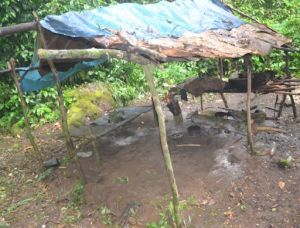
Hunting camp in Ebo forest © Nkemnyi Standly -
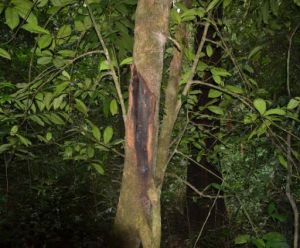
Harvest of bark for medicinal purpose © Nkemnyi Standly -
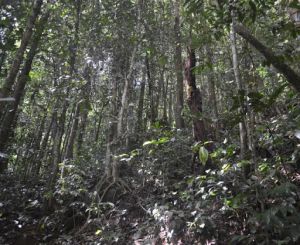
Ebo forest © Nkemnyi Standly


Conservation activities
Community conservation outreach around the Ebo forest targets traditional authorities who play an important role in maintaining the cultural, political, social and economic integrity of their communities. Each community member has a stake in the management of resources around them, and their involvement in biodiversity conservation can lead to positive behaviours toward threatened species in particular and biodiversity in general. Since 2012, the "Club des Amis des Gorilles" initiative aims to encourage local communities around the gorilla habitat to be directly involved in monitoring for gorilla signs and threats in the forest around their villages, as well as raising awareness about the significance of gorillas and other species within and outside their communities (Abwe et al. 2015).
Table 4. Conservation activities reported for Ebo Forest
| Category | Specific activity | Description | Implementing organization(s) | Year of activity |
|---|---|---|---|---|
| 2 Counter-wildlife crime | 2.13 Provide sustainable alternative livelihoods; establish fish- or domestic meat farms | A poultry project was initiated in the Mosse community in 2014 with more than 300 fowls produced. However, the demand was low within the small community and marketing the fowls was a challenge given the long distances to neighbouring populations and the poor state of roads (Abwe et al. 2015). | 2014 | |
| 4 Education & awareness | 4.1 Educate local communities about apes and sustainable use | promote positive behaviours towards gorillas, chimpanzees and other wildlife through sensitisation and conservation education within and outside communities (Abwe et al. 2015). | Ongoing (2015) | |
| 4 Education & awareness | 4.2 Involve local community in ape research and conservation management | The "Club des Amis des Gorilles" monitor gorillas and threats towards them within their habitat in order to record the human impact on this fragile population (Abwe et al. 2015). | Ongoing (2015) | |
| 4 Education & awareness | 4.3 Install billboards to raise ape conservation awareness | Billboards (Abwe et al. 2015). | Ongoing (2015) | |
| 4 Education & awareness | 4.5 Implement multimedia campaigns using theatre, film, print media, discussions | Conservation education messages in storytelling, songs, on T-shirts, posters, parades, presentations, banners and billboards are widely used. Storytelling sessions where elders tell heroic animal stories to youths and school children are organised regularly in Iboti and Locndeng (Abwe et al. 2015). | Ongoing (2015) | |
| 7 Economic & other incentives | 7.2 Provide non-monetary benefits to local communities for sustainably managing their forest and its wildlife (e.g., better education, infrastructure development) | With the support of EFRP, high yielding cocoa bean nursery projects have been carried out in Iboti, Locndeng and Locnanga. The seedlings from the nurseries have been transplanted into CAG and other community members’ individual farms (Abwe et al. 2015). | Ongoing (2015) | |
| 8 Permanent presence | 8.1 Run research project and ensure permanent human presence at site | Three stations established as part of San Diego Zoo's Ebo Forest Research Project (Morgan 2010). | Ongoing (2010) |
Challenges
Table 5. Challenges reported for Ebo Forest
| Challenges | Specific challenges | Source | Year(s) |
|---|---|---|---|
| 4 Institutional support | 4.2 Lack of government support | Nkemnyi, S., pers. comm. 2023 |
Enablers
Table 6. Enablers reported for Ebo Forest
| Enablers | Specific enablers | Source | Year(s) |
|---|---|---|---|
| 1 Site management | |||
| 2 Resources and capacity | |||
| 3 Engaged community | |||
| 4 Institutional support | |||
| 5 Ecological context | |||
| 6 Safety and stability |
Research activities
The San Diego Zoo's Ebo Forest Research Project established three permanently-manned research stations in the Ebo forest. The first station, established 2005, concentrates on the ecology and behaviour of the drill and chimpanzees, although botany research has been ongoing since 2005. The second research station was established in early 2008 to specifically concentrate on conserving and studying the small gorilla population, which occurs in a relatively small (c. 25 km²) area in this region of the forest. Finally, the Njuma research station was established in early 2009 to concentrate research on chimpanzees and Preuss's red colobus monkey (Morgan 2010).
The forest has been a site of interest for researchers and students from several government institutions, such as the National Herbarium, which has led botanical inventories in the area since 2005; the universities of Buea, Douala, Dschang, Yaounde and the National Forestry School, Mbalmayo; as well as several researchers and students from universities across the world (Abwe & Morgan 2020).
Documented behaviours
Table 7. Behaviours documented for Ebo Forest
| Category | Behavior | Observation type | Prevalence | Observation dates | Source | Habituation | Species | Comment |
|---|---|---|---|---|---|---|---|---|
| Not reported |
Exposure to climate change impacts
As part of a study on the exposure of African great ape sites to climate change impacts, Kiribou et al. (2024) extracted climate data and data on projected extreme climate impact events for the site. Climatological characteristics were derived from observation-based climate data provided by the Inter-Sectoral Impact Model Intercomparison Project (ISIMIP, www.isimip.org). Parameters were calculated as the average across each 30-year period. For 1981-2010, the EWEMBI dataset from ISIMIP2a was used. For the two future periods (2021-2050 and 2071-2099) ISIMIP2b climate data based on four CMIP5 global climate models were used. For future projections, two Representative Concentration Pathways (RCP) were used. RCP 2.6 is a scenario with strong mitigation measures in which global temperatures would likely rise below 2C. RCP 6.0 is a scenario with medium emissions in which global temperatures would likely rise up to 3C by 2100. For the number of days with heavy precipitation events, the 98th percentile of all precipitation days (>1mm/d) was calculated for the 1979-2013 reference period as a threshold for a heavy precipitation event. Then, for each year, the number of days above that threshold was derived. The figures on temperature and precipitation anomaly show the deviation from the mean temperature and mean precipitation for the 1979-2013 reference period.
The estimated exposure to future extreme climate impact events (crop failure, drought, river flood, wildfire, tropical cyclone, and heatwave) is based on a published dataset by Lange et al. 2020 derived from ISIMIP2b data. The same global climate models and RCPs as described above were used. Within each 30-year period, the number of years with an extreme event and the average proportion of the site affected were calculated (Kiribou et al. 2024).
Table 8. Estimated past and projected climatological characteristics in Ebo Forest
| Value | 1981-2010 | 2021-2050, RCP 2.6 | 2021-2050, RCP 6.0 | 2071-2099, RCP 2.6 | 2071-2099, RCP 6.0 |
|---|---|---|---|---|---|
| Mean temperature [C] | 25.8 | 26.9 | 26.7 | 27.1 | 28.1 |
| Annual precipitation [mm] | 2617 | 2717 | 2739 | 2767 | 2834 |
| Max no. consecutive dry days (per year) | 36.6 | 31.5 | 33.7 | 31.4 | 36.2 |
| No. days with heavy precipitation (per year) | 6.4 | 9.6 | 10.1 | 10.6 | 11.4 |
Table 9. Projected exposure of apes to extreme climate impact events in Ebo Forest
| Type | No. of years with event (2021-2050, RCP 2.6) | % of site exposed (2021-2050, RCP 2.6) | No. of years with event (2021-2050, RCP 6.0) | % of site exposed (2021-2050, RCP 6.0) | No. of years with event (2070-2099, RCP 2.6) | % of site exposed (2070-2099, RCP 2.6) | No. of years with event (2070-2099, RCP 6.0) | % of site exposed (2070-2099, RCP 6.0) |
|---|---|---|---|---|---|---|---|---|
| Crop failure | 5 | 0.03 | 6.5 | 0.04 | 4.5 | 0.05 | 11 | 0.03 |
| Drought | 0 | 0 | 0 | 0 | 0 | 0 | 0 | 0 |
| Heatwave | 10 | 100 | 7.5 | 100 | 10 | 100 | 14 | 100 |
| River flood | 2.25 | 1.6 | 1.25 | 0.65 | 2.5 | 0.92 | 6 | 1.35 |
| Tropical cyclone | 0 | 0 | 0 | 0 | 0 | 0 | 0 | 0 |
| Wildfire | 30 | 0.68 | 30 | 0.68 | 29 | 0.64 | 29 | 0.72 |
-
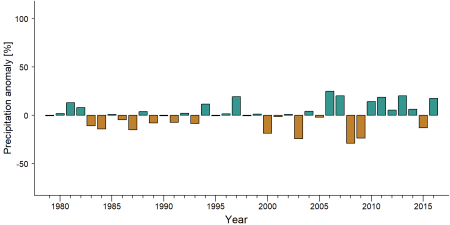
Precipitation anomaly in Ebo Forest -
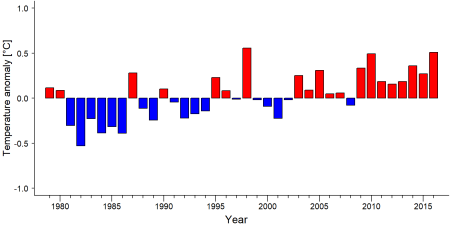
Temperature anomaly in Ebo Forest


External links
Re:wild- Ebo Forest: A Stronghold for Cameroon’s Wildlife
References
Abwe, E.E., B.J. Morgan. (2020). Gorillas of the Ebo forest threatened by proposed Forest management Units for timber exploitation. Gorilla Journal 60, 18–20. link
Abwe, E. E., Mfossa, D. M., & Morgan, B. J. (2015). Community-led conservation action in the Ebo forest, Cameroon.
Atabong, A. B. (2022). Private road sparks fears for Cameroon’s Ebo Forest. Retrieved 23 May 2023 from Mongabay. Online: https://news.mongabay.com/2022/08/private-road-sparks-fears-for-cameroons-ebo-forest/
Morgan, B. J., Wild, C., & Ekobo, A. (2003). Newly Discovered Gorilla Population in the Ebo Forest, Littoral Province, Cameroon. International Journal of Primatology, 24(5), 1129-1137. doi:10.1023/a:1026288531361
Morgan, B.J. (2010). The gorillas of the Ebo forest, Cameroon. Gorilla Journal 40, 16–18. link
Ruiz-Gartzia, I., Pawar, H., Alvarez-Estape, M., Orkin, J. D., Alentorn-Moron, P., Ruibal-Puertas, S., …, & Marques-Bonet, T. (2026). Non-invasive genomic sampling uncovers novel connectivities and origins of confiscated gorillas. doi:10.64898/2026.02.03.701083
Whytock, R. C., Abwe, E. E., Mfossa, D. M., Ketchen, M. E., Abwe, A. E., Nguimdo, V. R. V., …, & Morgan, B. J. (2021). Mammal distribution and trends in the threatened Ebo 'intact forest landscape', Cameroon. Global Ecology and Conservation, 31, e01833. doi:10.1016/j.gecco.2021.e01833
Kiribou, R., Tehoda, P., Chukwu, O., Bempah, G., Kühl, H. S., Ferreira, J., …, & Heinicke, S. (2024). Exposure of African ape sites to climate change impacts. PLOS Climate, 3(2), e0000345. doi:10.1371/journal.pclm.0000345
Page created by: Nkemnyi Standly & APES Atlas Team Date: 2023-07-19
Page updated by: APES Atlas Team Date: 2026-18-02