
Moukalaba-Doudou National Park
Central Africa > Gabon > Moukalaba-Doudou National Park
Français | Português | Español | Bahasa Indonesia | Melayu
Summary
- Central chimpanzees (Pan troglodytes troglodytes) & western lowland gorillas (Gorilla gorilla gorilla) are present in Moukalaba-Doudou National Park.
- The population sizes are unknown.
- The population trends are unknown.
- The site has a total size of 4,458. km².
- Current threats are unknown; in the past, hunting and logging were the main threats.
- Conservation activities have focused on habituation of gorillas for research and ecotourism, awareness raising and involving local community conservation.
Site characteristics
Moukalaba-Doudou National Park is located in southwestern Gabon, 700 km south of Libreville. The Moukalaba area was designated as a Forest Reserve in 1962 and as a National Park in 2002 (Ando, Iwata & Yamagiwa 2008). Vegetation types present in the park include primary and secondary forest, riverine forest, montane forest, and savanna (Ando, Iwata & Yamagiwa 2008).
Table 1. Basic site information for Moukalaba-Doudou National Park
| Species | Gorilla gorilla gorilla, Pan troglodytes troglodytes |
| Area | 4,458 km² |
| Coordinates | Lat: -2.403664 , Lon: 10.399228 |
| Type of site | Protected area (National Park) |
| Habitat types | Subtropical/tropical moist lowland forest, Savanna, Subtropical/tropical moist montane forest |
| Type of governance | Governance by government |
Types of sites Governance types Habitat types
Ape status
Table 2. Ape population estimates reported for Moukalaba-Doudou National Park
| Species | Year | Occurrence | Encounter or vistation rate (nests/km; ind/day) | Density estimate [ind./ km²] (95% CI) | Abundance estimate (95% CI) | Survey area | Sampling method | Analytical framework | Source | Comments | A.P.E.S. database ID |
|---|---|---|---|---|---|---|---|---|---|---|---|
| Gorilla gorilla gorilla | 2019-2020 | Present | 0.12 | 1.14-1.48 | North-East part of the park | Reconnaissance walk | Ismaila et al. 2021 | ||||
| Pan troglodytes troglodytes | 2013-2014 | Present | Moukalaba-Doudou National Park (280 km²) | Reconnaissance walk | Ebang Ella et al. 2023 | ||||||
| Pan troglodytes troglodytes & Gorilla gorilla gorilla | 2003-2007 | Present | Moukalaba-Doudou National Park (280 km²) | Opportunistic observation | Ebang Ella et al. 2023 | ||||||
| Gorilla gorilla gorilla | 2002 | 1.08 | 6.99 | Northern part of Moukalaba-Doudou National Park | Line transects | Takenoshita, Y., & Yamagiwa 2008 | Survey effort: 44.3 km. Authors note that density might have been overestimated. |
Sampling methods Analytical frameworks
Threats
Since logging stopped in 1988, no poaching of gorillas has been recorded (Ando, Iwata & Yamagiwa 2008). During the period when logging was actively carried out, gorillas were being hunted. The Gabonese government prohibited hunting in 1986 and the logging company in Moukalaba left in 1988 (Ando, Iwata & Yamagiwa 2008).
Table 3. Threats to apes reported for Moukalaba-Doudou National Park
| Category | Specific threats | Threat level | Description | Year of threat |
|---|---|---|---|---|
| 4 Transportation & service corridors | 4.1 Roads & railroads | Present (unknown severity) | Roads constructed for timber transportation (Ando, Iwata & Yamagiwa 2008). | Ongoing (2008) |
| 5 Biological resource use | 5.1 Hunting & collecting terrestrial animals | Present (unknown severity) | Gorillas hunted during the period when logging sites were active. Hunting was forbidden in 1986 and the logging company left in 1988 (Ando, Iwata & Yamagiwa 2008). | 1962-1988 |
| 5 Biological resource use | 5.1.3 Commercial bushmeat trade | High (more than 70% of population affected) | Illegal hunting for bushmeat and trafficking threatens chimpanzees and gorillas in Moukalaba-Doudou (IUCN SSC 2014). | Ongoing (2014) |
| 5 Biological resource use | 5.3 Logging & wood harvesting | Present (unknown severity) | Selective logging initiated in 1962. Logging activities ended in 1988 (Ando, Iwata & Yamagiwa 2008). | 1962-1988 |
Conservation activities
Table 4. Conservation activities reported for Moukalaba-Doudou National Park
| Category | Specific activity | Description | Implementing organization(s) | Year of activity |
|---|---|---|---|---|
| 3 Species health | 3.2 Keep safety distance to habituated apes | A minimum distance of 20 m from gorillas was kept during the habituation process (Ando, Iwata & Yamagiwa 2008). | Ongoing (2008) | |
| 4 Education & awareness | 4.1 Educate local communities about apes and sustainable use | Promoting environmental awareness in schools to enhance community engagement in projects aimed at conserving their natural heritage (Alliance pour la Conservation des Grands Singes en Afrique Centrale, n.d.). | Ongoing (2025) | |
| 4 Education & awareness | 4.2 Involve local community in ape research and conservation management | Involving local communities in conservation awareness and benefit-sharing initiatives (IUCN SSC 2014). | ANPN, WWF, local associations | 2010-Ongoing (2025) |
| 5 Protection & restoration | 5.2 Legally protect ape habitat | The park was legally created, and officially designated as a national park in 2002. | 2002-Ongoing (2026) | |
| 6 Species management | 6.1 Habituate primates to human presence to reduce stress from tourists/researchers | Programs to habituate western lowland gorillas for research and ecotourism (Berggorilla & Regenwald Direkthilfe 2004, Ando, Iwata & Yamagiwa 2008). In 2014, the NGO PROGRAM was appointed by the National Agency of National Parks to provide on-the-ground management of the habituation of a group of gorillas called “Musiru”, intended for tourism, in collaboration with Kyoto/IRET (PPI). | ANPN, Kyoto University, local NGOs | 2003-Ongoing (2014) |
| 7 Economic & other incentives | 7.2 Provide non-monetary benefits to local communities for sustainably managing their forest and its wildlife (e.g., better education, infrastructure development) | Beekeeping and the use of non-timber forest products (NTFPs) provide alternative income sources for local communities (Alliance pour la Conservation des Grands Singes en Afrique Centrale, n.d.). | Ongoing (2025) | |
| 8 Permanent presence | 8.2 Run tourist projects and ensure permanent human presence at site | A local NGO, (PROGRAM), fosters community-based ecotourism and organises gorilla trekking around Doussala. | Ongoing (2025) |
Challenges
Table 5. Challenges reported for Moukalaba-Doudou National Park
| Challenges | Specific challenges | Source | Year(s) |
|---|---|---|---|
| Not reported |
Enablers
Table 6. Enablers reported for Moukalaba-Doudou National Park
| Enablers | Specific enablers | Source | Year(s) |
|---|---|---|---|
| 1 Site management | |||
| 2 Resources and capacity | |||
| 3 Engaged community | |||
| 4 Institutional support | |||
| 5 Ecological context | |||
| 6 Safety and stability |
Research activities
Ecological studies on the sympatric population of gorillas and chimpanzees have been carried out at the site since the early 2000s. The habituation of gorillas started in 2003 during a long-term socio-ecological primate survey (Ando, Iwata & Yamagiwa 2008, Takenoshita, Ando & Yamagiwa 2008).
Bed and bed-site reuse by gorillas in relation to rainfall, fruit abundance and fruit consumption has also been studied at the site (Iwata & Ando 2007).
Documented behaviours
Table 7. Behaviours documented for Moukalaba-Doudou National Park
| Category | Behavior | Observation type | Prevalence | Observation dates | Source | Habituation | Species | Comment |
|---|---|---|---|---|---|---|---|---|
| honey extraction with tools | Wilfried & Yamagiwa 2014 | |||||||
| hunting with tools | Wilfried & Yamagiwa 2014 |
Exposure to climate change impacts
As part of a study on the exposure of African great ape sites to climate change impacts, Kiribou et al. (2024) extracted climate data and data on projected extreme climate impact events for the site. Climatological characteristics were derived from observation-based climate data provided by the Inter-Sectoral Impact Model Intercomparison Project (ISIMIP, www.isimip.org). Parameters were calculated as the average across each 30-year period. For 1981-2010, the EWEMBI dataset from ISIMIP2a was used. For the two future periods (2021-2050 and 2071-2099) ISIMIP2b climate data based on four CMIP5 global climate models were used. For future projections, two Representative Concentration Pathways (RCP) were used. RCP 2.6 is a scenario with strong mitigation measures in which global temperatures would likely rise below 2C. RCP 6.0 is a scenario with medium emissions in which global temperatures would likely rise up to 3C by 2100. For the number of days with heavy precipitation events, the 98th percentile of all precipitation days (>1mm/d) was calculated for the 1979-2013 reference period as a threshold for a heavy precipitation event. Then, for each year, the number of days above that threshold was derived. The figures on temperature and precipitation anomaly show the deviation from the mean temperature and mean precipitation for the 1979-2013 reference period.
The estimated exposure to future extreme climate impact events (crop failure, drought, river flood, wildfire, tropical cyclone, and heatwave) is based on a published dataset by Lange et al. 2020 derived from ISIMIP2b data. The same global climate models and RCPs as described above were used. Within each 30-year period, the number of years with an extreme event and the average proportion of the site affected were calculated (Kiribou et al. 2024).
Table 8. Estimated past and projected climatological characteristics in Moukalaba-Doudou National Park
| Value | 1981-2010 | 2021-2050, RCP 2.6 | 2021-2050, RCP 6.0 | 2071-2099, RCP 2.6 | 2071-2099, RCP 6.0 |
|---|---|---|---|---|---|
| Mean temperature [C] | 25.9 | 26.9 | 26.9 | 27.1 | 28.1 |
| Annual precipitation [mm] | 3868 | 4089 | 3970 | 4051 | 3977 |
| Max no. consecutive dry days (per year) | 43.4 | 31.1 | 26.3 | 30.3 | 26.9 |
| No. days with heavy precipitation (per year) | 5.7 | 8 | 7.5 | 8 | 8.8 |
Table 9. Projected exposure of apes to extreme climate impact events in Moukalaba-Doudou National Park
| Type | No. of years with event (2021-2050, RCP 2.6) | % of site exposed (2021-2050, RCP 2.6) | No. of years with event (2021-2050, RCP 6.0) | % of site exposed (2021-2050, RCP 6.0) | No. of years with event (2070-2099, RCP 2.6) | % of site exposed (2070-2099, RCP 2.6) | No. of years with event (2070-2099, RCP 6.0) | % of site exposed (2070-2099, RCP 6.0) |
|---|---|---|---|---|---|---|---|---|
| Crop failure | 4.5 | 0.01 | 3.5 | 0.01 | 2.5 | 0 | 8.5 | 0.02 |
| Drought | 0 | 0 | 0 | 0 | 0 | 0 | 0 | 0 |
| Heatwave | 15.5 | 100 | 15.5 | 100 | 15.5 | 100 | 14.5 | 100 |
| River flood | 2.25 | 1.22 | 1.5 | 1.07 | 2 | 1.26 | 5 | 1.2 |
| Tropical cyclone | 0 | 0 | 0 | 0 | 0 | 0 | 0 | 0 |
| Wildfire | 30 | 0.57 | 30 | 0.55 | 29 | 0.56 | 29 | 0.53 |
-
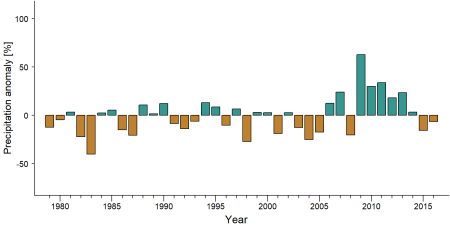
Precipitation anomaly in Moukalaba-Doudou National Park -
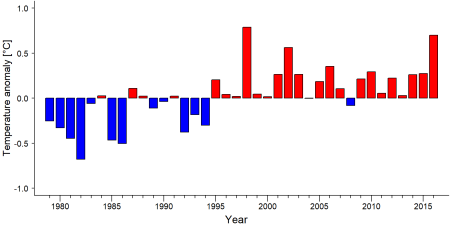
Temperature anomaly in Moukalaba-Doudou National Park


External links
Moukalaba-Doudou National Park
References
Alliance pour la Conservation des Grands Singes en Afrique Centrale. (n.d.). Association Protectrice des Grands Singes de la Moukalaba. Retrieved October 16, 2025, from https://alliance-gsac.org/association-protectrice-des-grands-singes/ link
Ando, C., Iwata, Y., & Yamagiwa, J. (2008). Progress of habituation of western lowland gorillas and their reaction to observers in Moukalaba-Doudou National Park, Gabon. African Study Monographs. Supplementary Issue, 39, 55–69. doi:10.14989/66238
Iwata, Y., & Ando, C. (2007). Bed and bed-site reuse by western lowland gorillas (Gorilla g. gorilla) in Moukalaba-Doudou National Park, Gabon. Primates, 48(1), 77–80. https://link.springer.com/article/10.1007/s10329-006-0003-4
IUCN - International Union for Conservation of Nature (2014). Regional Action Plan for the Conservation of Western Lowland Gorillas and Central Chimpanzees 2015–2025. International Union for Conservation of Nature. doi:10.2305/iucn.ch.2005.ssc-rap.1.en
Takenoshita, Y., Ando, C., & Yamagiwa, J. (2008). Fruit phenology of the great ape habitat in the Moukalaba-Doudou National Park, Gabon. African Study Monographs. Supplementary Issue, 39, 23–39. https://repository.kulib.kyoto-u.ac.jp/dspace/handle/2433/66240
Takenoshita, Y., & Yamagiwa, J. (2008). Estimating gorilla abundance by dung count in the northern part of Moukalaba-Doudou National Park, Gabon. African Study Monographs. Supplementary Issue, 39, 41–54. https://repository.kulib.kyoto-u.ac.jp/dspace/bitstream/2433/66239/1/ASM_S_39_41.pdf link
UNESCO World Heritage Committee. (2016). State of conservation report: Ecosystem and Relict Cultural Landscape of Lopé-Okanda (Gabon). UNESCO. link
Wilfried, E. E. G., & Yamagiwa, J. (2014). Use of tool sets by chimpanzees for multiple purposes in Moukalaba-Doudou National Park, Gabon. Primates, 55(4), 467-472. doi:10.1007/s10329-014-0431-5
Kiribou, R., Tehoda, P., Chukwu, O., Bempah, G., Kühl, H. S., Ferreira, J., …, & Heinicke, S. (2024). Exposure of African ape sites to climate change impacts. PLOS Climate, 3(2), e0000345. doi:10.1371/journal.pclm.0000345
PROGRAM. https://www.nationalparks.africa/listing/moukalaba-doudou-national-park/
Page created by: APES Atlas Team Date: 2022-02-18
Page updated by: Aime Mizero, Priscilla Stanley Shao Date: 2025-10-10