
Kambui Hills Forest Reserve
West Africa > Sierra Leone > Kambui Hills Forest Reserve
Français | Português | Español | Bahasa Indonesia | Melayu
Summary
- Western chimpanzees (Pan troglodytes verus) are present in Kambui Hills Forest Reserve.
- The chimpanzee population size is unknown.
- The chimpanzee population trend is unknown.
- This site has a total size of 212 km².
- Key threats to chimpanzees are logging and poaching.
- Conservation work at the reserve consists of achieving long-term community-based forest management.
Site characteristics
Located in southeastern Sierra Leone, the site forms part of the Upper Guinea forest ecosystem (Brncic et al. 2010). The site consist of two blocks, Kambui North (20,348 ha), and Kambui South (880 ha, BirdLife International 2019). The two sections are divided by a main road leading to the town of Kenema. The site is a catchment area for reservoirs that supply water to Kenema and nearby communities (Brncic et al. 2010). The Kambui Hills Forest Reserve is an Important Bird Area (IBA; BirdLife International 2019), and in addition to the high diversity of bird species, other species found at the site include Diana monkey (Cercopithecus diana), western black-and-white colobus monkey, forest elephant (Loxodonta cyclotis), and Jentink’s duiker (Cephalophus jentinki, BirdLife International 2019). The vegetation mostly consists of mature secondary moist forest, with semi-deciduous forest on the slopes (BirdLife International 2019).
Table 1. Basic site information for Kambui Hills Forest Reserve
| Species | Pan troglodytes verus |
| Area | 212 km² |
| Coordinates | Lat: 7.78 , Lon: -11.34 |
| Type of site | Protected area (Forest Reserve) |
| Habitat types | Subtropical/tropical moist lowland forest, Subtropical/tropical moist montane forest, Agricultural land |
| Type of governance |
Types of sites Governance types Habitat types
Ape status
The chimpanzee population size is unknown. Based on the most recent survey of the area (Brncic et al. 2010), there might not be a substantial population within the reserve, which may only be used seasonally by chimpanzees. Chimpanzee nests and signs were found between Kambui North and Kambui South during a survey of the area (Brncic et al. 2010). It is likely that high logging and hunting pressure in the areas have greatly reduced the population (Brncic et al 2010).
Table 2. Ape population estimates reported for Kambui Hills Forest Reserve
| Species | Year | Occurrence | Encounter or vistation rate (nests/km; ind/day) | Density estimate [ind./ km²] (95% CI) | Abundance estimate (95% CI) | Survey area | Sampling method | Analytical framework | Source | Comments | A.P.E.S. database ID |
|---|---|---|---|---|---|---|---|---|---|---|---|
| Pan troglodytes verus | 2010 | 0.20 | Kambui Hills (152 km²) | Line transects | Brncic et al. 2010 | Total survey effort: 20 km. Encounter signs were not nests; only feeding remains and calls recorded |
Sampling methods Analytical frameworks
Threats
Signs of human activity are very high in the reserve, particularly in Kambui North. In fact, the encounter rate of human signs (logging, snares, gun shells, footpaths) during a survey of the area was 7.35 signs per km, with logging having the greatest impact at the site (Brncic et al. 2010).
Table 3. Threats to apes reported for Kambui Hills Forest Reserve
| Category | Specific threats | Threat level | Description | Year of threat |
|---|---|---|---|---|
| 5 Biological resource use | 5.1 Hunting & collecting terrestrial animals | Present (unknown severity) | Snares and gun shells present, especially in Kambui North (Brncic et al. 2010). High hunting intensity in the area was already observed in the 1980s (Oates 1999). | 1980-Ongoing (2010) |
| 1 Residential & commercial development | 1.1 Residential areas | Present (unknown severity) | Human settlements are present in the reserve (Brncic et al. 2010). | Ongoing (2010) |
| 2 Agriculture & aquaculture | 2.1 Annual & perennial non-timber crops | High (more than 70% of population affected) | Signs of farming and former farming activities are present in the site, as well as farm encroachment at its boundaries (Brncic et al. 2010). | Ongoing (2010) |
| 3 Energy production & mining | 3.2 Mining & quarrying | Present (unknown severity) | Signs of gold mining found in Kambui North (Brncic et al. 2010). | Ongoing (2010) |
| 4 Transportation & service corridors | 4.1 Roads & railroads | High (more than 70% of population affected) | Logging roads, footpaths, and motor roads are present (Brncic et al. 2010). | Ongoing (2010) |
| 5 Biological resource use | 5.3 Logging & wood harvesting | High (more than 70% of population affected) | Signs of illegal logging have been found throughout the reserve (Brncic et al. 2010). | Ongoing (2010) |
| 7 Natural system modifications | 7.1 Fire & fire suppression | Present (unknown severity) | Fire damage in some parts of the reserve (Brncic et al. 2010). | Ongoing (2010) |
Conservation activities
The management of conservation efforts at the site is largely unknown. The site is in great need for increased protection efforts and rehabilitation (Brncic et al. 2010). Currently, there is one project aiming to develop community-based forest management at the reserve, which is funded by the Aage V. Jensen Charity Foundation (BirdLife International 2018).
Table 4. Conservation activities reported for Kambui Hills Forest Reserve
| Category | Specific activity | Description | Implementing organization(s) | Year of activity |
|---|---|---|---|---|
| 5 Protection & restoration | 5.2 Legally protect ape habitat | The site was established as a forest reserve in 1919 (BirdLife International 2018). | 1919-Ongoing (2018) |
Challenges
Table 5. Challenges reported for Kambui Hills Forest Reserve
| Challenges | Specific challenges | Source | Year(s) |
|---|---|---|---|
| Not reported |
Enablers
Table 6. Enablers reported for Kambui Hills Forest Reserve
| Enablers | Specific enablers | Source | Year(s) |
|---|---|---|---|
| 1 Site management | |||
| 2 Resources and capacity | |||
| 3 Engaged community | |||
| 4 Institutional support | |||
| 5 Ecological context | |||
| 6 Safety and stability |
Research activities
No information on research activities has been documented.
Documented behaviours
Table 7. Behaviours documented for Kambui Hills Forest Reserve
| Category | Behavior | Observation type | Prevalence | Observation dates | Source | Habituation | Species | Comment |
|---|---|---|---|---|---|---|---|---|
| Not reported |
Exposure to climate change impacts
As part of a study on the exposure of African great ape sites to climate change impacts, Kiribou et al. subm. extracted climate data and data on projected extreme climate impact events for the site. Climatological characteristics were derived from observation-based climate data provided by the Inter-Sectoral Impact Model Intercomparison Project (ISIMIP, www.isimip.org). Parameters were calculated as the average across each 30-year period. For 1981-2010, the EWEMBI dataset from ISIMIP2a was used. For the two future periods (2021-2050 and 2071-2099) ISIMIP2b climate data based on four CMIP5 global climate models were used. For future projections, two Representative Concentration Pathways (RCP) were used. RCP 2.6 is a scenario with strong mitigation measures in which global temperatures would likely rise below 2C. RCP 6.0 is a scenario with medium emissions in which global temperatures would likely rise up to 3C by 2100. For the number of days with heavy precipitation events, the 98th percentile of all precipitation days (>1mm/d) was calculated for the 1979-2013 reference period as a threshold for a heavy precipitation event. Then, for each year, the number of days above that threshold was derived. The figures on temperature and precipitation anomaly show the deviation from the mean temperature and mean precipitation for the 1979-2013 reference period.
The estimated exposure to future extreme climate impact events (crop failure, drought, river flood, wildfire, tropical cyclone, and heatwave) is based on a published dataset by Lange et al. 2020 derived from ISIMIP2b data. The same global climate models and RCPs as described above were used. Within each 30-year period, the number of years with an extreme event and the average proportion of the site affected were calculated (see Kiribou et al. subm. for details).
Table 8. Estimated past and projected climatological characteristics in Kambui Hills Forest Reserve
| Value | 1981-2010 | 2021-2050, RCP 2.6 | 2021-2050, RCP 6.0 | 2071-2099, RCP 2.6 | 2071-2099, RCP 6.0 |
|---|---|---|---|---|---|
| Mean temperature [C] | 26.3 | 27.4 | 27.4 | 27.4 | 28.6 |
| Annual precipitation [mm] | 2309 | 2259 | 2334 | 2306 | 2333 |
| Max no. consecutive dry days (per year) | 36.9 | 36.1 | 32.4 | 31 | 36.6 |
| No. days with heavy precipitation (per year) | 6 | 6.5 | 6.4 | 6.7 | 8.1 |
Table 9. Projected exposure of apes to extreme climate impact events in Kambui Hills Forest Reserve
| Type | No. of years with event (2021-2050, RCP 2.6) | % of site exposed (2021-2050, RCP 2.6) | No. of years with event (2021-2050, RCP 6.0) | % of site exposed (2021-2050, RCP 6.0) | No. of years with event (2070-2099, RCP 2.6) | % of site exposed (2070-2099, RCP 2.6) | No. of years with event (2070-2099, RCP 6.0) | % of site exposed (2070-2099, RCP 6.0) |
|---|---|---|---|---|---|---|---|---|
| Crop failure | 3 | 0.22 | 3 | 0.22 | 3 | 0.22 | 6 | 0.22 |
| Drought | 0 | 0 | 0 | 0 | 0 | 0 | 0 | 0 |
| Heatwave | 8 | 100 | 8.5 | 100 | 10 | 100 | 10.5 | 100 |
| River flood | 1 | 0.1 | 1 | 1.17 | 1 | 2.67 | 4.5 | 2.61 |
| Tropical cyclone | 0 | 0 | 0 | 0 | 0.5 | 2.05 | 0.5 | 3.83 |
| Wildfire | 30 | 0.5 | 30 | 0.49 | 29 | 0.51 | 29 | 0.5 |
-
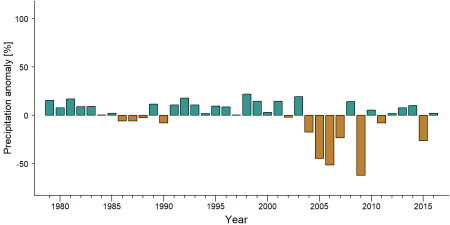
Precipitation anomaly inKambui Hills Forest Reserve -
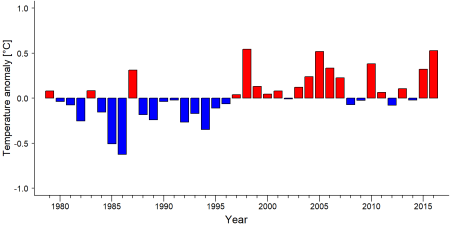
Temperature anomaly inKambui Hills Forest Reserve


External links
References
BirdLife International. 2018. Kambui Hills Forest: the reserve run by a whole community. Online: http://www.birdlife.org/worldwide/news/kambui-hills-forest-reserve-run-whole-community
BirdLife International. 2019. Important Bird Areas factsheet: Kambui Hills Forest Reserve. Downloaded from http://www.birdlife.org on 23/07/2019.
Brncic, T.M., Amarasekaran,B. & McKenna,A. 2010. Final Report of the Sierra Leone National Chimpanzee Census Project. Tacugama Chimpanzee Sanctuary, Freetown, Sierra Leone.
Oates, J. F. 1999. Myth and Reality in the Rain Forest: How Conservation Strategies Are Failing in West Africa. University of California Press, Berkeley, CA. pp. 59-90.
Page created by: APES Atlas Team Date: 2019-09-02