
Kokolopori Bonobo Reserve
Central Africa > Democratic Republic of the Congo > Kokolopori Bonobo Reserve
Français | Português | Español | Bahasa Indonesia | Melayu
Summary
- Bonobos (Pan paniscus) are present in Kokolopori Bonobo Reserve.
- The population size is unknown.
- The population trend is unknown.
- The site has a total size of 4,875 km².
- Key threats to bonobos are hunting, artisanal mining, roads and agricultural expansion.
- Conservation activities have focused on providing benefits to the local community.
Site characteristics
The site was established as a community-based nature reserve in 2009 (Surbeck, Coxe & Lokasola 2017). Besides bonobos, the site is inhabited by various duiker species (e.g. blue duiker Cephalophus monticola, black-fronted duiker Cephalophus nigrifrons, bay duiker Cephalophus dorsalis and Peter’s duiker Cephalophus callipygus), monkeys (e.g. red-tailed monkeys Cercopithecus ascanius, Wolf’s mona monkey Cercopithecus wolfi and De Brazza’s monkey Cercopithecus neglectus), red river hogs (Potamochoerus porcus), sitatungas (Tragelaphus spekii), aardvarks (Orycteropus afer), tree pangolins (Phataginus tricuspis), golden cats (Felis aurata) and leopards (Panthera pardus).
Table 1. Basic site information for Kokolopori Bonobo Reserve
| Species | Pan paniscus |
| Area | 4,875 km² |
| Coordinates | Lat: 0.416667 , Lon: 22.966667 |
| Type of site | Protected area (Nature Reserve) |
| Habitat types | Subtropical/tropical dry forest, Subtropical/tropical moist lowland forest, Wetlands (lakes, rivers, streams, bogs, marshes), Agricultural land, Subtropical/tropical heavily degraded former forest |
| Type of governance | Governance by indigenous peoples and local communities |
Types of sites Governance types Habitat types
-
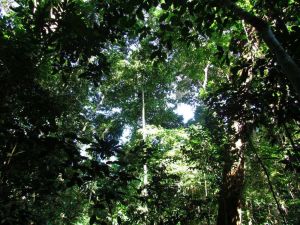
Kokolopori forest © Stefano Lucchesi -
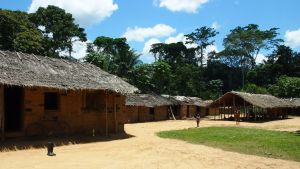
Yete village © Stefano Lucchesi -
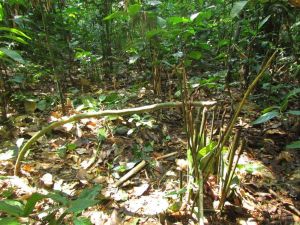
Hunting trap © Stefano Lucchesi


Ape status
Table 2. Ape population estimates reported for Kokolopori Bonobo Reserve
| Species | Year | Occurrence | Encounter or vistation rate (nests/km; ind/day) | Density estimate [ind./ km²] (95% CI) | Abundance estimate (95% CI) | Survey area | Sampling method | Analytical framework | Source | Comments | A.P.E.S. database ID |
|---|---|---|---|---|---|---|---|---|---|---|---|
| Pan paniscus | Kokolopori Bonobo Reserve |
Sampling methods Analytical frameworks
Threats
Table 3. Threats to apes reported for Kokolopori Bonobo Reserve
| Category | Specific threats | Threat level | Description | Year of threat |
|---|---|---|---|---|
| 2 Agriculture & aquaculture | 2.1 Annual & perennial non-timber crops | Medium (30-70% of population affected) | Slash-and-burn agriculture aimed at opening fields for self-sustenance (Lucchesi pers. comm. 2020). Forest clearing for farming near or within reserve boundaries; farms expanding into wildlife habitat; edge effects (Vie Sauvage 2023). | 2020-Ongoing (2023) |
| 5 Biological resource use | 5.1 Hunting & collecting terrestrial animals | High (more than 70% of population affected) | Hunting, mainly with snares and traps, but also guns (Lucchesi pers. comm. 2020). Hunting of wildlife (bonobos, other species) for meat; includes occasional snares; driven by need for food/income (Vie Sauvage 2023). | 2020-Ongoing (2023) |
| 3 Energy production & mining | 3.2 Mining & quarrying | Low (up to 30% of population affected) | Artisanal gold mining next to rivers, low intensity and small scale (Lucchesi pers. comm. 2020). | Ongoing (2020) |
| 4 Transportation & service corridors | 4.1 Roads & railroads | Present (unknown severity) | Wide dirt road crossing bonobo ranges (Lucchesi pers. comm. 2020). | Ongoing (2020) |
Conservation activities
The establishment of the reserve resulted as a collaborative effort among the DRC government, the ICCN, the Bonobo Conservation Initiative, the local NGO Vie Sauvage, and the residents of Kokolopori (BCI 2020).
Table 4. Conservation activities reported for Kokolopori Bonobo Reserve
| Category | Specific activity | Description | Implementing organization(s) | Year of activity |
|---|---|---|---|---|
| 5 Protection & restoration | 5.2 Legally protect ape habitat | The reserve was initiated by Vie Sauvage in 2000 and supported by BCI in 2001, with community-based governance and participatory decision-making (Narat et al. 2015). Villages sign accords with Vie Sauvage and BCI to protect bonobos and forest; formal recognition by DRC government in 2009 (Vie Sauvage 2023). | Vie Sauvage, Bonobo Conservation Initiative, local communities, DRC government (ICCN). | 2000, 2009-Ongoing (2025) |
| 2 Counter-wildlife crime | 2.12 Implement community control of patrolling, banning hunting and removing snares | Local trackers / eco‑guards employed; monitoring of bonobo groups; restriction of snares (Vie Sauvage 2023). | Vie Sauvage, BCI, local communities | 2003-Ongoing(2025) |
| 6 Species management | 6.1 Habituate primates to human presence to reduce stress from tourists/researchers | Habituation of certain bonobo groups, tracking, behavioral & ecological studies; permanent field site (Lonoa) established (Surbeck et al. 2017). | Harvard / Max Planck via Kokolopori Bonobo Research Project, Vie Sauvage, BCI | 2005-Ongoing (2017) |
| 7 Economic & other incentives | 7.2 Provide non-monetary benefits to local communities for sustainably managing their forest and its wildlife (e.g., better education, infrastructure development) | The BCI and Vie Sauvage initiated the Bonobo Health Clinic, funded by the Indigo Foundation. The Bonobo Health Clinic provides health-care to the local community (Indigo Foundation 2020). In addition to the clinic, other programs were also implemented, including initiatives for resistant cassava, microcredit, sewing machines for women, agricultural cooperative support and development of ecotourism projects (Vie Sauvage 2023). | Vie Sauvage, Bonobo Conservation Initiative, local cooperatives | 2007, 2020-Ongoing (2025) |
| 4 Education & awareness | 4.2 Involve local community in ape research and conservation management | BCI adopted an information-exchange approach with local communities, and participatory mapping of community forests was implemented (Narat et al. 2015). | BCI, Vie Sauvage | Ongoing (2015) |
| 4 Education & awareness | 4.1 Educate local communities about apes and sustainable use | Environmental education and awareness (Vie Sauvage 2023). | Vie Sauvage, local communities, Bonobo Conservation Initiative | Ongoing (2025) |
| 4 Education & awareness | 4.6 Integrate religion/local taboos into conservation education | Customary knowledge may include spiritual or cultural beliefs are preserved and promote structured feedback with creative outreach (Vie Sauvage 2023). | Vie Sauvage, local communities, Bonobo Conservation Initiative | Ongoing (2025) |
Challenges
Table 5. Challenges reported for Kokolopori Bonobo Reserve
| Challenges | Specific challenges | Source | Year(s) |
|---|---|---|---|
| Not reported |
Enablers
Table 6. Enablers reported for Kokolopori Bonobo Reserve
| Enablers | Specific enablers | Source | Year(s) |
|---|---|---|---|
| 1 Site management | |||
| 2 Resources and capacity | |||
| 3 Engaged community | 3.6 Local community engagement and support | Vie Sauvage 2023 | Ongoing (2025) |
| 3 Engaged community | 3.2 Local taboos in favor of conservation | Vie Sauvage 2023 | Ongoing (2025) |
| 4 Institutional support | |||
| 5 Ecological context | |||
| 6 Safety and stability |
Research activities
The Kokolopori Bonobo Research Project explores the behavioural diversity and feeding ecology of the bonobo population in Kokolopori. The research team has fully habituated two bonobo groups, which are followed on a daily basis since 2016. In 2018, the team also started to habituate and follow a third bonobo group. The habituation of multiple neighbouring bonobo groups in the site has also provided a unique opportunity for the study of within- and between-group relationships in bonobos.
Documented behaviours
Table 7. Behaviours documented for Kokolopori Bonobo Reserve
| Category | Behavior | Observation type | Prevalence | Observation dates | Source | Habituation | Species | Comment |
|---|---|---|---|---|---|---|---|---|
| Bonobo cannibalism | Tokuyama et al. 2017 | |||||||
| Duiker, squirrel and anomalure hunting | Samuni, Wegdell & Surbeck 2020 | |||||||
| Truffle feeding | Lucchesi pers. comm. |
Exposure to climate change impacts
As part of a study on the exposure of African great ape sites to climate change impacts, Kiribou et al. subm. extracted climate data and data on projected extreme climate impact events for the site. Climatological characteristics were derived from observation-based climate data provided by the Inter-Sectoral Impact Model Intercomparison Project (ISIMIP, www.isimip.org). Parameters were calculated as the average across each 30-year period. For 1981-2010, the EWEMBI dataset from ISIMIP2a was used. For the two future periods (2021-2050 and 2071-2099) ISIMIP2b climate data based on four CMIP5 global climate models were used. For future projections, two Representative Concentration Pathways (RCP) were used. RCP 2.6 is a scenario with strong mitigation measures in which global temperatures would likely rise below 2C. RCP 6.0 is a scenario with medium emissions in which global temperatures would likely rise up to 3C by 2100. For the number of days with heavy precipitation events, the 98th percentile of all precipitation days (>1mm/d) was calculated for the 1979-2013 reference period as a threshold for a heavy precipitation event. Then, for each year, the number of days above that threshold was derived. The figures on temperature and precipitation anomaly show the deviation from the mean temperature and mean precipitation for the 1979-2013 reference period.
The estimated exposure to future extreme climate impact events (crop failure, drought, river flood, wildfire, tropical cyclone, and heatwave) is based on a published dataset by Lange et al. 2020 derived from ISIMIP2b data. The same global climate models and RCPs as described above were used. Within each 30-year period, the number of years with an extreme event and the average proportion of the site affected were calculated (see Kiribou et al. subm. for details).
Table 8. Estimated past and projected climatological characteristics in Kokolopori Bonobo Reserve
| Value | 1981-2010 | 2021-2050, RCP 2.6 | 2021-2050, RCP 6.0 | 2071-2099, RCP 2.6 | 2071-2099, RCP 6.0 |
|---|---|---|---|---|---|
| Mean temperature [C] | 25.5 | 26.7 | 26.5 | 26.9 | 27.9 |
| Annual precipitation [mm] | 2085 | 2099 | 2076 | 2014 | 2128 |
| Max no. consecutive dry days (per year) | 5.3 | 9.7 | 10.3 | 10.1 | 9.2 |
| No. days with heavy precipitation (per year) | 7.2 | 9.1 | 9.7 | 9.3 | 10.5 |
Table 9. Projected exposure of apes to extreme climate impact events in Kokolopori Bonobo Reserve
| Type | No. of years with event (2021-2050, RCP 2.6) | % of site exposed (2021-2050, RCP 2.6) | No. of years with event (2021-2050, RCP 6.0) | % of site exposed (2021-2050, RCP 6.0) | No. of years with event (2070-2099, RCP 2.6) | % of site exposed (2070-2099, RCP 2.6) | No. of years with event (2070-2099, RCP 6.0) | % of site exposed (2070-2099, RCP 6.0) |
|---|---|---|---|---|---|---|---|---|
| Crop failure | 9.5 | 0.02 | 8 | 0.02 | 9.5 | 0.03 | 26 | 0.03 |
| Drought | 0 | 0 | 0 | 0 | 0 | 0 | 0 | 0 |
| Heatwave | 2 | 100 | 3 | 50 | 9.5 | 100 | 8 | 100 |
| River flood | 0 | 0 | 1 | 1.09 | 0.75 | 0.25 | 2.5 | 0.41 |
| Tropical cyclone | 0 | 0 | 0 | 0 | 0 | 0 | 0 | 0 |
| Wildfire | 30 | 0.35 | 30 | 0.33 | 29 | 0.41 | 29 | 0.26 |
External links
Bonobo Conservation Initiative - Kokolopori
References
Bonobo Conservation Initiative (BCI). (2020, October 21). Kokolopori Bonobo Reserve.https://www.bonobo.org/programs/kokolopori-bonobo-reserve
Indigo Foundation (2020, October 21). Democratic Republic of Congo: Kokolopori and Vie Sauvage. https://www.indigofoundation.org/completed-projects/democratic-republic-of-congo-kokolopori
Samuni, L., Wegdell, F., & Surbeck. M. (2020). Behavioural diversity of bonobo prey preference as a potential cultural trait. eLife, e59191. DOI: 10.7554/eLife.59191
Surbeck, M., Coxe, S., & Lokasola, A. L. (2017). Lonoa: The Establishment of a Permanent Field Site for Behavioural Research on Bonobos in the Kokolopori Bonobo Reserve. Pan Africa News, 24(2), 13–15.
Tokuyama, N., Moore, D. L., Graham, K. E., Lokasola, A., & Furuichi, T. (2017). Cases of maternal cannibalism in wild bonobos (Pan paniscus) from two different field sites, Wamba and Kokolopori, Democratic Republic of the Congo. Primates, 58, 7–12.
Vie Sauvage (2023). Vie Sauvage Case Study: The Kokolopori Bonobo Reserve and the Bonobo Peace Forest. Equator Initiative.
Narat, V., Pennec, F., & Pourrut, X. (2015). Bonobo conservation as a means for local development: Lessons from the Kokolopori Bonobo Reserve. In Hohmann, G., Robbins, M. M., & Boesch, C. (Eds.), Bonobos: Unique in Mind, Brain, and Behavior (pp. 355–370). Oxford University Press.
Page created by: Leveda Cheng & Stefano Lucchesi Date: 2020-12-10
Page updated by: Aime Mizero Date: 2025-09-19