
Nouabalé-Ndoki National Park
Central Africa > Republic of the Congo > Nouabalé-Ndoki National Park
Français | Português | Español | Bahasa Indonesia | Melayu
Summary
- Central chimpanzees (Pan troglodytes troglodytes) & Western lowland gorillas (Gorilla gorilla gorilla) are present in Nouabalé-Ndoki National Park.
- The population sizes are unknown.
- The population trends are unknown.
- The site has a total size of 4,071 km².
- Conservation activities have focused on anti-poaching patrols and surveillance, bio-monitoring, and eco-tourism .
- The park forms part of the Sangha Trinational transboundary conservation complex.
-
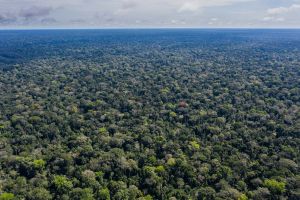
Forest Nouabalé-Ndoki National Park © Scott Ramsay -
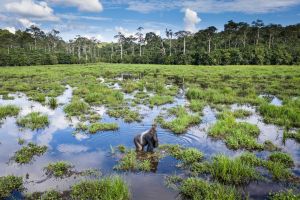
Nouabalé-Ndoki National Park © Scott Ramsay -
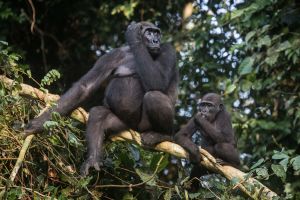
Nouabalé-Ndoki National Park © Scott Ramsay


Site characteristics
Established in 1993, Nouabalé-Ndoki National Park (NNNP) is situated in the northern part of Congo, bordering Cameroon and Central African Republic. Together with Lobéké National Park in Cameroon and Dzanga-Ndoki National Park in the Central African Republic, NNNP is part of the Sangha Trinational (TNS) complex, a UNESCO World Heritage site of global importance for biodiversity conservation (Gately 2006). In 2001, NNNP was extended when the government annexed an area known as the Goualougo Triangle. Surveys in the Goualougo Triangle recorded the first encounter with naïve chimpanzees- i.e., they had not seen humans before (Gately 2006). NNNP harbors important populations of gorillas, forest elephants, chimpanzees, bongos, and many other endangered large mammals. Over 300 bird species have been recorded in the area, making NNNP an Important Bird Area (BirdLife International 2020). The park has never been logged, contains no settlements or roads within its borders, and is one of the best examples of an intact forest ecosystem remaining in the Congo Basin.
Table 1. Basic site information for Nouabalé-Ndoki National Park
| Species | Pan troglodytes troglodytes, Gorilla gorilla gorilla |
| Area | 4,071 km² |
| Coordinates | Lat: 2.568540 , Lon: 16.622951 |
| Type of site | Protected area (National Park) |
| Habitat types | Subtropical/tropical moist lowland forest, Subtropical/tropical swamp forest |
| Type of governance |
Types of sites Governance types Habitat types

Ape status
Repetition of large mammal surveys in 2006, 2010-11, and 2016-17, using the same methods, allowed us to detect trends in great apes populations. Gorilla and chimpanzee populations were stable between 2006 and 2016-17 (unpublished data; Brncic, 2017).
Table 2. Ape population estimates reported for Nouabalé-Ndoki National Park
| Species | Year | Occurrence | Encounter or vistation rate (nests/km; ind/day) | Density estimate [ind./ km²] (95% CI) | Abundance estimate (95% CI) | Survey area | Sampling method | Analytical framework | Source | Comments | A.P.E.S. database ID |
|---|---|---|---|---|---|---|---|---|---|---|---|
| Gorilla gorilla gorilla | 2016 | 1.8 | 0.53 (0.35-0.80) | 2,168 (1,443-3,257) | Nouabalé-Ndoki National Park (4,071 km²) | Line transects | Brncic 2017 | Unpublished data, WCS report. Survey effort: 90 km | |||
| Pan troglodytes troglodytes | 2016 | 4.9 | 0.74 (0.49-1.11) | 3,018 (2,015-4,521) | Nouabalé-Ndoki National Park (4,071 km²) | Line transects | Brncic 2017 | Unpublished data, WCS report. Survey effort: 90 km |
Sampling methods Analytical frameworks
-
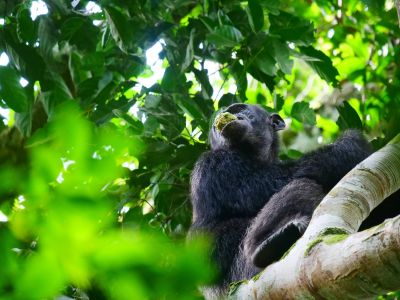
Chimpanzee enjoying a wadge. A wadge is either leaves or fruit rolled into a ball that the chimpanzee sucks on. Chimpanzees of GTAP also use leaf wadges as sponges. © S.Brogan -
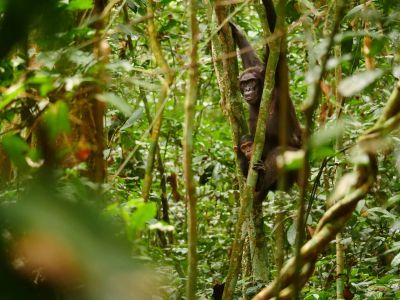
Theresa and Elaine (infant) glancing over at observers while descending from the canopy. Infants prefer to climb on their mothers when they start to travel © S.Brogan


Threats
Logging operations in concessions bordering the park inadvertently facilitate illegal activities, such as bushmeat and ivory exploitation for commercial purposes. A major road crossing the Loundougou Forestry Management Unit, just a few kilometres from the park, has created an access route for poachers (Gately 2006). Logging settlements constructed to house the company employees increase the demand for bushmeat and other wildlife products (Gately 2006).
Table 3. Threats to apes reported for Nouabalé-Ndoki National Park
| Category | Specific threats | Threat level | Description | Year of threat |
|---|---|---|---|---|
| 4 Transportation & service corridors | 4.1 Roads & railroads | Present (unknown severity) | Road building in nearby logging concessions and upgrading of national highways have made the area much more accessible to poachers (WCS). | Ongoing (2021) |
| 5 Biological resource use | 5.1 Hunting & collecting terrestrial animals | Present (unknown severity) | Commercial hunting, mainly of antelopes and monkeys (WCS), | Ongoing (2021) |
| 8 Invasive & other problematic species, genes & diseases | 8.4 Pathogens | Present (unknown severity) | As accessibility to the park increases, great apes come into closer and more frequent contact with humans, thereby increasing the risk of disease transmission (WCS). | Ongoing (2021) |
Conservation activities
In the early 90s, the Wildlife Conservation Society (WCS) conducted a series of reconnaissance surveys that helped determine the boundaries of the park (Gately 2006). The WCS still collaborates with the Congolese Ministry of Forestry Economy to conserve wildlife and their habitat at NNNP (Gately 2006). Since 2013, the park has been managed by the Nouabalé-Ndoki Foundation, a more efficient, transparent ‘public-private partnership’ - or PPP - between the Government of Congo and WCS.
Table 4. Conservation activities reported for Nouabalé-Ndoki National Park
| Category | Specific activity | Description | Implementing organization(s) | Year of activity |
|---|---|---|---|---|
| 2 Counter-wildlife crime | 2.11 Implement monitoring surveillance strategies (e.g., SMART) or use monitoring data to improve effectiveness of patrols | Observation data on tracks and other poaching signs collected by patrols and analyzed by SMART (Spatial Monitoring and Reporting Tool) (WCS). | Ongoing (2021) | |
| 2 Counter-wildlife crime | 2.3 Conduct regular anti-poaching patrols | Eco-guards protect the area from illegal human activities (Gately 2006, Estienne pers. comm. 2021). | 2006-Ongoing (2021) | |
| 2 Counter-wildlife crime | 2.8 Provide training to anti-poaching ranger patrols | Estienne pers. comm. 2021 | Ongoing (2021) | |
| 3 Species health | 3.1 Wear face-masks to avoid transmission of viral and bacterial diseases to primates | Estienne pers. comm. 2021 | Ongoing (2021) | |
| 3 Species health | 3.12 Detect & report dead apes and clinically determine their cause of death to avoid disease transmission | Estienne pers. comm. 2021 | Ongoing (2021) | |
| 3 Species health | 3.13 Implement a health programme for local communities | Estienne pers. comm. 2021 | Ongoing (2021) | |
| 3 Species health | 3.2 Keep safety distance to habituated apes | Estienne pers. comm. 2021 | Ongoing (2021) | |
| 3 Species health | 3.3 Limit time that researchers/tourists are allowed to spend with habituated apes | Estienne pers. comm. 2021 | Ongoing (2021) | |
| 3 Species health | 3.4 Implement quarantine for people arriving at, and leaving the site | Estienne pers. comm. 2021 | Ongoing (2021) | |
| 3 Species health | 3.6 Ensure that researchers/tourists are up-to-date with vaccinations and healthy | Continuous wild apes health monitoring data collection protocols are in place at long term research sites; no permanent vet is present (Estienne pers. comm. 2021). | Ongoing (2021) | |
| 4 Education & awareness | 4.1 Educate local communities about apes and sustainable use | Estienne pers. comm. 2021 | Ongoing (2021) | |
| 4 Education & awareness | 4.2 Involve local community in ape research and conservation management | Estienne pers. comm. 2021 | Ongoing (2021) | |
| 5 Protection & restoration | 5.2 Legally protect ape habitat | 1993-Ongoing (2026) | ||
| 8 Permanent presence | 8.1 Run research project and ensure permanent human presence at site | The park includes three long-term research sites, plus several other research projects, all of which require the involvement of local communities (Estienne, pers. comm. 2021). | Ongoing (2021) | |
| 8 Permanent presence | 8.2 Run tourist projects and ensure permanent human presence at site | Ecotourism at the site is focused on viewing habituated gorillas and other animals from platforms at Mbeli and Wali Bai (Gately 2006, Estienne pers. comm. 2021). | 2006-Ongoing (2021) | |
| 8 Permanent presence | 8.3 Permanent presence of staff/manager | Estienne pers. comm. 2021 | Ongoing (2021) |
Challenges
Table 5. Challenges reported for Nouabalé-Ndoki National Park
| Challenges | Specific challenges | Source | Year(s) |
|---|---|---|---|
| Not reported |
Enablers
Table 6. Enablers reported for Nouabalé-Ndoki National Park
| Enablers | Specific enablers | Source | Year(s) |
|---|---|---|---|
| 1 Site management | |||
| 2 Resources and capacity | |||
| 3 Engaged community | |||
| 4 Institutional support | |||
| 5 Ecological context | |||
| 6 Safety and stability |
Research activities
The Park includes three permanent research sites, supporting three long-term research projects, namely the Mbeli Bai Study, the Goualougo Triangle Ape Project, and the Mondika Gorilla Study (WCS). In addition, since 2005, a landscape survey has been implemented every five years to monitor large mammals, providing population estimates for elephants, gorillas, chimpanzees, as well as data on the presence of rarer large mammals such as bongos and buffaloes. The park has been the site for research and development into new advances in conservation science and technology, including aerial videography, remote cameras and acoustic monitoring techniques. Advances in conservation science have been strengthened by an extensive capacity building program (Estienne pers. comm. 2021).

Documented behaviours
Table 7. Behaviours documented for Nouabalé-Ndoki National Park
| Category | Behavior | Observation type | Prevalence | Observation dates | Source | Habituation | Species | Comment |
|---|---|---|---|---|---|---|---|---|
| termite fishing | Sanz et al. 2004 | |||||||
| honey pounding | Sanz & Morgan 2007 | |||||||
| use leafy twigs for rain cover | Sanz & Morgan 2007 |
Exposure to climate change impacts
As part of a study on the exposure of African great ape sites to climate change impacts, Kiribou et al. subm. extracted climate data and data on projected extreme climate impact events for the site. Climatological characteristics were derived from observation-based climate data provided by the Inter-Sectoral Impact Model Intercomparison Project (ISIMIP, www.isimip.org). Parameters were calculated as the average across each 30-year period. For 1981-2010, the EWEMBI dataset from ISIMIP2a was used. For the two future periods (2021-2050 and 2071-2099) ISIMIP2b climate data based on four CMIP5 global climate models were used. For future projections, two Representative Concentration Pathways (RCP) were used. RCP 2.6 is a scenario with strong mitigation measures in which global temperatures would likely rise below 2C. RCP 6.0 is a scenario with medium emissions in which global temperatures would likely rise up to 3C by 2100. For the number of days with heavy precipitation events, the 98th percentile of all precipitation days (>1mm/d) was calculated for the 1979-2013 reference period as a threshold for a heavy precipitation event. Then, for each year, the number of days above that threshold was derived. The figures on temperature and precipitation anomaly show the deviation from the mean temperature and mean precipitation for the 1979-2013 reference period.
The estimated exposure to future extreme climate impact events (crop failure, drought, river flood, wildfire, tropical cyclone, and heatwave) is based on a published dataset by Lange et al. 2020 derived from ISIMIP2b data. The same global climate models and RCPs as described above were used. Within each 30-year period, the number of years with an extreme event and the average proportion of the site affected were calculated (see Kiribou et al. subm. for details).
Table 8. Estimated past and projected climatological characteristics in Nouabalé-Ndoki National Park
| Value | 1981-2010 | 2021-2050, RCP 2.6 | 2021-2050, RCP 6.0 | 2071-2099, RCP 2.6 | 2071-2099, RCP 6.0 |
|---|---|---|---|---|---|
| Mean temperature [C] | 24.7 | 25.9 | 25.9 | 26.3 | 27.3 |
| Annual precipitation [mm] | 1586 | 1613 | 1637 | 1645 | 1641 |
| Max no. consecutive dry days (per year) | 21.9 | 20.3 | 21.9 | 17.8 | 22.6 |
| No. days with heavy precipitation (per year) | 6.5 | 10.1 | 11.5 | 10.6 | 13 |
Table 9. Projected exposure of apes to extreme climate impact events in Nouabalé-Ndoki National Park
| Type | No. of years with event (2021-2050, RCP 2.6) | % of site exposed (2021-2050, RCP 2.6) | No. of years with event (2021-2050, RCP 6.0) | % of site exposed (2021-2050, RCP 6.0) | No. of years with event (2070-2099, RCP 2.6) | % of site exposed (2070-2099, RCP 2.6) | No. of years with event (2070-2099, RCP 6.0) | % of site exposed (2070-2099, RCP 6.0) |
|---|---|---|---|---|---|---|---|---|
| Crop failure | 4.5 | 0 | 4.5 | 0 | 2 | 0 | 13 | 0 |
| Drought | 0 | 0 | 0 | 0 | 0 | 0 | 0 | 0 |
| Heatwave | 2 | 31.25 | 1.5 | 32.14 | 2.5 | 69.64 | 9.5 | 82.86 |
| River flood | 0 | 0 | 1 | 0.62 | 0.75 | 0.14 | 0.5 | 0.04 |
| Tropical cyclone | 0 | 0 | 0 | 0 | 0 | 0 | 0 | 0 |
| Wildfire | 30 | 0.83 | 30 | 0.87 | 29 | 0.75 | 29 | 0.8 |
-
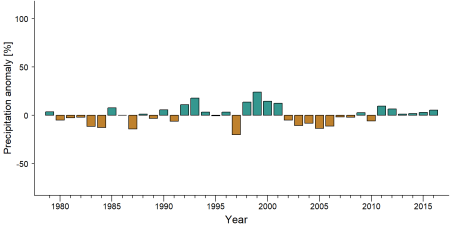
Precipitation anomaly in Nouabalé-Ndoki National Park -
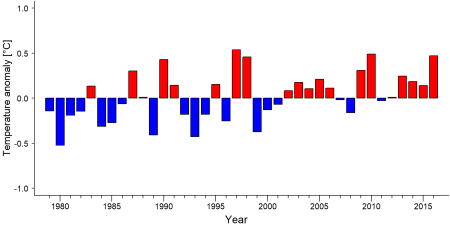
Temperature anomaly in Nouabalé-Ndoki National Park


External links
WCS Nouabalé-Ndoki National Park
References
BirdLife International. (2020). Important Bird Areas factsheet: Nouabalé-Ndoki National Park complex. Retrieved from http://www.birdlife.org on 24/11/2020.
Brncic, T. (2017). Results of the 2016-2017 large mammal survey of the Ndoki-Likouala landscape. Wildlife Conservation Society Report, Brazzaville, Congo
Gately, M. (2006). A Guide to the Nouabale-Ndoki National Park. Wildlife Conservation Society, Congo Program, Brazzaville, Congo.
IUCN. (2012). World heritage nomination – IUCN technical evaluation Sangha Trinational (Congo, Cameroon, Central African Republic), ID No. 1380 Rev. Available at https://whc.unesco.org/en/list/1380/documents/
Sanz, C., Morgan, D. (2007). Chimpanzee tool technology in the Goualougo Triangle, Republic of Congo. Journal of Human Evolution, 52(4), 420-433.
Sanz, C., Morgan, D., & Gulick, S. (2004). New Insights into Chimpanzees, Tools, and Termites from the Congo Basin. The American Naturalist 2004 164(5), 567-581.
UNESCO (2012). Trinational de la Sangha- Proposition d’inscription sur la liste du patrimoine mondial. Available at https://whc.unesco.org/uploads/nominations/1380rev.pdf
Page created by: Vittoria Estienne Date: 2022-01-18