
Cabinda
Central Africa > Angola > Cabinda
Français | Português | Español | Bahasa Indonesia | Melayu
Summary
- Central chimpanzees (Pan troglodytes troglodytes) and western lowland gorillas (Gorilla gorilla gorilla) are present in Angola, Cabinda.
- It has been estimated that 1,705 (CI: 1,027–4,801) chimpanzees and 1,652 (CI: 1,174–3,311) gorillas occur in the site.
- The great ape population trend is unknown.
- The site has a total size of 7,300 km².
- Key threats to great apes are bushmeat hunting and habitat loss as a result of agricultural expansion and logging.
- Conservation activities are not documented.
Site characteristics
The Cabinda exclave lies north of the Congo river. Cabinda is separated from the rest of Angola by 30 km of DRC (Caldecott & Miles 2005). It is the only part of Angola in which great apes are found. The forest of Maiombe (2,000 sq. km) supports the largest population of great apes in Cabinda (Caldecott & Miles 2005; Heffernan 2005). The Maiombe forest is part of a larger rainforest that spreads across southwest Gabon, east and northwest of Cabinda, and southwestern areas of Republic of Congo and Democratic Republic of the Congo (Heffernan 2005). In addition to the western lowland gorilla and central chimpanzee, other species inhabiting the area include forest elephants, grey parrots, guenons, various duikers, and dwarf forest buffalos (Heffernan 2005).
Table 1. Basic site information for Cabinda
| Species | Pan troglodytes troglodytes, Gorilla gorilla gorilla |
| Area | 7,300 km² |
| Coordinates | Lat: -4.682290 , Lon: 12.628115 |
| Type of site | Non-protected area |
| Habitat types | Subtropical/tropical swamp forest |
| Type of governance |
Types of sites Governance types Habitat types
Ape status
Great ape population estimates have been difficult to obtain, as civil conflict has deterred field studies (Caldecott & Miles 2005). However, based on a density distribution model, the predicted chimpanzee population in Cabinda for 2013 was 1,705 (95% CI: 1,027-4,801) individuals, and the predicted gorilla population was 1,652 (95% CI: 1,174-3,311) individuals (Strindberg et al. 2018).
Table 2. Ape population estimates reported for Cabinda
| Species | Year | Occurrence | Encounter or vistation rate (nests/km; ind/day) | Density estimate [ind./ km²] (95% CI) | Abundance estimate (95% CI) | Survey area | Sampling method | Analytical framework | Source | Comments | A.P.E.S. database ID |
|---|---|---|---|---|---|---|---|---|---|---|---|
| Pan troglodytes troglodytes | 2005-2013 | 1,705 (1,027-4,801) | Angola, Cabinda | Other | Strindberg et al. 2018 | ||||||
| Gorilla gorilla gorilla | 2013 | 1,652 (1,174-3,311) | Angola, Cabinda | Other | Strindberg et al. 2018 |
Sampling methods Analytical frameworks
Threats
Table 3. Threats to apes reported for Cabinda
| Category | Specific threats | Threat level | Description | Year of threat |
|---|---|---|---|---|
| 2 Agriculture & aquaculture | 2.1 Annual & perennial non-timber crops | High (more than 70% of population affected) | Encroachment into forest areas for agricultural expansion (Heffernan 2005). | Ongoing (2005) |
| 5 Biological resource use | 5.1 Hunting & collecting terrestrial animals | Present (unknown severity) | Bushmeat hunting for subsistence and commercial purposes (Caldecott & Miles 2005). | Ongoing (2005) |
| 5 Biological resource use | 5.3 Logging & wood harvesting | High (more than 70% of population affected) | Local and commercial logging is widespread, often involving clear-cutting large areas (Heffernan 2005). | Ongoing (2005) |
Conservation activities
Since 2008, the UN Environment and the International Union for Conservation of Nature (IUCN) have assisted Angola, Congo, and DR Congo to create a cooperation agreement for the management of the Mayombe Forest Transfrontier Protected Area (TPA). A transboundary management plan was approved in 2013. Due to the lack of progress in the implementation of the plan, recent discussions have been held towards the revitalization of the initiative (UNEP).
Challenges
Table 5. Challenges reported for Cabinda
| Challenges | Specific challenges | Source | Year(s) |
|---|---|---|---|
| 6 Safety and stability | 6.3 Civil unrest/war | Caldecott & Miles 2005 | |
| 4 Institutional support | 4.1 Lack of law enforcement | Caldecott & Miles 2005 |
Enablers
Table 6. Enablers reported for Cabinda
| Enablers | Specific enablers | Source | Year(s) |
|---|---|---|---|
| 1 Site management | |||
| 2 Resources and capacity | |||
| 3 Engaged community | |||
| 4 Institutional support | |||
| 5 Ecological context | |||
| 6 Safety and stability |
Research activities
Documented behaviours
Table 7. Behaviours documented for Cabinda
| Category | Behavior | Observation type | Prevalence | Observation dates | Source | Habituation | Species | Comment |
|---|---|---|---|---|---|---|---|---|
| Not reported |
Exposure to climate change impacts
As part of a study on the exposure of African great ape sites to climate change impacts, Kiribou et al. subm. extracted climate data and data on projected extreme climate impact events for the site. Climatological characteristics were derived from observation-based climate data provided by the Inter-Sectoral Impact Model Intercomparison Project (ISIMIP, www.isimip.org). Parameters were calculated as the average across each 30-year period. For 1981-2010, the EWEMBI dataset from ISIMIP2a was used. For the two future periods (2021-2050 and 2071-2099) ISIMIP2b climate data based on four CMIP5 global climate models were used. For future projections, two Representative Concentration Pathways (RCP) were used. RCP 2.6 is a scenario with strong mitigation measures in which global temperatures would likely rise below 2C. RCP 6.0 is a scenario with medium emissions in which global temperatures would likely rise up to 3C by 2100. For the number of days with heavy precipitation events, the 98th percentile of all precipitation days (>1mm/d) was calculated for the 1979-2013 reference period as a threshold for a heavy precipitation event. Then, for each year, the number of days above that threshold was derived. The figures on temperature and precipitation anomaly show the deviation from the mean temperature and mean precipitation for the 1979-2013 reference period.
The estimated exposure to future extreme climate impact events (crop failure, drought, river flood, wildfire, tropical cyclone, and heatwave) is based on a published dataset by Lange et al. 2020 derived from ISIMIP2b data. The same global climate models and RCPs as described above were used. Within each 30-year period, the number of years with an extreme event and the average proportion of the site affected were calculated (see Kiribou et al. subm. for details).
Table 8. Estimated past and projected climatological characteristics in Cabinda
| Value | 1981-2010 | 2021-2050, RCP 2.6 | 2021-2050, RCP 6.0 | 2071-2099, RCP 2.6 | 2071-2099, RCP 6.0 |
|---|---|---|---|---|---|
| Mean temperature [C] | 25.2 | 26.3 | 26.1 | 26.3 | 27.3 |
| Annual precipitation [mm] | 1200 | 1252 | 1213 | 1226 | 1266 |
| Max no. consecutive dry days (per year) | 80.3 | 67.8 | 64.3 | 75 | 64.2 |
| No. days with heavy precipitation (per year) | 5.1 | 8.2 | 8.5 | 8.8 | 9.8 |
Table 9. Projected exposure of apes to extreme climate impact events in Cabinda
| Type | No. of years with event (2021-2050, RCP 2.6) | % of site exposed (2021-2050, RCP 2.6) | No. of years with event (2021-2050, RCP 6.0) | % of site exposed (2021-2050, RCP 6.0) | No. of years with event (2070-2099, RCP 2.6) | % of site exposed (2070-2099, RCP 2.6) | No. of years with event (2070-2099, RCP 6.0) | % of site exposed (2070-2099, RCP 6.0) |
|---|---|---|---|---|---|---|---|---|
| Crop failure | 11 | 0.11 | 8.5 | 0.11 | 4.5 | 0.08 | 16 | 0.14 |
| Drought | 0.5 | 12.5 | 1 | 28.12 | 0 | 0 | 0 | 0 |
| Heatwave | 15.5 | 56.3 | 12.5 | 59.13 | 13.5 | 53.33 | 19.5 | 61.72 |
| River flood | 1.5 | 0.17 | 3 | 1.16 | 2.75 | 0.49 | 3 | 0.11 |
| Tropical cyclone | 0.5 | 0.47 | 0 | 0 | 0 | 0 | 1 | 6.1 |
| Wildfire | 30 | 0.65 | 30 | 0.63 | 29 | 0.65 | 29 | 0.63 |
-
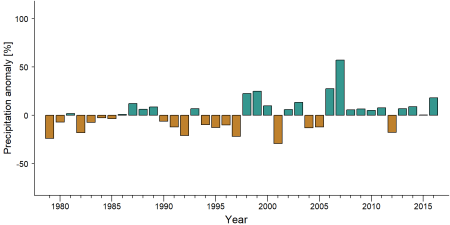
Precipitation anomaly in Cabinda -
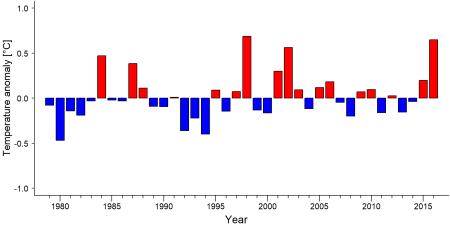
Temperature anomaly in Cabinda


External links
References
Caldecott, J. & Miles, L. (2005). World atlas of great apes and their conservation. University of California Press, Berkeley.
Heffernan, J. (2005). Elephants of Cabinda; Mission report, Angola, April 2005. Fauna & Flora International & United Nations Development Programme in co-operation with the Dept. of Urban Affairs and Environment, Cabinda, Angola.
Strindberg, S., Maisels, F., Williamson, E. A., Blake, S., Stokes, E. J., Aba’a, R., Abitsi, G., Agbor, A., Ambahe, R. D., Bakabana, P. C., Bechem, M., Berlemont, A., Bokoto de Semboli, B., Boundja, P. R., Bout, N., Breuer, T., Campbell, G., De Wachter, P., Ella Akou, M., … Wilkie, D. S. (2018). Guns, germs, and trees determine density and distribution of gorillas and chimpanzees in Western Equatorial Africa. Science Advances, 4(4), eaar2964. https://doi.org/10.1126/sciadv.aar2964
Page created by: APES Atlas Team Date: 2021-01-05