
Sapo National Park
West Africa > Liberia > Sapo National Park
Français | Português | Español | Bahasa Indonesia | Melayu
Summary
- Western chimpanzees (Pan troglodytes verus) are present in Sapo National Park.
- It has been estimated that 1,055 (CI: 595-1,870) individuals occur in the site.
- The chimpanzee population trend is stable.
- The park has a total size of 1,804 km².
- Key threats to chimpanzees are poaching, human wildlife conflict and illegal mining.
- Conservation activities have focused on long-term bio-monitoring and law enforcement, involving and supporting local communities, together with education and awareness raising.
- Sapo National Park is Liberia's first protected area, established in 1983.
Site characteristics
Located in southeastern Liberia, Sapo National Park is Liberia's first protected area and represents one of the most intact forest ecosystems of the country (Tweh et al. 2018). The area of the park was extended from 1,304 km² to 1,804 km² in 2003 (Tweh et al. 2018). The park forms part of the Upper Guinean Forest ecosystem, and contains high levels of biodiversity (N'Goran et al. 2010). The park is a low elevation tropical humid rainforest. Elevation in the southeastern area is approximately 100m with gently rolling hills while in the north, the elevation is approximately 400m in the north with steep ridges (Peal & Kranz 1990). In addition to the western chimpanzee, other endangered and vulnerable species inhabit the site, including forest elephants (Loxodonta africana), pygmy hippopotamus (Hexaprotodon liberiensis), Jentink’s duiker (Cephalophus jentinki), red colobus (Piliocolobus badius), and Diana monkeys (Cercopithecus diana diana, N'Goran 2010).
Table 1. Basic site information for Sapo National Park
| Species | Pan troglodytes verus |
| Area | 1,804 km² |
| Coordinates | Lat: 5.378432 , Lon: -8.496117 |
| Type of site | Protected area (National Park) |
| Habitat types | Subtropical/tropical moist lowland |
| Type of governance | Governance by government |
Types of sites Governance types Habitat types
Ape status
A survey in 1982 (one year before the establishment of the park), confirmed the presence of chimpanzees in the Sapo forest (Anderson et al. 1983). Based on the estimates from two surveys, one in 2009 (N'Goran et al. 2010) and a second one in 2017 (Tweh et al. 2018), the chimpanzee population in the park has remained relatively stable, with an estimated abundance of approximately 1,055 individuals.
Table 2. Ape population estimates reported for Sapo National Park
| Species | Year | Occurrence | Encounter or vistation rate (nests/km; ind/day) | Density estimate [ind./ km²] (95% CI) | Abundance estimate (95% CI) | Survey area | Sampling method | Analytical framework | Source | Comments | A.P.E.S. database ID |
|---|---|---|---|---|---|---|---|---|---|---|---|
| Pan troglodytes verus | 1983 | Present | 0.24 | Southeastern sector of the park (50 km²) | Line transects | Anderson et al. 1983 | Total survey effort: 42.7 km | ||||
| Pan troglodytes verus | 2016-2017 | 0.83 | 1,055 (595-1,870) | Sapo National Park, excluding south east area | Line transects | Tweh et al. 2018 | Total survey effort: 38.38 km | ||||
| Pan troglodytes verus | 2009 | 4.05 | 0.86 | 1,079 (713-1,633) | Sapo National Park, excluding mining areas | Line transects | N'Goran et al. 2010 | ||||
| Pan troglodytes verus | 2002 | Present | Sapo National Park | Line transects | Waitkuwait 2003 | Assessment of Fauna & Flora International's bio-monitoring programme | |||||
| Pan troglodytes verus | 2007-2009 | 0.27 | Sapo National Park, excluding south east area | Line transects | Vogt 2011 | Fauna & Flora International bio-monitoring programme |
Sampling methods Analytical frameworks
Threats
Sapo National Park has been primarily threatened by illegal hunting and mining (Tweh et al. 2018; Greengrass 2015; N'Goran et al. 2010). An estimated 18,000 illegal miners were inhabiting the park in 2010, the majority of which was evicted by the government on the same year (Vogt 2011). A survey of two commercial hunting camps bordering the park revealed high hunting pressure in the area, and the majority of bushmeat harvested was destined to urban areas (Greengrass 2015). The carcasses documented during this survey included chimpanzees as well as other endangered and vulnerable species, such as the red colobus monkey, Diana monkey, and pygmy hippopotamus. Furthermore, the development of the road network around the park is expected to increase hunting pressure and facilitate the bushmeat trade (Greengrass 2015), as well as other illegal activities in the park.
Table 3. Threats to apes reported for Sapo National Park
| Category | Specific threats | Threat level | Description | Year of threat |
|---|---|---|---|---|
| 1 Residential & commercial development | 1.1 Residential areas | High (more than 70% of population affected) | Illegal settlement of miners (Vogt 2011). | 2010 |
| 2 Agriculture & aquaculture | 2.1 Annual & perennial non-timber crops | Present (unknown severity) | Present as a result of illegal settlements; scale unknown (N’Goran et al. 2010). | Ongoing (2010) |
| 3 Energy production & mining | 3.2.3 Artisanal mining | Present (unknown severity) | Illicit gold mining which has decreased since 2010 (Tweh et al. 2018); artisanal mining is still present (Junket per. comm. 2019). | 2010-Ongoing (2019) |
| 4 Transportation & service corridors | 4.1 Roads & railroads | Present (unknown severity) | Development of the road network around the park facilitates illegal human activities in the park (Greengrass 2015). | Ongoing (2015) |
| 5 Biological resource use | 5.1 Hunting & collecting terrestrial animals | High (more than 70% of population affected) | Poaching represents a major threat to chimpanzees and other species in the park (Tweh et al. 2018, N’Goran et al. 2010, Greengrass 2015), and most of the bushmeat is destined to urban areas (Greengrass 2015). | 2010-Ongoing (2018) |
| 5 Biological resource use | 5.1.5 Persecution/human wildlife conflict | Present (unknown severity) | Human great ape conflict has been reported in areas where great apes raid crops (Tally B. pers. comm. 2025). | Ongoing (2025) |
| 6 Human intrusions & disturbance | 6.2 War, civil unrest & military exercises | High (more than 70% of population affected) | Two civil wars since the establishment of the park disrupted conservation activities, and led to illegal occupation of the park, as well as poaching and extraction of natural resources (Greengrass 2015, Collen et al. 2011). | 1989-1996, 1999-2003 |
-
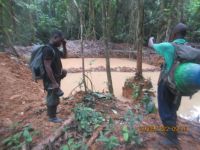
Illegal mining activity in Sapo © Ben Tally -
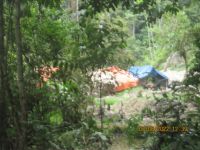
Mining camp © Ben Tally -
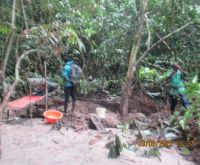
Illegal mining © Ben Tally -
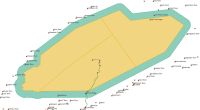
Illegal mining © Ben Tally


Conservation activities
The Forestry Development Authority of Liberia is responsible for the sustainable management of the forest sector and the protection of all natural resources. It runs the Sapo National Park in collaboration with Fauna & Flora International (FFI) and Wild Chimpanzee Foundation (WCF). Main activities at the national park level include anti-poaching, conservation education awareness, and bio-monitoring & scientific research. As of 2019, the main activities in the research area have been camera trappings (2019,2020, 2021) by FFI and FDA in the entire national park. eDNA (focusing on Pygmy hippopotamus) was conducted in 2022. The national park forms part of the Tai-Grebo-Sapo Forest Complex, which is a conservation priority in West Africa. Conservation efforts in Sapo National Park have mainly focused on law enforcement, conservation awareness, and bio-monitoring. The WCF has supported Community Watch Teams (CWT), which comprise members from surrounding communities, and regularly patrol and support FDA rangers (WCF 2019). CWTs have played an important role in the eviction of illegal miners from the national park (WCF 2019). In 2012, Fauna & Flora International established a long-term bio-monitoring program to follow the population trends for chimpanzees, pygmy hippopotamuses, elephants, as well as duikers, birds, reptiles, and amphibians (Tweh et al. 2018). Together with Liberia's Forestry Development Authority, permanent transects are surveyed twice a year as part of this long-term bio-monitoring program (Tweh et al. 2018).
Table 4. Conservation activities reported for Sapo National Park
| Category | Specific activity | Description | Implementing organization(s) | Year of activity |
|---|---|---|---|---|
| 2 Counter-wildlife crime | 2.11 Implement monitoring surveillance strategies (e.g., SMART) or use monitoring data to improve effectiveness of patrols | Long-term bio-monitoring of chimpanzee population (Tweh et al. 2018) | Ongoing (2019) | |
| 2 Counter-wildlife crime | 2.3 Conduct regular anti-poaching patrols | Community Watch Teams supported by the WCF regularly patrol the site (WCF 2019) | Ongoing (2019) | |
| 2 Counter-wildlife crime | 2.8 Provide training to anti-poaching ranger patrols | Members of the Community Watch Teams are trained in the use of equipment (GPS, compass, camera) and patrolling (WCF 2019) | Ongoing (2019) | |
| 4 Education & awareness | 4.1 Educate local communities about apes and sustainable use | Awareness and educational activities about great apes are conducted (Tally B. pers. comm. 2025). | Ongoing (2025) | |
| 4 Education & awareness | 4.2 Involve local community in ape research and conservation management | As part of a long-term bio-monitoring program, staff of Liberia’s Forestry Development Authority and members of the local community are involved in the surveys (Tweh et al. 2018). In addition, local people are consulted on conservation activities, employed to work at the park, supported in their livelihood efforts, and provided with basic knowledge on protecting and conserving great apes and preventing pollution (Tally B. pers. comm. 2025). | 2018-Ongoing (2025) | |
| 5 Protection & restoration | 5.2 Legally protect ape habitat | The area is designated as National Park. | 1983-Ongoing (2026) | |
| 5 Protection & restoration | 5.6 Habitat restoration | Forest rehabilitation and protection activities reported (Tally B. pers. comm. 2025). | Ongoing (2025) | |
| 5 Protection & restoration | 5.9 Resettle illegal human communities (i.e., in a protected area) to another location | Eviction of 18,000 illegal settlers in the park by the Liberia's government (Vogt 2011) | 2010 | |
| 7 Economic & other incentives | 7.1 Provide monetary benefits to local communities for sustainably managing their forest and its wildlife (e.g., REDD, alternative income, employment) | Local community members are hired to work on conservation projects (Tally B. pers. comm. 2025). | Ongoing (2025) | |
| 7 Economic & other incentives | 7.2 Provide non-monetary benefits to local communities for sustainably managing their forest and its wildlife (e.g., better education, infrastructure development) | Local people are provided with general education and life skills, as well as supporting the community to manage their own forests, ecotourism and develop other new income sources like selling local products (Tally B. pers. comm. 2025). | Ongoing (2025) |
Challenges
The influx of local community dwellers inside the national park is hampering the SNP management to implement the protection of chimpanzees. Low manpower for conducting anti-poaching patrols in and outside the park has put chimpanzees under serious threat.
Very high illiteracy among the rangers thus making it difficult to collect data, process court procedures, and conduct conservation education awareness to local community people.
Table 5. Challenges reported for Sapo National Park
| Challenges | Specific challenges | Source | Year(s) |
|---|---|---|---|
| 1 Site management | 1.2 Need for improved coordination | Waitkuwait 2003 | |
| 1 Site management | 1.4 Conflict on land tenure | Tally, B. pers. comm. 2022 | |
| 2 Resources and capacity | 2.1 Lack of capacity/training | Tally B. pers. comm. 2025 | Ongoing (2025) |
| 2 Resources and capacity | 2.2 Lack of staff | Tally B. pers. comm. 2025 | Ongoing (2025) |
| 2 Resources and capacity | 2.3 General lack of funding | Tally B. pers. comm. 2025 | Ongoing (2025) |
| 2 Resources and capacity | 2.4 Lack of continuous/long-term funding | Tally B. pers. comm. 2025 | Ongoing (2025) |
| 2 Resources and capacity | 2.5 Lack of equipment/transportation | Tweh et al. 2018 | |
| 4 Institutional support | 4.1 Lack of law enforcement | Greengrass 2015, N'Goran et al. 2010 |
Enablers
Table 6. Enablers reported for Sapo National Park
| Enablers | Specific enablers | Source | Year(s) |
|---|---|---|---|
| 2 Resources and capacity | 2.6 External partnerships that add expertise or resources | Tally B. pers. comm. 2025 | Ongoing (2025) |
| 3 Engaged community | 3.6 Local community engagement and support | Tally B. pers. comm. 2025 | Ongoing (2025) |
| 1 Site management | |||
| 4 Institutional support | |||
| 5 Ecological context | |||
| 6 Safety and stability |
Research activities
Several surveys have been done in the park to monitor the chimpanzee population (e.g., N'Goran et al. 2010, Tweh et al. 2018), assess the impacts of conservation interventions (Tweh et al. 2018), investigate the behavior and ecology of chimpanzees in the park (Anderson et al. 1983), and investigate the impact of hunting pressure in the area (Greengrass 2015).
Documented behaviours
Table 7. Behaviours documented for Sapo National Park
| Category | Behavior | Observation type | Prevalence | Observation dates | Source | Habituation | Species | Comment |
|---|---|---|---|---|---|---|---|---|
| Nut cracking | Anderson et al. 1983 |
Exposure to climate change impacts
As part of a study on the exposure of African great ape sites to climate change impacts, Kiribou et al. subm. extracted climate data and data on projected extreme climate impact events for the site. Climatological characteristics were derived from observation-based climate data provided by the Inter-Sectoral Impact Model Intercomparison Project (ISIMIP, www.isimip.org). Parameters were calculated as the average across each 30-year period. For 1981-2010, the EWEMBI dataset from ISIMIP2a was used. For the two future periods (2021-2050 and 2071-2099) ISIMIP2b climate data based on four CMIP5 global climate models were used. For future projections, two Representative Concentration Pathways (RCP) were used. RCP 2.6 is a scenario with strong mitigation measures in which global temperatures would likely rise below 2C. RCP 6.0 is a scenario with medium emissions in which global temperatures would likely rise up to 3C by 2100. For the number of days with heavy precipitation events, the 98th percentile of all precipitation days (>1mm/d) was calculated for the 1979-2013 reference period as a threshold for a heavy precipitation event. Then, for each year, the number of days above that threshold was derived. The figures on temperature and precipitation anomaly show the deviation from the mean temperature and mean precipitation for the 1979-2013 reference period.
The estimated exposure to future extreme climate impact events (crop failure, drought, river flood, wildfire, tropical cyclone, and heatwave) is based on a published dataset by Lange et al. 2020 derived from ISIMIP2b data. The same global climate models and RCPs as described above were used. Within each 30-year period, the number of years with an extreme event and the average proportion of the site affected were calculated (see Kiribou et al. subm. for details).
Table 8. Estimated past and projected climatological characteristics in Sapo National Park
| Value | 1981-2010 | 2021-2050, RCP 2.6 | 2021-2050, RCP 6.0 | 2071-2099, RCP 2.6 | 2071-2099, RCP 6.0 |
|---|---|---|---|---|---|
| Mean temperature [C] | 25.9 | 26.9 | 26.8 | 26.9 | 28 |
| Annual precipitation [mm] | 2893 | 2882 | 3001 | 2921 | 2958 |
| Max no. consecutive dry days (per year) | 17.5 | 21 | 16.9 | 20.4 | 19.1 |
| No. days with heavy precipitation (per year) | 5.9 | 12.5 | 14.3 | 14.1 | 15.6 |
Table 9. Projected exposure of apes to extreme climate impact events in Sapo National Park
| Type | No. of years with event (2021-2050, RCP 2.6) | % of site exposed (2021-2050, RCP 2.6) | No. of years with event (2021-2050, RCP 6.0) | % of site exposed (2021-2050, RCP 6.0) | No. of years with event (2070-2099, RCP 2.6) | % of site exposed (2070-2099, RCP 2.6) | No. of years with event (2070-2099, RCP 6.0) | % of site exposed (2070-2099, RCP 6.0) |
|---|---|---|---|---|---|---|---|---|
| Crop failure | 2 | 0.04 | 1 | 0.04 | 1 | 0.04 | 6 | 0.04 |
| Drought | 0 | 0 | 0 | 0 | 0 | 0 | 0 | 0 |
| Heatwave | 13 | 100 | 10.5 | 100 | 17.5 | 100 | 15 | 100 |
| River flood | 0 | 0 | 1 | 4.2 | 0.5 | 0.92 | 0.5 | 0.08 |
| Tropical cyclone | 0 | 0 | 1 | 1.36 | 0 | 0 | 0.5 | 1 |
| Wildfire | 30 | 0.44 | 30 | 0.38 | 29 | 0.46 | 29 | 0.41 |
-
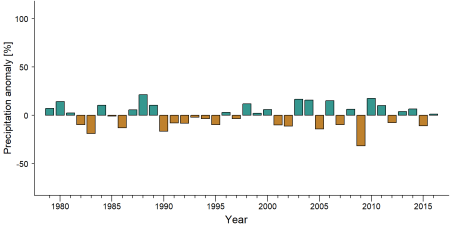
Precipitation anomaly in Sapo National Park -
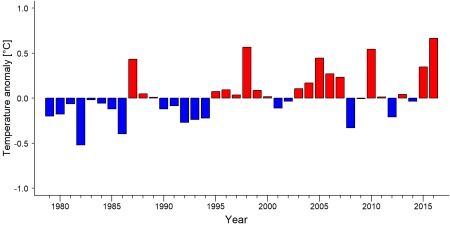
Temperature anomaly in Sapo National Park


External links
References
Tweh, C., Kouakou, C.Y., Chira, R., Freeman, B., Githaiga, J.M., Kerwillain, S., Molokwu-Odozi, M., Varney M. and Junker, J. 2018. Nest counts reveal a stable chimpanzee population in Sapo National Park, Liberia. Primate Conservation 2018 (32): 12 pp.
N’Goran, K. P., Kouakou, C.Y. and Herbinger I. 2010. Report on the Population Survey and Monitoring of Chimpanzee in Sapo National Park, Liberia (June–December 2009). Report. Wild Chimpanzee Foundation, Abidjan, Côted’Ivoire.
Anderson, R., Williamson, E.A., and Carter, J. 1983. Chimpanzees of Sapo Forest, Liberia: density, nests, tools and meat-eating. PRIMAaXS, 24(4): 594-601.
Waitkuwait, W.E. 2003. Report on the First Year of Operation of a Community-based Bio-monitoring Programme in and around Sapo National Park, Sinoe County, Liberia. Report. Fauna and Flora International.
Vogt, M. 2011. Results of Sapo National Park Bio-Monitoring Programme 2007-2009. Report. Fauna & Flora International, Monrovia, Liberia.
Greengrass, E. 2015. Commercial hunting to supply urban markets threatens mammalian biodiversity in Sapo National Park. Oryx 50(3), 397–404.
Collen, B., Howard, B., Konie, J., Daniel, O., and Rist, J. 2011. Field surveys for the endangered pygmy hippopotamus Choerpsis liberiensis in Sapo National Park, Liberia. Oryx, 45(1), 35–37.
Wild Chimpanzee Foundation. 2019. Activities of the Wild Chimpanzee Foundation for improved conservation of chimpanzees and their habitat in West Africa. Annual Report 2018.
Peal, A. L., & Kranz, K. R. (1990). Antelopes: GLobal Survey and Regional Action Plans, Part 3. West and
Central Africa. Gland, Switzerland: World Conservation Union.
Page created by: Ben Tally & APES Atlas Team Date: 2023-01-23
Page updated by: Ben Tally & APES Atlas Team Date: 2025-10-29