Revision as of 13:55, 30 October 2025 by WikiEdit(talk | contribs)(Created page with "Asia > Malaysia > Sabah '''[https://apesatlas-iucnapesportal-org.translate.goog/index.php/Sabah?_x_tr_sl=auto&_x_tr_tl=fr&_x_tr_hl=en&_x_tr_pto=wapp Français]''' | '''[https://apesatlas-iucnapesportal-org.translate.goog/index.php/Sabah?_x_tr_sl=auto&_x_tr_tl=pt&_x_tr_hl=en&_x_tr_pto=wapp Português]''' | '''[https://apesatlas-iucnapesportal-org.translate.goog/index.php/Sabah?_x_tr_sl=auto&_x_tr_tl=es&_x_tr_hl=en&_x_tr_pto=wapp Español]''' | '''[https://ape...")
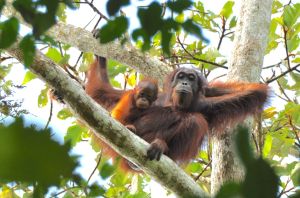
Northeast Bornean orangutans (Pongo pygmaeus morio) are present in Sabah.
It has been estimated that 9,558 (CI: 6,815-15,129) individuals occur in the site.
The orangutan population trend is decreasing.
The site has a total size of 76,000 km².
Key threats to orangutans are forest conversion and fragmentation.
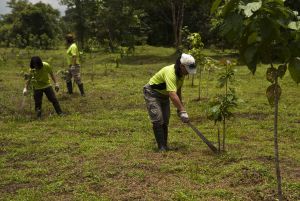
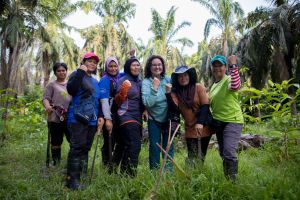
Conservation activities have focused on orangutan rehabilitation, canopy bridges, involvement of local people in conservation activities, habitat restoration, and capacity building.
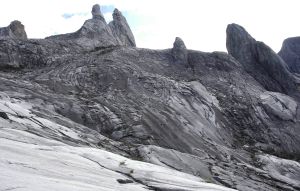
Sabah is one of the 13 states in Malaysia, situated in the north of Borneo. The state covers about 76,000 sq. km. The state features the highest mountain in Malaysia, Mount Kinabalu, at 4,095 m. About 16% of Sabah's total forest area is under some form of protection (Butler 2020). Mangrove forests are found largely on the east coast facing the Sulu Sulawesi Seas. Sabah harbours a wide diversity of wildlife, including 221 recorded species of mammals, 98 of amphibians, 197 of reptiles, 664 of birds, and thousands of invertebrate species (Mannan et al. 2013). In addition to orangutans, proboscis monkey, tembadau, rhinoceros and pygmy elephant are also present in Sabah (Mannan et al. 2013).
Table 1. Basic site information for Sabah
Species
Pongo pygmaeus morio
Area
76,000 km²
Coordinates
Lat: 5.212839 , Lon: 116.996555
Type of site
Non-protected area
Habitat types
Subtropical/tropical moist lowland forest, Subtropical/tropical moist montane forest, Rocky areas (inland cliffs, mountain peaks), Subtropical/tropical heavily degraded former forest, Agricultural land, Urban areas
In the early 1980s, WWF-Malaysia estimated 4,000 orangutans in 5,000 sq. km. of Sabah’s primary forest in the eastern lowlands and central uplands. In the mid-1980s, the first aerial nest surveys were conducted; combined with habitat assessments, it was estimated that up to 21,000 orangutans inhabited Sabah´s forest reserves and state parks (Simon et al. 2019). Fifteen years later, in 2002-2003, an aerial and ground nest survey identified 16 major orangutan populations in Sabah with a total 11,000 individuals (Ancrenaz et al. 2005). The most recent aerial survey that followed, between 2014 and 2017, estimated 9,558 orangutans (95% CI: 6,815 to 15,129), with separate studies recording a further 800 orangutans in the Lower Kinabatangan region. This results in a conservative population estimate of 10,300 orangutans in Sabah’s Permanent Forest Reserve and wildlife sanctuary (Simon et al. 2019).
Table 2. Ape population estimates reported for Sabah
Species
Year
Occurrence
Encounter or vistation rate (nests/km; ind/day)
Density estimate [ind./ km²] (95% CI)
Abundance estimate (95% CI)
Survey area
Sampling method
Analytical framework
Source
Comments
A.P.E.S. database ID
Pongo pygmaeus morio
2014-2017
9,558 (6,815-15,129)
Sabah, 63% of the previously surveyed areas (in 2002-2003).
Forest conversion and fragmentation are the key threats to orangutans in Sabah (Wich et al. 2008). Between 1973 and 2010, 39% of rainforests were lost in Borneo, including more than 98,000 sq. km of suitable orangutan habitat (Simon et al. 2019). Specifically, conversion of natural habitat to oil palm and tree plantations is a major threat (Simon et al. 2019).
Table 3. Threats to apes reported for Sabah
Category
Specific threats
Threat level
Description
Year of threat
2 Agriculture & aquaculture
2.1 Annual & perennial non-timber crops
High (more than 70% of population affected)
Deforestation for agriculture (Wich et al. 2008; Simon et al. 2019).
2008-Ongoing (2019)
5 Biological resource use
5.3 Logging & wood harvesting
High (more than 70% of population affected)
Timber extraction (Wich et al. 2008; Simon et al. 2019).
2008-Ongoing (2019)
11 Climate change & severe weather
11.1 Habitat shifting & alteration
Present (unknown severity)
Impacts of climate change are likely to reduce suitable orangutan habitat (Simon et al. 2019).
Ongoing (2019)
5 Biological resource use
5.1 Hunting & collecting terrestrial animals
Present (unknown severity)
Hunting pressure, either for meat or human-orangutan conflict situations (Simon et al. 2019).
Ongoing (2019)
5 Biological resource use
5.1.5 Persecution/human wildlife conflict
Present (unknown severity)
Hunting pressure, either for meat or human-orangutan conflict situations (Simon et al. 2019).
Ongoing (2019)
12 Other threat
Other
High (more than 70% of population affected)
Forest fragmentation is the main threat to orangutans in Sabah (SWD 2020).
Ongoing (2020)
4 Transportation & service corridors
4.1 Roads & railroads
High (more than 70% of population affected)
Construction of the Pan Borneo highway is increasing forest fragmentation and opening up forested areas for resource extraction (Tian Tong 2021).
Almost half of Sabah's landmass has been gazetted as Permanent Forest Reserve (PFR), which encompasses 3.54 million ha, of which 1.61 million ha are protected forests, and the remaining 1.93 million are production forests (Simon et al. 2019). In addition to the PFR, state parks, wildlife sanctuaries and conservation areas add another 0.27 million ha of protected forests (Simon et al. 2019). In 1998, with support from the Sabah Wildlife Department, HUTAN established the Kinabatangan Orang-utan Conservation Programme (or KOCP) in the village of Sukau. The 2020-2029 Orangutan Action Plan for Sabah highlights the following objectives and actions to be implemented in the region: halting habitat loss and restore habitat, ensure better protection of orangutans (e.g., more effective law enforcement), ensure survival of orangutans in agricultural landscapes, improve ex-situ practises (e.g., rehabilitation of individuals), and monitor and predict population trends (SWD 2020).
Table 4. Conservation activities reported for Sabah
2.12 Implement community control of patrolling, banning hunting and removing snares
In 2002, the Sabah Wildlife Department trained and appointed people from the Kinabatangan community to become “Honorary Wildlife Wardens” or HWWs. HWWs are civilians who are given the same legal powers as rangers from the Sabah Wildlife Department to conserve and manage the natural resources of the State and to apprehend offenders when necessary (HUTAN).
2002-Ongoing (2021)
1 Development impact mitigation
1.9 Install green bridges (overpasses) or canopy bridges over transportation or service corridors
4.1 Educate local communities about apes and sustainable use
The Sabah Environmental Education Network (SEEN) is a network of people and NGOs working together to implement environmental education programmes and activities in Sabah (Sabah SEEN). The HUTAN Environmental and Awareness Program (HEAP) offers high-quality free environmental education programmes (sanctioned by the Sabah Education Department) to primary and secondary schools throughout Sabah (HUTAN).
Ongoing (2021)
5 Protection & restoration
5.6 Habitat restoration
Habitat restoration to link isolated populations (HUTAN).
Ongoing (2021)
5 Protection & restoration
5.2 Legally protect ape habitat
More than 80% of the current orangutan population in Sabah occurs in fully protected forests (HUTAN).
Research activities have been mainly focused on surveys and biomonitoring, studies on orangutan ecology in disturbed forest as well as agricultural landscapes, genetic studies, and in the past, rehabilitation/post release monitoring. Based on the results of the surveys undertaken by HUTAN and the Sabah Wildlife Department, the government increased the size of areas under protection in the state from about 12% of the land-mass in the early 2000s to 26% today. The ultimate goal of the government is to fully protect 30% of Sabah's land-mass. Currently, more than 80% of the current orang-utan population found in Sabah occurs in fully protected forests (HUTAN).
Ancrenaz M, Gimenez O, Ambu L, Ancrenaz K, Andau P, Goossens B, et al. (2005) Aerial Surveys Give New Estimates for Orangutans in Sabah, Malaysia. PLoS Biol 3(1): e3. https://doi.org/10.1371/journal.pbio.0030003
Mannan, S., Lee, Y.F., Kugan, F., Ong, R.C. & Chung, A.Y.C. (2013). Wealth creation from biodiversity conservation: the Sabah way. Paper presented at the International Conference on Challenges of Extended Mega Urban Regions: the Challenging Face of South East Asia and the World. 19-21 November, 2013, Putrajaya, Malaysia.
Sabah Wildlife Department (2020). Orangutan Action Plan for Sabah 2020-2029. Kota Kibanalu, Sabah, Malaysia.
Wich, S., Meijaard, E., Marshall, A., Husson, S., Ancrenaz, M., Lacy, R., . . . Singleton, I. (2008). Distribution and conservation status of the orang-utan (Pongo spp.) on Borneo and Sumatra: How many remain? Oryx, 42(3), 329-339. doi:10.1017/S003060530800197X
Page created by: Marc Ancrenaz & APES Atlas Team Date: 2021-12-08