
Gadha Woundou Classified Forest
West Africa > Republic of Guinea > Gadha Woundou Classified Forest
Français | Português | Español | Bahasa Indonesia | Melayu
Summary
- Western chimpanzees (Pan troglodytes verus) are present in Gadha Woundou Classified Forest.
- Estimates for the chimpanzee population range between 50 and 500 individuals.
- The chimpanzee population trend is unknown.
- The total size of the area has not been reported.
- Agriculture and roads are the most prevalent signs of human activity in Gadha Woundou.
- Local residents have established forest monitoring committees.
Site characteristics
Gadha Woundou is a sub-prefecture located in Northern Guinea in the prefecture Koubia in the Fouta Djallon.
Two classified forests, located right next to each other separated by the river Gambie, were established in 1952, Woundou North and Woundou South (WCF 2012). Gadha Woundou does not have a designated IUCN category nor is it listed in the World Database on Protected Areas (UNEP-WCMC and IUCN 2018). The habitat is characterized by a mosaic of wooded savanna, savanna grassland, gallery forests and bamboo forests (WCF 2012). The presence of jackals (Canis sp.), leopards (Panthera pardus), green monkeys (Chlorocebus sabaeus), Guinea baboons (Papio papio), and patas monkeys (Erythrocebus patas) has also been confirmed (WCF 2012).
Table 1. Basic site information for Gadha Woundou Classified Forest
| Species | Pan troglodytes verus |
| Area | |
| Coordinates | Lat: 11.97 , Lon: -11.64 |
| Type of site | Unknown |
| Habitat types | Savanna, Shrubland, Subtropical/tropical dry forest, Agricultural land |
| Type of governance |
Types of sites Governance types Habitat types
Ape status
In 1997, Rebecca Kormos conducted reconnaissance surveys in Gadha Woundou and confirmed the presence of western chimpanzees (Ham 1998). I.S. Camara surveyed Woundou North Classified Forest and estimated the chimpanzee population at more than 500 individuals (Camara 2007, report not in the public domain, details cited here were taken from WCF 2012). In 2011, the Wild Chimpanzee Foundation also surveyed Woundou North in collaboration with the Office for Biodiversity and Protected Areas Guinea (OGuiBDPA) (WCF 2012). They estimated that around 50 chimpanzees occur in the area, but noted that this was an underestimate because they encountered a group of 50 individuals while other survey teams noticed two additional chimpanzee groups (WCF 2012). In savanna mosaics chimpanzee nests are mainly found in gallery forests and a systematic survey design can lead to underestimations in such fragmented habitat (WCF 2012).
Table 2. Ape population estimates reported for Gadha Woundou Classified Forest
| Species | Year | Occurrence | Encounter or vistation rate (nests/km; ind/day) | Density estimate [ind./ km²] (95% CI) | Abundance estimate (95% CI) | Survey area | Sampling method | Analytical framework | Source | Comments | A.P.E.S. database ID |
|---|---|---|---|---|---|---|---|---|---|---|---|
| Pan troglodytes verus | 2011 | 0.167 (0.091-0.306) | 47 (25-95) | Woundou North (appr. 280 km²) | Line transects | WCF 2012 | Total survey effort: 83.5 km, * report stated that total abundance was likely strongly underestimated | GIN0002, GIN0010 GIN0016, GIN0020, GIN0023, GIN0024, GIN0025, GIN0027, GIN0029, GIN0036, GIN0069
| |||
| Pan troglodytes verus | 2007 | 55.74 | 500.0 | Woundou North (appr. 280 km²) | Line transects | Camara 2007 (as found in WCF 2012) | Total survey effort: 30.5km. Abundance estimate is a minimum. | GIN0002, GIN0010 GIN0016, GIN0020, GIN0023, GIN0024, GIN0025, GIN0027, GIN0029, GIN0036, GIN0069
| |||
| Pan troglodytes verus | 1997 | Present | Gadha Woundou | Reconnaissance walk | Ham 1998 | Reconnaissance survey | GIN0019, GIN0021 |
Sampling methods Analytical frameworks
Threats
Around 5.600 people are living in proximity to Gadha Woundou (Camara 2007). Human density in Woundou North Classified Forest is low with seven villages around the site (WCF 2012). Roads to these villages are, however, not passable year round. A survey of anthropogenic signs found paths to be most prevalent, followed by slash and burn agriculture, traditional hunting and wood extraction (WCF 2012). Chimpanzees are not hunted and there were no signs of commercial hunting (WCF 2012).
Table 3. Threats to apes reported for Gadha Woundou Classified Forest
| Category | Specific threats | Threat level | Description | Year of threat |
|---|---|---|---|---|
| 1 Residential & commercial development | 1.1 Residential areas | Low (up to 30% of population affected) | Sign of villages (WCF 2012) | Ongoing (2012) |
| 2 Agriculture & aquaculture | 2.1 Annual & perennial non-timber crops | Medium (30-70% of population affected) | Signs of agriculture were found in 12% of Woundou North (WCF 2012) | Ongoing (2012) |
| 3 Energy production & mining | 3.2 Mining & quarrying | Low (up to 30% of population affected) | No further details mentioned in WCF 2012 | Ongoing (2012) |
| 4 Transportation & service corridors | 4.1 Roads & railroads | Medium (30-70% of population affected) | Paths were the most prevalent sign of anthropogenic activities (WCF 2012) | Ongoing (2012) |
| 5 Biological resource use | 5.1 Hunting & collecting terrestrial animals | Low (up to 30% of population affected) | Signs of traditional hunting were found but there were no signs of commercial hunting (WCF 2012) | Ongoing (2012) |
| 5 Biological resource use | 5.3 Logging & wood harvesting | Low (up to 30% of population affected) | Signs of wood extraction for local use were recorded (WCF 2012) | Ongoing (2012) |
Conservation activities
According to local authorities monitoring committees have been established by local residents and are responsible for forest monitoring to deter poachers (WCF 2012).
Table 4. Conservation activities reported for Gadha Woundou Classified Forest
| Category | Specific activity | Description | Implementing organization(s) | Year of activity |
|---|---|---|---|---|
| 2 Counter-wildlife crime | 2.12 Implement community control of patrolling, banning hunting and removing snares | Local residents established monitoring committees that are responsible for forest monitoring to deter poachers (WCF 2012) | Ongoing (2012) |
Challenges
Table 5. Challenges reported for Gadha Woundou Classified Forest
| Challenges | Specific challenges | Source | Year(s) |
|---|---|---|---|
| Not reported |
Enablers
Table 6. Enablers reported for Gadha Woundou Classified Forest
| Enablers | Specific enablers | Source | Year(s) |
|---|---|---|---|
| 1 Site management | |||
| 2 Resources and capacity | |||
| 3 Engaged community | |||
| 4 Institutional support | |||
| 5 Ecological context | |||
| 6 Safety and stability |
Research activities
From 1996 to 1997 Rebecca Kormos (née Ham) did a nationwide surveys on chimpanzees across Guinea and also surveyed Gadha Woundou (Ham 1998). Woundou North was surveyed by I.S. Camara (Camara 2007) and the Wild Chimpanzee Foundation (WCF 2012).
Documented behaviours
Table 7. Behaviours documented for Gadha Woundou Classified Forest
| Category | Behavior | Observation type | Prevalence | Observation dates | Source | Habituation | Species | Comment |
|---|---|---|---|---|---|---|---|---|
| Not reported |
Exposure to climate change impacts
As part of a study on the exposure of African great ape sites to climate change impacts, Kiribou et al. (2024) extracted climate data and data on projected extreme climate impact events for the site. Climatological characteristics were derived from observation-based climate data provided by the Inter-Sectoral Impact Model Intercomparison Project (ISIMIP, www.isimip.org). Parameters were calculated as the average across each 30-year period. For 1981-2010, the EWEMBI dataset from ISIMIP2a was used. For the two future periods (2021-2050 and 2071-2099) ISIMIP2b climate data based on four CMIP5 global climate models were used. For future projections, two Representative Concentration Pathways (RCP) were used. RCP 2.6 is a scenario with strong mitigation measures in which global temperatures would likely rise below 2C. RCP 6.0 is a scenario with medium emissions in which global temperatures would likely rise up to 3C by 2100. For the number of days with heavy precipitation events, the 98th percentile of all precipitation days (>1mm/d) was calculated for the 1979-2013 reference period as a threshold for a heavy precipitation event. Then, for each year, the number of days above that threshold was derived. The figures on temperature and precipitation anomaly show the deviation from the mean temperature and mean precipitation for the 1979-2013 reference period.
The estimated exposure to future extreme climate impact events (crop failure, drought, river flood, wildfire, tropical cyclone, and heatwave) is based on a published dataset by Lange et al. 2020 derived from ISIMIP2b data. The same global climate models and RCPs as described above were used. Within each 30-year period, the number of years with an extreme event and the average proportion of the site affected were calculated (Kiribou et al. 2024).
Table 8. Estimated past and projected climatological characteristics in Gadha Woundou Classified Forest
| Value | 1981-2010 | 2021-2050, RCP 2.6 | 2021-2050, RCP 6.0 | 2071-2099, RCP 2.6 | 2071-2099, RCP 6.0 |
|---|---|---|---|---|---|
| Mean temperature [C] | 26 | 27.3 | 27.1 | 27.5 | 28.8 |
| Annual precipitation [mm] | 1379 | 1335 | 1329 | 1350 | 1282 |
| Max no. consecutive dry days (per year) | 85.2 | 89.3 | 91.6 | 93.2 | 94.2 |
| No. days with heavy precipitation (per year) | 3.3 | 4.6 | 4.1 | 5 | 3.8 |
Table 9. Projected exposure of apes to extreme climate impact events in Gadha Woundou Classified Forest
| Type | No. of years with event (2021-2050, RCP 2.6) | % of site exposed (2021-2050, RCP 2.6) | No. of years with event (2021-2050, RCP 6.0) | % of site exposed (2021-2050, RCP 6.0) | No. of years with event (2070-2099, RCP 2.6) | % of site exposed (2070-2099, RCP 2.6) | No. of years with event (2070-2099, RCP 6.0) | % of site exposed (2070-2099, RCP 6.0) |
|---|---|---|---|---|---|---|---|---|
| Crop failure | 10 | 0.68 | 7 | 0.68 | 10.5 | 0.68 | 16 | 0.68 |
| Drought | 0 | 0 | 0 | 0 | 0 | 0 | 0 | 0 |
| Heatwave | 0 | 0 | 0 | 0 | 0 | 0 | 1 | 50 |
| River flood | 0.75 | 1.19 | 0 | 0 | 0.5 | 0.02 | 0 | 0 |
| Tropical cyclone | 0 | 0 | 0 | 0 | 0.5 | 2.57 | 0 | 0 |
| Wildfire | 30 | 1.77 | 30 | 1.49 | 29 | 1.67 | 29 | 2.24 |
-
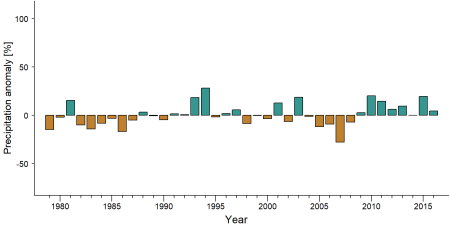
Precipitation anomaly in Gadha Woundou Classified Forest -
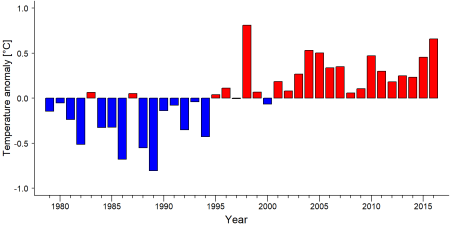
Temperature anomaly in Gadha Woundou Classified Forest


External links
References
Camara (2007) Inventaire des chimpanzes pan troglodytes verus dans la foret classée de la Woundou –nord, Prefecture de Koubia. Mémoire de fin d’études Supérieures, 41ème promotion, Institut Supérieur agronomique et vétérinaire Valéry Giscard d’Estaing de Faranah.
Ham R. 1998. Nationwide chimpanzee census and large mammal survey Republic of Guinea. Unpublished report for the European Communion, Guinea-Conakry.
UNEP-WCMC, IUCN. 2018. Protected Planet: The World Database on Protected Areas (WDPA), Cambridge, UK: UNEP-WCMC and IUCN Online: www.protectedplanet.net link
WCF. 2012. Etat de la faune et des menaces dans les aires protégées terrestres et principales zones de forte biodiversité de Rep. de Guinée. Report. Wild Chimpanzee Foundation, Sangaredi, Republic of Guinea. Online: Wild Chimpanzee Foundation
Kiribou, R., Tehoda, P., Chukwu, O., Bempah, G., Kühl, H. S., Ferreira, J., …, & Heinicke, S. (2024). Exposure of African ape sites to climate change impacts. PLOS Climate, 3(2), 1-19. doi:10.1371/journal.pclm.0000345
Page created by: APES Atlas Team Date: 2019-01-11