
Cavally Nature Reserve
West Africa > Côte d'Ivoire > Cavally Nature Reserve
Français | Português | Español | Bahasa Indonesia | Melayu
Summary
- Western chimpanzees (Pan troglodytes verus) are present in Cavally Nature Reserve.
- It has been estimated that 52 (CI: 28-96) individuals occur at the site.
- The chimpanzee population trend is unknown.
- This site has a total size of 675 km².
- Key threats to chimpanzees are deforestation and illegal bushmeat hunting.
- Conservation activities conducted include law enforcement patrols, environmental education, and alternative livelihood projects.
- Cavally is one of a few remaining forest blocks in Côte d’Ivoire.
Site characteristics
Cavally Nature Reserve is located in southwestern Côte d’Ivoire, directly neighboring the Goin-Débé Classified Forest. It is one of the last remaining lowland forests of the Upper Guinea forest ecosystem in Côte d’Ivoire (Alonso et al. 2005). It connects the two large forest blocks of Taï National Park, Côte d’Ivoire, and Grebo-Krahn National Park, Liberia.
Cavally is a lowland rainforest. A rapid biological assessment of the Cavally forest in 2002 found 639 plant species, 63 insect species, 26 fishes, 36 amphibians, 11 reptiles, 153 birds, 16 small mammals and 34 large mammal species (Alonso et al. 2005). 13% of the plants recorded were endemic to West Africa. Species present in Cavally include ungulates such as the royal antelope (Neotragus pygmaeus), bongo (Tragelaphus eurycerus), and bushbuck (Tragelaphus scriptus); birds, including hornbills (Buceros sp.) and turacos (Tauraco sp.); red river hog (Potamochoerus porcus), pygmy hippopotamus (Choeropsis liberiensis), and several primate species, including Campbell’s monkey (Cercopithecus campbelli), sooty mangabey (Cercocebus atys), Diana monkey (Cercopithecus diana), and western red colobus (Piliocolobus badius, Normand 2010).
Because of the presence of the endangered bird species Gola malimbe (Malimbus ballmanni) Cavally and Goin-Débé are designated as Important Bird Areas (BirdLife International 2019). Cavally was previously a Classified Forest; it was reclassified in September 2023 as a Nature Reserve (WCF 2023).
Table 1. Basic site information for Cavally Nature Reserve
| Species | Pan troglodytes verus |
| Area | 675 km² |
| Coordinates | Lat: 6.07 , Lon: -7.67 |
| Type of site | Protected area (Nature Reserve) |
| Habitat types | Subtropical/tropical moist lowland forest, Agricultural land |
| Type of governance |
Types of sites Governance types Habitat types
Ape status
A survey by the Wild Chimpanzee Foundation (WCF) concluded that the chimpanzee population remained stable at around 50 individuals (Normand 2010). However, with the strong pressure on the Cavally forest and large-scale deforestation in the past years it is not clear how many chimpanzees remain (WCF 2016).
Table 2. Ape population estimates reported for Cavally Nature Reserve
| Species | Year | Occurrence | Encounter or vistation rate (nests/km; ind/day) | Density estimate [ind./ km²] (95% CI) | Abundance estimate (95% CI) | Survey area | Sampling method | Analytical framework | Source | Comments | A.P.E.S. database ID |
|---|---|---|---|---|---|---|---|---|---|---|---|
| Pan troglodytes verus | 2009 | 0.292 | 0.068 (0.037-0.127) | 44 (24-81) | Cavally Nature Reserve | Line transects | Normand 2010 | Total survey effort: 130 km | |||
| Pan troglodytes verus | 2010 | 0.343 | 0.081 (0.044-0.149) | 52 (28-96) | Cavally Nature Reserve | Line transects | Normand 2010 | Total survey effort: 300 km | |||
| Pan troglodytes verus | 2002 | Present | Cavally Nature Reserve | Reconnaissance walk | Alonso et al. 2005 |
Sampling methods Analytical frameworks
Threats
The site is under strong deforestation pressure driven by the arrival of farmers from other areas trying to clear forest for the establishment of cocoa plantations. In the 2010 WCF survey signs of deforestation were mainly restricted to the northern part of Cavally (Normand 2010). However, with the infiltration of migrant farmers who were displaced from Mont Peko in 2016, pressure on the forest increased strongly (WCF 2016). Logging activities were already recorded in the rapid biological assessment in 2002 (Alonso et al. 2005). These logging activities resulted in increased illegal bushmeat hunting and establishment of illegal cocoa plantations (Alonso et al. 2005). Signs of hunting were found throughout the forest (Normand 2010). Monitoring activities by eco-guards trained by the WCF concluded that around 60% of Cavally forest remained intact, while 35% were plantations, mainly cocoa (WCF 2017).
Table 3. Threats to apes reported for Cavally Nature Reserve
| Category | Specific threats | Threat level | Description | Year of threat |
|---|---|---|---|---|
| 5 Biological resource use | 5.1 Hunting & collecting terrestrial animals | High (more than 70% of population affected) | bushmeat hunting widespread (Alonso et al. 2005, Normand 2010) | 2005-Ongoing (2010) |
| 2 Agriculture & aquaculture | 2.1 Annual & perennial non-timber crops | High (more than 70% of population affected) | agricultural activities widespread (Normand 2010), increasing pressure after the infiltration of migrant farmers in 2016 (WCF 2016) | 2010-Ongoing (2016) |
| 5 Biological resource use | 5.3 Logging & wood harvesting | High (more than 70% of population affected) | high deforestation pressure on Cavally CF (Chatelain et al. 2010, Normand 2010, WCF 2016, 2017) | 2010-Ongoing (2017) |
| 3 Energy production & mining | 3.2 Mining & quarrying | Low (up to 30% of population affected) | Signs of artisanal mining for gold during 2007 survey (Normand 2010) | Ongoing (2010) |
| 4 Transportation & service corridors | 4.1 Roads & railroads | Present (unknown severity) | roads used to access plantations but also for wood extraction (Normand 2010) | Ongoing (2010) |
Conservation activities
Since 2005, the WCF has worked in close cooperation with the “Société pour le Développement des Forêts” (SODEFOR) to implement conservation activities to combat poaching and deforestation in Cavally. The WCF implements monitoring activities, and with its presence wants to deter illegal agricultural activities (Normand 2007, WCF 2011, WCF 2013). Community eco guards are central to the monitoring program; eco guards make patrols and record wildlife presence, signs of illegal human activities, and
monitor forest status (WCF 2023). SODEFOR dismantled illegal cocoa plantations in 2013 (WCF 2013). In 2013, a management plan was agreed upon by all stakeholders. Starting in 2014, the WCF started a FLEGT process (Forest Law Enforcement Governance and Trade), a program financed by the EU, UN FAO and UK Department for International Development (EU FLEGT Facility 2016). The WCF trained eco-guards (SODEFOR officers, employees of the logging company and people from communities around Cavally) to conduct patrols to prevent illegal activities, destroy illegal plantations and monitor wildlife (WCF 2014, 2015, 2017).
The WCF collaborates with local NGOs NOFNA (Our Forest, Our Future), OPRFT (Observatory for the Protection and Reconstitution of Fauna and Tropical Flora) and IDEF (Community Development and Forest Conservation) to monitor the forest and to raise awareness on the threats to Cavally (WCF 2016). This collaboration also started alternative livelihood support projects around Cavally forest (frozen food store, pig and chicken farm, cassava production and transformation, WCF 2018). Environmental awareness activities include village meetings, panel discussions, radio broadcasting, and a theatre tour (WCF 2016, 2017, 2018).
Table 4. Conservation activities reported for Cavally Nature Reserve
| Category | Specific activity | Description | Implementing organization(s) | Year of activity |
|---|---|---|---|---|
| 5 Protection & restoration | 5.2 Legally protect ape habitat | designated as Classified Forest as far back as 2001 (BirdLife International 2019) and reclassified as a Nature Reserve in 2023. | 2001-Ongoing (2023) | |
| 2 Counter-wildlife crime | 2.11 Implement monitoring surveillance strategies (e.g., SMART) or use monitoring data to improve effectiveness of patrols | law enformcement patrols done by SODEFOR, training and equipment of eco-guards to monitor the forest (WCF 2014, 2015, 2017, 2018, 2023) | 2014- Ongoing (2023) | |
| 4 Education & awareness | 4.2 Involve local community in ape research and conservation management | WCF is training eco-guards that include member of the community to monitor the forest since 2014 (WCF 2014, 2023) | 2014-Ongoing (2023) | |
| 4 Education & awareness | 4.1 Educate local communities about apes and sustainable use | environmental awareness raising activities include village discussions and involvement of schools (WCF 2016, 2017, 2018, 2023) | 2016-Ongoing (2023) | |
| 4 Education & awareness | 4.5 Implement multimedia campaigns using theatre, film, print media, discussions | theater tour (WCF 2017, 2018) and panel discussion (WCF 2017) | 2017-Ongoing (2018) | |
| 1 Development impact mitigation | 1.15 Certify products from agriculture, mining or logging and market them as ape friendly | WCF is cooperating with SODEFOR and OIPR to establish and monitor sustainable logging practices (Normand 2007, WCF 2018) | Ongoing (2018) | |
| 2 Counter-wildlife crime | 2.13 Provide sustainable alternative livelihoods; establish fish- or domestic meat farms | collaboration of WCF, NOFNA and OPRFT established alternative livelihood support projects, incl. (frozen food store, pig and chicken farm, cassava production and transformation (WCF 2018) | Ongoing (2018) | |
| 4 Education & awareness | 4.4 Regularly play TV and radio announcements to raise ape conservation awareness | radio announcements are broadcasted (WCF 2018) | Ongoing (2018) | |
| 7 Economic & other incentives | 7.2 Provide non-monetary benefits to local communities for sustainably managing their forest and its wildlife (e.g., better education, infrastructure development) | Alternative livelihood support projects around Cavally forest (frozen food store, pig and chicken farm, cassava production and transformation) by WCF and local NGOs OPRFT, NOFNA and IDEF (WCF 2018). | Ongoing (2018) |
Challenges
As part of their work to establish and monitor sustainable logging practices the WCF noted several impediments to conservation, including civil unrest, corruption, lack of capacity and lack of law enforcement, the latter also at the level of the judicial system (WCF 2012, 2013, 2015, 2016, 2017).
Table 5. Challenges reported for Cavally Nature Reserve
| Challenges | Specific challenges | Source | Year(s) |
|---|---|---|---|
| 6 Safety and stability | 6.3 Civil unrest/war | WCF 2012 | |
| 1 Site management | 1.3 Corruption | WCF 2016, 2017 | |
| 2 Resources and capacity | 2.1 Lack of capacity/training | WCF 2015 | |
| 4 Institutional support | 4.1 Lack of law enforcement | WCF 2012, WCF 2013, WCF 2015 |
Enablers
Table 6. Enablers reported for Cavally Nature Reserve
| Enablers | Specific enablers | Source | Year(s) |
|---|---|---|---|
| 1 Site management | |||
| 2 Resources and capacity | |||
| 3 Engaged community | |||
| 4 Institutional support | |||
| 5 Ecological context | |||
| 6 Safety and stability |
Research activities
Beyond the monitoring activities mentioned in the section ‘Ape Status’ no further research activities have been reported.
Documented behaviours
Table 7. Behaviours documented for Cavally Nature Reserve
| Category | Behavior | Observation type | Prevalence | Observation dates | Source | Habituation | Species | Comment |
|---|---|---|---|---|---|---|---|---|
| Not reported |
Exposure to climate change impacts
As part of a study on the exposure of African great ape sites to climate change impacts, Kiribou et al. subm. extracted climate data and data on projected extreme climate impact events for the site. Climatological characteristics were derived from observation-based climate data provided by the Inter-Sectoral Impact Model Intercomparison Project (ISIMIP, www.isimip.org). Parameters were calculated as the average across each 30-year period. For 1981-2010, the EWEMBI dataset from ISIMIP2a was used. For the two future periods (2021-2050 and 2071-2099) ISIMIP2b climate data based on four CMIP5 global climate models were used. For future projections, two Representative Concentration Pathways (RCP) were used. RCP 2.6 is a scenario with strong mitigation measures in which global temperatures would likely rise below 2C. RCP 6.0 is a scenario with medium emissions in which global temperatures would likely rise up to 3C by 2100. For the number of days with heavy precipitation events, the 98th percentile of all precipitation days (>1mm/d) was calculated for the 1979-2013 reference period as a threshold for a heavy precipitation event. Then, for each year, the number of days above that threshold was derived. The figures on temperature and precipitation anomaly show the deviation from the mean temperature and mean precipitation for the 1979-2013 reference period.
The estimated exposure to future extreme climate impact events (crop failure, drought, river flood, wildfire, tropical cyclone, and heatwave) is based on a published dataset by Lange et al. 2020 derived from ISIMIP2b data. The same global climate models and RCPs as described above were used. Within each 30-year period, the number of years with an extreme event and the average proportion of the site affected were calculated (see Kiribou et al. subm. for details).
Table 8. Estimated past and projected climatological characteristics in Cavally Nature Reserve
| Value | 1981-2010 | 2021-2050, RCP 2.6 | 2021-2050, RCP 6.0 | 2071-2099, RCP 2.6 | 2071-2099, RCP 6.0 |
|---|---|---|---|---|---|
| Mean temperature [C] | 25.5 | 26.6 | 26.6 | 26.7 | 27.8 |
| Annual precipitation [mm] | 1834 | 1849 | 1905 | 1885 | 1962 |
| Max no. consecutive dry days (per year) | 23.2 | 25.7 | 24.5 | 27.9 | 26.9 |
| No. days with heavy precipitation (per year) | 6.4 | 8 | 7.7 | 8.2 | 10.8 |
Table 9. Projected exposure of apes to extreme climate impact events in Cavally Nature Reserve
| Type | No. of years with event (2021-2050, RCP 2.6) | % of site exposed (2021-2050, RCP 2.6) | No. of years with event (2021-2050, RCP 6.0) | % of site exposed (2021-2050, RCP 6.0) | No. of years with event (2070-2099, RCP 2.6) | % of site exposed (2070-2099, RCP 2.6) | No. of years with event (2070-2099, RCP 6.0) | % of site exposed (2070-2099, RCP 6.0) |
|---|---|---|---|---|---|---|---|---|
| Crop failure | 2 | 1.79 | 4.5 | 1.36 | 6 | 1.15 | 6.5 | 1.61 |
| Drought | 0 | 0 | 0 | 0 | 0 | 0 | 0 | 0 |
| Heatwave | 10 | 100 | 9 | 100 | 15 | 100 | 17 | 100 |
| River flood | 0.5 | 0.23 | 2 | 4.11 | 2.5 | 1.91 | 2.75 | 2.94 |
| Tropical cyclone | 0 | 0 | 0 | 0 | 0 | 0 | 0 | 0 |
| Wildfire | 30 | 0.51 | 30 | 0.49 | 29 | 0.52 | 29 | 0.56 |
-
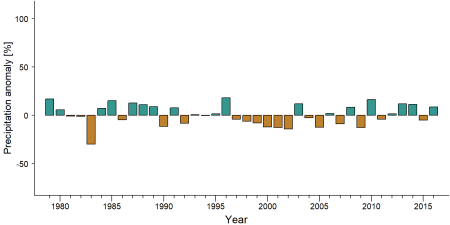
Precipitation anomaly inCavally Nature Reserve -
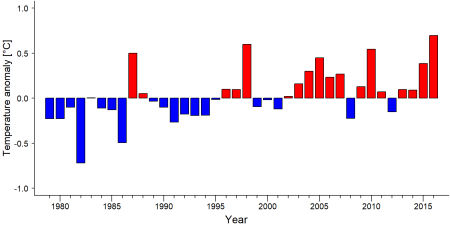
Temperature anomaly inCavally Nature Reserve


External links
References
Alonso LE, Lauginie F and Rondeau G. 2005. A Rapid Biological Assessment of two Classified Forests in South-Western Côte d’Ivoire. RAP Bulletin of Biological Assessment No. 34. Conservation International. Washington, D.C.
BirdLife International. 2019. Important Bird Areas factsheet: Cavally and Goin - Debe Forest Reserves. Online: www.birdlife.org
Chatelain C et al. 2010. Monitoring tropical forest fragmentation in the Zagné-Taï area (west of Taï National Park, Côte d’Ivoire). Biodiversity and Conservation 19:2405-2420.
EU FLEGT Facility. 2016. Governance gain in Côte d’Ivoire with new contract for independent forest observers. EU FLEGT Facility
Normand E. 2007. Protection of two high priority classified Forests in Côte d’Ivoire (Cavally and Goin-Débé): Improved management plan and bio-monitoring of logging operations. Unpublished report, Wild Chimpanzee Foundation
Normand E. 2010. Rapport de suivi écologique dans les forêts de Goin-Débé et de Cavally (2007-2010). Unpublished report, Wild Chimpanzee Foundation
Sanderson J et al. 2005. A rapid survey of mammals from the Haute Dodo and Cavally forests, Côte d’Ivoire, in Alonso et al. (ed) A Rapid Biological Assessment of two Classified Forests in South-Western Côte d’Ivoire. RAP Bulletin of Biological Assessment No. 34. Conservation International. Washington, D.C.
WCF. 2011. Annual report of the activities undertaken by the Wild Chimpanzee Foundation to improve the protection of wild chimpanzees and their habitat in West Africa, Year 2011. Online: Wild Chimpanzee Foundation
WCF. 2012. Annual report 2012 – activities of the Wild Chimpanzee Foundation for improved conservation of chimpanzees and their habitat in West Africa. Online: Wild Chimpanzee Foundation
WCF. 2013. Rapport Annuel 2013. Activités menées par la Wild Chimpanzee Foundation pour améliorer la protection des chimpanzés et leur habitat en Afrique de l’Ouest. Online: Wild Chimpanzee Foundation
WCF. 2014. Annual report 2014 – activities of the Wild Chimpanzee Foundation for improved conservation of chimpanzees and their habitat in West Africa. Online: Wild Chimpanzee Foundation
WCF. 2015 Annual report 2015 – activities of the Wild Chimpanzee Foundation for improved conservation of chimpanzees and their habitat in West Africa. Online: Wild Chimpanzee Foundation
WCF. 2016. Annual report 2016 – activities of the Wild Chimpanzee Foundation for improved conservation of chimpanzees and their habitat in West Africa. Online: Wild Chimpanzee Foundation
WCF. 2017. Annual report 2017 – activities of the Wild Chimpanzee Foundation for improved conservation of chimpanzees and their habitat in West Africa. Online: Wild Chimpanzee Foundation
WCF. 2018. Annual report 2018 – activities of the Wild Chimpanzee Foundation for improved conservation of chimpanzees and their habitat in West Africa. Online: Wild Chimpanzee Foundation
WCF. 2023. Annual report 2022 – activities of the Wild Chimpanzee Foundation for improved conservation of chimpanzees and their habitat in West Africa. Online: Wild Chimpanzee Foundation
Page created by: APES Atlas Team, Julia Riedel & Virginie Vergnes Date: 2023-11-24