
Haut Niger National Park
West Africa > Republic of Guinea > Haut Niger National Park
Français | Português | Español | Bahasa Indonesia | Melayu
Summary
- Western chimpanzees (Pan troglodytes verus) are present in Haut Niger National Park.
- It has been estimated that more than 400 chimpanzees occur in the park.
- The chimpanzee population trend is not known, but there is evidence that it is decreasing.
- This site has a total size of 12,000 km².
- Key threats to chimpanzees are hunting, agriculture and presence of humans in the core area for fishing and honey collection.
- The Chimpanzee Conservation Center rehabilitates orphaned chimpanzees and released a group into the wild in 2008. It also conducts an awareness raising program.
- The site protects one of the last open dry forests in West Africa and serves key hydrological functions. It features a high biodiversity including lions, hippos and a diversity of fish and bird species, and contains a UNESCO Biosphere Reserve, an Important Bird Area and two Ramsar sites.
Site characteristics
The Haut Niger National Park (also called Upper Niger National Park) is situated in the Niger basin in east-central Guinea. It has been designated a National Park in 1997 and consists of two distinct core areas, Mafou forest (554 km²) and Kouyah forest (674 km²), and a buffer zone (Fleury-Brugière & Brugière 2010). The total area of the park, meaning core areas and buffer zone, is around 12,000 km2 (Fleury-Brugière & Brugière 2010). The two core areas are designated as IUCN category II and the buffer zone is designated as IUCN category V (Brugière & Kormos 2009).
In 2002 Mafou forest and surrounding areas were proclaimed a UNESCO Biosphere Reserve (UNESCO MAB 2011) consisting of the Mafou forest as the core area, a buffer zone (3,641 km2) and transition area (2,275 km2, Brugière & Kormos 2009).
Haut Niger is located at the border of the two prefectures Faranah and Kankan, on a plateau with stream valleys. The annual rainfall ranges from 1,500 and 1,700 mm (BirdLife International 2018). This National Parks protects one of the last primary open dry forests in West Africa (UNESCO MAB 2011). The habitat is characterized by wooded and open savanna, dry forest, bamboo forest, and gallery forest along the Niger River and its tributaries (UNESCO MAB 2011, Fleury-Brugière & Brugière 2010). There are also permanent ponds which are an important part of cultural life (Ramsar 2002). Haut Niger National Park is characterized by a high biodiversity. With its 300 bird species (Nikolaus 1999) Mafou forest has been declared an Important Bird Area (BirdLife International 2018).
Two Ramsar sites were gazetted that same year. The Niger-Mafou Ramsar site has a total area of 10,154.50 km2 and is characterized by permanent and seasonal rivers, and marshes (Ramsar 2002). Migratory large mammals use this area as a corridor with abundant water sources year round and the site is visited by birds (Ramsar 2002). The second site, Niger-Niandan-Milo covers an area of 10,464 km2 and features a high diversity in fish species (Crespi 1998) and serves important hydrological functions (Ramsar 2017). The site is also known for its diversity in waterbirds (Ramsar 2017).
In a survey from 1995 to 1997 a total of 94 species of mammals were identified (Ziegler et al. 2002). The park is home to a small population of lions (Panthera leo) (Lion Alert 2012, Bauer 2003), as well as leopards (Panthera pardus), hippopotamus (Hippopotamus amphibius, Brugière et al. 2006), jackals (Canis sp.), civets, patas monkeys (Erythrocebus patas), baboons (Papio sp.), green monkeys (Chlorocebus sabaeus), and mangabeys (Cercocebus sp., Brugière 2006, Brugière & Kormos 2009, WCF 2012, Ziegler et al. 2002).
Table 1. Basic site information for Haut Niger National Park
| Species | Pan troglodytes verus |
| Area | 12,000 km² |
| Coordinates | Lat: 10.21 , Lon: -10.09 |
| Type of site | Protected area (National Park) |
| Habitat types | Subtropical/tropical dry forest, Savanna, Shrubland, Wetlands (lakes, rivers, streams, bogs, marshes), Agricultural land |
| Type of governance |
Types of sites Governance types Habitat types
Ape status
In a nationwide survey from 1995 to 1997 Rebecca Kormos identified Mafou forest as an “area of particular interest thought to have a healthy population of chimpanzees” based on reconnaissance surveys (Ham 1998). From 2001 to 2002 transect surveys were conducted in the Mafou core area and a total abundance of 480 individuals was estimated for that core area (Fleury-Brugière & Brugière 2010). Extrapolated to the entire park it has been suggested that the park protects up to 650 chimpanzees (Kormos et al. 2003). A follow-up survey conducted between 2008 and 2009 in the northern part of Mafou found a lower chimpanzee density and derived an estimate of 334 individuals (200-601) for Mafou (Humle et al. 2009a). It was concluded that the population likely decreased (Humle et al. 2009a). Yet another transect survey in 2009 found even lower densities for Mafou and estimated 288 individuals (190-437, WCF 2012). At the same time Kouyah core area was sampled for the first time and 132 individuals (60-290) were estimated to occur there (WCF 2012).
Haut Niger National Park was identified as an ‘Exceptionally Important Priority Area’ in the Regional Conservation Action Plan for western chimpanzees in 2003 (Kormos & Boesch 2003).
Table 2. Ape population estimates reported for Haut Niger National Park
| Species | Year | Occurrence | Encounter or vistation rate (nests/km; ind/day) | Density estimate [ind./ km²] (95% CI) | Abundance estimate (95% CI) | Survey area | Sampling method | Analytical framework | Source | Comments | A.P.E.S. database ID |
|---|---|---|---|---|---|---|---|---|---|---|---|
| Pan troglodytes verus | 1995-1997 | Present | Kouyah forest | Informed guess | Ham 1998 | Anectodal reports | |||||
| Pan troglodytes verus | 2001-2002 | 7.9 | 0.87 | 480.0 | Mafou core area | Line transects | Fleury-Brugière & Brugière 2010 | Total survey effort: 103.83 km, encounter rate 7.9 (range 0.16-11.7) | |||
| Pan troglodytes verus | 2008-2009 | 7.6 | 0.60 (0.36-1.1) | 334 (200-601) | Mafou core area | Line transects | Humle et al. 2009a | Total survey effort: 60.5 km | |||
| Pan troglodytes verus | 2009 | 2.34 | 0.7 | 420 (250-727) | Mafou and Kouya core area | Line transects | WCF 2012 | Total survey effort: 196 km, abundances Mafou: 288 (190-437), Kouyah: 132 (60-290), densities Mafou: 0.47, Kouyah: 0.23 | |||
| Pan troglodytes verus | 1995-1997 | Present | Mafou forest | Reconnaissance walk | Ham 1998 | Reconnaissance survey |
Sampling methods Analytical frameworks
Threats
The main threats to chimpanzees in Haut Niger National Park are hunting, agriculture and presence of humans in the core area for fishing and honey collection. Humle et al. (2009) identified hunting as one of the most prevalent pressures in the park with an encounter rate of poaching signs of 0.15/km. A similar encounter rate was found by the WCF survey with 0.18 signs/km (WCF 2012). Chimpanzees are also hunted opportunistically. In the bushmeat survey in 2001 Brugière and Magassouba (2009) found 14 chimpanzee carcasses offered for sale over the course of a year.
Hunters regularly set fires at night as a hunting technique to drive out animals so they can be shot while fleeing. 70% of transects surveyed by Humle et al. (2009) showed signs of recent burning.
Slash and burn agriculture is another threat to chimpanzees (Humle et al. 2009a). According to the WCF survey (2012) agriculture is widespread in the Kouyah core area, but can only be found in the south of Mafou core area in proximity to two villages. The WCF (2012) encountered 0.31 signs of agriculture per km across the two parks. With around 80,000 people living in the buffer zone of the park, agriculture is widespread there and has led to severe environmental degradation (Ramsar 2017).
People regularly enter the core areas to fish and collect honey. For the latter, trees are felled for the harvest of wild honey and self-made bee hives are set up in trees in the periphery of Mafou core area (Humle et al. 2009a). Fishing is still partly done using techniques destructive for waterways and fish species, such as using explosives and chemicals, leading to high fish mortalities (Ramsar 2017).
While there a no permanent human settlements within the two core areas, fishing camps can be found along the rivers and they harbor up to 100 people for up to six months (Humle et al. 2009a, WCF 2012).
Illegal logging was very prevalent in the buffer zone until 2009, but due to increased law enforcement activities, including road blocks, such activities ceased (Humle et al. 2009a). But these initiatives were short-term, so the current impact of this threat is unclear.
In conclusion though, after a nationwide survey of 11 sites a WCF report concluded that anthropogenic signs inside the two core areas were a lot less prevalent than in other protected areas across Guinea (WCF 2012).
Table 3. Threats to apes reported for Haut Niger National Park
| Category | Specific threats | Threat level | Description | Year of threat |
|---|---|---|---|---|
| 1 Residential & commercial development | 1.1 Residential areas | Medium (30-70% of population affected) | Fishing camps along the rivers, also inside core areas, with up to 100 people living in these camps for up to 6 months (Humle et al. 2009a, WCF 2012). | 2009-Ongoing (2012) |
| 2 Agriculture & aquaculture | 2.1 Annual & perennial non-timber crops | Medium (30-70% of population affected) | Signs of agricultural throughout Kouyah core area (WCF 2012) and widespread in buffer zone (Humle et al. 2009a, WCF 2012); people also use trees in the periphery of Mafou core area for setting up self-made bee hives (Humle et al. 2009a). | 2009-Ongoing (2012) |
| 4 Transportation & service corridors | 4.1 Roads & railroads | Medium (30-70% of population affected) | Trails and path can be found also in the core area and these are used by hunters and fishers (Humle et al 2009a, WCF 2012), the threat from such trails to chimpanzees is indirect as they facilitate access for humans. | 2009-Ongoing (2012) |
| 5 Biological resource use | 5.1 Hunting & collecting terrestrial animals | High (more than 70% of population affected) | Widespread hunting especially in the buffer zone but also in the core areas (Humle et al 2009a, WCF 2012), chimpanzees also hunted opportunistically (Brugière and Magassouba 2009); wild honey collection (Humle et al. 2009a, Klop et al. 2019). | 2009, 2012-Ongoing (2019) |
| 5 Biological resource use | 5.3 Logging & wood harvesting | Medium (30-70% of population affected) | Illegal logging in the buffer zone (Humle et al. 2009a, Klop et al. 2019). | 2009-Ongoing (2019) |
| 7 Natural system modifications | 7.1 Fire & fire suppression | Medium (30-70% of population affected) | Fires are set at night by hunters to shoot fleeing animals (Humle et al. 2009a), can affect behavior of chimpanzees. Savannah burning (Klop et al. 2019). | 2009-Ongoing (2019) |
| 5 Biological resource use | 5.3 Logging & wood harvesting | Low (up to 30% of population affected) | Fishing in the rivers, also using dynamite and chemicals, is widespread (Ramsar 2017, Klop et al. 2019); effect on chimpanzees is indirect due to presence of humans in the core area. | 2017-Ongoing (2019) |
| 3 Energy production & mining | 3.2 Mining & quarrying | Present (unknown severity) | Gold mining was observed in a field visit that was conducted (Klop et al. 2019). Government issued an environmental compliance certificate to a foreign company to mine for gold (Schneider 2025). | 2019-Ongoing (2025) |
Conservation activities
As part of the “Programme Regional d’Aménagement des Bassins Versants du Niger et de la Gambie” (PRABV) which was funded by the European Union in the 1990’s, biodiversity surveys were conducted in and around Mafou and Kouya forest, which ultimately led to the creation of the Haut Niger National Park in 1997 (Brugière & Kormos 2009). From 1995 to 2005 the European funded AGIR project (Programme Régional d’Appui à la Gestion Intégrée des Ressources Naturelles des Bassins du Niger et de la Gambie) implemented a management plan in collaboration with government officials and supported law enforcement within the park (Humle et al. 2009a). When funding ceased government authorities were lacking the financial, logistical and technical means to continue these efforts at the same level (Humle et al. 2009a).
In 2008 the Guinean government stepped up efforts against illegal logging using a nation-wide information campaign via the radio and setting up road blocks in 2008-2009 at the roads entering the national parc (Humle et al. 2009a).
In 1997 the sanctuary Chimpanzee Conservation Center (CCC) was founded. The sanctuary rescues, rehabilitates and cares for orphaned chimpanzees. As it is the only chimpanzee sanctuary in Guinea, it is the contact point for taking care of chimpanzees confiscated by the Guinean government officials.
In 2008 CCC released the first group of chimpanzees in Mafou core area consisting of 12 individuals with the aim of reinforcing the wild chimpanzee population in the park (Projet Primates 2016, Humle et al. 2011). Two years later 9 individuals were still free-living and two females had offsprings (Humle et al. 2011).
Since 2004 CCC also implements an awareness raising program on the topics of ‘importance of chimpanzee conservation’, activities that are illegal and threatening chimpanzees, and the general importance of protecting the national park by holding village meetings, distributing information material and creating radio programs in local languages for broadcasting across Guinea (Projet Primates 2016). There is also an ecomuseum and a botanical garden in the national park (UNESCO MAB 2011).
Table 4. Conservation activities reported for Haut Niger National Park
| Category | Specific activity | Description | Implementing organization(s) | Year of activity |
|---|---|---|---|---|
| 5 Protection & restoration | 5.2 Legally protect ape habitat | Designated as National Park. | 1952-Ongoing (2018) | |
| 6 Species management | 6.9 Rehabilitate injured/orphaned apes | CCC takes care of and rehabilitates orphaned chimpanzees (Projet Primates 2016) | 1997-Ongoing (2016) | |
| 8 Permanent presence | 8.3 Permanent presence of staff/manager | Permanent presence of CCC staff since 1997 (Projet Primates 2016) | 1997-Ongoing (2016) | |
| 6 Species management | 6.8 Reintroduction of apes (captively-bred or rehabilitated indviduals) | 12 individuals released in Mafou core area (Humle et al. 2009a, Projet Primates 2016) | 2008 | |
| 2 Counter-wildlife crime | 2.1 Implement road blocks to inspect cars for illegal ape bushmeat | The road blocks set up to control illegal logging were used to also control illegal bushmeat (Humle et al. 2009a) | 2008-2009 | |
| 4 Education & awareness | 4.1 Educate local communities about apes and sustainable use | As part of awareness program by Chimpanzee Conservation Center (CCC, Projet Primates 2016) | Ongoing (2016) | |
| 4 Education & awareness | 4.4 Regularly play TV and radio announcements to raise ape conservation awareness | As part of awareness program by CCC (Projet Primates 2016) | Ongoing (2016) | |
| 4 Education & awareness | 4.5 Implement multimedia campaigns using theatre, film, print media, discussions | As part of awareness program by CCC (Projet Primates 2016) | Ongoing (2016) | |
| 2 Counter-wildlife crime | 2.3 Conduct regular anti-poaching patrols | The AGIR project supported law enforcement within the park (Humle et al. 2009a) | Unknown | |
| 5 Protection & restoration | 5.1 Create buffer zones around protected ape habitat | The park is surrounded by buffer zones in both its core areas (Klop et al. 2019) | Ongoing (2019) |
Challenges
Lack of funding as well as logistical and technical support were cited as impediments to making and implementing a new management plan for the park (Humle et al. 2009a). The evaluation of management effectiveness concluded, that due to a lack of financial and technical means as well as lack of training, an efficient monitoring and law enforcement throughout the park was not possible (METT 2009).
Table 5. Challenges reported for Haut Niger National Park
| Challenges | Specific challenges | Source | Year(s) |
|---|---|---|---|
| 2 Resources and capacity | 2.1 Lack of capacity/training | METT 2009, Henschel et al. 2014 | 2009-Ongoing (2014) |
| 2 Resources and capacity | 2.3 General lack of funding | Humle et al. 2009a, METT 2009 | Ongoing (2009) |
| 1 Site management | 1.2 Need for improved coordination | Humle et al. 2009a, METT 2009 | Ongoing (2009) |
| 2 Resources and capacity | 2.5 Lack of equipment/transportation | Humle et al. 2009a, METT 2009 | Ongoing (2009) |
Enablers
Table 6. Enablers reported for Haut Niger National Park
| Enablers | Specific enablers | Source | Year(s) |
|---|---|---|---|
| 1 Site management | |||
| 2 Resources and capacity | |||
| 3 Engaged community | |||
| 4 Institutional support | |||
| 5 Ecological context | |||
| 6 Safety and stability |
Research activities
To inform the creation of the National Park several biomonitoring studies have been undertaken targeting different taxa, such as mammals (Ziegler 2002), fish (Crespi 1998), ungulates (Brugière 2005), birds (Nikolaus 1999), and amphibians and reptiles (Greenbaum & Carr 2005). As detailed above several surveys on chimpanzees have been implemented (Ham 1998, Humle et al. 2009a, Fleury-Brugière & Brugière 2010, WCF 2012).
In addition, studies were conducted that analysed the bushmeat trade in Haut Niger National Park (Brugière & Magassouba 2009, Humle & Alexandre 2015). Following the release of a group of rehabilitated chimpanzees their ranging patterns and behavior has been studies (Humle et al. 2009b, Humle et al. 2011).
Documented behaviours
Table 7. Behaviours documented for Haut Niger National Park
| Category | Behavior | Observation type | Prevalence | Observation dates | Source | Habituation | Species | Comment |
|---|---|---|---|---|---|---|---|---|
| Hand-clasp grooming | Humle et al. 2009b |
Exposure to climate change impacts
As part of a study on the exposure of African great ape sites to climate change impacts, Kiribou et al. subm. extracted climate data and data on projected extreme climate impact events for the site. Climatological characteristics were derived from observation-based climate data provided by the Inter-Sectoral Impact Model Intercomparison Project (ISIMIP, www.isimip.org). Parameters were calculated as the average across each 30-year period. For 1981-2010, the EWEMBI dataset from ISIMIP2a was used. For the two future periods (2021-2050 and 2071-2099) ISIMIP2b climate data based on four CMIP5 global climate models were used. For future projections, two Representative Concentration Pathways (RCP) were used. RCP 2.6 is a scenario with strong mitigation measures in which global temperatures would likely rise below 2C. RCP 6.0 is a scenario with medium emissions in which global temperatures would likely rise up to 3C by 2100. For the number of days with heavy precipitation events, the 98th percentile of all precipitation days (>1mm/d) was calculated for the 1979-2013 reference period as a threshold for a heavy precipitation event. Then, for each year, the number of days above that threshold was derived. The figures on temperature and precipitation anomaly show the deviation from the mean temperature and mean precipitation for the 1979-2013 reference period.
The estimated exposure to future extreme climate impact events (crop failure, drought, river flood, wildfire, tropical cyclone, and heatwave) is based on a published dataset by Lange et al. 2020 derived from ISIMIP2b data. The same global climate models and RCPs as described above were used. Within each 30-year period, the number of years with an extreme event and the average proportion of the site affected were calculated (see Kiribou et al. subm. for details).
The study was conducted in Haut Niger National Park, covering both the Kouyah and Mafou areas. The tables and figures below present data for Haut Niger National Park – Kouyah and Haut Niger National Park – Mafou, respectively.
Table 8. Estimated past and projected climatological characteristics in Haut Niger National Park
| Value | 1981-2010 | 2021-2050, RCP 2.6 | 2021-2050, RCP 6.0 | 2071-2099, RCP 2.6 | 2071-2099, RCP 6.0 |
|---|---|---|---|---|---|
| Mean temperature [C] | 25.9 | 27.2 | 27.1 | 27.3 | 28.4 |
| Annual precipitation [mm] | 1439 | 1429 | 1479 | 1437 | 1496 |
| Max no. consecutive dry days (per year) | 67.1 | 64.7 | 68.3 | 68.8 | 65.2 |
| No. days with heavy precipitation (per year) | 4.3 | 5.6 | 5.3 | 5.1 | 6.1 |
| Mean temperature [C] | 26 | 27.2 | 27.1 | 27.4 | 28.5 |
| Annual precipitation [mm] | 1442 | 1433 | 1475 | 1452 | 1490 |
| Max no. consecutive dry days (per year) | 63.2 | 59.8 | 64.9 | 64.9 | 65.3 |
| No. days with heavy precipitation (per year) | 4.2 | 5.6 | 5.5 | 5.5 | 6.4 |
Table 9. Projected exposure of apes to extreme climate impact events in Haut Niger National Park
| Type | No. of years with event (2021-2050, RCP 2.6) | % of site exposed (2021-2050, RCP 2.6) | No. of years with event (2021-2050, RCP 6.0) | % of site exposed (2021-2050, RCP 6.0) | No. of years with event (2070-2099, RCP 2.6) | % of site exposed (2070-2099, RCP 2.6) | No. of years with event (2070-2099, RCP 6.0) | % of site exposed (2070-2099, RCP 6.0) |
|---|---|---|---|---|---|---|---|---|
| Crop failure | 9.5 | 0.12 | 3.5 | 0.12 | 10 | 0.12 | 17 | 0.12 |
| Drought | 0 | 0 | 0 | 0 | 0 | 0 | 0 | 0 |
| Heatwave | 4.5 | 100 | 5.5 | 100 | 2 | 100 | 10 | 100 |
| River flood | 0.5 | 0.01 | 1 | 4.06 | 1 | 2.41 | 2.5 | 2.78 |
| Tropical cyclone | 0 | 0 | 0 | 0 | 0 | 0 | 0 | 0 |
| Wildfire | 30 | 1.31 | 30 | 1.11 | 29 | 1.19 | 29 | 1.68 |
| Crop failure | 2.5 | 0.1 | 2.5 | 0.1 | 2 | 0.1 | 10 | 0.1 |
| Drought | 0 | 0 | 0 | 0 | 0 | 0 | 0 | 0 |
| Heatwave | 5.5 | 100 | 4 | 100 | 3.5 | 100 | 10.5 | 100 |
| River flood | 0 | 0 | 1.5 | 1.8 | 0.75 | 0.09 | 2 | 1.3 |
| Tropical cyclone | 0 | 0 | 0 | 0 | 0 | 0 | 0 | 0 |
| Wildfire | 30 | 1.51 | 30 | 1.25 | 29 | 1.15 | 29 | 1.88 |
-
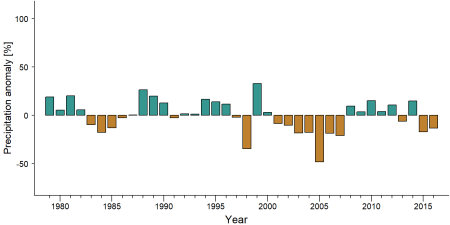
Precipitation anomaly inHaut Niger National Park -
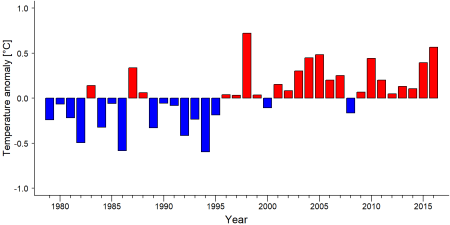
Temperature anomaly inHaut Niger National Park


External links
References
Bauer H et al. 2003. Research needs for lion conservation in West and Central Africa, C. R. Biologies, 326: S112–S118
BirdLife International. 2018. Important Bird Areas factsheet: Mafou. Online: www.birdlife.org
Brugière D et al. 2005. Large- and medium-sized ungulates in the Haut Niger National Park, Republic of Guinea: population changes 1997–2002, Oryx, 39:50-55
Brugière D et al. 2006. Population abundance of the common hippopotamus Hippopotamus amphibius in the Haut Niger National Park, Republic of Guinea, Mammalia:14-16
Brugière D, Kormos R. 2009. Review of the protected area network in Guinea, West Africa, and recommendations for new sites for biodiversity conservation, Biodiversity and Conservation, 18:847
Brugière D, Magassouba B. 2009. Pattern and sustainability of the bushmeat trade in the Haut Niger National Park, Republic of Guinea, African Journal of Ecology, 44:630-639
Crespi V. 1998. Preliminary study on the fishery resources of the River Niger in the Upper Niger National Park, Guinea, Fisheries Management and Ecology, 5:201–208
Fleury-Brugière MC, Brugière D. 2010. High Population Density of Pan troglodytes verus in the Haut Niger National Park, Republic of Guinea: Implications for Local and Regional Conservation, International Journal of Primatology, 31: 383-392
Greenbaum E, Carr JL. 2005. The Herpetofauna of Upper Niger National Park, Guinea, West Africa, Natural History Museum The University of Kansas, 37:1-21
Ham R. 1998. Nationwide chimpanzee census and large mammal survey Republic of Guinea.
Humle T et al. 2009a. Report on chimpanzee surveys conducted in Parc National du Haut Niger, Republic of Guinea 2008-09
Humle T et al. 2009b. Preliminary Report on Hand-Clasp Grooming in Sanctuary-Released Chimpanzees, Haut Niger National Park, Guinea, Pan Africa News, 16(1): 7-10
Humle T et al. 2011. Group Release of Sanctuary Chimpanzees (Pan troglodytes) in the Haut Niger National Park, Guinea, West Africa: Ranging Patterns and Lessons So Far, International Journal of Primatology, 32:456-473
Humle T, Konate A. 2015. Primates and Bushmeat Hunting Around the High Niger National Park, Guinea, West Africa: Drivers and Patterns of Change, Folia Primatol, 86:235–386
Kormos R et al. 2003. The Republic of Guinea, in Kormos, R. Boesch, C., Bakarr, M.I. & Butynski, T.M. [eds.] Status Survey and Conservation Action Plan, IUCN/SSC Primate Specialist Group. IUCN, Gland, Switzerland and Cambridge, UK
Kormos R, Boesch C. 2003. Regional Action Plan for the Conservation of Chimpanzees in West Africa. IUCN/SSC Primate Specialist Group and Conservation International, Washington DC.
Lion Alert. 2012. Online: Lion Alert
METT. 2009. Management Effectiveness Evaluations – Parc National du Haut Niger. Online: papaco.org
Nikolaus G. 1999. The birds of the Parc National du Haut Niger, Guinea, Malimbus, 22, 1–22
Projet Primates. 2016. Online: Chimpanzee Conservation Center (CCC)
Ramsar. 2002. Online: Ramsar 2002
Ramsar. 2017. Online: Ramsar 2017
UNESCO MAB. 2011. UNESCO MAB Biosphere Reserve Directory. Haut Niger. Online: www.unesco.org
WCF. 2012. Etat de la faune et des menaces dans les aires protégées terrestres et principales zones de forte biodiversité de Rep. de Guinée. Report. Wild Chimpanzee Foundation, Sangaredi, Republic of Guinea. Online: Wild Chimpanzee Foundation
Klop, E., Sikkema, M., Diawara, M., & Gado, A. (2019). Ecological hotspots and land use patterns in the Upper Niger Basin, Guinea (A&W‑report 2501). Altenburg & Wymenga Ecologisch Onderzoek
Henschel, P., L. Coad, C. Burton, B. Chataigner, A. Dunn, D. MacDonald, Y. Saidu & L.T.B. Hunter 2014. The lion in West Africa is critically endangered. PLOS One 9: 1-11.
Schneider, V. (2025, February 26). Guinea greenlights gold mine in habitat of critically endangered chimpanzees. Mongabay
Ziegler S et al. 2002. High mammalian diversity in the newly established National Park of Upper Niger, Republic of Guinea, Oryx, 36:73-80
Page created by: APES Atlas Team Date: 2018-12-06
Page updated by: Priscilla Stanley Shao Date: 2025-10-15