
Mont Péko National Park
West Africa > Côte d'Ivoire > Mont Péko National Park
Français | Português | Español | Bahasa Indonesia | Melayu
Summary
- West African chimpanzees (Pan troglodytes verus) are present in Mont Péko National Park.
- This site has a total surface area of 340 km².
- The main threats to chimpanzees are farming and hunting.
- Awareness-raising and surveillance activities are carried out on site.
Site characteristics
The park is located to the west, betweenin the Bangolo and Duékoué departments. The park is under the authority of the Office Ivoirien des Parcs et Réserves (OIPR). OIPR has set up a wildlife inventory system, with the presence of chimpanzees confirmed. For the moment, the number of chimpanzees is still unknown, pending a report on the chimpanzee population in the area (Soiret pers. comm. 2025).
Table 1. Basic site information for Mont Péko National Park
| Species | Pan troglodytes verus |
| Area | 340 km² |
| Coordinates | Lat: 7.010004 , Lon: -7.251357 |
| Type of site | Protected area (National Park) |
| Habitat types | Subtropical/tropical moist lowland forest, Subtropical/tropical moist montane forest, Subtropical/tropical heavily degraded former forest, Agricultural land |
| Type of governance | Governance by government |
Types of sites Governance types Habitat types
Ape status
The absence of chimpanzees was reported in 2015, but in the last biomonitoring survey in 2025, they found signs of their presence in the site in degraded forest (OIPR 2025).
Table 2. Ape population estimates reported for Mont Péko National Park
| Species | Year | Occurrence | Encounter or vistation rate (nests/km; ind/day) | Density estimate [ind./ km²] (95% CI) | Abundance estimate (95% CI) | Survey area | Sampling method | Analytical framework | Source | Comments | A.P.E.S. database ID |
|---|---|---|---|---|---|---|---|---|---|---|---|
| Pan troglodytes verus | 2001 | 1.6 | 320.0 | Mont Péko National Park (340km²) | Line transects | Kormos et al. 2003 | Estimate for weaned individuals. | ||||
| Pan troglodytes verus | 2015 | Absent | Mont Péko National Park (340km²) | Unknown | E. Normand, personal communication (2016) as cited by Arcus Fountation 2024 | ||||||
| Pan troglodytes verus | 2025 | 0.1849 | Mont Péko National Park (340km²) | Line transects & recces | They calculate the Kilometric abundance Index (KAI) with indirect signs with Transect and Recce and combined the result | OIPR 2025 | |||||
| Pan troglodytes verus | 2025 | 0.1747 | Mont Péko National Park (340km²) | Line transects | OIPR 2025 | ||||||
| Pan troglodytes verus | 2025 | 0.0101 | Mont Péko National Park (340km²) | Reconnaissance walk | OIPR 2025 |
Sampling methods Analytical frameworks
Threats
From 2002 to 2011, Côte d’Ivoire faced a political-military crisis that resulted in the removal of park management teams and widespread illegal encroachment on its territory. This led to considerable deforestation and fragmentation of ecosystems, endangering the site's ecological integrity.
Table 3. Threats to apes reported for Mont Péko National Park
| Category | Specific threats | Threat level | Description | Year of threat |
|---|---|---|---|---|
| 2 Agriculture & aquaculture | 2.1.1 Shifting agriculture | High (more than 70% of population affected) | Slash-and-burn farming is severely encroaching the park (Assui et al. 2022). They found 15 plantations and new clearings (OIPR 2025). | 2002-Ongoing (2025) |
| 5 Biological resource use | 5.1 Hunting & collecting terrestrial animals | Present (unknown severity) | Signs of poaching have been found throught the park (gunshots and shell casings; Assui et al. 2022). Between 2024 and 2025, they also heard gunshots and found shell casings, but less than reported by Assui et al. 2022 (OIPR, 2025). | 2002-Ongoing (2025) |
| 9 Pollution | 9.3 Agricultural & forestry effluents | Present (unknown severity) | Environmental pollution through the use of pesticides (Assui et al. 2022). | Ongoing (2022) |
Conservation activities
The forest is being restored by OIPR. Awareness-raising and surveillance activities are carried out in the site. These activities have the financial support of the ADB and the World Bank through the PIF project. A management plan for the park has been drawn up. Biomonitoring activities have been carried out since 2024, with the first transect data collection in the park (Soiret pers. comm. 2025, OIPR 2025).
Table 4. Conservation activities reported for Mont Péko National Park
| Category | Specific activity | Description | Implementing organization(s) | Year of activity |
|---|---|---|---|---|
| 5 Protection & restoration | 5.2 Legally protect ape habitat | 1968-Ongoing (2025) | ||
| 2 Counter-wildlife crime | 2.11 Implement monitoring surveillance strategies (e.g., SMART) or use monitoring data to improve effectiveness of patrols | Surveillance activities. Biomonitoring activities have been carried out since 2024, with the first transect data collection in the Park (Soiret pers. comm. 2025, OIPR 2025). | Office Ivoirien des Parcs et Réserves (OIPR) | 2024-Ongoing (2025) |
| 4 Education & awareness | 4.1 Educate local communities about apes and sustainable use | Awareness raising activities (Soiret pers. comm. 2025). | Ongoing (2025) | |
| 5 Protection & restoration | 5.6 Habitat restoration | The forest is being restored by OIPR (Soiret pers. comm. 2025). | Ongoing (2025) |
Challenges
Table 5. Challenges reported for Mont Péko National Park
| Challenges | Specific challenges | Source | Year(s) |
|---|---|---|---|
| 2 Resources and capacity | 2.1 Lack of capacity/training | OIPR 2025 | Ongoing (2025) |
| 2 Resources and capacity | 2.3 Continuous/long-term funding | OIPR 2025 | Ongoing (2025) |
| 2 Resources and capacity | 2.5 Lack of equipment/transportation | OIPR 2025 | Ongoing (2025) |
| 2 Resources and capacity | 2.6 Lack of biomonitoring/survey data | OIPR 2025 | Ongoing (2025) |
| 5 Ecological context | 5.1 Ecological constraints (e.g., susceptibility to climate change, difficult terrain) | OIPR 2025 | Ongoing (2025) |
Enablers
Table 6. Enablers reported for Mont Péko National Park
| Enablers | Specific enablers | Source | Year(s) |
|---|---|---|---|
| 4 Institutional support | 4.1 Effective legislation and law enforcement | OIPR 2025 | 2018-Ongoing (2025) |
Research activities
Documented behaviours
Exposure to climate change impacts
As part of a study on the exposure of African great ape sites to climate change impacts, Kiribou et al. subm. extracted climate data and data on projected extreme climate impact events for the site. Climatological characteristics were derived from observation-based climate data provided by the Inter-Sectoral Impact Model Intercomparison Project (ISIMIP, www.isimip.org). Parameters were calculated as the average across each 30-year period. For 1981-2010, the EWEMBI dataset from ISIMIP2a was used. For the two future periods (2021-2050 and 2071-2099) ISIMIP2b climate data based on four CMIP5 global climate models were used. For future projections, two Representative Concentration Pathways (RCP) were used. RCP 2.6 is a scenario with strong mitigation measures in which global temperatures would likely rise below 2C. RCP 6.0 is a scenario with medium emissions in which global temperatures would likely rise up to 3C by 2100. For the number of days with heavy precipitation events, the 98th percentile of all precipitation days (>1mm/d) was calculated for the 1979-2013 reference period as a threshold for a heavy precipitation event. Then, for each year, the number of days above that threshold was derived. The figures on temperature and precipitation anomaly show the deviation from the mean temperature and mean precipitation for the 1979-2013 reference period.
The estimated exposure to future extreme climate impact events (crop failure, drought, river flood, wildfire, tropical cyclone, and heatwave) is based on a published dataset by Lange et al. 2020 derived from ISIMIP2b data. The same global climate models and RCPs as described above were used. Within each 30-year period, the number of years with an extreme event and the average proportion of the site affected were calculated (see Kiribou et al. subm. for details).
Table 8. Estimated past and projected climatological characteristics in Mont Péko National Park
| Value | 1981-2010 | 2021-2050, RCP 2.6 | 2021-2050, RCP 6.0 | 2071-2099, RCP 2.6 | 2071-2099, RCP 6.0 |
|---|---|---|---|---|---|
| Mean temperature [C] | 25.4 | 26.6 | 26.5 | 26.6 | 27.8 |
| Annual precipitation [mm] | 1587 | 1593 | 1653 | 1608 | 1702 |
| Max no. consecutive dry days (per year) | 37.1 | 33.2 | 34.5 | 34.7 | 34.2 |
| No. days with heavy precipitation (per year) | 5.8 | 5.7 | 6 | 5.9 | 8.4 |
Table 9. Projected exposure of apes to extreme climate impact events in Mont Péko National Park
| Type | No. of years with event (2021-2050, RCP 2.6) | % of site exposed (2021-2050, RCP 2.6) | No. of years with event (2021-2050, RCP 6.0) | % of site exposed (2021-2050, RCP 6.0) | No. of years with event (2070-2099, RCP 2.6) | % of site exposed (2070-2099, RCP 2.6) | No. of years with event (2070-2099, RCP 6.0) | % of site exposed (2070-2099, RCP 6.0) |
|---|---|---|---|---|---|---|---|---|
| Crop failure | 2 | 2.18 | 2 | 1.95 | 2 | 2.18 | 4.5 | 2.18 |
| Drought | 0 | 0 | 0 | 0 | 0 | 0 | 0 | 0 |
| Heatwave | 5 | 100 | 3 | 100 | 3.5 | 100 | 7.5 | 100 |
| River flood | 1 | 0.29 | 2 | 1.98 | 1.75 | 2.01 | 5 | 2.59 |
| Tropical cyclone | 0 | 0 | 0 | 0 | 0 | 0 | 0 | 0 |
| Wildfire | 30 | 0.53 | 30 | 0.53 | 29 | 0.52 | 29 | 0.55 |
-
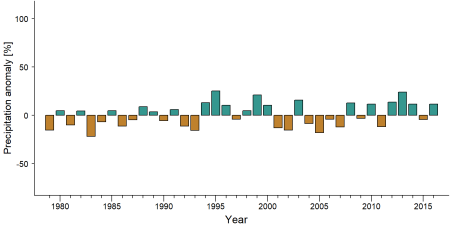
Precipitation anomaly in Mont Péko National Park -
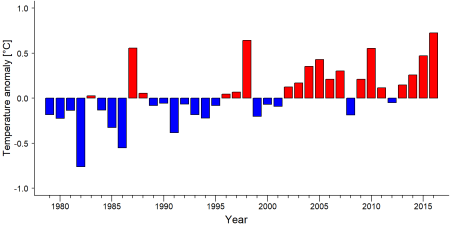
Temperature anomaly in Mont Péko National Park


External links
References
Arcus Foundation. (2024). State of the Apes: Abundance annex (Vol. 5). Arcus Foundation. https://www.stateoftheapes.com/
Assui Wa Kassi N’Guessan Dawy, Kouakou, Y. C., Bamba, K., N’Guessan, K. A., Koffi Djaha, A., Kouakou, C.-V., & Bene, J.-C. K. (2022). État de conservation des moyens et grands mammifères du Parc national du Mont Péko en période post crises socio-politiques dans l’ouest de la Côte d’Ivoire [Conservation status of medium-sized and large mammals at Mont Péko National Park in the post socio-political crisis period in western Côte d’Ivoire]. International Journal of Innovation and Scientific Research, 61(1), 50–63. http://www.ijisr.issr-journals.org/
OIPR. (2025) Rapport de la phase pilote 2024 de suivi-écologique au Parc national du Mont Péko.
Page created by: Serge Soiret Date: 2025-05-27
Page updated by: Diorne Zausa Date: 2025-10-08