
Deng Deng National Park
Central Africa > Cameroon > Deng Deng National Park
Français | Português | Español | Bahasa Indonesia | Melayu
Summary
- Central chimpanzees (Pan troglodytes troglodytes) & western lowland gorillas (Gorilla gorilla gorilla) are present in Deng Deng National Park.
- In 2016, the great ape population was estimated at 390 (95% CI: 214-711) individuals.
- The great ape population trend was decreasing between 2012 and 2016.
- The site has a total size of 682 km².
- Key threats to great apes are poaching and illegal logging.
- The Wildlife Conservation Society implements conservation activities in the area, such as biomonitoring, and environmental education and awareness raising.
Site characteristics
Deng Deng National Park is located in eastern Cameroon, about 50 km southeast of the Mbam et Djerem National Park. In 1998, the Cameroon Oil Transportation Company (COTCO) commissioned an environmental impact survey for a proposed oil pipeline route from Chad to Cameroon. The survey identified a forested area along the pipeline, known as Deng Deng, which is geographically isolated from most of southern Cameroon’s forests by savannas and agricultural lands (Maisels et al. 2011). The site has a wide diversity of wildlife species from both savanna and forest habitats. In addition to western lowland gorillas and central chimpanzees, other mammals found at the site include three species of pangolins (white-bellied, black-bellied, and giant ground pangolins), forest elephants, golden cats, red river hogs, and duikers (Maisels et al. 2011, Maurice et al. 2019). The park was demarcated within the wider Deng Deng forest reserve created in 1971, which includes a communal forest and logging concessions (Forest Management Unit, or UFA). In combination with the nearby Mbam et Djerem National Park, adjacent logging concessions, and community forests, the area forms the largest conservation landscape in Cameroon (WCS n.d.). The site was designated as a national park in 2010 (Maisels et al. 2011).
Table 1. Basic site information for Deng Deng National Park
| Species | Gorilla gorilla gorilla |
| Area | 682 km² |
| Coordinates | Lat: 5.153806 , Lon: 13.634405 |
| Type of site | Protected area (National Park) |
| Habitat types | Subtropical/tropical moist lowland forest, Savanna |
| Type of governance | Governance by government |
Types of sites Governance types Habitat types
Ape status
Surveys have been conducted in 2010 and 2012, covering roughly half of Deng Deng National Park, as well as a logging concession (UFA 10-065). The part was also surveyed in 2016 (Benavides et al. 2016).
Table 2. Ape population estimates reported for Deng Deng National Park
| Species | Year | Occurrence | Encounter or vistation rate (nests/km; ind/day) | Density estimate [ind./ km²] (95% CI) | Abundance estimate (95% CI) | Survey area | Sampling method | Analytical framework | Source | Comments | A.P.E.S. database ID |
|---|---|---|---|---|---|---|---|---|---|---|---|
| Gorilla gorilla gorilla | 2010 | 3.5 | 1.29 (0.7‐2.4) | 459 (247‐854) | Deng Deng National Park | Line transects | Distance sampling | Maisels et al. 2013 | |||
| Gorilla gorilla gorilla | 2012 | 6.3 (2.9‐13.6) | 1.67 (0.84‐3.31) | 641 (323‐1,273) | Deng Deng National Park, south (384 km²) | Line transects | Distance sampling | Maisels et al. 2013 | |||
| Pan troglodytes troglodytes | 2012 | 0.5 (0.1‐1.7) | Deng Deng National Park, south (384 km²) | Line transects | Distance sampling | Maisels et al. 2013 | |||||
| Pan troglodytes troglodytes & Gorilla gorilla gorilla | 2012 | 6.8 (3.3‐14.1) | 1.74 (0.91‐3.35) | 670 (349‐1,287) | Deng Deng National Park, south (384 km²) | Line transects | Distance sampling | Maisels et al. 2013 | |||
| Pan troglodytes troglodytes & Gorilla gorilla gorilla | 2016 | 3.16 | 1.01 (0.56-1.85) | 390 (214-711) | Deng Deng National Park, south (384 km²) | Line transects | Distance sampling | Benavides et al. 2016 |
Sampling methods Analytical frameworks
Threats
The main threats to great apes and other wildlife in the area are poaching and illegal logging (WCS n.d.). The ongoing construction of the 60,000 ha Lom Pangar dam is likely to exacerbate these threats by bringing many people to the region who will engage in natural resource extraction (WCS n.d.). Information collected by the park's team suggests that there is a significant trade in bushmeat from the Deng Deng forest to Belabo and Bertoua. It is therefore highly likely that the decline in great ape densities observed between 2012 and 2016 in the PNDD is the result of increased poaching pressure in the Deng Deng forest massif as a whole (Benavides et al. 2016).
Table 3. Threats to apes reported for Deng Deng National Park
| Category | Specific threats | Threat level | Description | Year of threat |
|---|---|---|---|---|
| 4 Transportation & service corridors | 4.1 Roads & railroads | Present (unknown severity) | A logging concession and Deng Deng National Park are separated by a road, which gorillas cross (Maisels et al. 2011). | Ongoing (2011) |
| 5 Biological resource use | 5.1 Hunting & collecting terrestrial animals | High (more than 70% of population affected) | Gunshots, snares and shotgun shells were recorded throughout the park and an adjacent logging concession in a 2010 survey. One hunting camp was found inside the park, and two more in the logging concession (Maisels et al. 2011). Signs of hunting were also recorded during a 2016 survey (Benavides et al. 2016). | 2010-Ongoing (2016) |
| 5 Biological resource use | 5.3 Logging & wood harvesting | High (more than 70% of population affected) | Illegal logging (Maisels et al. 2011). | Ongoing (2011) |
| 7 Natural system modifications | 7.2 Dams & water management/use | High (more than 70% of population affected) | Construction of the Lom Pangar dam (WCS n.d.). | Ongoing (2021) |
| 2 Agriculture & aquaculture | 2.1 Annual & perennial non-timber crops | Present (unknown severity) | Signs of land clearing for agriculture recorded in a 2016 survey (Benavides et al. 2016). | Ongoing (2016) |
Conservation activities
Wildlife Conservation Society (WCS) began working in the Deng Deng landscape in 2009, as part of a collaborative effort between WCS and the Ministry of Forestry and Wildlife (MINFOF), with funding support from the French Development Agency (WCS n.d.).
Table 4. Conservation activities reported for Deng Deng National Park
| Category | Specific activity | Description | Implementing organization(s) | Year of activity |
|---|---|---|---|---|
| 2 Counter-wildlife crime | 2.11 Implement monitoring surveillance strategies (e.g., SMART) or use monitoring data to improve effectiveness of patrols | Biological and socio-economic surveys and monitoring (WCS n.d., Benavides et al. 2016). | 2009-Ongoing (2016) | |
| 4 Education & awareness | 4.1 Educate local communities about apes and sustainable use | Environmental education and raising awareness for the protection of great apes and biodiversity conservation (WCS n.d.). | Ongoing (2009) | |
| 5 Protection & restoration | 5.2 Legally protect ape habitat | The national park was stablished in 2010. | 2010-Ongoing (2025) | |
| 5 Protection & restoration | 5.4 Create natural habitat patches (including corridors) | Corridor between Deng Deng National Park (DDNP) and Belabo Council Forest (https://erudef.org/deng-deng-conservation-corridor-project/). | Unknown | |
| 7 Economic & other incentives | 7.2 Provide non-monetary benefits to local communities for sustainably managing their forest and its wildlife (e.g., better education, infrastructure development) | Capacity building in natural resources management and support for livelihood initiatives (WCS n.d.). | Ongoing (2009) |
Challenges
Table 5. Challenges reported for Deng Deng National Park
| Challenges | Specific challenges | Source | Year(s) |
|---|---|---|---|
| Not reported |
Enablers
Table 6. Enablers reported for Deng Deng National Park
| Enablers | Specific enablers | Source | Year(s) |
|---|---|---|---|
| 1 Site management | |||
| 2 Resources and capacity | |||
| 3 Engaged community | |||
| 4 Institutional support | |||
| 5 Ecological context | |||
| 6 Safety and stability |
Research activities
Documented behaviours
Table 7. Behaviours documented for Deng Deng National Park
| Category | Behavior | Observation type | Prevalence | Observation dates | Source | Habituation | Species | Comment |
|---|---|---|---|---|---|---|---|---|
| Not reported |
Exposure to climate change impacts
As part of a study on the exposure of African great ape sites to climate change impacts, Kiribou et al. subm. extracted climate data and data on projected extreme climate impact events for the site. Climatological characteristics were derived from observation-based climate data provided by the Inter-Sectoral Impact Model Intercomparison Project (ISIMIP, www.isimip.org). Parameters were calculated as the average across each 30-year period. For 1981-2010, the EWEMBI dataset from ISIMIP2a was used. For the two future periods (2021-2050 and 2071-2099) ISIMIP2b climate data based on four CMIP5 global climate models were used. For future projections, two Representative Concentration Pathways (RCP) were used. RCP 2.6 is a scenario with strong mitigation measures in which global temperatures would likely rise below 2C. RCP 6.0 is a scenario with medium emissions in which global temperatures would likely rise up to 3C by 2100. For the number of days with heavy precipitation events, the 98th percentile of all precipitation days (>1mm/d) was calculated for the 1979-2013 reference period as a threshold for a heavy precipitation event. Then, for each year, the number of days above that threshold was derived. The figures on temperature and precipitation anomaly show the deviation from the mean temperature and mean precipitation for the 1979-2013 reference period.
The estimated exposure to future extreme climate impact events (crop failure, drought, river flood, wildfire, tropical cyclone, and heatwave) is based on a published dataset by Lange et al. 2020 derived from ISIMIP2b data. The same global climate models and RCPs as described above were used. Within each 30-year period, the number of years with an extreme event and the average proportion of the site affected were calculated (see Kiribou et al. subm. for details).
Table 8. Estimated past and projected climatological characteristics in Deng Deng National Park
| Value | 1981-2010 | 2021-2050, RCP 2.6 | 2021-2050, RCP 6.0 | 2071-2099, RCP 2.6 | 2071-2099, RCP 6.0 |
|---|---|---|---|---|---|
| Mean temperature [C] | 24.4 | 25.6 | 25.3 | 25.7 | 26.8 |
| Annual precipitation [mm] | 1464 | 1524 | 1524 | 1508 | 1552 |
| Max no. consecutive dry days (per year) | 46.2 | 43.6 | 48.4 | 43.5 | 48.5 |
| No. days with heavy precipitation (per year) | 5.8 | 6.8 | 6.8 | 6.4 | 7.9 |
Table 9. Projected exposure of apes to extreme climate impact events in Deng Deng National Park
| Type | No. of years with event (2021-2050, RCP 2.6) | % of site exposed (2021-2050, RCP 2.6) | No. of years with event (2021-2050, RCP 6.0) | % of site exposed (2021-2050, RCP 6.0) | No. of years with event (2070-2099, RCP 2.6) | % of site exposed (2070-2099, RCP 2.6) | No. of years with event (2070-2099, RCP 6.0) | % of site exposed (2070-2099, RCP 6.0) |
|---|---|---|---|---|---|---|---|---|
| Crop failure | 6 | 0.54 | 4 | 0.55 | 5 | 0.54 | 8.5 | 0.42 |
| Drought | 0 | 0 | 0 | 0 | 0 | 0 | 0 | 0 |
| Heatwave | 2 | 100 | 1 | 50 | 4 | 100 | 2.5 | 100 |
| River flood | 0.5 | 0.88 | 1 | 0.42 | 1 | 0.23 | 3 | 2.17 |
| Tropical cyclone | 0 | 0 | 0 | 0 | 0 | 0 | 0 | 0 |
| Wildfire | 30 | 0.74 | 30 | 0.74 | 29 | 0.76 | 29 | 0.72 |
-
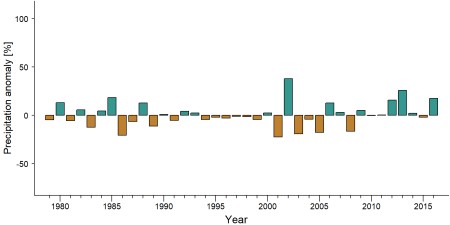
Precipitation anomaly in Deng Deng National Park -
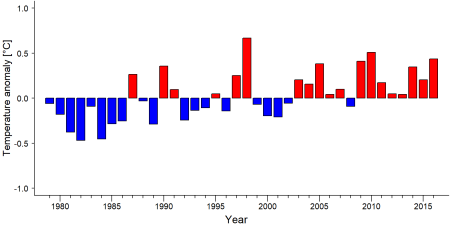
Temperature anomaly in Deng Deng National Park


External links
References
Benavides, J., Dia, T.P., Rodriguez, V. & Brugière, D. (2016). Dénombrement de la population de grands singes du Parc National de Deng Deng. PNDD-BRLI-EDC.
Maurice, M. E., Lionel Ebong, E., Fuashi, N. A., Godwill, I. I., & Zeh, A. F. (2019). The ecological impact on the distribution of Pangolins in Deng-Deng National Park, Eastern Region, Cameroon. Global Journal of Ecology, 4(1), 008-014.
Maisels, F., Ambahe, R., Ambassa, E., Fosso, B., Poumegne, J-B., & Fotso, R. (2011). Gorilla Population in Deng Deng National Park and a Logging Concession. Gorilla Journal 42.
Maisels, F., Strindberg , S., Ambahe, R., Ambassa, E., Yara, C.N., Pouomegne, B., Fosso, B., Fotso, R. (2013). Deng Deng National Park and UFA 10‐065, Republic of Cameroon. Wildlife and Human Impact Survey 2012. 37pp. Wildlife Conservation Society.
WCS (n.d.). WCS Cameroon Deng Deng National Park Project. Online: https://cameroon.wcs.org/Wild-Places/Deng-Deng-National-Park.aspx
Page created by: APES Atlas Team Date: 2021-12-18
Page updated by: APES Atlas Team Date: 2025-10-22