
Luo Scientific Reserve
Central Africa > Democratic Republic of the Congo > Luo Scientific Reserve
Français | Português | Español | Bahasa Indonesia | Melayu
Summary
- Bonobos (Pan paniscus) are present in Luo Scientific Reserve.
- It has been estimated that 173 to 231 individuals occur in the site.
- The bonobo population trend is decreasing.
- The site has a total size of 481 km².
- Key threats to bonobos are habitat encroachment as a result of agricultural expansion, and hunting, particularly during past periods of civil conflict .
- Conservation activities have focused on the maintenance of infrastructure, medical services, and education.
- Long-term studies on wild bonobos began at Wamba, Luo Scientific Reserve, in 1973.
Site characteristics
Table 1. Basic site information for Luo Scientific Reserve
| Species | Pan paniscus |
| Area | 481 km² |
| Coordinates | Lat: 0.045 , Lon: 22.543 |
| Type of site | Protected area (Multiple Sustainable Use Reserve) |
| Habitat types | Subtropical/tropical moist lowland forest, Subtropical/tropical swamp forest |
| Type of governance |
Types of sites Governance types Habitat types
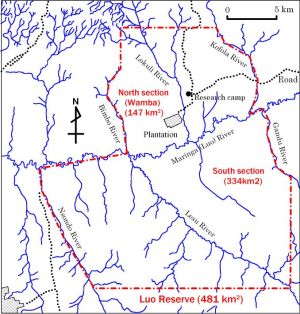
Map of Luo Scientific Reserve © Takeshi Furuichi -
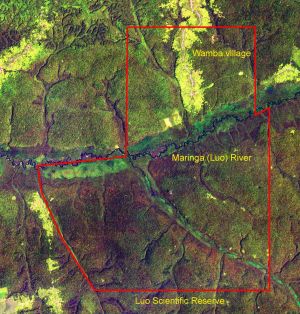
Map of Luo Scientific Reserve © Takeshi Furuichi


Ape status
The study of bonobos at Wamba (in the northern sector of the current Luo Scientific Reserve) started in 1973. The number of bonobos were steadily increasing until some cases of illegal hunting occurred in the 1980's. In order to protect bonobos in this area, a Congolese research center and Japanese researchers established a station for scientific research in 1992, which included both northern and southern sectors on both banks of the Luo River. During two periods of civil war, from 1996 to 2003, bonobos in the northern sector decreased to 40% and those in the southern sector disappeared from half of the area. Bonobos in the northern sector steadily increased from 2003 when research activities resumed, and almost recovered to the previous population size, but the current trend in the southern sector is unknown (Furuichi pers. comm. 2020).
Table 2. Ape population estimates reported for Luo Scientific Reserve
| Species | Year | Occurrence | Encounter or vistation rate (nests/km; ind/day) | Density estimate [ind./ km²] (95% CI) | Abundance estimate (95% CI) | Survey area | Sampling method | Analytical framework | Source | Comments | A.P.E.S. database ID |
|---|---|---|---|---|---|---|---|---|---|---|---|
| Pan paniscus | 1996 | 0.48 | 231.0 | Luo Scientific Reserve (481 km²) | Full count | Hashimoto & Furuichi, 2001 | Density was estimated by number of individuals/ranging area for two study groups. | ||||
| Pan paniscus | 1996 | 0.36 | 173.0 | Luo Scientific Reserve (481 km²) | Line transects | Hashimoto & Furuichi, 2001 |
Sampling methods Analytical frameworks
Threats
Bonobos in the northern sector decreased to 40% between 1991 and 2002 probably due to hunting by soldiers and local people, but they steadily recovered after 2003 when research resumed. During the war, people who fled from the village made a number of small homesteads in the forest. Currently, local people are expanding their agricultural fields into the protected area (Furuichi pers. comm. 2020).
Table 3. Threats to apes reported for Luo Scientific Reserve
| Category | Specific threats | Threat level | Description | Year of threat |
|---|---|---|---|---|
| 2 Agriculture & aquaculture | 2.1 Annual & perennial non-timber crops | Medium (30-70% of population affected) | Agricultural expansion into the protected area (Furuichi pers. comm. 2020) | Ongoing (2020) |
| 5 Biological resource use | 5.1 Hunting & collecting terrestrial animals | Medium (30-70% of population affected) | Bonobos in the northern sector decreased to 40% between 1991 and 2002 during civil conflict due to hunting by soldiers and local people, but they steadily recovered after 2003 when we resumed the study (Furuichi pers. comm. 2020). | 1991-1996, 1996-2002 |
Conservation activities
In order to strengthen public awareness, an NGO called “Support for Conservation of Bonobos” was established to help in the maintenance of infrastructure, medical services, and education that had been seriously damaged by the war. A joint patrolling program involving people from all homesteads in Wamba village is also implemented (Furuichi pers. comm. 2020).
Table 4. Conservation activities reported for Luo Scientific Reserve
| Category | Specific activity | Description | Implementing organization(s) | Year of activity |
|---|---|---|---|---|
| 7 Economic & other incentives | 7.2 Provide non-monetary benefits to local communities for sustainably managing their forest and its wildlife (e.g., better education, infrastructure development) | Support for local community (maintenance of infrastructure, medical services, and education; Furuichi pers. comm. 2020) | Ongoing (2020) |
Challenges
Table 5. Challenges reported for Luo Scientific Reserve
| Challenges | Specific challenges | Source | Year(s) |
|---|---|---|---|
| 6 Safety and stability | 6.3 Civil unrest/war | Nackoney et al, 2014; Idani et al, 2008 | |
| 3 Engaged community | 3.1 General lack of community engagement or support | Furuichi pers. comm. 2020 |
Enablers
Table 6. Enablers reported for Luo Scientific Reserve
| Enablers | Specific enablers | Source | Year(s) |
|---|---|---|---|
| 1 Site management | |||
| 2 Resources and capacity | |||
| 3 Engaged community | |||
| 4 Institutional support | |||
| 5 Ecological context | |||
| 6 Safety and stability |
Research activities
In the northern sector, behavioral and ecological studies of bonobos have been conducted since 1973, except for a break between 1992 and 2002 due to political instability and civil war. In the southern sector, an ecological survey was being conducted until 1992; currently no research activities are being carried out in this sector (Furuichi pers. comm. 2020).
Documented behaviours
Table 7. Behaviours documented for Luo Scientific Reserve
| Category | Behavior | Observation type | Prevalence | Observation dates | Source | Habituation | Species | Comment |
|---|---|---|---|---|---|---|---|---|
| Not reported |
Exposure to climate change impacts
As part of a study on the exposure of African great ape sites to climate change impacts, Kiribou et al. subm. extracted climate data and data on projected extreme climate impact events for the site. Climatological characteristics were derived from observation-based climate data provided by the Inter-Sectoral Impact Model Intercomparison Project (ISIMIP, www.isimip.org). Parameters were calculated as the average across each 30-year period. For 1981-2010, the EWEMBI dataset from ISIMIP2a was used. For the two future periods (2021-2050 and 2071-2099) ISIMIP2b climate data based on four CMIP5 global climate models were used. For future projections, two Representative Concentration Pathways (RCP) were used. RCP 2.6 is a scenario with strong mitigation measures in which global temperatures would likely rise below 2C. RCP 6.0 is a scenario with medium emissions in which global temperatures would likely rise up to 3C by 2100. For the number of days with heavy precipitation events, the 98th percentile of all precipitation days (>1mm/d) was calculated for the 1979-2013 reference period as a threshold for a heavy precipitation event. Then, for each year, the number of days above that threshold was derived. The figures on temperature and precipitation anomaly show the deviation from the mean temperature and mean precipitation for the 1979-2013 reference period.
The estimated exposure to future extreme climate impact events (crop failure, drought, river flood, wildfire, tropical cyclone, and heatwave) is based on a published dataset by Lange et al. 2020 derived from ISIMIP2b data. The same global climate models and RCPs as described above were used. Within each 30-year period, the number of years with an extreme event and the average proportion of the site affected were calculated (see Kiribou et al. subm. for details).
Table 8. Estimated past and projected climatological characteristics in Luo Scientific Reserve
| Value | 1981-2010 | 2021-2050, RCP 2.6 | 2021-2050, RCP 6.0 | 2071-2099, RCP 2.6 | 2071-2099, RCP 6.0 |
|---|---|---|---|---|---|
| Mean temperature [C] | 25.4 | 26.5 | 26.4 | 26.8 | 27.8 |
| Annual precipitation [mm] | 2394 | 2407 | 2386 | 2307 | 2440 |
| Max no. consecutive dry days (per year) | 3.8 | 9.1 | 9.8 | 9.2 | 9.3 |
| No. days with heavy precipitation (per year) | 7 | 9.6 | 10.8 | 10.5 | 11.5 |
Table 9. Projected exposure of apes to extreme climate impact events in Luo Scientific Reserve
| Type | No. of years with event (2021-2050, RCP 2.6) | % of site exposed (2021-2050, RCP 2.6) | No. of years with event (2021-2050, RCP 6.0) | % of site exposed (2021-2050, RCP 6.0) | No. of years with event (2070-2099, RCP 2.6) | % of site exposed (2070-2099, RCP 2.6) | No. of years with event (2070-2099, RCP 6.0) | % of site exposed (2070-2099, RCP 6.0) |
|---|---|---|---|---|---|---|---|---|
| Crop failure | 13.5 | 0.1 | 9 | 0.11 | 9.5 | 0.13 | 27 | 0.08 |
| Drought | 0 | 0 | 0 | 0 | 0 | 0 | 0 | 0 |
| Heatwave | 1.5 | 100 | 3 | 50 | 9 | 100 | 7 | 100 |
| River flood | 0 | 0 | 1.25 | 0.15 | 1 | 1.28 | 2.5 | 2.68 |
| Tropical cyclone | 0 | 0 | 0 | 0 | 0 | 0 | 0 | 0 |
| Wildfire | 30 | 0.3 | 30 | 0.28 | 29 | 0.31 | 28.5 | 0.24 |
-
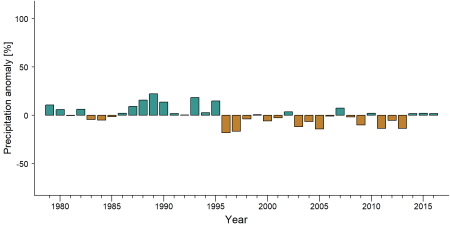
Precipitation anomaly in Luo Scientific Reserve -
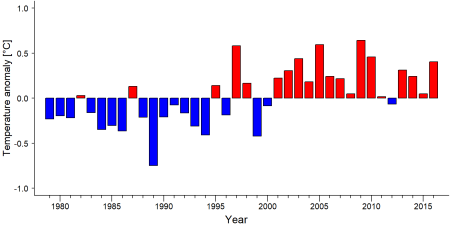
Temperature anomaly in Luo Scientific Reserve


External links
References
Kano T (1992) The Last Ape: Pygmy Chimpanzee Behavior and Ecology. Stanford University Press, Stanford, California
Kano T, Bongoli L, Idani G, Hashimoto C (1996) The challenge of Wamba. Etica & Animali 8/96: 68-74
Hashimoto C, Furuichi T (2001) Current situation of bonobos in the Luo Reserve, Equateur, Democratic Republic of Congo. In: All apes great and small, vol.1: African Apes Kluwer Acad/Plenum, New York, pp 83-93
Idani G, Mwanza N, Ihobe H, Hashimoto C, Tashiro Y, Furuichi T (2008) Changes in the status of bonobos, their habitat, and the situation of humans at Wamba in the Luo Scientific Reserve, Democratic Republic of Congo. In: Furuichi T, Thompson J (eds) The bonobos: behavior, ecology, and conservation. Springer, New York, pp 291-302
Furuichi T et al. (2012) Long-term studies on wild bonobos at Wamba, Luo Scientific Reserve, D. R. Congo: towards the understanding of female life history in a male-philopatric species. In: Kappeler PM, Watts DP (eds) Long-term field studies of primates. Springer-Verlag, Berlin, Heidelberg, pp 413-433
Nackoney J, Molinario G, Potapov P, Turubanova S, Hansen MC, Furuichi T (2014) Impacts of civil conflict on primary forest habitat in northern Democratic Republic of the Congo, 1990–2010. Biol Conserv http://dx.doi.org/10.1016/j.biocon.2013.12.033
Page created by: Takeshi Furuichi Date: 2020-12-01