
Okapi Wildlife Reserve
Central Africa > Republic of the Congo > Okapi Wildlife Reserve
Français | Português | Español | Bahasa Indonesia | Melayu
Summary
- Eastern chimpanzees (Pan troglodytes schweinfurthii) are present in Okapi Wildlife Reserve.
- It has been estimated that 5,019 individuals occur in the site.
- The chimpanzee population trend is stable.
- The site has a total size of 13,700 km².
- Armed groups involved in illegal mining, logging and hunting are the most concerning threat to chimpanzees and other wildlife in the Okapi Wildlife Reserve.
- Conservation activities at the site include anti-poaching patrols.
Site characteristics
Established in 1992, the Okapi Wildlife Reserve occupies about one-fifth of the Ituri forest in the Democratic Republic of the Congo (Okapi Conservation Project). The reserve was declared a UNESCO World Heritage Site in 1996, and it is also an Important Bird Area, with nearly 400 bird species recorded (BirdLife International 2020). The site is one of the largest blocks of intact forest remaining in the Congo Basin. The forest is important for the Mbuti and Efé pygmies, who live here as hunter-gatherers (BirdLife International 2020; UNESCO). The reserve is famous for being home to the largest population of the endemic okapi, Okapia johnstoni (BirdLife International 2020; UNESCO). The reserve supports other mammals of global conservation importance, including eastern chimpanzees, forest elephants, water chevrotains, aquatic genets, bongos, Hamlyn's monkeys, and mountain monkeys (BirdLife International 2020). The site is also notably rich in butterfly species (BirdLife International 2020).
Table 1. Basic site information for Okapi Wildlife Reserve
| Species | Pan troglodytes schweinfurthii |
| Area | 13,700 km² |
| Coordinates | Lat: 1.758921 , Lon: 28.504352 |
| Type of site | Protected area (Wildlife Reserve) |
| Habitat types | Subtropical/tropical moist lowland forest, Subtropical/tropical swamp forest |
| Type of governance | Governance by government |
Types of sites Governance types Habitat types
Ape status
The eastern chimpanzee population remained stable between 2007-2018, at around 5000 individuals; in 2018 the estimate was 5019 individuals (CI 3719-6773; CV 15%). However, there is some evidence of a range reduction in the west of the Reserve since 2011 (Madidi et al. 2019).
Table 2. Ape population estimates reported for Okapi Wildlife Reserve
| Species | Year | Occurrence | Encounter or vistation rate (nests/km; ind/day) | Density estimate [ind./ km²] (95% CI) | Abundance estimate (95% CI) | Survey area | Sampling method | Analytical framework | Source | Comments | A.P.E.S. database ID |
|---|---|---|---|---|---|---|---|---|---|---|---|
| Pan troglodytes schweinfurthii | 2018 | 5,019 (3,719-6,773) | Okapi Wildlife Reserve (12,000 km²) | Line transects | Madidi et al. 2019 | survey effort: 321 km | |||||
| Pan troglodytes schweinfurthii | 2009 | 0.62 | 8802.0 | Okapi Wildlife Reserve (14,157 km²) | Reconnaissance walk | Plumptre et al. 2010 |
Sampling methods Analytical frameworks
Threats
The presence of armed militia involved in illegal mining, logging and hunting is one of the most concerning threats to the Okapi Wildlife Reserve. Most human activity is associated with the concentration of mines in the south and west, both north and south of the national road that bisects the Reserve (Madidi et al. 2019). In 2012, armed rebel groups brutally attacked the headquarters of the reserve, killing six people and 14 captive okapis (Dasgupta 2019). Immigration is also a serious threat, as the RN4 road, which bisects the southern part of the reserve was rehabilitated, allowing easy access to pristine forests (IUCN 2020).
Table 3. Threats to apes reported for Okapi Wildlife Reserve
| Category | Specific threats | Threat level | Description | Year of threat |
|---|---|---|---|---|
| 3 Energy production & mining | 3.2 Mining & quarrying | High (more than 70% of population affected) | Artisanal mining for diamonds and coltan largely controlled by organised criminal networks with the support of some local chiefs and foreign companies (IUCN 2020). Miners often depend on bushmeat (Dasgupta 2019). Mining is concentrated in the southern and western parts of the reserve (Madidi et al. 2019). | Ongoing (2019) |
| 4 Transportation & service corridors | 4.1 Roads & railroads | High (more than 70% of population affected) | Rehabilitation of the RN4 road, which bisects the southern part of the reserve from east to west facilitated access to the forest (IUCN 2020). | Ongoing (2020) |
| 5 Biological resource use | 5.1 Hunting & collecting terrestrial animals | High (more than 70% of population affected) | Hunting for bushmeat, linked to illegal mining activities (IUCN 2020). | Ongoing (2020) |
| 5 Biological resource use | 5.3 Logging & wood harvesting | High (more than 70% of population affected) | Illegal logging and clearing of forest by immigrants (Dasgupta 2019; IUCN 2020). | Ongoing (2020) |
| 6 Human intrusions & disturbance | 6.2 War, civil unrest & military exercises | High (more than 70% of population affected) | Armed militia involved in illegal mining, logging and hunting (IUCN 2020). | Ongoing (2020) |
Conservation activities
In 2019 an agreement was reached to manage the Okapi Wildlife Reserve between Wildlife Conservation Society (WCS) and the Government’s Nature Conservation Agency, ICCN (WCS). Between 2011 and 2019, hunting activity diminished as people have shifted their activities towards the mining camps in the southwest of the reserve. In addition, the core area is regularly patrolled by anti poaching teams (Madidi et al. 2019).
Table 4. Conservation activities reported for Okapi Wildlife Reserve
| Category | Specific activity | Description | Implementing organization(s) | Year of activity |
|---|---|---|---|---|
| 2 Counter-wildlife crime | 2.3 Conduct regular anti-poaching patrols | Rangers walk up to 20 days a month to patrol the forest (Okapi Conservation Project, Madidi et al. 2019). | Ongoing (2019) | |
| 3 Species health | 3.2 Keep safety distance to habituated apes | Reported on KBA 2025. | Ongoing (2023) | |
| 5 Protection & restoration | 5.2 Legally protect ape habitat | The site is designated as a Wildlife Reserve. | ICCN | 1992-Ongoing (2026) |
| 6 Species management | 6.3 Other human disturbances | Reported on KBA 2025. | Ongoing (2023) |
Challenges
Table 5. Challenges reported for Okapi Wildlife Reserve
| Challenges | Specific challenges | Source | Year(s) |
|---|---|---|---|
| 1 Site management | 1.2 Need for improved coordination | BirdLife International 2020 | |
| 6 Safety and stability | 6.3 Civil unrest/war | IUCN 2020 |
Enablers
Table 6. Enablers reported for Okapi Wildlife Reserve
| Enablers | Specific enablers | Source | Year(s) |
|---|---|---|---|
| 1 Site management | |||
| 2 Resources and capacity | |||
| 3 Engaged community | |||
| 4 Institutional support | |||
| 5 Ecological context | |||
| 6 Safety and stability |
Research activities
A research project has been based at Epulu since the early 1980s and has been supported since 1986 by the Wildlife Conservation Society. Besides conducting the first study of Okapi in the wild, this project has included long-term studies of natural and selectively-logged forest and research into the socio-economic impact of human migration (BirdLife International 2020).
Documented behaviours
Table 7. Behaviours documented for Okapi Wildlife Reserve
| Category | Behavior | Observation type | Prevalence | Observation dates | Source | Habituation | Species | Comment |
|---|---|---|---|---|---|---|---|---|
| Making ground nests | Plumptre et al. 2010 | |||||||
| Smashing large snails | Plumptre et al. 2010 | |||||||
| Smashing tortoises | Plumptre et al. 2010 |
Exposure to climate change impacts
As part of a study on the exposure of African great ape sites to climate change impacts, Kiribou et al. subm. extracted climate data and data on projected extreme climate impact events for the site. Climatological characteristics were derived from observation-based climate data provided by the Inter-Sectoral Impact Model Intercomparison Project (ISIMIP, www.isimip.org). Parameters were calculated as the average across each 30-year period. For 1981-2010, the EWEMBI dataset from ISIMIP2a was used. For the two future periods (2021-2050 and 2071-2099) ISIMIP2b climate data based on four CMIP5 global climate models were used. For future projections, two Representative Concentration Pathways (RCP) were used. RCP 2.6 is a scenario with strong mitigation measures in which global temperatures would likely rise below 2C. RCP 6.0 is a scenario with medium emissions in which global temperatures would likely rise up to 3C by 2100. For the number of days with heavy precipitation events, the 98th percentile of all precipitation days (>1mm/d) was calculated for the 1979-2013 reference period as a threshold for a heavy precipitation event. Then, for each year, the number of days above that threshold was derived. The figures on temperature and precipitation anomaly show the deviation from the mean temperature and mean precipitation for the 1979-2013 reference period.
The estimated exposure to future extreme climate impact events (crop failure, drought, river flood, wildfire, tropical cyclone, and heatwave) is based on a published dataset by Lange et al. 2020 derived from ISIMIP2b data. The same global climate models and RCPs as described above were used. Within each 30-year period, the number of years with an extreme event and the average proportion of the site affected were calculated (see Kiribou et al. subm. for details).
Table 8. Estimated past and projected climatological characteristics in Okapi Wildlife Reserve
| Value | 1981-2010 | 2021-2050, RCP 2.6 | 2021-2050, RCP 6.0 | 2071-2099, RCP 2.6 | 2071-2099, RCP 6.0 |
|---|---|---|---|---|---|
| Mean temperature [C] | 23.9 | 25.1 | 24.9 | 25.3 | 26.3 |
| Annual precipitation [mm] | 1831 | 1841 | 1940 | 1801 | 2032 |
| Max no. consecutive dry days (per year) | 7.4 | 15.6 | 17.4 | 18.6 | 17 |
| No. days with heavy precipitation (per year) | 7 | 12 | 13.1 | 11.2 | 18.4 |
Table 9. Projected exposure of apes to extreme climate impact events in Okapi Wildlife Reserve
| Type | No. of years with event (2021-2050, RCP 2.6) | % of site exposed (2021-2050, RCP 2.6) | No. of years with event (2021-2050, RCP 6.0) | % of site exposed (2021-2050, RCP 6.0) | No. of years with event (2070-2099, RCP 2.6) | % of site exposed (2070-2099, RCP 2.6) | No. of years with event (2070-2099, RCP 6.0) | % of site exposed (2070-2099, RCP 6.0) |
|---|---|---|---|---|---|---|---|---|
| Crop failure | 9.5 | 0.01 | 6.5 | 0.01 | 10 | 0.01 | 22 | 0.01 |
| Drought | 0 | 0 | 0 | 0 | 0 | 0 | 0 | 0 |
| Heatwave | 4 | 60.67 | 5 | 52.5 | 11 | 60.21 | 13 | 58.18 |
| River flood | 4.5 | 0.78 | 5.75 | 0.92 | 4.75 | 0.36 | 10 | 1.5 |
| Tropical cyclone | 0 | 0 | 0 | 0 | 0 | 0 | 0 | 0 |
| Wildfire | 30 | 0.5 | 30 | 0.47 | 29 | 0.47 | 29 | 0.38 |
-
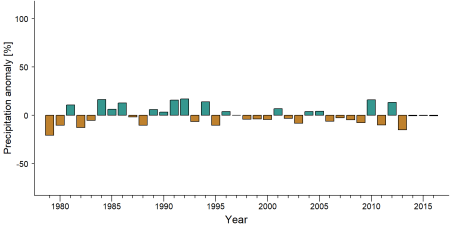
Precipitation anomaly in Okapi Wildlife Reserve -
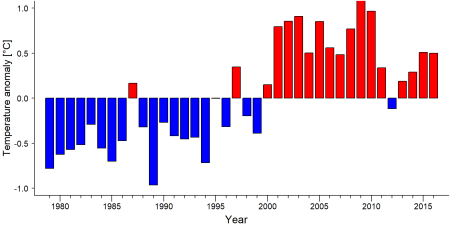
Temperature anomaly in Okapi Wildlife Reserve


External links
References
BirdLife International (2020). Important Bird Areas factsheet: Okapi Faunal Reserve. Downloaded from http://www.birdlife.org on 30/12/2020.
IUCN (2020). Okapi Wildlife Reserve. IUCN World Heritage Outlook
Dasgupta, S. (2019). DRC’s Okapi Wildlife Reserve gets new management partner in WCS. Retrieved 30 December 2020 from Mongabay.com. Web site: https://news.mongabay.com/2019/10/drcs-okapi-wildlife-reserve-gets-new-management-partner-in-wcs/#
Key Biodiversity Areas Partnership (2025) Key Biodiversity Areas factsheet: Okapi Wildlife Reserve. Extracted from the World Database of Key Biodiversity Areas. Developed by the Key Biodiversity Areas Partnership: BirdLife International, IUCN, American Bird Conservancy, Amphibian Survival Alliance, Conservation International, Critical Ecosystem Partnership Fund, Global Environment Facility, Re:wild, NatureServe, Rainforest Trust, Royal Society for the Protection of Birds, World Wildlife Fund and Wildlife Conservation Society. Downloaded from https://keybiodiversityareas.org/ on Jun 4, 2025
Madidi, J., Maisels, F., Kahindo, F., Nsafusa, B., Angemito, T., Manala, M., Ngohe, O., & Liengola, I. 2019. Inventaires des Grands Mammifères et de l’Impact Humaine, Réserve de Faune à Okapis, 2018. Rapport technique No : 01/BION/RFO/2019 p. 40. WCS DRC, Kinshasa, DRC.
Plumptre, A.J., Rose, R., Nangendo, G., Williamson, E.A., Didier, K., Hart, J., Mulindahabi, F., Hicks, C., Griffin, B., Ogawa, H., Nixon, S., Pintea, L., Vosper, A., McClennan, M., Amsini, F., McNeilage, A., Makana, J.R., Kanamori, M., Hernandez, A., Piel, A., Stewart, F., Moore, J., Zamma, K., Nakamura, M., Kamenya, S., Idani, G., Sakamaki, T., Yoshikawa, M., Greer, D., Tranquilli, S., Beyers, R., Furuichi, T., Hashimoto, C. and Bennett, E. (2010). Eastern Chimpanzee (Pan troglodytes schweinfurthii): Status Survey and Conservation Action Plan 2010–2020. IUCN/SSC Primate Specialist Group, Gland, Switzerland. 52pp
Page created by: APES Atlas Team Date: 2023-08-14