
Outamba-Kilimi National Park
West Africa > Sierra Leone > Outamba-Kilimi National Park
Français | Português | Español | Bahasa Indonesia | Melayu
Summary
- Western chimpanzees (Pan troglodytes verus) are present in Outamba-Kilimi National Park.
- It has been estimated that 1,020 (CI: 658-1,596) individuals occur in the site.
- The chimpanzee population trend is unknown.
- This site has a total size of 1,109 km².
- The key threat to chimpanzees is habitat destruction caused by intentional burning for agricultural activities and hunting, and mining.
- Reforestation, law enforcement, awereness raising, and ecotourism are the main conservation interventions that have been implemented at the site.
Site characteristics
Situated in the north of Sierra Leone, Outamba-Kilimi National Park is divided into two blocks: Outamba (741 km²) and Kilimi (368 km²) (BirdLife International 2019). In the 1980s, with support from the IUCN and WWF, Geza Teleki, a primatologist and conservationist, was a driving force behind the establishment of Outamba-Kilimi National Park, which was finally declared as such in 1995 (Brncic et al. 2010, Munro 2015). In addition to the western chimpanzee, the site is home to forest elephants (Loxodonta cyclotis), Western red colobus monkeys (Piliocolobus badius), pygmy hippopotamus (Choeropsis liberiensis), leopards (Panthera pardus), and forest buffalos (Brncic et al. 2010). With at least 256 bird species, the site is also an Important Bird Area (BirdLife International 2019).
Table 1. Basic site information for Outamba-Kilimi National Park
| Species | Pan troglodytes verus |
| Area | 1,109 km² |
| Coordinates | Lat: 9.73 , Lon: -12.07 |
| Type of site | Protected area (National Park) |
| Habitat types | Subtropical/tropical dry forest, Subtropical/tropical moist lowland forest, Savanna, Agricultural land, Urban areas, Subtropical/tropical heavily degraded former forest |
| Type of governance | Governance by government |
Types of sites Governance types Habitat types
Ape status
The population size was estimated at 1,020 chimpanzees during a nationwide survey in 2010 (Brncic et al. 2010). Due to a lack of survey data, the population trend is unknown. Chimpanzee densities are higher in Outamba than in Kilimi (Brncic et al. 2010).
Table 2. Ape population estimates reported for Outamba-Kilimi National Park
| Species | Year | Occurrence | Encounter or vistation rate (nests/km; ind/day) | Density estimate [ind./ km²] (95% CI) | Abundance estimate (95% CI) | Survey area | Sampling method | Analytical framework | Source | Comments | A.P.E.S. database ID |
|---|---|---|---|---|---|---|---|---|---|---|---|
| Pan troglodytes verus | 2010 | 8.9 (6.71-11.83) | 1.21 (0.78-1.88) | 950 (615-1472) | Outamba | Line transects | Brncic et al. 2010 | ||||
| Pan troglodytes verus | 2010 | 1.9 (0.61-6.41) | 0.27 (0.08-0.90) | 70 (22-246) | Kilimi | Line transects | Brncic et al. 2010 | ||||
| Pan troglodytes verus | 2010 | 0.97 (0.62-1.51) | 1020 (658-1596) | Outamba-Kilimi | Line transects | Brncic et al. 2010 | |||||
| Pan troglodytes verus | 1983 | 0.3 | 49-60 | Kilimi | Reconnaissance walk | Harding 1984 as cited by Brncic et al. 2010 | Reconnaissance walk | ||||
| Pan troglodytes verus | 1989 | 200-300 | Outamba | Unknown | Alp 1989 as cited by Brncic et al. 2010 | The population size was thought to be as high as 600-700 |
Sampling methods Analytical frameworks
Threats
The export and trade of wild animals, especially chimpanzees, emerged as a lucrative enterprise in Sierra Leone in the 1920s (Munro 2015). Two prominent wildlife dealers, Franz Sitter and Suleiman Mansaray, exported approximately 2,000 chimpanzees in the 1970s alone (Munro 2015). After Outamba and Kilimi were proposed as game reserves in 1965, Franz Sitter intensified hunting to take as much wildlife as possible from these areas before they could be protected (Brncic et al. 2010). However, there are no signs of an ongoing chimpanzee trade.
Nowadays, the biggest threat to chimpanzees is habitat destruction caused by illegal mining and the intentional burning of areas. Hunting signs are present in both Outamba and Kilimi, indicating that poaching is an ongoing threat (Brncic et al. 2010). Villages are found within the park, especially throughout the Kilimi section of the park, where cattle grazing, farming, and timber extraction also occur (Brncic et al. 2010). In the Outamba section, larger areas seem to be unaffected by humans than in Kilimi (Brncic et al. 2010).
Table 3. Threats to apes reported for Outamba-Kilimi National Park
| Category | Specific threats | Threat level | Description | Year of threat |
|---|---|---|---|---|
| 1 Residential & commercial development | 1.1 Residential areas | Low (up to 30% of population affected) | A number of villages is located in both sections of the park (Brncic et al. 2010). | Ongoing (2010) |
| 2 Agriculture & aquaculture | 2.1 Annual & perennial non-timber crops | Low (up to 30% of population affected) | Small-scale subsistence farming and palm plantations (Kaiser pers. obs.). | Ongoing (2019) |
| 2 Agriculture & aquaculture | 2.3 Livestock farming & ranching | Present (unknown severity) | The northern part of Kilimi is used for cattle grazing (Brncic et al. 2010). | Ongoing (2010) |
| 3 Energy production & mining | 3.2 Mining & quarrying | High (more than 70% of population affected) | Illegal gold mining activities in Outamba (Brncic et al. 2010). Reports of illegal mining in the park (Lahai Keifala pers. comm. 2025). | 2010-Ongoing (2025) |
| 5 Biological resource use | 5.1 Hunting & collecting terrestrial animals | High (more than 70% of population affected) | High hunting intensity in the late 1960s and 1970s; hunting signs are still frequently found in the park (Brncic et al. 2010). Hunting reported as ongoing in 2025 (Lahai Keifala pers. comm. 2025). | 2010-Ongoing (2025) |
| 5 Biological resource use | 5.3 Logging & wood harvesting | Present (unknown severity) | Timber extraction in the northern part of Kilimi (Brncic et al. 2010). Reported as ongoing in 2025 (Lahai Keifala pers. comm. 2025). | 2010-Ongoing (2025) |
| 6 Human intrusions & disturbance | 6.2 War, civil unrest & military exercises | Present (unknown severity) | The park’s infrastructure was destroyed and conservation activities were brought to a halt due to civil war (Munro 2015). | 1991-2002 |
| 7 Natural system modifications | 7.1 Fire & fire suppression | High (more than 70% of population affected) | Annual burning affects a large proportion of the park (Brncic et al. 2010). | Ongoing (2010) |
| 7 Natural system modifications | 7.2 Dams & water management/use | Present (unknown severity) | Signs of dam inside the park used for fishing activities (Kaiser pers. obs. 2019). | Ongoing (2019) |
| 8 Invasive & other problematic species, genes & diseases | 8.2 Problematic native species | Medium (30-70% of population affected) | Widespread zones of elephant grass (Pennisetum purpureum) that degrade the forest edge (Kaiser pers. obs.). | Ongoing (2019) |
Conservation activities
Park guards funded by the government are stationed around the park to monitor and deter poaching and illegal mining. The site is a priority zone for the STEWARD program, which is a forest conservation and sustainable livelihoods program supported by the United States Agency for International Development (USAID) and the United States Forest Service / International Programs (USFS/IP) (WCF 2015). The https://panverus.org/about/ Pan Verus Project] also aims to address the needs of local communities and find ways to provide sustainable agriculture practices and alternative livelihoods, for example, through tourism.
Table 4. Conservation activities reported for Outamba-Kilimi National Park
| Category | Specific activity | Description | Implementing organization(s) | Year of activity |
|---|---|---|---|---|
| 2 Counter-wildlife crime | 2.3 Conduct regular anti-poaching patrols | Government funded park guards stationed around park to monitor illegal poaching and mining (Kaiser pers. obs.) | National Protected Area Authority | Ongoing (2025) |
| 4 Education & awareness | 4.1 Educate local communities about apes and sustainable use | The Pan Verus Project founded the Outamba Kilimi National Park Education Centre and Community Library to promote awareness of the park's biodiversity (Lahai Keifala pers. comm. 2025). | Tacugama Chimpanzee Sanctuary | 2019 |
| 4 Education & awareness | 4.5 Implement multimedia campaigns using theatre, film, print media, discussions | The Wild Chimpanzee Foundation (WCF) organized an awareness raising theater play, which toured around the site (WCF 2011); discussion and showing camera trap images (PanAfrican Programme). | 2010, 2016, 2017 | |
| 5 Protection & restoration | 5.2 Legally protect ape habitat | The site is a national park since 1995 (Munro 2015). | 1995-Ongoing (2026) | |
| 5 Protection & restoration | 5.6 Habitat restoration | Tree planting initiatives were put in place to restore the ecosystem and the site (Lahai Keifala pers. comm. 2025). | Tacugama Chimpanzee Sanctuary, EUCORD | 2024 |
| 8 Permanent presence | 8.2 Run tourist projects and ensure permanent human presence at site | OKNP offers guided safaris, boat tours, and forest walks, allowing visitors to experience wildlife in its natural habitat (Lahai Keifala pers. comm. 2025). | National Park Association | 2020 |
Challenges
Table 5. Challenges reported for Outamba-Kilimi National Park
| Challenges | Specific challenges | Source | Year(s) |
|---|---|---|---|
| 2 Resources and capacity | 2.5 Lack of equipment/transportation | Brncic et al. 2010 | |
| 2 Resources and capacity | 2.7 Lack of infrastructure | Lahai Keifala pers. comm. 2025, Sierra Eye Magazine | 2024 |
| 3 Engaged community | 3.1 General lack of community engagement or support | Brncic et al. 2010 |
Enablers
Table 6. Enablers reported for Outamba-Kilimi National Park
| Enablers | Specific enablers | Source | Year(s) |
|---|---|---|---|
| 1 Site management | |||
| 2 Resources and capacity | |||
| 3 Engaged community | |||
| 4 Institutional support | |||
| 4 Institutional support | |||
| 5 Ecological context | |||
| 6 Safety and stability |
Research activities
Outamba-Kilimi was a temporary research site for the PanAfrican Programme based at the Max-Planck Institute for Evolutionary Anthropology.
Documented behaviours
Table 7. Behaviours documented for Outamba-Kilimi National Park
| Category | Behavior | Observation type | Prevalence | Observation dates | Source | Habituation | Species | Comment |
|---|---|---|---|---|---|---|---|---|
| Algae scooping | Kühl et al. 2019 | |||||||
| Ant dipping | Kühl et al. 2019 | |||||||
| Ant eating | Kühl et al. 2019 | |||||||
| Stepping sticks | Alp 1997 | |||||||
| Seat sticks | Alp 1997 |
Exposure to climate change impacts
As part of a study on the exposure of African great ape sites to climate change impacts, Kiribou et al. subm. extracted climate data and data on projected extreme climate impact events for the site. Climatological characteristics were derived from observation-based climate data provided by the Inter-Sectoral Impact Model Intercomparison Project (ISIMIP, www.isimip.org). Parameters were calculated as the average across each 30-year period. For 1981-2010, the EWEMBI dataset from ISIMIP2a was used. For the two future periods (2021-2050 and 2071-2099) ISIMIP2b climate data based on four CMIP5 global climate models were used. For future projections, two Representative Concentration Pathways (RCP) were used. RCP 2.6 is a scenario with strong mitigation measures in which global temperatures would likely rise below 2C. RCP 6.0 is a scenario with medium emissions in which global temperatures would likely rise up to 3C by 2100. For the number of days with heavy precipitation events, the 98th percentile of all precipitation days (>1mm/d) was calculated for the 1979-2013 reference period as a threshold for a heavy precipitation event. Then, for each year, the number of days above that threshold was derived. The figures on temperature and precipitation anomaly show the deviation from the mean temperature and mean precipitation for the 1979-2013 reference period.
The estimated exposure to future extreme climate impact events (crop failure, drought, river flood, wildfire, tropical cyclone, and heatwave) is based on a published dataset by Lange et al. 2020 derived from ISIMIP2b data. The same global climate models and RCPs as described above were used. Within each 30-year period, the number of years with an extreme event and the average proportion of the site affected were calculated (see Kiribou et al. subm. for details).
Table 8. Estimated past and projected climatological characteristics in Outamba-Kilimi National Park
| Value | 1981-2010 | 2021-2050, RCP 2.6 | 2021-2050, RCP 6.0 | 2071-2099, RCP 2.6 | 2071-2099, RCP 6.0 |
|---|---|---|---|---|---|
| Mean temperature [C] | 27 | 28.1 | 27.9 | 28.2 | 29.4 |
| Annual precipitation [mm] | 1969 | 1889 | 1950 | 1978 | 1931 |
| Max no. consecutive dry days (per year) | 62.3 | 56.9 | 55.8 | 63.1 | 61.2 |
| No. days with heavy precipitation (per year) | 4.5 | 5.3 | 5.1 | 5.7 | 5.8 |
Table 9. Projected exposure of apes to extreme climate impact events in Outamba-Kilimi National Park
| Type | No. of years with event (2021-2050, RCP 2.6) | % of site exposed (2021-2050, RCP 2.6) | No. of years with event (2021-2050, RCP 6.0) | % of site exposed (2021-2050, RCP 6.0) | No. of years with event (2070-2099, RCP 2.6) | % of site exposed (2070-2099, RCP 2.6) | No. of years with event (2070-2099, RCP 6.0) | % of site exposed (2070-2099, RCP 6.0) |
|---|---|---|---|---|---|---|---|---|
| Crop failure | 3 | 0.2 | 2 | 0.2 | 0 | 0 | 7 | 0.23 |
| Drought | 0 | 0 | 0 | 0 | 0 | 0 | 0 | 0 |
| Heatwave | 4.5 | 100 | 4 | 100 | 1.5 | 100 | 6 | 100 |
| River flood | 0.5 | 0 | 1.25 | 2.2 | 1 | 0.42 | 2.5 | 1.46 |
| Tropical cyclone | 0.5 | 0.16 | 1 | 0.39 | 0 | 0 | 0 | 0 |
| Wildfire | 30 | 1.14 | 30 | 0.79 | 29 | 0.93 | 29 | 1.05 |
-
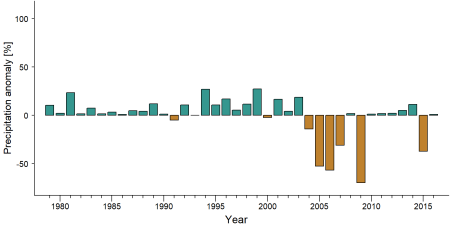
Precipitation anomaly in Outamba-Kilimi National Park -
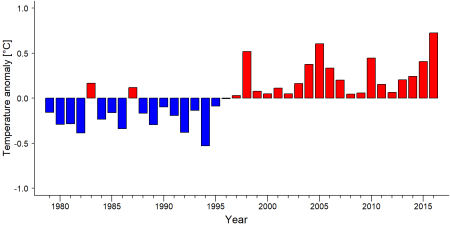
Temperature anomaly in Outamba-Kilimi National Park


External links
References
Alp, R. 1997. "Stepping-sticks" and "seat-sticks": new types of tools used by wild chimpanzees (Pan troglodytes) in Sierra Leone. American Journal of Primatology, 41(1):45-52.
BirdLife International. 2019. Important Bird Areas factsheet: Outamba-Kilimi National Park. Downloaded from http://www.birdlife.org on 19/07/2019.
Brncic, T.M., Amarasekaran,B. & McKenna,A. 2010. Final Report of the Sierra Leone National Chimpanzee Census Project. Tacugama Chimpanzee Sanctuary, Freetown, Sierra Leone.
Kühl HS et al. 2019. Human impact erodes chimpanzee behavioral diversity, Science 363, 1453–1455
Munro, P. 2015. Geza Teleki and the Emergence of Sierra Leone’s Wildlife Conservation Movement. Primate Conservation, (29):115-122. DOI: http://dx.doi.org/10.1896/052.029.0112
Tourism – navigating opportunities amidst challenges. (2024, November 27). *Sierra Eye Magazine*. https://www.sierraeyemagazine.com/tourism-navigating-opportunities-amidst-challenges/
Wild Chimpanzee Foundation (WCF). 2011. Report on Education and Awareness Activities to improve the protection of wild chimpanzees and their habitat in West Africa, undertaken by the Wild Chimpanzee Foundation. Report online: https://www.wildchimps.org/fileadmin/content_files/pdfs/reports/2010-Education_Ecotour_yearly-report_2010_April-2011.pdf
Wild Chimpanzee Foundation (WCF). 2015. Baseline Assessment of Chimpanzee and Elephant Populations in the Mano River Union Countries – Côte d’Ivoire, Liberia, Sierra Leone and Guinea (2007-2014). Report online: https://www.wildchimps.org/fileadmin/content_files/pdfs/reports/STEWARD_Report_on_chimpanzee_and_elephant_Status_MRU_FINAL.pdf
Page created by: M. Kaiser & APES Atlas Team Date: 2019-11-12
Page updated by: Lahai Keifala Date: 2025-04-23