
Bili-Uéré-Mbomu Complex
Central Africa > Democratic Republic of the Congo > Bili-Uéré-Mbomu Complex
Français | Português | Español | Bahasa Indonesia | Melayu
Summary
- Eastern chimpanzees (Pan troglodytes schweinfurthii) are present in Bili-Uéré.
- It has been estimated that 313-984 individuals occur in the site.
- The chimpanzee population trend is stable.
- The site has a total size of 43,400 km².
- Key threats to chimpanzees are mining, poaching, trafficking of infants, and agricultural activities.
- Conservation activities implemented at the site include forest patrols, community conservation activities focusing on agro-pastoral alternatives to bushmeat and household revenue diversification, and participatory landscape planning.

Site characteristics
The Mbomu Wildlife Reserves and the Bili-Uéré Hunting Domain make up the largest protected area in DRC, covering an area of 43,400 km². The protected area complex consists of the Bili-Uéré Hunting Domain and three distinct areas of the Mbomu Wildlife Reserve to the North, along the Mbomu River and the border with the Central African Republic. There are also discussions for the creation of a National Park which could upgrade key areas of the Hunting Domain and Okapi habitats on either side of the River Uélé to the south (H.Bailey 2025). The Bili-Uéré Hunting Domain covers an area of 32,732.8 km², and the Mbomu Wildlife reserve covers a total area of 10,687 km²; both areas are also designated as Key Biodiversity Areas (KBA 2025a, KBA 2025b). The region is characterized by extensive areas of savanna and savanna woodland, mixed with islands of old-growth tropical moist forest. The savanna is interlaced with hundreds of small streams and rivers, many of which dry up in the dry season, and which harbor lush gallery forests. The savanna eco-type becomes progressively more predominant to the north towards the Mbomu River. The fauna is a mix of savanna species such as aardvark, warthogs, lions and bushbuck, together with forest species: forest buffalo, forest elephant, giant forest hog, okapi, and leopard. Nine species of non-human primates occur (Hicks 2010a).
Table 1. Basic site information for Bili-Uéré-Mbomu Complex
| Species | Pan troglodytes schweinfurthii |
| Area | 43,400 km² |
| Coordinates | Lat: 4.537 , Lon: 25.332 |
| Type of site | Conservation area (Hunting domain, Wildlife Reserve) |
| Habitat types | Subtropical/tropical dry forest, Grassland, Savanna, Subtropical/tropical heavily degraded former forest |
| Type of governance | Shared governance |
Types of sites Governance types Habitat types
Ape status
In the Domaine de Chasse, no significant difference in the encounter rates of chimpanzee nests was found between 2005 and 2012 (Hicks et al. 2014).
Table 2. Ape population estimates reported for Bili-Uéré-Mbomu Complex
| Species | Year | Occurrence | Encounter or vistation rate (nests/km; ind/day) | Density estimate [ind./ km²] (95% CI) | Abundance estimate (95% CI) | Survey area | Sampling method | Analytical framework | Source | Comments | A.P.E.S. database ID |
|---|---|---|---|---|---|---|---|---|---|---|---|
| Pan troglodytes schweinfurthii | 2005-2012 | 3.03 (2.01-4.58) | 0.66-2.08 | 313-984 | Bili-Uéré (473.1 20 km²) | Line transects | Hicks et al. 2014 |
Sampling methods Analytical frameworks
Threats
Table 3. Threats to apes reported for Bili-Uéré-Mbomu Complex
| Category | Specific threats | Threat level | Description | Year of threat |
|---|---|---|---|---|
| 2 Agriculture & aquaculture | 2.1.1 Shifting agriculture | Present (unknown severity) | Slash-and-burn agriculture near roads and villages (Hicks et al. 2012, H.Bailey 2025). | 2004-Ongoing (2025) |
| 5 Biological resource use | 5.1.1 Subsistence bushmeat hunting | Medium (30-70% of population affected) | Bushmeat hunting (Hicks et al. 2010b, Hicks et al. 2012). Hunting is widespread and mainly for subsistence (H.Bailey 2025). | 2004-Ongoing (2025) |
| 3 Energy production & mining | 3.2.3 Artisanal mining | Medium (30-70% of population affected) | Gold miners invaded the area in 2007, leading to the abandonment of a conservation project. Overall rates of mining are low compared to other nearby areas (Hicks et al. 2013). Large scale artisanal gold mining continues to be a threat in 2025 (H.Bailey 2025). | 2007-Ongoing (2025) |
| 2 Agriculture & aquaculture | 2.3 Livestock farming & ranching | Present (unknown severity) | Pastoralists are frequently present in the site (KBA 2025b, H.Bailey 2025). | Ongoing (2025) |
| 5 Biological resource use | 5.1.4 Capture for the live animal trade | Medium (30-70% of population affected) | Trafficking of chimpanzee infants (H.Bailey 2025). | Ongoing (2025) |
| 5 Biological resource use | 5.3 Logging & wood harvesting | Present (unknown severity) | Firewood collection (H.Bailey 2025). | Ongoing (2025) |
| 5 Biological resource use | Other | Low (up to 30% of population affected) | Trees are sometimes cut down to harvest honey (H.Bailey 2025). | Ongoing (2025) |
| 9 Pollution | Other | Present (unknown severity) | Poisoning of water and soil from mining activities (H.Bailey 2025). | Ongoing (2025) |
Conservation activities
Between 2002 and 2007, The Wasmoeth Wildlife Foundation ran a community conservation project at Bili (Hicks 2010a). Since 2012, African Wildlife Foundation (AWF) and Institut Congolais pour la Conservation de la Nature (ICCN) have collaborated on patrolling the forest (Lushimba 2018). The EU in the NaturAfrica program has funded the AWF-ICCN co-management unit to carry out a three year pilot project to protect the Core Bili-Gangu area identified by Hicks in 2006 of high ecological importance. Activities include intelligence led anti-poaching patrols, ROMEO teams (community conservation where local youth carry out surveillance in parts of the protected areas in collaboration with the ecoguards), TANGO teams (unarmed teams focussing on the monitoring, sensitisation and dissuasion of transhumance populations attempting to enter the protected areas), the development of logistics and infrastructure capacity to manage such a remote protected area, as well as "research in action" studying the costs and possibilities of social shared infrastructure developments, adaptations and diversification for the socio-economic wellbeing of riparian populations. This will serve to help design and cost more effective conservation activities and attract appropriate funding in the future (H.Bailey 2025).
Table 4. Conservation activities reported for Bili-Uéré-Mbomu Complex
| Category | Specific activity | Description | Implementing organization(s) | Year of activity |
|---|---|---|---|---|
| 5 Protection & restoration | 5.2 Legally protect ape habitat | The area is legally protected and co-managed by the ICCN and AWF. | African Wildlife Foundation, Institut Congolais pour la Conservation de la Nature | 1974-Ongoing (2025) |
| 1 Development impact mitigation | 1.4 Farm more intensively and effectively in selected areas and spare more natural land | The Wasmoeth Wildlife Foundation bought local coffee in exchange for help protecting wildlife (Hicks 2010a). | 2002-2007 | |
| 2 Counter-wildlife crime | 2.3 Conduct regular anti-poaching patrols | With the support of the African Wildlife Foundation, ICCN conduct anti-poaching patrols (Lushimba 2018, H. Bailey 2025). | African Wildlife Foundation, Institut Congolais pour la Conservation de la Nature | 2012-Ongoing (2025) |
| 7 Economic & other incentives | 7.1 Provide monetary benefits to local communities for sustainably managing their forest and its wildlife (e.g., REDD, alternative income, employment) | Reparation of bridges in 2025, allowing people to access markets and open routes. Medicines were able to be delivered to the hospital.This work was done in collaboration with communities; AWF finances 80% of work and also provides some technical support (H.Bailey 2025). | African Wildlife Foundation | 2025 |
| 2 Counter-wildlife crime | 2.1 Implement road blocks to inspect cars for illegal ape bushmeat | Two permanent road blocks manned by ICCN are present (H.Bailey 2025). | ICCN | Ongoing (2025) |
| 4 Education & awareness | 4.2 Involve local community in ape research and conservation management | Local community research teams and camps have been set up in 2025 for research, monitoring and habituation in the area (H.Bailey 2025). | African Wildlife Foundation | Ongoing (2025) |
| 5 Protection & restoration | 5.4 Create natural habitat patches (including corridors) | One of the aims of land use planning with different communities is to designate areas for resource use and development, and areas for wildlife corridors (H.Bailey 2025). | African Wildlife Foundation | Ongoing (2025) |
| 6 Species management | 6.1 Habituate primates to human presence to reduce stress from tourists/researchers | Community research teams are engaged in the habituation process of chimpanzees (). The community ROMEO team are accompanied by REMO (Recherech et Monitoring) ecoguards, and in addition to carrying out surveillance of their zone, they are at the beginning of following habituation protocols (H.Bailey 2025). | African Wildlife Foundation | Ongoing (2025) |
| 7 Economic & other incentives | 7.1 Provide monetary benefits to local communities for sustainably managing their forest and its wildlife (e.g., REDD, alternative income, employment) | Technical and financial support to women's groups in the landscape to diversity food security, develop value chain and encourage small business opportunities (H.Bailey 2025). | African Wildlife Foundation | Ongoing (2025) |
| 7 Economic & other incentives | 7.1 Provide monetary benefits to local communities for sustainably managing their forest and its wildlife (e.g., REDD, alternative income, employment) | Honey hunters identified; a planned activity is to help them become apiculturists (H.Bailey 2025). | African Wildlife Foundation | Ongoing (2025) |
| 2 Counter-wildlife crime | Other | An intelligence-led approach to law enforcement is implemented to increase crime prevention (H.Bailey 2025). | African Wildlife Foundation | Ongoing (2025) |
Challenges
Lawlessness, corruption and inaccessibility hinder conservation work. Fortunately human impact and population density remain low (Hicks et al. 2010).
Table 5. Challenges reported for Bili-Uéré-Mbomu Complex
| Challenges | Specific challenges | Source | Year(s) |
|---|---|---|---|
| 1 Site management | 1.4 Conflict on land tenure | Hicks et al. 2016 | 2010-Ongoing (2020) |
| 4 Institutional support | 4.1 Lack of law enforcement | Hicks et al. 2010; H.Bailey 2025 | 2010-Ongoing (2025) |
| 1 Site management | 1.3 Corruption | Hicks et al. 2010; H.Bailey 2025 | 2010-Ongoing (2025) |
| 2 Resources and capacity | 2.3 General lack of funding | H.Bailey 2025 | Ongoing (2025) |
| 2 Resources and capacity | 2.2 Lack of staff | Lack of staff to cover the whole area (H.Bailey 2025) | Ongoing (2025) |
| 2 Resources and capacity | 2.6 Lack of biomonitoring/survey data | H.Bailey 2025 | Ongoing (2025) |
| 2 Resources and capacity | 2.7 Lack of infrastructure | H.Bailey 2025 | Ongoing (2025) |
| 2 Resources and capacity | 2.1 Lack of capacity/training | Local logistics capacity (H.Bailey 2025) | Ongoing (2025) |
Enablers
Table 6. Enablers reported for Bili-Uéré-Mbomu Complex
| Enablers | Specific enablers | Source | Year(s) |
|---|---|---|---|
| 1 Site management | |||
| 2 Resources and capacity | 2.6 External partnerships that add expertise or resources | Ongoing (2025) | Co-management agreement between AWF-ICCN, Funding from the EU (H.Bailey 2025) |
| 3 Engaged community | 3.6 Local community engagement and support | Ongoing (2025) | H.Bailey 2025 |
| 4 Institutional support | 4.2 Strong government support | Ongoing (2025) | H.Bailey 2025 |
| 5 Ecological context | |||
| 6 Safety and stability |
Research activities
Hicks and team conducted surveys to estimate chimpanzee population densities (Hicks et al. 2014). In addition they published papers on chimpanzee conservation in the area (Hicks et al. 2010), behaviors (Hicks et al. 2012 and 2013), material culture (Hicks et al. 2019a and 2020) and faunivory (Hicks et al. 2019b). Although the area hosts a wide diversity of habitats of high conservation value, comprehensive biological surveys have yet to be conducted. Existing information is fragmented and limited, particularly for taxa such as birds, reptiles, and amphibians. Despite these gaps, available data confirm that KBA status is triggered by several threatened species on the IUCN Red List, including chimpanzees, African golden cat, leopard, giant pangolin, white-bellied pangolin, forest elephant, and the African soft-shell turtle (KBA 2025a, KBA 2025b).
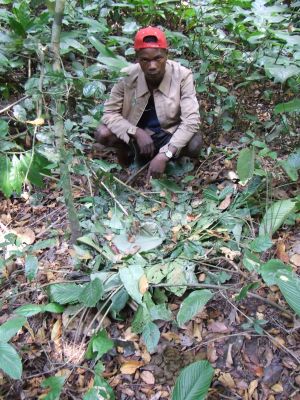
Gangu ground nest with Likambo © Cleve Hicks/The Wasmoeth Wildlife 2007 Foundation -
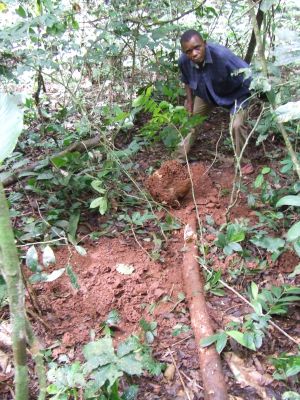
Kisangola Polycarpe with termite pound site, Leguga Forest near the Uele River © Cleve Hicks 2008


Documented behaviours
Table 7. Behaviours documented for Bili-Uéré-Mbomu Complex
| Category | Behavior | Observation type | Prevalence | Observation dates | Source | Habituation | Species | Comment |
|---|---|---|---|---|---|---|---|---|
| Making ground nests | Hicks et al. 2019a | |||||||
| 5 kinds of tools for insects and honey | Hicks et al. 2019a | |||||||
| Termite mound pounding | Hicks et al. 2019a | |||||||
| Possible snail and tortoise pounding | Hicks et al. 2019a |
Exposure to climate change impacts
As part of a study on the exposure of African great ape sites to climate change impacts, Kiribou et al. subm. extracted climate data and data on projected extreme climate impact events for the site. Climatological characteristics were derived from observation-based climate data provided by the Inter-Sectoral Impact Model Intercomparison Project (ISIMIP, www.isimip.org). Parameters were calculated as the average across each 30-year period. For 1981-2010, the EWEMBI dataset from ISIMIP2a was used. For the two future periods (2021-2050 and 2071-2099) ISIMIP2b climate data based on four CMIP5 global climate models were used. For future projections, two Representative Concentration Pathways (RCP) were used. RCP 2.6 is a scenario with strong mitigation measures in which global temperatures would likely rise below 2C. RCP 6.0 is a scenario with medium emissions in which global temperatures would likely rise up to 3C by 2100. For the number of days with heavy precipitation events, the 98th percentile of all precipitation days (>1mm/d) was calculated for the 1979-2013 reference period as a threshold for a heavy precipitation event. Then, for each year, the number of days above that threshold was derived. The figures on temperature and precipitation anomaly show the deviation from the mean temperature and mean precipitation for the 1979-2013 reference period.
The estimated exposure to future extreme climate impact events (crop failure, drought, river flood, wildfire, tropical cyclone, and heatwave) is based on a published dataset by Lange et al. 2020 derived from ISIMIP2b data. The same global climate models and RCPs as described above were used. Within each 30-year period, the number of years with an extreme event and the average proportion of the site affected were calculated (see Kiribou et al. subm. for details).
Table 8. Estimated past and projected climatological characteristics in Bili-Uéré-Mbomu Complex
| Value | 1981-2010 | 2021-2050, RCP 2.6 | 2021-2050, RCP 6.0 | 2071-2099, RCP 2.6 | 2071-2099, RCP 6.0 |
|---|---|---|---|---|---|
| Mean temperature [C] | 24.7 | 25.9 | 25.8 | 26.2 | 27.3 |
| Annual precipitation [mm] | 1830 | 1863 | 1904 | 1896 | 1940 |
| Max no. consecutive dry days (per year) | 28.9 | 34.2 | 33.6 | 36.1 | 38.8 |
| No. days with heavy precipitation (per year) | 6.9 | 8.9 | 9.3 | 9.4 | 10.8 |
Table 9. Projected exposure of apes to extreme climate impact events in Bili-Uéré-Mbomu Complex
| Type | No. of years with event (2021-2050, RCP 2.6) | % of site exposed (2021-2050, RCP 2.6) | No. of years with event (2021-2050, RCP 6.0) | % of site exposed (2021-2050, RCP 6.0) | No. of years with event (2070-2099, RCP 2.6) | % of site exposed (2070-2099, RCP 2.6) | No. of years with event (2070-2099, RCP 6.0) | % of site exposed (2070-2099, RCP 6.0) |
|---|---|---|---|---|---|---|---|---|
| Crop failure | 24 | 0.01 | 17.5 | 0.01 | 26.5 | 0.01 | 28.5 | 0.01 |
| Drought | 0 | 0 | 0 | 0 | 0 | 0 | 0 | 0 |
| Heatwave | 5 | 21.59 | 6.5 | 23.81 | 10 | 25.15 | 9.5 | 27.95 |
| River flood | 2.5 | 0.18 | 3.5 | 0.41 | 3 | 0.37 | 3.25 | 0.69 |
| Tropical cyclone | 0 | 0 | 0 | 0 | 0 | 0 | 0 | 0 |
| Wildfire | 30 | 0.8 | 30 | 0.8 | 29 | 0.79 | 29 | 0.8 |
External links
It's a matter of taste: Chimpanzee cultural realms in Congo | Cleve Hicks | TEDxUniversityofWarsaw
On Assignment: Mystery Apes of the Congo NBC News
On Assignment: One More Thing - Mystery Apes of the Congo NBC News
References
Lushimba, A. (2018, July 5). Enhancing management and security in Bili-Uele. African Wildlife Foundation. https://www.awf.org/blog/enhancing-management-and-security-bili-uele.
Hicks, T. C. (2010a). A chimpanzee mega-culture. Exploring behavioral continuity in Pan troglodytes schweinfurthii across northern DR Congo. University of Amsterdam, Netherlands: PhD thesis.
Hicks, T. C., Darby, L., Hart, J., Swinkels, J., January, N., & Menken, S. (2010b). Trade in orphans and bushmeat threatens one of the Democratic Republic of the Congo’s most important populations of Eastern Chimpanzees (Pan troglodytes schweinfurthii). African Primates, 7(1), 1-18.
Hicks, T. C., Roessingh, P., & Menken, S. B. (2012). Reactions of Bili‐Uele Chimpanzees to Humans in Relation to Their Distance From Roads and Villages. American Journal of Primatology, 74(8), 721-733.
Hicks, T. C., Roessingh, P., & Menken, S. B. (2013). Impact of humans on long-distance communication behaviour of eastern chimpanzees (Pan troglodytes schweinfurthii) in the Northern Democratic Republic of the Congo. Folia primatologica, 84(3-5), 135-156.
Hicks, T.C., Tranquilli, S., Kuehl, H., Campbell, G., Swinkels, J., Darby, L., Boesch, C., Hart, J. and Menken, S.B., (2014). Absence of evidence is not evidence of absence: discovery of a large, continuous population of Pan troglodytes schweinfurthii in the Central Uele region of northern DRC. Biological conservation, 171, pp.107-113.
Hicks, T. C. (2016). A Leopard’s Breakfast Interrupted: Further Explorations of a Congolese Wilderness. In We Discover. Marc Guttman, Editor. Pronoun Books. 370 pp.
Hicks T. C., Kühl H. S., Boesch C., Dieguez P., Ayimisin A. E., Fernandez R. M., Zungawa D. B., Kambere M., Swinkels J., Menken S. B. J., Hart J., Mundry R. & Roessingh R. (2019a). Bili-Uéré: A chimpanzee behavioral realm in Northern DR Congo. Folia Primatologica. 90: 3-64
Hicks T. C., Menken S. B. J., Laudisoit A., Hart J. (2019b). Handling and consumption of vertebrate prey by chimpanzees (Pan troglodytes schweinfurthii) in Northern DR Congo. In Chimpanzees: Classification, evolution and behavior. Mary Lee Jensvold (ed.). Nova. Pp. 1-34.
Hicks, Thurston C., Hjalmar S. Kühl, Christophe Boesch, Steph BJ Menken, John Hart, Peter Roessingh, Corneille Ewango, and Roger Mundry (2020). The Relationship Between Tool Use and Prey Availability in Chimpanzees (Pan troglodytes schweinfurthii) of Northern Democratic Republic of Congo (advance online).International Journal of Primatology.
Key Biodiversity Areas Partnership (2025a) Key Biodiversity Areas factsheet: Bili-Ueré Hunting Domain. Extracted from the World Database of Key Biodiversity Areas. Developed by the Key Biodiversity Areas Partnership: BirdLife International, IUCN, American Bird Conservancy, Amphibian Survival Alliance, Conservation International, Critical Ecosystem Partnership Fund, Global Environment Facility, Re:wild, NatureServe, Rainforest Trust, Royal Society for the Protection of Birds, World Wildlife Fund and Wildlife Conservation Society. Downloaded from https://keybiodiversityareas.org/ on Aug 14, 2025.
Key Biodiversity Areas Partnership (2025b) Key Biodiversity Areas factsheet: Bomu wildlife and hunting reserve. Extracted from the World Database of Key Biodiversity Areas. Developed by the Key Biodiversity Areas Partnership: BirdLife International, IUCN, American Bird Conservancy, Amphibian Survival Alliance, Conservation International, Critical Ecosystem Partnership Fund, Global Environment Facility, Re:wild, NatureServe, Rainforest Trust, Royal Society for the Protection of Birds, World Wildlife Fund and Wildlife Conservation Society. Downloaded from https://keybiodiversityareas.org/ on Aug 14, 2025.
Page created by: Cleve Hicks Date: 2020-11-13
Page updated by: Henry Bailey, Landscape Director, African Wildlife Foundation Date: 2025-08-12