
Cestos-Senkwehn Proposed Protected Area
West Africa > Liberia > Cestos-Senkwehn Proposed Protected Area
Français | Português | Español | Bahasa Indonesia | Melayu
Summary
- Western chimpanzees (Pan troglodytes verus) are present in Cestos-Senkwehn.
- The population size is unknown.
- The chimpanzee population trend is unknown.
- This site has a total size of 832.09 km².
- Key threats to chimpanzees are artisanal and large-scale mining and poaching.
- No conservation activities have been reported for the site.
- Cestos-Senkwehn Proposed Protected Area forms part of an Important Bird Area (IBA). There are plans to link Cestos-Senkwehn Proposed Protected Area to Sapo National Park. The area falls into one of the conservation priority areas identified for Liberia by Junker et al. (2015). The latter was ranked highest of all patches in terms of chimpanzee density, and mammal and tree diversity and links up with Krahn Bassa National Forest.
Site characteristics
Cestos-Senkwehn Proposed Protected Area lies in the lowly populated coastal centre of Liberia between the towns of Buchanan and Greenville and stretches inland from the coast for some 70 km. The area serves as host for wildlife transiting from Krahn-Bassa Proposed Protected Area and Sapo National Park. Cestos-Senkwehn Proposed Protected Area includes inland-, littoral-, and mangrove forests (Verschuren 1983). The site has also been classified as an IBA. In addition to chimpanzees, Tweh et al. (2014) found tracks of zebra- Cephalophus zebra, Maxwell- Philantomba maxwellii, and black duiker Cephalophus niger in this area during their nationwide survey. The endangered pygmy hippopotamus Choeropsis liberiensis has been reported for this site (Mallon et al. 2011), but could not be confirmed by Tweh et al. (2014) who surveyed two line transects in this area.
Table 1. Basic site information for Cestos-Senkwehn Proposed Protected Area
| Species | Pan troglodytes verus |
| Area | 832.09 km² |
| Coordinates | Lat: 5.49 , Lon: -9.30 |
| Type of site | Proposed protected area |
| Habitat types | Subtropical/tropical moist lowland forest, Wetlands (lakes, rivers, streams, bogs, marshes), Marine coastal/supratidal |
| Type of governance |
Types of sites Governance types Habitat types
Ape status
No published information could be found on wildlife surveys conducted in this area. Tweh et al. (2014) surveyed two line transects, each 3 km in length, and recces in Cestos-Senkwehn Proposed Protected Area during their nationwide survey and found 10 chimpanzee nests in three different groups (Junker unpubl. data).
Table 2. Ape population estimates reported for Cestos-Senkwehn Proposed Protected Area
| Species | Year | Occurrence | Encounter or vistation rate (nests/km; ind/day) | Density estimate [ind./ km²] (95% CI) | Abundance estimate (95% CI) | Survey area | Sampling method | Analytical framework | Source | Comments | A.P.E.S. database ID |
|---|---|---|---|---|---|---|---|---|---|---|---|
| Pan troglodytes verus | 2023 | Present | Cestos-Senkwehn Proposed Protected Area | Camera trap | Fauna & Flora | ||||||
| Pan troglodytes verus | 2012 | 3.3 | Cestos-Senkwehn Proposed Protected Area | Line transects & recces | Tweh et al. 2014 (Junker unpubl. data) | Reconnaissance walk, total survey effort: 6 km, 10 nests were found | LBR0026 |
Sampling methods Analytical frameworks
Threats
The main threats to chimpanzees in this area include artisanal mining for gold and poaching. Tweh et al. (2014) found numerous empty cartridges and a few snares, as well as signs of artisanal gold mining. However, people who were interviewed in the villages in this area reported that there was a local taboo against killing chimpanzees in their area (Junker unpubl. data). The area has also been assigned to a mining company on a Mineral Exploration License (MEL) (Johnson et al. 2015). This license type entails that after a proposed exploration program has been handed to the Minister of Land, Mines, and Energy, the company commences exploration (Wilson et al. 2017).
Table 3. Threats to apes reported for Cestos-Senkwehn Proposed Protected Area
| Category | Specific threats | Threat level | Description | Year of threat |
|---|---|---|---|---|
| 3 Energy production & mining | 3.2 Mining & quarrying | High (more than 70% of population affected) | Open pit mining for gold (Johnson 2015), MEL issued in 2011 (Johnson 2015), signs of artisanal gold mining were recorded on 2 line transects (Junker unpubl. data) | 2011-Ongoing (2017) |
| 5 Biological resource use | 5.1 Hunting & collecting terrestrial animals | Present (unknown severity) | Empty cartridges and snares were recorded on 2 line transects (Junker unpubl. data). Hunting signs recorded on recce transects (Fauna & Flora 2023). | 2014-Ongoing (2023) |
Conservation activities
No conservation activities have been reported for the site.
Table 4. Conservation activities reported for Cestos-Senkwehn Proposed Protected Area
| Category | Specific activity | Description | Implementing organization(s) | Year of activity |
|---|---|---|---|---|
| 5 Protection & restoration | 5.5 Demarcate and enforce boundaries of protected areas | Bamford pers. comm. 2024 | Ongoing (2024) |
Challenges
Table 5. Challenges reported for Cestos-Senkwehn Proposed Protected Area
| Challenges | Specific challenges | Source | Year(s) |
|---|---|---|---|
| Not reported | |||
| Unknown |
Enablers
Table 6. Enablers reported for Cestos-Senkwehn Proposed Protected Area
| Enablers | Specific enablers | Source | Year(s) |
|---|---|---|---|
| 1 Site management | |||
| 2 Resources and capacity | |||
| 3 Engaged community | |||
| 4 Institutional support | |||
| 5 Ecological context | |||
| 6 Safety and stability |
Research activities
No information on research activities has been documented.
Documented behaviours
Table 7. Behaviours documented for Cestos-Senkwehn Proposed Protected Area
| Category | Behavior | Observation type | Prevalence | Observation dates | Source | Habituation | Species | Comment |
|---|---|---|---|---|---|---|---|---|
| Not reported | ||||||||
| Not reported |
Exposure to climate change impacts
As part of a study on the exposure of African great ape sites to climate change impacts, Kiribou et al. (2024) extracted climate data and data on projected extreme climate impact events for the site. Climatological characteristics were derived from observation-based climate data provided by the Inter-Sectoral Impact Model Intercomparison Project (ISIMIP, www.isimip.org). Parameters were calculated as the average across each 30-year period. For 1981-2010, the EWEMBI dataset from ISIMIP2a was used. For the two future periods (2021-2050 and 2071-2099) ISIMIP2b climate data based on four CMIP5 global climate models were used. For future projections, two Representative Concentration Pathways (RCP) were used. RCP 2.6 is a scenario with strong mitigation measures in which global temperatures would likely rise below 2C. RCP 6.0 is a scenario with medium emissions in which global temperatures would likely rise up to 3C by 2100. For the number of days with heavy precipitation events, the 98th percentile of all precipitation days (>1mm/d) was calculated for the 1979-2013 reference period as a threshold for a heavy precipitation event. Then, for each year, the number of days above that threshold was derived. The figures on temperature and precipitation anomaly show the deviation from the mean temperature and mean precipitation for the 1979-2013 reference period.
The estimated exposure to future extreme climate impact events (crop failure, drought, river flood, wildfire, tropical cyclone, and heatwave) is based on a published dataset by Lange et al. 2020 derived from ISIMIP2b data. The same global climate models and RCPs as described above were used. Within each 30-year period, the number of years with an extreme event and the average proportion of the site affected were calculated (Kiribou et al. 2024).
Table 8. Estimated past and projected climatological characteristics in Cestos-Senkwehn Proposed Protected Area
| Value | 1981-2010 | 2021-2050, RCP 2.6 | 2021-2050, RCP 6.0 | 2071-2099, RCP 2.6 | 2071-2099, RCP 6.0 |
|---|---|---|---|---|---|
| Mean temperature [C] | 26 | 26.9 | 26.8 | 27 | 28 |
| Annual precipitation [mm] | 2803 | 2837 | 2950 | 2840 | 2959 |
| Max no. consecutive dry days (per year) | 16.6 | 21.5 | 17.4 | 20.9 | 19.9 |
| No. days with heavy precipitation (per year) | 5.9 | 12.3 | 12.8 | 13.3 | 14.7 |
Table 9. Projected exposure of apes to extreme climate impact events in Cestos-Senkwehn Proposed Protected Area
| Type | No. of years with event (2021-2050, RCP 2.6) | % of site exposed (2021-2050, RCP 2.6) | No. of years with event (2021-2050, RCP 6.0) | % of site exposed (2021-2050, RCP 6.0) | No. of years with event (2070-2099, RCP 2.6) | % of site exposed (2070-2099, RCP 2.6) | No. of years with event (2070-2099, RCP 6.0) | % of site exposed (2070-2099, RCP 6.0) |
|---|---|---|---|---|---|---|---|---|
| Crop failure | 0.5 | 0 | 1 | 0.03 | 0.5 | 0.01 | 1.5 | 0.03 |
| Drought | 0 | 0 | 0 | 0 | 0 | 0 | 0 | 0 |
| Heatwave | 12 | 100 | 10.5 | 100 | 12.5 | 100 | 15 | 100 |
| River flood | 0.5 | 0.08 | 1.5 | 2.19 | 1 | 0.25 | 2 | 0.15 |
| Tropical cyclone | 0 | 0 | 1 | 2.24 | 0 | 0 | 0.5 | 3.23 |
| Wildfire | 29.75 | 0.48 | 30 | 0.41 | 29 | 0.49 | 29 | 0.44 |
-
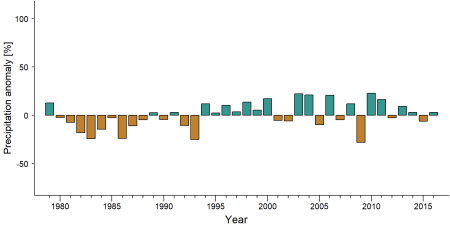
Precipitation anomaly in Cestos-Senkwehn Proposed Protected Area -
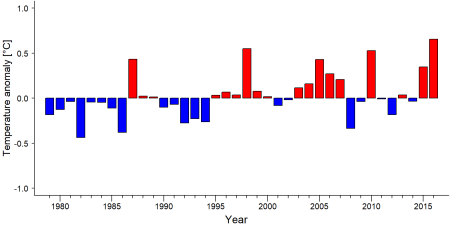
Temperature anomaly in Cestos-Senkwehn Proposed Protected Area


External links
References
Fauna & Flora International (2023). Threat assessment of Cestos-Senkwehn and Grand Kru-River Gee proposed protected areas. Conservation Works/USAID.
Johnson, S. (2015). Aggregated biodiversity offsets: A roadmap for Liberia’s mining sector. Unpublished report by the World Bank Group (WBG) and Program on Forests (PROFOR).
Junker, J., Boesch, C., Freeman, T., Mundry, R., Stephens, C., & Kühl, H. S. (2015). Integrating wildlife conservation with conflicting economic land-use goals in a West African biodiversity hotspot. Basic and Applied Ecology, 16(8), 690-702. doi:10.1016/j.baae.2015.07.002
Mallon, D., Wightman, C., De Onellas, P., & Ransom, C. (2011). Conservation strategy for the pygmy hippopotamus. IUCN Species Survival Commission.
Tweh, C. G., Lormie, M. M., Kouakou, C. Y., Hillers, A., Kühl, H. S., & Junker, J. (2015). Conservation status of chimpanzees Pan troglodytes verus and other large mammals in Liberia: a nationwide survey. Oryx, 49(4), 710-718. doi:10.1017/s0030605313001191
Verschuren, J. (1983). Conservation of tropical rainforest in Liberia: Recommendations for wildlife conservation and national parks. IUCN/WWF. doi:10.5771/0506-7286-1984-1-109
Wilson, S. T. K., Wang, H., Kabenge, M., & Qi, X. (2017). The mining sector of Liberia: current practices and environmental challenges. Environmental Science and Pollution Research, 24(23), 18711-18720. doi:10.1007/s11356-017-9647-4
Kiribou, R., Tehoda, P., Chukwu, O., Bempah, G., Kühl, H. S., Ferreira, J., …, & Heinicke, S. (2024). Exposure of African ape sites to climate change impacts. PLOS Climate, 3(2), e0000345. doi:10.1371/journal.pclm.0000345
Page created by: Andrew Bamford Date: 2024-09-05