
Garamba National Park Complex
Central Africa > Democratic Republic of the Congo > Garamba National Park Complex
Français | Português | Español | Bahasa Indonesia | Melayu
Summary
- Eastern chimpanzees (Pan troglodytes schweinfurthii) are present in Garamba National Park Complex.
- The population size is unknown.
- The population trend is unknown.
- The site has a total size of 14,795 km².
- Key threats to chimpanzees are poaching and armed conflict.
- Conservation activities have focused on anti-poaching patrols, providing employment and non-monetary benefits to the local communities, such as healthcare.
- The site is a UNESCO World Heritage site.

Site characteristics
The Garamba National Park Complex (GNPC) is located in northeastern Democratic Republic of the Congo. Garamba National Park was designated as a UNESCO World Heritage Site in 1980 for its protection of critical habitat for elephants, giraffes, hippopotamuses and the critically endangered northern white rhinoceros (UNESCO 2011). Since 2005, the park has been managed by African Parks in partnership with the Institut Congolais pour la Conservation de la Nature (ICCN). The park spans 5,133 km2, and the adjacent domaines de chasse, or hunting areas, cover 9,662 km2. The hunting areas are: Azande, Mondo-Missa, and Gangala na Bodio (UNESCO 2011). The GNPC comprises a vast undulating plateau composed mainly of long-grass and dense bush savanna shaped by fire (UNESCO 2011). Situated between the Guinean and Sudanese biogeographic realms, the area is unusually diverse. Together with Manovo in the Central African Republic, the Garamba National Park is one of the most important habitats for a number of sudano-guinean species (UNESCO 2011). Until recently it contained the last viable natural population of northern white rhinoceros, Ceratotherium simum cottoni, which have not been recorded in the park since 2008 (UNESCO 2021). Among 42 other mammal species, over 8,800 eastern chimpanzees have been recorded for the area around the Ituri forest, Okapi and Garamba (UNESCO 2011).
Table 1. Basic site information for Garamba National Park Complex
| Species | Pan troglodytes schweinfurthii |
| Area | 14,795 km² |
| Coordinates | Lat: 4.192005 , Lon: 29.578278 |
| Type of site | Conservation area |
| Habitat types | Subtropical/tropical dry forest, Savanna, Grassland, Subtropical/tropical swamp forest |
| Type of governance |
Types of sites Governance types Habitat types

Ape status
In 2008 a monitoring programme was set up to identify the distribution of chimpanzees (Africa Parks 2012). The monitoring involved chimpanzee tracking on foot (more than 3000 km have been covered), recording calls and counting nests. In 2011 a camera trap in the Mondo-Missa region recorded a chimpanzee (Africa Parks 2012). In 2021 and 2022 camera traps were deployed in Mondo-Missa and Azande hunting areas. Chimpanzee presence was confirmed again in Azande for the first time since 1994. The camera trap survey also led to the re-discovery of Oustalet’s red colobus (Piliocolobus oustaleti) in Azande (Diodio et al. 2022, Laudisoit 2022). Furthermore, the presence of the golden cat, giant pangolin, leopard, yellow-backed duiker, aardvark and bongo were recorded in Mondo-Missa, and the Koreri forest fragment just outside the GNPC was found to hold a high density of chimpanzees, although given its small size, the fragment might be home to 6 or 7 individuals only (Diodio et al. 2022, Laudisoit 2022).
Table 2. Ape population estimates reported for Garamba National Park Complex
| Species | Year | Occurrence | Encounter or vistation rate (nests/km; ind/day) | Density estimate [ind./ km²] (95% CI) | Abundance estimate (95% CI) | Survey area | Sampling method | Analytical framework | Source | Comments | A.P.E.S. database ID |
|---|---|---|---|---|---|---|---|---|---|---|---|
| Pan troglodytes schweinfurthii | 2022 | 1.9 | Azande | Reconnaissance walk | Diodio et al. 2022, Laudisoit 2022 | ||||||
| Pan troglodytes schweinfurthii | 2022 | 0 | Kurukwata-Planteki fragment (1 km²) | Reconnaissance walk | Diodio et al. 2022, Laudisoit 2022 | 5.9 km recce walked. The forest fragment is outside of the GNPC | |||||
| Pan troglodytes schweinfurthii | 2021-2022 | 4.7 | Gbere, Mondo-Missa | Line transects & recces | Diodio et al. 2022, Laudisoit 2022 | 152 chimpanzee nests were recorded along one 1.4 km transect; 5 individuals were identified | |||||
| Pan troglodytes schweinfurthii | 2021 | 7.3 | Buru, Mondo-Missa | Line transects & recces | Diodio et al. 2022, Laudisoit 2022 | 54 nests were recorded along 1.8 km transect and 7.28 km recce; 11 individuals were identified | |||||
| Pan troglodytes schweinfurthii | 2011 | Present | Mondo Missa | Camera trap | AP 2012 |
Sampling methods Analytical frameworks
Threats
Table 3. Threats to apes reported for Garamba National Park Complex
| Category | Specific threats | Threat level | Description | Year of threat |
|---|---|---|---|---|
| 2 Agriculture & aquaculture | 2.1 Annual & perennial non-timber crops | High (more than 70% of population affected) | Slash-and-burn agriculture and habitat conversion in Buru and in the Kurukwata-Planteki forest fragment (Diodio et al. 2022, Laudisoit 2022). | Ongoing (2022) |
| 3 Energy production & mining | 3.2 Mining & quarrying | High (more than 70% of population affected) | Small scale gold mining in Mondo-Missa. A total of 18 mine pits were recorded and collateral damage to the forest is visible with logged trees and slash-and-burnt areas to the west of the gallery forest (Diodio et al. 2022, Laudisoit 2022). | Ongoing (2022) |
| 5 Biological resource use | 5.1 Hunting & collecting terrestrial animals | High (more than 70% of population affected) | Poaching by nationals and trans-border armed groups (UNESCO 2021). Poachers made up of South Sudanese armed groups, the Lords Resistance Army (LRA) and others, mainly target the region’s remaining elephants for their ivory (Africa Parks). | Ongoing (2021) |
| 5 Biological resource use | 5.3 Logging & wood harvesting | High (more than 70% of population affected) | In Buru and Kurukwata-Planteki, logging, slash-and-burn practice and habitat conversion is the main threat (Diodio et al. 2022, Laudisoit 2022). | Ongoing (2022) |
| 6 Human intrusions & disturbance | 6.2 War, civil unrest & military exercises | High (more than 70% of population affected) | Armed conflict and political instability threatening flagship species of the park (UNESCO 2021). | Ongoing (2021) |
Conservation activities
Table 4. Conservation activities reported for Garamba National Park Complex
| Category | Specific activity | Description | Implementing organization(s) | Year of activity |
|---|---|---|---|---|
| 2 Counter-wildlife crime | 2.3 Conduct regular anti-poaching patrols | The site has a canine unit available to improve surveillance in the park. The number of guards increased from 243 to 286 in 2021. The number of patrols has also increased, from 447 in 2018 to 744 in 2020, leading to arrests and seizures of illegal products (UNESCO 2021). | Ongoing (2021) | |
| 7 Economic & other incentives | 7.1 Provide monetary benefits to local communities for sustainably managing their forest and its wildlife (e.g., REDD, alternative income, employment) | Garamba employs over 500 full-time local staff with 2,000 more on short-term contracts (Africa Parks). | Ongoing (2021) | |
| 7 Economic & other incentives | 7.2 Provide non-monetary benefits to local communities for sustainably managing their forest and its wildlife (e.g., better education, infrastructure development) | Access to health care and various activities covering educational to environmental services is provided to the park's staff and local communities as part of a sustainable development strategy (UNESCO 2021). | Ongoing (2021) |

Challenges
Table 5. Challenges reported for Garamba National Park Complex
| Challenges | Specific challenges | Source | Year(s) |
|---|---|---|---|
| Not reported |

Enablers
Table 6. Enablers reported for Garamba National Park Complex
| Enablers | Specific enablers | Source | Year(s) |
|---|---|---|---|
| 1 Site management | |||
| 2 Resources and capacity | |||
| 3 Engaged community | |||
| 4 Institutional support | |||
| 5 Ecological context | |||
| 6 Safety and stability |
Research activities
In the early 1950s a wealth of taxonomic information was gathered in an expedition, which was made available in a series of publications. In the early 1970s, the FAO gathered information on the rhinoceros and flew an aerial census of large mammal species. Since 1984, as part of a rehabilitation project, the rhino population has been investigated and monitored; general ecosystem monitoring was carried out, including aerial counts, vegetation description and habitat mapping. An experimental burning programme was also tested (UNESCO 2021).
In 2022, a survey team documented the presence of Oustalet’s Red Colobus in the Azande hunting area. While P. oustaleti is probably the most abundant of the 18 red colobus taxa documented to date, they were considered vulnerable during the last CITES assessment, mostly due to habitat degradation and loss. The GNPC and Azande DC in particular thus represent strongholds for the species away from anthropogenic landscapes (Diodio et al. 2022, Laudisoit 2022).
Documented behaviours
Table 7. Behaviours documented for Garamba National Park Complex
| Category | Behavior | Observation type | Prevalence | Observation dates | Source | Habituation | Species | Comment |
|---|---|---|---|---|---|---|---|---|
| Ground nesting | Diodio et al. 2022, Laudisoit 2022 |
Exposure to climate change impacts
As part of a study on the exposure of African great ape sites to climate change impacts, Kiribou et al. (2024) extracted climate data and data on projected extreme climate impact events for the site. Climatological characteristics were derived from observation-based climate data provided by the Inter-Sectoral Impact Model Intercomparison Project (ISIMIP, www.isimip.org). Parameters were calculated as the average across each 30-year period. For 1981-2010, the EWEMBI dataset from ISIMIP2a was used. For the two future periods (2021-2050 and 2071-2099) ISIMIP2b climate data based on four CMIP5 global climate models were used. For future projections, two Representative Concentration Pathways (RCP) were used. RCP 2.6 is a scenario with strong mitigation measures in which global temperatures would likely rise below 2C. RCP 6.0 is a scenario with medium emissions in which global temperatures would likely rise up to 3C by 2100. For the number of days with heavy precipitation events, the 98th percentile of all precipitation days (>1mm/d) was calculated for the 1979-2013 reference period as a threshold for a heavy precipitation event. Then, for each year, the number of days above that threshold was derived. The figures on temperature and precipitation anomaly show the deviation from the mean temperature and mean precipitation for the 1979-2013 reference period.
The estimated exposure to future extreme climate impact events (crop failure, drought, river flood, wildfire, tropical cyclone, and heatwave) is based on a published dataset by Lange et al. 2020 derived from ISIMIP2b data. The same global climate models and RCPs as described above were used. Within each 30-year period, the number of years with an extreme event and the average proportion of the site affected were calculated (Kiribou et al. 2024).
Table 8. Estimated past and projected climatological characteristics in Garamba National Park Complex
| Value | 1981-2010 | 2021-2050, RCP 2.6 | 2021-2050, RCP 6.0 | 2071-2099, RCP 2.6 | 2071-2099, RCP 6.0 |
|---|---|---|---|---|---|
| Mean temperature [C] | 25.1 | 26.3 | 26.3 | 26.7 | 27.7 |
| Annual precipitation [mm] | 1447 | 1434 | 1471 | 1408 | 1477 |
| Max no. consecutive dry days (per year) | 30.5 | 41.2 | 37.9 | 40.4 | 43.4 |
| No. days with heavy precipitation (per year) | 6.3 | 8.3 | 7.7 | 7.8 | 9 |
Table 9. Projected exposure of apes to extreme climate impact events in Garamba National Park Complex
| Type | No. of years with event (2021-2050, RCP 2.6) | % of site exposed (2021-2050, RCP 2.6) | No. of years with event (2021-2050, RCP 6.0) | % of site exposed (2021-2050, RCP 6.0) | No. of years with event (2070-2099, RCP 2.6) | % of site exposed (2070-2099, RCP 2.6) | No. of years with event (2070-2099, RCP 6.0) | % of site exposed (2070-2099, RCP 6.0) |
|---|---|---|---|---|---|---|---|---|
| Crop failure | 11 | 0 | 9.5 | 0 | 13 | 0 | 27.5 | 0 |
| Drought | 0 | 0 | 0 | 0 | 0 | 0 | 0 | 0 |
| Heatwave | 1 | 100 | 1.5 | 100 | 2.5 | 100 | 4 | 100 |
| River flood | 1.5 | 1.47 | 1.75 | 0.68 | 1.5 | 0.32 | 2 | 0.45 |
| Tropical cyclone | 0 | 0 | 0 | 0 | 0 | 0 | 0 | 0 |
| Wildfire | 30 | 0.93 | 30 | 0.86 | 29 | 0.81 | 29 | 0.84 |
-
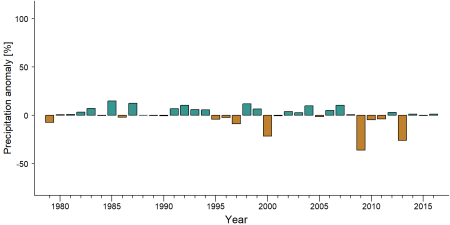
Precipitation anomaly in Garamba National Park Complex -
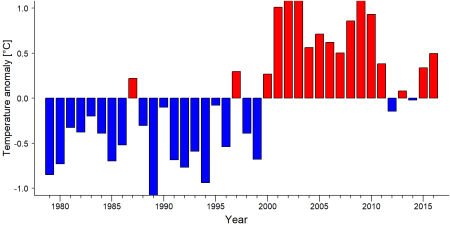
Temperature anomaly in Garamba National Park Complex


External links
References
Diodio, A.S., Vogel, J., Diana, D.K., Massini, J.M., Edouard, D.N., Minahilo, R.G., Esube, R.L., Lugala, D.K., Antonínová, M., Jérôme, A. and Laudisoit, A. (2022). A decade of silent chimpanzee monitoring in the Garamba Complex, Democratic Republic of the Congo. Abstracts of the conference of the European Federation for Primatology (EFP), 1-3 June 2022, Royal Burgers’ Zoo, Arnhem, The Netherlands.
Laudisoit A. (2022). Chimpanzee monitoring within the Garamba NP Complex. Internal Report. Year 2021-2022. 26p. Delivered to African Parks Network.
UNESCO (2021). State of conservation: Garamba National Park. Online: https://whc.unesco.org/en/soc/4023
UNESCO (2011). Garamba National Park. Online: http://world-heritage-datasheets.unep-wcmc.org/datasheet/output/site/garamba-national-park/
Kiribou, R., Tehoda, P., Chukwu, O., Bempah, G., Kühl, H. S., Ferreira, J., …, & Heinicke, S. (2024). Exposure of African ape sites to climate change impacts. PLOS Climate, 3(2), e0000345. doi:10.1371/journal.pclm.0000345
Africa Parks. https://www.africanparks.org/the-parks/garamba
Page created by: Anne Laudisoit & APES Atlas Team Date: 2023-02-21